
Syncletica of Alexandria
Our Venerable Mother Syncletica of Alexandria
Venerable · b. c. 270, Alexandria — d. c. 350, Alexandria
Commemorated 5 January — Repose at Alexandria — kept on the Eve of the Theophany
Syncletica of Alexandria (c. 270 – c. 350) is the greatest of the Desert Mothers — the "Ammas" of the Egyptian ascetic golden age whose sayings stand beside the Fathers' in the Apophthegmata. Born to a wealthy Alexandrian family of Macedonian descent and celebrated for her beauty, she refused marriage from her youth; when her parents died she gave the whole inheritance to the poor, was tonsured, and withdrew with her blind sister to a kinsman's burial-crypt outside the city, taking up a life of extreme fasting and prayer. Women gathered to her, and she became their mother and teacher, and the Life attributed to Athanasius preserves her long discourses on the inner warfare of the soul — on humility, discernment, and the snares of vainglory, often figured in the sea-images of her merchant city. In her old age she was struck by a disfiguring cancer of the mouth and lungs which she bore for three years with the patience of Job, and reposed about the year 350, some eighty years old, on the Eve of the Theophany. Her Life and her twenty-eight recorded sayings made her a foundational voice of women's monasticism.
.jpg)
Origins and early life
Syncletica was born in the great city of Alexandria, about the year 270, into a family of wealth and standing. The tradition and the Life make her parents Macedonians who had settled in Egypt — people of the Greco-Roman propertied class, whom later readers of her nautical language have imagined as belonging to the shipping and mercantile world of the port. She was one of several children: the Life remembers two brothers, one of whom died on the very eve of his wedding, and a sister who was blind and would share her withdrawal from the world. Syncletica herself is described as remarkably beautiful, and many sought her in marriage; but she had fixed her heart from girlhood upon Christ alone, and turned every suitor away, disciplining a body that others admired with fasting and vigil so that its beauty might not become a snare to herself or to others.
Her very name became, for the hymnographers, a figure of her calling. Synklētikē is the feminine of synklētikos, "of the senate," a senatorial lady — and the tradition plays on it without end: she who might have taken her place among the notable of the earthly city forsook "the bondage of this life" to be enrolled, as the synaxarion verse puts it, among "the called (klētoi) servants of God" in heaven.
The renunciation
The turning came at the death of her parents. Their estate passed to Syncletica and her blind sister, and Syncletica did with it what the Gospel counsels the rich young man to do: she distributed the whole of it to the poor, keeping nothing back. Then, summoning a priest, she had her hair cut off — the token of her consecration and of her renunciation of the world's adornment — and, taking her sister with her, left Alexandria for a burial-crypt (a rock-cut tomb-chamber) belonging to a relative a little outside the city, and there shut herself up to live as a solitary. The choice of a tomb for a dwelling was itself a sermon: she who had died to the world made her cell of the place of the dead, that she might rise with Christ.
There is a deliberate hiddenness in her beginning. Unlike Antony, whose fame the whole desert knew, Syncletica sought no notice and left no monastery of stone; she withdrew precisely to escape the praise of men, which her teaching would name as the subtlest of all the passions. But holiness of that order cannot long be hidden, and word of the woman living the angelic life in the crypt drew others to her.
Amma and teacher
Women came — first a few, then many — asking to live under her guidance and to learn the way she walked, and Syncletica, at first unwilling, was drawn by love into the office of spiritual mother to a growing company of ascetic women. It is as their teacher that the tradition chiefly remembers her, and the Life is built around the discourses she is said to have given them: not a system but a seasoned, practical wisdom of the interior life, wrung from her own long struggle and delivered, the Life insists, only under the compulsion of their entreaty and against her own desire for silence.
Her teaching turns on a few great themes, and they are the themes of the whole desert. It is not place but disposition that saves. "There are many who live in the mountains and behave as if they were in the town, and they are wasting their time. It is possible to be a solitary in one's mind while living in a crowd, and it is possible for one who is a solitary to live in the crowd of his own thoughts." Asceticism is a means, not an end, and the outward labour is worth nothing without the inward: the fasting and the vigil are medicines, to be measured to the sickness, and there is a gluttony of abstinence and a pride of poverty as deadly as any fleshly sin. Against the newcomer's zeal she set the warning that the beginning is warfare: "In the beginning there are a great many battles and a good deal of suffering for those who are advancing towards God, and afterwards, ineffable joy. It is like those who wish to light a fire; at first they are choked by the smoke and cry, until they obtain what they seek… so we must kindle the divine fire in ourselves with tears and struggle." And over all she set the danger of vainglory — the passion that grows precisely out of virtue and devours it, the pride that follows humility "like a shadow" — and the discernment (diakrisis) that distinguishes the labour offered to God from the labour offered, in secret, to the self.
A distinctive imagery of the sea runs through her sayings, and the tradition that her people were seafarers has been read out of it: the soul is a ship, the world a storm, the passions contrary winds; the ascetic must "steer between" presumption and despair; the merchant who would gain must first put out from the safe harbour and risk the deep. Whether or not the family were literally shippers, the figures belong to the woman of the great port, and they give her teaching a colour all its own among the Apophthegmata.
The last illness
The crown of her life, as the Life tells it, was her final sickness, and it is told at length because in it her teaching became flesh. In her eightieth year she was struck by a grievous and disfiguring disease — a cancer or gangrene that began in the mouth and jaw, consuming the flesh, the teeth, and the bone, and spread at last to the lungs — a torment that lasted some three years and a half. The pain was extreme and the corruption so foul that those who tended her could scarcely bear to approach; and the Life draws the comparison openly to Job, the righteous man tried in the flesh, whom the saint's own apolytikion names: she "remained unshaken as the renowned Job under the assault of the enemy." She refused every earthly remedy and every self-pity, bore the agony with thanksgiving, and — though the disease had all but taken her speech — went on consoling and teaching the sisters who wept around her, turning even her dissolution into a lesson on the profit of suffering borne for God. Three days before the end she was granted a vision of the holy angels and of the place prepared for her, and, foretelling the hour, she reposed about the year 350, some eighty years old (a few reckonings give eighty-four). The Church keeps her memory on January 5.
Feast and commemoration
Syncletica is commemorated on January 5 (church date; Old Calendar civil January 18), the Eve of the Theophany, and her office in the Menaion is sung together with the hymns of the Forefeast of the Theophany — so that her memory falls within the strict-fast vigil of the Lord's Baptism. The Greek, Slavonic, and Antiochian calendars agree on the day. She is honoured as one of the three great Ammas — with Sarah and Theodora — whose sayings the Apophthegmata gathered under their own names among the Fathers of the desert, and the tradition ranks her, for the depth of her teaching, first among the mothers of the ascetic life. Her name-day is widely kept in the Greek world (Synklētikē being a living baptismal name), and her feast is a natural patronal day for communities of monastic women.
Hymns
Troparion — Tone 4
Adorned with wisdom and with grace, O modest one, thou didst remain unshaken as the renowned Job beneath the assault of the enemy; wherefore, O Syncletica, the glory of heaven received thee at thy end as a wise virgin. Wherein do thou ever remember those who keep thy memory.
Original translation from the Greek
Kontakion — Tone 3
Shining forth with the rays of the virtues as a lamp that is ever alight, O God-bearing Syncletica, thou didst blunt the goads of the murderous foe, and didst guide unto the bridal chamber of the glory on high a holy company of virgins; with whom beseech that we may find mercy.
Original translation from the Greek
Synaxarion
Syncletica, forsaking the bondage of this life, dwells now in heaven among the *called* servants of God.
Iconography
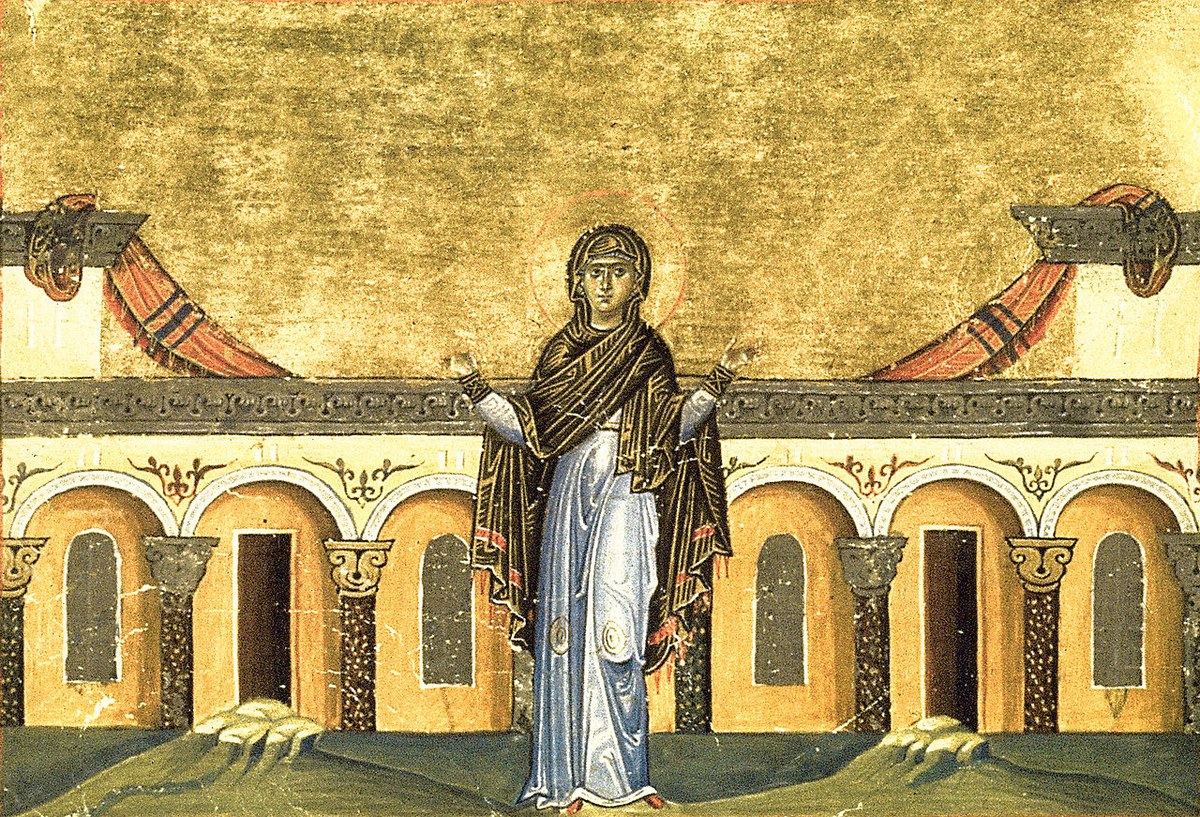
Syncletica is depicted as an aged nun in the dark monastic mandyas and veil, her face lean with fasting, most often in the frontal portrait-type of the venerable mothers; her age and the veil, and the scroll of teaching she sometimes holds, distinguish her. Because the memory of her final illness is so central to the Life, some narrative images show her on her sick-bed attended by the sisters, a visual echo of the Job-comparison. She is regularly grouped with the other Ammas and with the great women ascetics of Egypt.
The stored image is the miniature for January 5 from the Menologion of Basil II (Constantinople, c. 985; Vatican, Vat. gr. 1613): the venerable Syncletica standing in the dark habit of a nun, her hand raised in blessing or in teaching, against the gold ground and rocky landscape of the manuscript's festal type — the God-bearing mother of the desert women (source, public domain, pd-old-work).
Disputed questions
- Authorship and date of the Life. The Vita Syncleticae comes down under the name of Athanasius of Alexandria (d. 373), which would make it a near-contemporary witness. Most modern scholarship doubts the ascription: the work's developed ascetic vocabulary and its apparent dependence on later monastic literature point rather to a pseudonymous composition of about the mid-fifth century, perhaps after the centre of gravity of monastic writing had shifted from Egypt toward Palestine. The doubt touches the authorship of the text, not the existence or sanctity of Syncletica, whose memory is independently fixed by the Apophthegmata and the calendars; this entry follows the traditional ascription in naming the Life while recording the scholarly reservation.
- Not to be confused with the martyr Syncletica of Najran (the noblewoman Ruhm, put to death with her daughters in the massacre of the Christians of Najran, c. 523, kept October 24) — a wholly different saint of a different age and country; nor with Apollinaria, the Egyptian ascetic also commemorated on this same January 5, who in the Western tradition is sometimes surnamed "Syncletica." The two January-5 Alexandrian ascetics are distinct persons, and the shared "Syncletica" is a standing occasion of confusion. Nor, again, with Mary Syncletica (August 11), the sixth-century Constantinopolitan woman healed by the Image of the Saviour Not-Made-by-Hands, in whose case Syncletica is not a name at all but the rank συγκλητική, "of senatorial order."