
Apollonia of Alexandria
The Holy Virgin-Martyr Apollonia of Alexandria
Virgin · Martyr · d. 249, at Alexandria
Commemorated 9 February — Virgin-martyr of Alexandria under Decius; kept with the leavetaking of the Meeting
Apollonia (†249) was an aged and revered virgin of Alexandria, martyred in the anti-Christian riot that swept the city in the last year of the emperor Philip, on the eve of the Decian persecution. Seized by the mob, she had all her teeth broken by repeated blows to the jaws, and was then dragged to a great fire kindled outside the city and threatened with burning alive unless she would blaspheme Christ. Given a moment's freedom, she paused as if to consider — and then, of her own accord, filled with a divine ardour, leapt into the flames and was consumed, a bride hastening to her Lord. Her martyrdom is one of the very few of the third century recorded by an eyewitness pen — that of Dionysius, bishop of Alexandria, whose letter Eusebius preserved — and from the manner of her torture she became, in East and West alike, the patroness invoked against toothache and by those who suffer in the teeth. The Church keeps her on February 9, with the leavetaking of the Meeting of the Lord.

The riot at Alexandria
The account of Apollonia is unusually well-founded for a martyr of her age, for it is contemporary. Dionysius the Great, bishop of Alexandria (†265), writing to Fabius of Antioch of the sufferings of his church, described the persecution that fell upon the Alexandrian Christians a year before the edict of Decius — about the year 248/249, in the reign of Philip the Arab — when a local prophet or agitator stirred the pagan populace of the city to fury against the Christians, and a savage mob-violence broke out, unsanctioned by any imperial law but no less deadly. Houses were plundered, Christians hunted through the streets, and several put to death; and among those the crowd seized was Apollonia.
Dionysius names her "a wonderful aged virgin" (παρθένος πρεσβῦτις) — a woman grown old in consecrated chastity, held in honour by the church of Alexandria. The description is the ground of her veneration as a virgin; whether the word presbytis implies also some recognised standing among the women of the church, as later readers supposed (styling her a deaconess), or means simply "the aged one," the tradition does not settle, and it is best left as Dionysius left it: an old and holy virgin.
Martyrdom
The mob fell upon her with peculiar cruelty. They struck her upon the jaws until they had broken out all her teeth — the detail Dionysius records, and the one that would define her memory and her iconography ever after. Then they led her outside the city, where they had built a pyre, and threatened to cast her into it alive if she would not repeat after them their impious blasphemies against Christ. She asked, or was given, a moment's respite; and when they loosed their hold a little, thinking she would recant, she sprang of her own will into the fire and was burned to death — choosing the flames over apostasy, and outrunning her persecutors to her crown.
Her voluntary leap into the fire drew, in later ages, a careful note from the Fathers — Saint Augustine among them — who observed that what would in another be a forbidden self-destruction was in Apollonia the work of the Holy Spirit, a divine impulse moving her to hasten to martyrdom, and so no sin but a grace; the Church has always numbered her among the martyrs, not among those who took their own lives. Her death is placed in 249.
Veneration
From Dionysius's near-contemporary notice her fame spread through the whole Church. In the West especially her cult grew immense in the Middle Ages, and — by the natural logic of her torture — she became the patroness against toothache and of all who suffer in the teeth, and later the patron of dentists; her image, holding a pair of tongs gripping a tooth, became one of the most recognisable in Christian art. The East keeps her memory more soberly but on the same day, February 9. The Coptic Church of her own Alexandria commemorates her on 2 Meshir.
Feast and commemoration
Apollonia is commemorated on February 9 (church date; New Calendar civil February 9, Old Calendar civil February 22), kept with the leavetaking of the Meeting of the Lord; East and West honour her on this day. As a martyr of the year 249 she belongs to the third century.
Hymns
Apolytikion — Tone 4
Thy ewe-lamb, O Jesus, crieth out with a loud voice: "Thee, my Bridegroom, do I long for, and seeking thee I contend; I am crucified with thee, and buried with thee in thy baptism; I suffer for thy sake, that I may reign with thee; I die for thee, that I may live in thee. Receive me as a spotless sacrifice, offered unto thee with love." By her prayers, as thou art merciful, save our souls.
Iconography
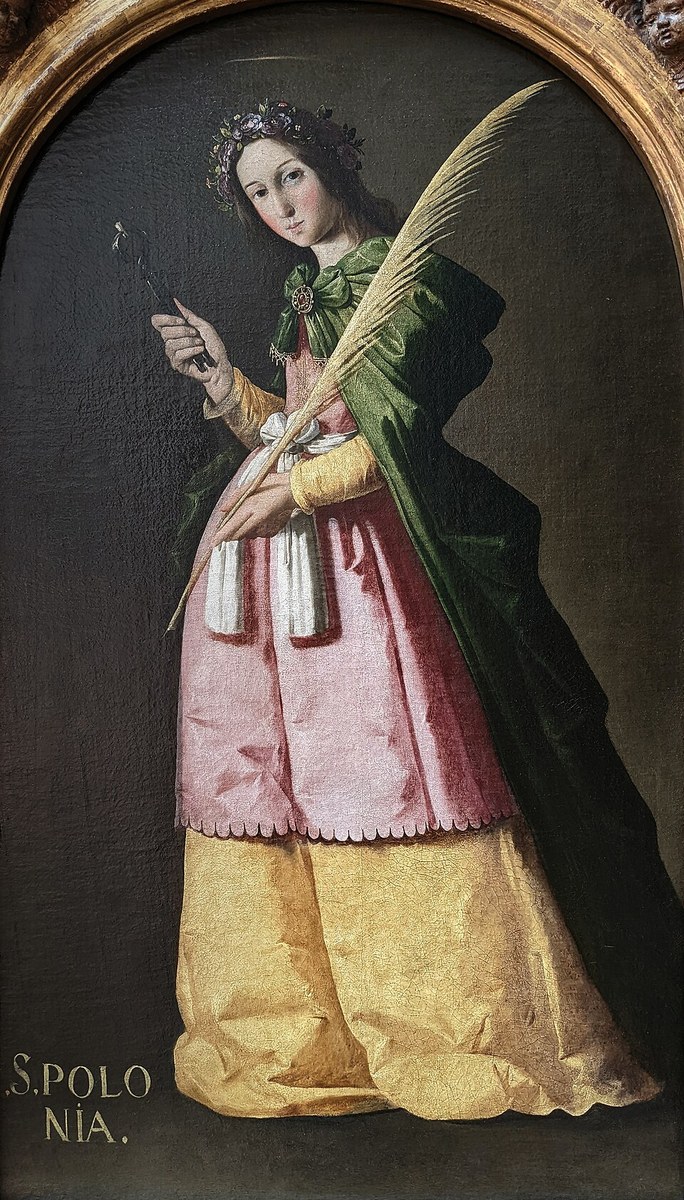
Apollonia's attribute is the instrument of her torture: she is shown holding a pair of pincers or tongs gripping a tooth, together with the palm of martyrdom and sometimes a book or a crown, a young or dignified woman crowned as a virgin. The stored image is Francisco de Zurbarán's Sainte Apolline (Musée du Louvre, c. 1635–1640) — the saint in the Spanish master's grave and luminous manner, bearing in her hand the tongs that clasp a tooth and the martyr's palm. Though a Western Baroque painting rather than a Byzantine icon, it is a faithful reproduction of a pre-modern (pre-1900) two-dimensional work and is retained under that provision; the Eastern iconographic type shows her likewise as a crowned virgin-martyr with the palm.