
Meeting of the Lord
The Meeting (Presentation) of our Lord and God and Saviour Jesus Christ
The Meeting (Presentation) of our Lord and God and Saviour Jesus Christ (February 2) is one of the Twelve Great Feasts and a feast of the Lord, kept on the fortieth day after the Nativity. On that day, in obedience to the Law of Moses, the Theotokos and Joseph carried the infant Christ up to the Temple at Jerusalem — to present the firstborn male to the Lord and to offer for his mother's purification the offering of the poor, a pair of turtledoves or two young pigeons. There the child was met by the righteous elder Symeon, to whom it had been revealed that he should not see death before he had seen the Lord's Christ; taking the child into his arms, Symeon blessed God and sang his departing song, "Now lettest thou thy servant depart in peace," naming the child "a light to lighten the Gentiles, and the glory of thy people Israel," and foretelling to Mary the sword that should pierce her own soul. The aged prophetess Anna came in that same hour and confessed the child to all who awaited redemption. The Greek name of the feast, Hypapante, means precisely this "Meeting" — the encounter, in the Temple of the Old Covenant, of the God of the Law with the aged remnant that had kept faith, so that the Old and the New are met and reconciled in the arms of a holy old man. Kept at Jerusalem already in the fourth century and made a great public feast at Constantinople under Justinian in 542, it has a forefeast on February 1 and an afterfeast to its leavetaking, and it is marked, East and West, by the blessing of candles from Symeon's word of the Light.
.jpg)
The Gospel narrative (Luke 2:22–40)
Alone of the Evangelists, Luke tells the events of the Lord's infancy in the Temple, and the feast is drawn wholly from his second chapter. "And when the days of her purification according to the law of Moses were accomplished, they brought him to Jerusalem, to present him to the Lord; (as it is written in the law of the Lord, Every male that openeth the womb shall be called holy to the Lord;) and to offer a sacrifice according to that which is said in the law of the Lord, A pair of turtledoves, or two young pigeons" (Luke 2:22–24). Two requirements of the Law are fulfilled together on the fortieth day: the presentation and redemption of the firstborn son, who by the Law belongs to God (Exodus 13:2, 12–15; Numbers 18:15–16), and the offering for the mother's purification after childbirth (Leviticus 12). The offering Luke names — the two birds — is expressly the concession the Law makes to the poor, "and if she be not able to bring a lamb, then she shall bring two turtledoves, or two young pigeons" (Leviticus 12:8): the Lord of all, whose mother could not afford the lamb, is redeemed with the offering of poverty, though he is himself the Lamb that the offering foreshadows.
"And, behold, there was a man in Jerusalem, whose name was Simeon; and the same man was just and devout, waiting for the consolation of Israel: and the Holy Ghost was upon him. And it was revealed unto him by the Holy Ghost, that he should not see death, before he had seen the Lord's Christ. And he came by the Spirit into the temple" (Luke 2:25–27). Guided by the Spirit into the courts at the very hour the child was brought, the old man took him up into his arms and blessed God: "Lord, now lettest thou thy servant depart in peace, according to thy word: for mine eyes have seen thy salvation, which thou hast prepared before the face of all people; a light to lighten the Gentiles, and the glory of thy people Israel" (Luke 2:29–32). Joseph and the child's mother marvelled at the things spoken of him; and Symeon blessed them, and said to Mary, "Behold, this child is set for the fall and rising again of many in Israel; and for a sign which shall be spoken against; (yea, a sword shall pierce through thy own soul also,) that the thoughts of many hearts may be revealed" (Luke 2:34–35).
There came in that instant the prophetess Anna, daughter of Phanuel, of the tribe of Aser, "of a great age," a widow of about fourscore and four years who "departed not from the temple, but served God with fastings and prayers night and day." She too gave thanks unto the Lord, "and spake of him to all them that looked for redemption in Jerusalem" (Luke 2:36–38). And when all was performed according to the Law, the holy family returned into Galilee, to their own city Nazareth. "And the child grew, and waxed strong in spirit, filled with wisdom: and the grace of God was upon him" (Luke 2:40) — Luke's quiet close, on which the hidden years of Nazareth begin.
The Law of the firstborn and the offering of the poor
The feast keeps two distinct commandments met on one day, and the hymnography plays upon the paradox in both. By the Law of the firstborn (Exodus 13), every male that first opened the womb was holy to the Lord, a claim rooted in the night of the Passover in Egypt, when the firstborn of Israel were spared and thereby made God's own; such a son was "presented" to the Lord and then redeemed by a payment of five shekels (Numbers 18:16). By the Law of purification (Leviticus 12), a woman who bore a male child was accounted ceremonially unclean for forty days, at the end of which she brought a lamb for a burnt offering and a young pigeon or turtledove for a sin offering, or, if she were poor, two birds in place of the lamb. The Church reads both laws fulfilled and transcended at once: the Lawgiver submits to his own Law; the Redeemer of all is himself presented for redemption; the birds of the poor are offered for him who is the true Lamb; and the ever-Virgin, who bore without corruption and had no need of cleansing, submits nonetheless to the rite of purification, "the pure one brought to the Temple as though impure," teaching by her humility the obedience that undoes the pride of Eve. The hymns are emphatic that neither mother nor child had need of what the Law required — "he who gave the Law is carried to the Temple as an infant, fulfilling the Law" — and that both fulfil it freely, that they might redeem us who were under it (cf. Galatians 4:4–5), the same economy the Nativity had opened.
"Hypapante": the Meeting, and the name of the feast
The Greek East names the feast not from the presentation but from the encounter: Hypapante (Ὑπαπαντή), "the Meeting" or "the going-to-meet," from hypantaō, to come face to face with, to go out to receive. It is the meeting of Symeon and Anna with the Lord; and, in the reading the whole feast turns upon, the meeting of the Old Covenant with the New. Symeon and Anna are the last and holiest of the Old — the aged righteous who had kept the Law and the hope of Israel through the long silence, "waiting for the consolation of Israel" and "looking for redemption in Jerusalem" — and into their waiting arms is placed the whole substance of the New, the incarnate God who is the consolation and the redemption they awaited. The place of the meeting is itself charged with the same meaning: the Temple, the very house of the shadow, receives its own Lord in the flesh, and the Law of Moses is met and fulfilled by the Lawgiver come as a child under the Law. So the feast's own name declares its theology: this is the day on which the two Testaments meet, and the elder generation, its watch ended, hands on its hope and goes in peace.
The Latin West took the feast under other names, weighting it differently. From early on it was kept there as the Purificatio sanctae Mariae, the Purification of the Blessed Virgin Mary — a Marian feast of the fortieth-day cleansing — and later, in the reformed Roman calendar of 1969, renamed the Praesentatio Domini, the Presentation of the Lord, restoring the Christ-centred emphasis the Greek name had always carried. Its most familiar English name, Candlemas, is drawn from its most beloved rite: the blessing of candles and the procession of lights, kindled from Symeon's naming of the child "a light to lighten the Gentiles" (see below). In the Slavonic churches the feast is Sretenie (Срѣтеніе, "Meeting"), a direct rendering of the Greek Hypapante, so that the Slavic and Greek names carry the one idea of the encounter, while the older Latin name carried the purification.
Symeon the God-receiver and the Nunc Dimittis
Of the aged Symeon Luke says only that he was "just and devout," a man of Jerusalem on whom the Holy Ghost rested and to whom it had been revealed that he should not taste death until he had seen the Lord's Christ. The tradition enlarged the portrait into that of a very old man whose life had been prolonged by God across the ordinary span precisely to this end — the last of the just of the Old Covenant, kept alive to receive its fulfilment. A widely repeated tradition, carried in the synaxaria and much of the hymnography, makes him one of the seventy translators of the Hebrew Scriptures into Greek at Alexandria under Ptolemy — the Septuagint — and holds that, translating Isaiah's "Behold, a virgin shall conceive," he stumbled at the word virgin, took his pen to correct it to "young woman," and was stayed by an angel, who told him he should not die until he had seen the prophecy fulfilled with his own eyes. Whatever the tradition's historical worth — the chronology of the Septuagint will not easily bear it, and the feast does not require it — it fixes the meaning the Church draws from Symeon: he is the man who held the fulfilment of the prophecy of the Virgin's child in his own arms, and the tradition styles him ever after ho Theodochos, the God-receiver, the one who received God into his hands.
His song at that moment, the Nunc Dimittis — "Lord, now lettest thou thy servant depart in peace" — passed at once into the daily prayer of the Church. It is sung or read every evening at Vespers, the Church's own evening thanksgiving for the Light seen at the day's decline, and it is chanted at the Christian's burial and at the churching of infants: the old man's readiness to depart, now that his eyes have seen salvation, is made the model of every Christian death met in peace. In the song the whole significance of the feast is compressed — salvation "prepared before the face of all people," a light for the Gentiles and glory for Israel — the universal reach of the redemption declared by an old man of the Law over an infant of forty days, before the child had spoken a word.
The sword that shall pierce thy soul
To the song Symeon added a prophecy, spoken to Mary alone, that the child was "set for the fall and rising again of many in Israel; and for a sign which shall be spoken against," and that a sword should pierce through her own soul also. The word is the first shadow of the Cross to fall across the infancy, and the Church has always read it so. The child laid in Symeon's arms in the Temple is already the "sign spoken against" whom the world will contradict to the end; the division he brings — the fall and rising of many, the revealing of the thoughts of hearts — is the sifting the Gospel will everywhere work; and the sword that shall pierce his mother is her share in his Passion, the grief that will run her through as she stands by the Cross (John 19:25). The tradition of the Stabat Mater and the Marian sorrows grew in the West from this verse; the Byzantine hymnography keeps it more soberly, weaving into the joy of the meeting the first note of the coming sorrow, so that the feast of the Light already looks toward Golgotha. In the icon the swaddled child, held out toward the altar, is turned toward the place of sacrifice; the meeting in the Temple is the presentation of the Lamb.
Anna the prophetess
With Symeon stands Anna, the aged widow-prophetess of the tribe of Aser, who had lived with a husband seven years and then in widowhood to the age of eighty-four, never leaving the Temple, serving God with fasting and prayer night and day. Coming in at the very hour, she too gave thanks and "spake of him to all them that looked for redemption in Jerusalem." She is the feminine witness answering the masculine, the prophetess answering the just elder, and with him she completes the company of the Old Covenant's faithful remnant who receive its Lord: the two of them, in extreme age, are the eyes of Israel at last opened. The Church honours her together with Symeon, and both are commemorated in their own right on the morrow of the feast (see the entries for Symeon the God-receiver and Anna the Prophetess).
Theology: the meeting of the Old and the New
The feast's deepest theme is stated in its name: it is the Meeting, and what meets is the two Covenants. The whole apparatus of the Law — the Temple, the purification, the redemption of the firstborn, the offering — is gathered up and carried to its fulfilment; and the Fulfiller comes not to abolish but to fulfil (Matthew 5:17), submitting as an infant to every ordinance he himself had given. The Lawgiver is presented under the Law; the God whom the Temple could not contain is carried into it as a child; the Ancient of Days is borne in the arms of an ancient man. The paradox the hymns press again and again is that of the borne and the Bearer: "he that is carried upon the cherubim, and hymned by the seraphim, is carried today into the Temple in the arms of Symeon"; "him whom the heavens cannot contain, the arms of the elder receive." And the meeting is also a handing-on: the aged Symeon, having received the Lord, asks and is granted his release — the Old goes in peace, its watch fulfilled, into the arms of the New. The Church reads Symeon's "now lettest thou thy servant depart" as the Old Covenant itself, aged and holy, laying down its long office in the moment of fulfilment and going home in peace. It is a feast of thresholds: the fortieth day that closes the days of the Nativity, the meeting that closes the age of the Law, the evening song that closes the day — everywhere the old ends in peace because the new has come.
Bound into this is the mystery of the Light. Symeon names the child "a light to lighten the Gentiles," and the feast makes the naming its own: Christ is the Sun of righteousness risen from the Virgin, giving light to those in darkness, as the troparion sings, and the candles of the feast are kindled from his word. The universalism of the song — salvation prepared "before the face of all people," light for the nations as well as glory for Israel — is proclaimed on the very threshold of the Temple of the one people, so that the meeting in the house of Israel already opens outward to the world.
A feast of the Lord and of the Theotokos
The Meeting has a double character, and the liturgical books register it with care. It is classed as a feast of the Lord (a Despotikon): its festal antiphons, its proper entrance-verse, and above all its behaviour when it falls on a Sunday — where, as a Dominical feast, its service displaces the ordinary Sunday resurrectional office, which a feast of the Theotokos would not do — all mark it as the Lord's. Yet its hymnography is saturated with the Theotokos: the apolytikion is addressed to her ("Rejoice, O Virgin Theotokos, full of grace"), much of the feast is a dialogue between Mary and Symeon, and the Western tradition kept it for centuries as her Purification. The feast thus stands, more than any other, at the meeting of the Dominical and the Theotokian — which is why it is authored here as a feast of the Lord (feast_type: dominical, with the Nativity and Theophany) while its strong Theotokian dimension is noted throughout. The tension is not a confusion but the feast's own truth: the child presented is the Lord, and he is presented by his Mother, and the day cannot sing of the one without the other.
The fortieth-day churching
Out of the feast grew a rite kept to this day: the churching of mother and child on the fortieth day after birth. In imitation of the Theotokos, who brought her forty-day-old son to the Temple, Orthodox mothers bring their infants to the church on the fortieth day, where the priest reads the prayers of purification over the mother — echoing the Law's forty days — and "churches" the child, carrying a male infant into the sanctuary and bearing both to the royal doors, saying the words of Symeon, "Now lettest thou thy servant depart." The Presentation is thus not only remembered but re-enacted in every Orthodox family, and the Nunc Dimittis is spoken over every child brought to the temple as it was first spoken over Christ. So the feast that shows the Lord presented on the fortieth day gives the Church the pattern of the fortieth-day presentation of all her children.
The history of the feast and its date
The feast is among the more ancient of the fixed year. Its earliest secure witness is the pilgrim Egeria (Aetheria), who about the year 384 describes it kept at Jerusalem with great solemnity as "the fortieth day after Epiphany" — for Jerusalem then kept the Nativity on January 6, and reckoned the fortieth day from there, so that the feast fell on February 14. She reports a procession to the Anastasis, a sermon on the Gospel of Luke, and a celebration "with the highest honour, as at Pascha." When the separate December 25 Nativity was received in the East through the later fourth century (see the Nativity of Christ), the fortieth day was reckoned anew from December 25, and the feast settled onto February 2, where it has remained. The count is exact: from December 25, taken as the first day, the fortieth day is February 2.
At Constantinople the feast was raised to a great public celebration under the emperor Justinian I in the year 542. The occasion, as the chroniclers relate, was calamity — a devastating plague (the Plague of Justinian) together with earthquakes — and the feast of the Meeting was solemnly instituted or greatly elevated in the capital, with processions and litanies, as a public act of supplication and thanksgiving; from Constantinople its rank as a chief feast of the year spread through the Byzantine world. In the West it is attested at Rome by the seventh century, where Pope Sergius I (687–701) is credited with establishing the candle-lit procession that gave the day its Western name. Whatever the differences of name and emphasis, the feast is one of the oldest common possessions of East and West, kept on February 2 wherever the December Nativity is kept.
Candlemas and the blessing of candles
The rite that gave the feast its English name springs directly from Symeon's word: because the child is "a light to lighten the Gentiles," the day is kept with lights. In the West the blessing of candles and a procession bearing them — festum candelarum, whence Candlemas — became the feast's chief ceremony from at least the eighth century; the candles blessed on this day were kept through the year and lit in sickness, at deathbeds and in storms, as a sacramental of the Light met in the Temple.
The East has its own, quieter form of the same. In the Slavonic churches especially, candles are blessed on the feast of the Meeting — the sretenskie svechi, "Meeting candles" (in the Carpathian and Russian usage often called "thunder candles," gromnitsy) — and taken home to be lit before the icons in time of trouble, sickness, or storm, a domestic keeping of the feast's light. The Byzantine services do not centre the day on a candle procession as the Roman rite does; there the theme of the Light lives chiefly in the hymnography and in the reading of Symeon's song, and the blessing of candles is a pious custom rather than a required rite. But in both East and West the instinct is the same: to carry home a flame kindled from the feast of him whom Symeon called the Light, so that the Light seen in the Temple might be kept burning in every house.
Feast and commemoration
February 2 (church date; New Calendar civil February 2, Old Calendar civil February 15), one of the Twelve Great Feasts and a feast of the Lord, kept universally in the Byzantine rite with an All-night Vigil. It falls on the fortieth day after the Nativity, the last echo of the Nativity cycle in the fixed calendar, and the last of the Great Feasts before the movable cycle of the Triodion and Pascha opens.
The feast has a forefeast of one day, February 1 (kept together with the martyr Tryphon), and an afterfeast whose length is variable — normally seven days, to the leavetaking (apodosis) on February 9 — because the feast lies near the moving edge of the Triodion. When the pre-Lenten and Lenten weeks fall early, the afterfeast is curtailed and the leavetaking transferred earlier, or the feast's own celebration adjusted, so that it does not run into the fasting weeks; in years of a late Pascha the full seven-day afterfeast is kept. The morrow of the feast, February 3, honours the two human ministers of the mystery, the righteous Symeon the God-receiver and the prophetess Anna — by the recurring logic of the calendar, the day after a Great Feast commemorates those who served it most nearly, as December 26 keeps the Theotokos after the Nativity and January 7 the Forerunner after the Theophany.
February 2 is not a fast day: as a Great Feast of the Lord the fast of Wednesday and Friday is relaxed in its honour, and fish, wine and oil are permitted on whatever day of the week it falls. Where a liturgical colour is appointed, the feast is served in white and gold, the colours of light and of the Lord's feasts — fitting for the feast of the Light met in the Temple; Greek practice keeps no fixed colour system and uses festal bright vestments by custom. As a feast of the Lord, when February 2 falls on a Sunday its service supersedes the resurrectional office of the tone, the one respect in which its Dominical rank shows most plainly against the Theotokian character of much of its hymnography. The feast is kept on the same church date, February 2, throughout the Orthodox world; the New Calendar churches (including the Antiochian Archdiocese) observe it on civil February 2, the Old Calendar churches thirteen days later, on civil February 15.
Hymns
Apolytikion — Tone 1
Rejoice, O Virgin Theotokos, full of grace, for from thee arose the Sun of righteousness, Christ our God, giving light to those in darkness. Be glad also, thou righteous Elder, as thou receivest into thine arms the Deliverer of our souls, who granteth unto us the Resurrection.
Kontakion — Tone 1
Thou who by thy birth didst sanctify the Virgin's womb, and as was meet didst bless the hands of Symeon, hast gone before to save us also now, O Christ our God. Give peace amid wars unto thy commonwealth, and strengthen the rulers whom thou hast loved, O thou who alone lovest mankind.
Original translation from the Greek
Appointed readings
Epistle — Hebrews 7:7–17
7And without all contradiction the less is blessed of the better. 8And here men that die receive tithes; but there he receiveth them, of whom it is witnessed that he liveth. 9And as I may so say, Levi also, who receiveth tithes, payed tithes in Abraham. 10For he was yet in the loins of his father, when Melchisedec met him. 11If therefore perfection were by the Levitical priesthood, (for under it the people received the law,) what further need was there that another priest should rise after the order of Melchisedec, and not be called after the order of Aaron? 12For the priesthood being changed, there is made of necessity a change also of the law. 13For he of whom these things are spoken pertaineth to another tribe, of which no man gave attendance at the altar. 14For it is evident that our Lord sprang out of Juda; of which tribe Moses spake nothing concerning priesthood. 15And it is yet far more evident: for that after the similitude of Melchisedec there ariseth another priest, 16Who is made, not after the law of a carnal commandment, but after the power of an endless life. 17For he testifieth, Thou art a priest for ever after the order of Melchisedec.
Gospel — Luke 2:22–40
22And when the days of her purification according to the law of Moses were accomplished, they brought him to Jerusalem, to present him to the Lord; 23(As it is written in the law of the Lord, Every male that openeth the womb shall be called holy to the Lord;) 24And to offer a sacrifice according to that which is said in the law of the Lord, A pair of turtledoves, or two young pigeons. 25And, behold, there was a man in Jerusalem, whose name was Simeon; and the same man was just and devout, waiting for the consolation of Israel: and the Holy Ghost was upon him. 26And it was revealed unto him by the Holy Ghost, that he should not see death, before he had seen the Lord’s Christ. 27And he came by the Spirit into the temple: and when the parents brought in the child Jesus, to do for him after the custom of the law, 28Then took he him up in his arms, and blessed God, and said, 29Lord, now lettest thou thy servant depart in peace, according to thy word: 30For mine eyes have seen thy salvation, 31Which thou hast prepared before the face of all people; 32A light to lighten the Gentiles, and the glory of thy people Israel. 33And Joseph and his mother marvelled at those things which were spoken of him. 34And Simeon blessed them, and said unto Mary his mother, Behold, this child is set for the fall and rising again of many in Israel; and for a sign which shall be spoken against; 35(Yea, a sword shall pierce through thy own soul also,) that the thoughts of many hearts may be revealed. 36And there was one Anna, a prophetess, the daughter of Phanuel, of the tribe of Aser: she was of a great age, and had lived with an husband seven years from her virginity; 37And she was a widow of about fourscore and four years, which departed not from the temple, but served God with fastings and prayers night and day. 38And she coming in that instant gave thanks likewise unto the Lord, and spake of him to all them that looked for redemption in Jerusalem. 39And when they had performed all things according to the law of the Lord, they returned into Galilee, to their own city Nazareth. 40And the child grew, and waxed strong in spirit, filled with wisdom: and the grace of God was upon him.
Iconography
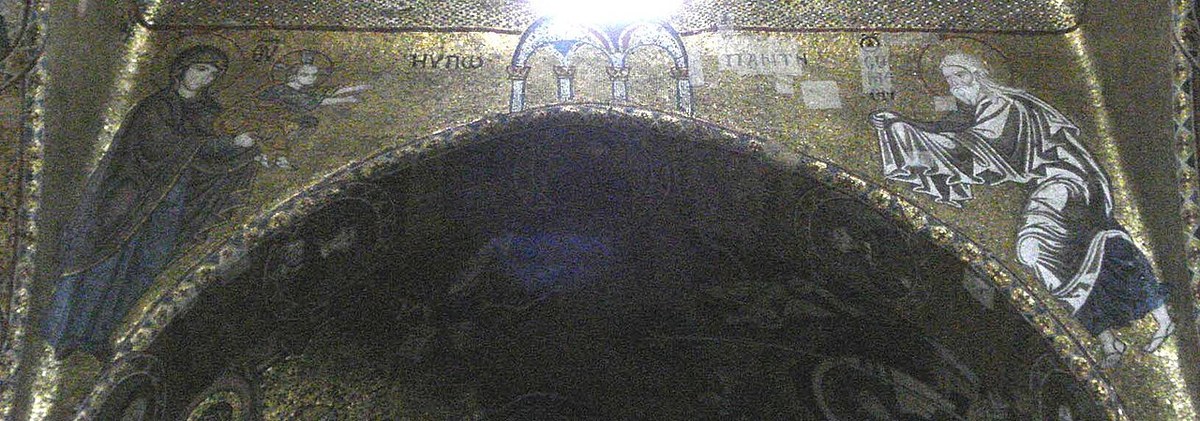
The icon of the Meeting is fixed in its essentials by the middle Byzantine period and varies little thereafter. Its structure is a meeting across a centre: the scene is built around the altar of the Temple, set beneath a ciborium (the domed canopy on four columns) and often veiled, toward which the figures converge from either side. At the centre-left comes the Theotokos, who has carried the child up and now hands him — or has just handed him — across the altar; her hands are frequently covered with her maphorion in reverence, and the swaddled or short-robed Christ-child is shown small but blessing, upright and lordly, not passive, turned toward the sanctuary and the sacrifice it signifies. Receiving him, on the right, bends the aged Symeon, his hands veiled in his cloak as he takes the Lord — the God-receiver reaching across the altar — his white head and long beard the very image of the Old Covenant grown old. Behind the Theotokos follows Joseph, bearing in his hands or in a fold of his garment the offering of the poor, the two turtledoves or pigeons; and behind or beside Symeon stands the prophetess Anna, aged and often veiled, one hand raised in witness or bearing a scroll inscribed with her prophecy, pointing to the child. The whole is set against the architecture of the Temple, and the altar under its canopy stands at the axis, so that the composition reads at a glance: the child borne from the world of his Mother into the house of God, met there by the last of its faithful.
The stored image is one of the great medieval examples of the type: a twelfth-century Byzantine mosaic from the church of Santa Maria dell'Ammiraglio, La Martorana, at Palermo (c. 1146–1151), worked by Byzantine mosaicists in the Norman kingdom of Sicily and among the finest surviving mosaic cycles of the Comnenian age. Set upon the golden ground across the curve of an arch and inscribed in Greek Η ΥΠΑΠΑΝΤΗ, "the Meeting," it shows on the left the Theotokos (marked ΜΡ ΘΥ), stepping forward and holding out the small blessing Christ-child, and on the right the elder Symeon, inclining across the space with hands reverently outstretched to receive the Lord. The two figures reach toward one another over the opening of the arch, the gold binding them into the single act the feast's name declares — the going-out and the meeting, the Old Covenant leaning forward to receive the New.