
Aquila and Priscilla
The Holy Apostles Aquila and Priscilla
Apostle · Apostle of the Seventy · Martyr · d. 1st century (tradition holds they were martyred)
Commemorated 13 February — Joint commemoration of the apostolic couple, 14 July — Aquila, apostle of the Seventy (his own commemoration)
Aquila and Priscilla were a married couple of the apostolic age, Jewish Christians and tentmakers by trade, who became among the closest and most faithful of the co-workers of the Apostle Paul. Aquila, a Jew of Pontus, and his wife Priscilla (Prisca) had been expelled from Rome by the emperor Claudius; they met Paul at Corinth, shared his craft and his household, and travelled with him to Ephesus, where in their own home they instructed the eloquent Apollos "more perfectly in the way of God" (Acts 18:26). Paul names them with singular warmth in his letters — "my fellow-workers in Christ Jesus, who laid down their own necks for my life" (Romans 16:3–4) — and greets "the church that is in their house." Aquila is numbered among the Seventy Apostles; the tradition holds that both were martyred for the faith. They are commemorated together on February 13, and Aquila among the Seventy on July 14.

A married pair of the apostolic Church
Aquila and Priscilla are among the very few married couples of the New Testament whom the Church venerates together, and almost the only lay husband and wife of the apostolic generation of whom a connected story survives. Aquila (Ἀκύλας) was a Jew born in Pontus, on the Black Sea coast of Asia Minor; his wife is called Priscilla in the Acts and the diminutive-fond usage of Luke, and Prisca, the fuller Roman form, by Paul in his epistles — the same woman under either name. They were tentmakers (or leather-workers) by trade, the craft that would bind them to Paul.
They had been living at Rome, in its large Jewish community, when — about the year 49 — the emperor Claudius issued the edict expelling the Jews from the city (the disturbances "at the instigation of Chrestus," as the Roman historian Suetonius reports, very probably reflecting controversy over Christ within the synagogues). Driven from Rome, Aquila and Priscilla came to Corinth, and there their path crossed the Apostle's.
With Paul at Corinth and Ephesus
"After these things Paul departed from Athens, and came to Corinth; and found a certain Jew named Aquila, born in Pontus, lately come from Italy, with his wife Priscilla… and because he was of the same craft, he abode with them, and wrought: for by their occupation they were tentmakers" (Acts 18:1–3). So began a partnership of the Gospel: Paul lodged and laboured with the couple through his long stay at Corinth, and when he sailed for Syria he took them with him as far as Ephesus, where they settled and where he left them (Acts 18:18–19).
At Ephesus the couple did the work for which they are best remembered. There came to the city Apollos, an Alexandrian Jew, "an eloquent man, and mighty in the scriptures," who taught accurately the things of the Lord but "knew only the baptism of John." Aquila and Priscilla, hearing him in the synagogue, "took him unto them, and expounded unto him the way of God more perfectly" (Acts 18:24–26) — so that this learned man was completed in the faith by two tentmakers, and among them, notably, by a woman: Priscilla, whom Luke names, in this passage and often, before her husband, a mark either of her rank or of her prominence in the teaching, and a witness the Church has treasured to the place of women in the apostolic mission.
"The church in their house"
Wherever they went, Aquila and Priscilla made their home a church. Writing from Ephesus to Corinth, Paul sends greeting: "Aquila and Priscilla salute you much in the Lord, with the church that is in their house" (1 Corinthians 16:19). Later, returned to Rome — for the couple went back when it was safe — they are greeted at the head of the long roll of Romans 16: "Greet Prisca and Aquila my fellow-workers in Christ Jesus, who for my life laid down their own necks: unto whom not only I give thanks, but also all the churches of the Gentiles; likewise greet the church that is in their house" (Romans 16:3–5). The phrase "laid down their own necks" points to some peril — an arrest, a riot, a danger of death — in which the couple risked their lives to save Paul's; the particular occasion is not recorded, but the debt of "all the churches of the Gentiles" is. At the last, in the Second Epistle to Timothy, written as Paul faced death, the Apostle's thoughts turn to them once more: "Salute Prisca and Aquila" (2 Timothy 4:19) — the couple among the last names on his lips.
Aquila of the Seventy, and the martyrdom
The tradition of the Church numbers Aquila among the Seventy Apostles — the wider company of disciples sent out by the Lord (Luke 10) and, in the Church's reckoning, extended to include the chief apostolic co-workers of the next years — and some notices make him a bishop (the tradition names Heraclea) set over a church by Paul. Of the end of the couple the Scriptures say nothing; the later tradition, followed by the Greek Menaion, which styles them "Holy Apostles and Martyrs," holds that Aquila and Priscilla shed their blood for Christ, put to death together for the faith they had served — so that the pair who had "laid down their necks" once for Paul laid them down at the last for the Lord. The manner and place are not securely transmitted; the Church keeps their memory as martyrs of the apostolic age.
Feast and commemoration
Aquila and Priscilla are commemorated together on February 13 (church date; New Calendar civil February 13, Old Calendar civil February 26), the joint feast of the apostolic couple, kept universally in the Byzantine churches; the Greek Menaion of the day names "the holy apostles Aquila and Priscilla" among its commemorations, styling them apostles and martyrs. Aquila is kept again on July 14 as one of the Seventy Apostles, and both are gathered into the Synaxis of the Seventy Apostles on January 4. The February feast honours them as Paul's co-workers and as a model of the Christian marriage made wholly a servant of the Gospel — the home that was a church, the wife who taught beside her husband, the pair who risked death for the Apostle and at the last for Christ.
Hymns
Troparion — Tone 3
O holy apostles Aquila and Priscilla, intercede with the merciful God, that he grant to our souls the forgiveness of our transgressions.
Original translation from the Greek
Kontakion — Tone 4
The Church ever possesseth you, O wise Aquila and Priscilla, as luminaries shining upon the world, adorning her with the beams of your teaching; wherefore, holy fellow-workers of Paul, entreat Christ God that his great mercy be granted unto us.
Original translation from the Greek
Iconography
Aquila and Priscilla are depicted together, as a couple — Aquila as an apostle, bearded and holding a scroll, and Priscilla beside him as a matron in the veil of a married woman, often both with the hand raised in confession or teaching. Because their memory is bound to the household-church and to the instruction of Apollos, they are among the couples set in the apostolic scenes of the menologia. Aquila alone appears in the ranks of the Seventy Apostles in the fresco cycles and in the menaia-icons for July.
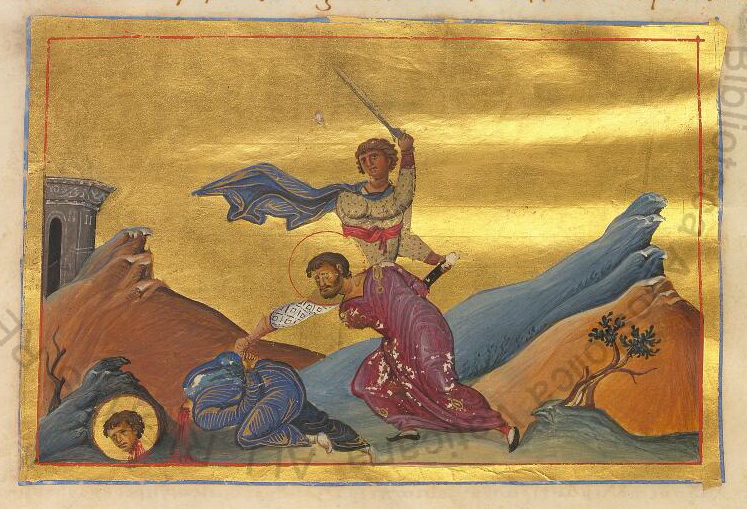
The stored image is the miniature for February 13 from the Menologion of Basil II (Constantinople, c. 985; Vatican, Vat. gr. 1613), depicting the two apostles, Priscilla and Aquila, standing together.
Disputed questions
- Priscilla or Prisca; and the order of the names. "Priscilla" (Acts) and "Prisca" (the epistles) are the same person, the diminutive and the formal Roman name. In four of the six New Testament mentions the wife is named first (Priscilla/Prisca before Aquila) — a striking usage much discussed, read by many as pointing to her higher social standing or her leading role in the teaching of the household.
- Aquila's individual commemoration. Aquila is kept in his own right among the Seventy Apostles on July 14 (and in the Synaxis of the Seventy on Jan 4); February 13 is the joint feast of the couple. This entry is authored at the couple's feast (Feb 13), the first in the liturgical year, and links from the Synaxis of the Seventy Apostles.
- The tradition of martyrdom. The New Testament reports neither their deaths nor a martyrdom; the martyr-title rests on the later synaxarial tradition (and the Menaion's rubric). The entry records the tradition as such.