
Synaxis of the Seventy Apostles
The Synaxis of the Holy and Glorious Seventy Apostles
Apostle · Apostle of the Seventy · Evangelist · Protomartyr · Hieromartyr · Martyr · Bishop · Deacon · d. 1st century
Commemorated 4 January — The common assembly (synaxis) of all the Seventy Apostles
On January 4 the Church keeps the Synaxis — the common assembly — of the Seventy Apostles, that second and wider company whom the Lord "appointed... and sent two and two before his face into every city and place, whither he himself would come" (Luke 10:1). Distinct from the Twelve yet joined to them in the one apostolate, the Seventy carried the Gospel to the ends of the earth as the first bishops, evangelists, and deacons of the infant Church; among them are the Lord's own brother James of Jerusalem, the Evangelists Luke and Mark, the protomartyr Stephen, and the companions of Paul — Timothy, Titus, Silas, and the many greeted by name in his epistles. Because so many of them are commemorated singly through the year and none must be reckoned less than another, the Church gathered them all into one festival "to indicate the equal honour of each," fixing it on the day after the Synaxis-days of the Circumcision and hard upon the Theophany. The roll of the Seventy was drawn up in antiquity — in the lists ascribed to Hippolytus of Rome and to Dorotheus of Tyre, and refined by later hagiographers — and, though it varies from book to book, it is kept whole in this common feast.

The Seventy in the Gospel
The institution of the Seventy is told only by the Evangelist Luke, himself counted among them: "After these things the Lord appointed other seventy also, and sent them two and two before his face into every city and place, whither he himself would come. Therefore said he unto them, The harvest truly is great, but the labourers are few" (Luke 10:1–2). He sent them out as lambs among wolves, without purse or scrip, to heal the sick and to proclaim that "the kingdom of God is come nigh unto you" (Luke 10:9); and when they returned with joy, saying "Lord, even the devils are subject unto us through thy name," he answered, "I beheld Satan as lightning fall from heaven... rejoice, because your names are written in heaven" (Luke 10:17–20). The Seventy are thus, after the Twelve, the Lord's own second sending — a foreshadowing of the Church's universal mission, and the reason the tradition ranks them, with the Twelve, among the Apostles proper.
The number itself is read as a sign. Many manuscripts of Luke, and much of the tradition, give seventy-two rather than seventy, and the Church has never treated the difference as a contradiction: seventy answers to the seventy elders whom Moses set over Israel (Numbers 11:16, 25) and to the seventy nations of the earth in the table of Genesis 10, so that the sending of the Seventy is the Gospel's answer to Babel, the ingathering of all the nations that the day of Pentecost would begin. Both numbers are honoured; the feast keeps the name "the Seventy," the round and scriptural figure, while the synaxaria note that seventy-two is often intended.
Who the Seventy were, and the making of the list
Unlike the Twelve, the Seventy are nowhere named as a body in Scripture, and no roster of them comes down from the apostolic age. What the Church possesses instead is a tradition, gathered gradually, that identifies the Seventy with the disciples and fellow-workers who appear by name across the Acts of the Apostles and the Epistles — the seven deacons of Acts 6, the companions of Paul, the many saluted in the last chapter of Romans and in the closing greetings of the other letters. Out of these the ancient hagiographers compiled catalogues: one is ascribed to Hippolytus of Rome (early third century), another, and the most influential in the East, to Dorotheus of Tyre (commemorated June 5). Later compilers — pre-eminently Dimitry of Rostov (†1709), whose Lives of the Saints set the roll in the form the Slavic and much of the Greek world now keep — weighed these against Scripture and the fathers, correcting where the older lists erred.
That the lists differ and even err is frankly acknowledged in the tradition itself. The catalogue attributed to Dorotheus of Tyre repeats some names (Herodion, Apollos, Tychicus, Aristarchus appear twice) and omits others who plainly belong (Timothy, Titus, Epaphras, Archippus, Aquila, Olympas); other books add or drop names, or divide one apostle into two, or fuse two into one. The Church has never canonised a single fixed roster, and this entry follows the common received list (that of Dimitry of Rostov and the printed synaxaria) while recording its provisional character. What the feast asserts is not a notarised register but the reality of the wider apostolate: that beyond the Twelve the Lord sent out a great company, and that the Church remembers them together.
The roll of the Seventy
The following is the traditional roll of the Seventy as kept in the synaxaria and in Dimitry of Rostov, with the day(s) of each apostle's own commemoration in parentheses. Each is authored at full depth on his own principal feast; the name is linked here where that entry already exists in this collection, and given as plain text where it is still to be written. Several are commemorated in companies, and the link then leads to the joint entry.
- James the Brother of the Lord, first bishop of Jerusalem (October 23)
- Mark the Evangelist (April 25)
- Luke the Evangelist (October 18)
- Cleopas, brother of Joseph the Betrothed (October 30)
- Simeon, son of Cleopas, bishop of Jerusalem (April 27)
- Barnabas, the Levite of Cyprus, first bishop of Cyprus (June 11)
- Joses (Joseph), called Barsabas and Justus (October 30)
- Thaddeus (August 21)
- Ananias of Damascus, who baptized Paul (October 1)
- Stephen the Protomartyr and Archdeacon (December 27)
- Philip the Deacon, of the Seven (October 11)
- Prochorus the Deacon, of the Seven (July 28)
- Nicanor the Deacon, of the Seven (July 28 and December 28)
- Timon the Deacon, of the Seven (July 28)
- Parmenas the Deacon, of the Seven (July 28)
- Timothy, companion of Paul, bishop of Ephesus (January 22)
- Titus, bishop of Crete (August 25)
- Philemon (November 22 and February 19)
- Onesimus (February 15)
- Epaphras (November 22)
- Archippus (November 22 and February 19)
- Silas, bishop of Corinth (July 30)
- Silvanus, bishop of Thessalonica (July 30)
- Crescens (Criscus), bishop of Galatia (July 30)
- Crispus, bishop of Aegina (July 30) — named in this roll but not in the Menaion's company for July 30, which lists five apostles and not six
- Epaenetus, bishop of Carthage (July 30)
- Andronicus, bishop of Pannonia (May 17, February 22 and July 30) — kept with Junia his fellow-labourer, who is not herself numbered in this roll
- Stachys, first bishop of Byzantium (October 31)
- Amplias (October 31)
- Urban (October 31)
- Narcissus (October 31)
- Apelles, bishop of Smyrna (October 31)
- Aristobulus, apostle to Britain (March 15 / Slavic March 16; and October 31)
- Herodion (Rodion) (April 8 and November 10)
- Agabus the Prophet (April 8)
- Rufus, bishop of Thebes (April 8)
- Asyncritus, bishop of Hyrcania (April 8)
- Phlegon, bishop of Marathon (April 8)
- Hermas (November 5 and May 31)
- Patrobas (Patrobus) (November 5)
- Hermes, bishop of Dalmatia (March 8 and April 8)
- Linus, bishop of Rome (November 5)
- Gaius (November 5)
- Philologus (November 5)
- Lucius, bishop of Laodicea (September 10)
- Jason, bishop of Tarsus (April 28)
- Sosipater, bishop of Iconium (April 28 and November 10)
- Olympas (Olympanus) (November 10)
- Tertius, bishop of Iconium (October 30 and November 10)
- Erastus, bishop of Paneas (November 10)
- Quartus, bishop of Berytus (November 10)
- Evodus (Euodius), second bishop of Antioch (September 7)
- Onesiphorus (September 7 and December 8)
- Clement, bishop of Rome (November 25)
- Sosthenes, bishop of Colophon (December 8)
- Apollos, bishop of Caesarea (March 30 and December 8)
- Tychicus, bishop of Colophon (December 8)
- Epaphroditus, bishop of Andriace (December 8)
- Carpus, bishop of Beroea in Thrace (May 26)
- Quadratus, bishop of Athens (September 21)
- Mark, also called John (September 27)
- Zeno (Zenas), bishop of Diospolis (September 27)
- Aristarchus, bishop of Apamea (April 15 and September 27)
- Pudens (April 15)
- Trophimus (April 15)
- Mark, nephew of Barnabas, bishop of Apollonias (October 30)
- Artemas, bishop of Lystra (October 30)
- Aquila (July 14 and February 13)
- Fortunatus (June 15)
- Achaicus (January 4)
To these the tradition joins the Apostle Cephas (whom Paul withstood at Antioch, Galatians 2:11 — reckoned by the fathers a distinct disciple, not Simon Peter) and Simeon called Niger (Acts 13:1), who are numbered among the Seventy in several catalogues. Two further apostles of the Seventy who already have entries in this collection fall outside this particular roll but belong to the same company: Apelles of Heraclea, with Lucius and Clement (September 10), whom the manuscripts frequently confuse with the like-named members above, and Mark of Apollonias, one of the "three Marks" of the Seventy — a tangle of doubled and divided names that the tradition acknowledges and never wholly resolves.
Their labours and their crowns
The Seventy are, collectively, the Church's first generation of pastors. From their number the tradition draws the first bishops of the great sees — James of Jerusalem, Evodus of Antioch, Stachys of Byzantium, Linus and Clement of Rome, Titus of Crete, Timothy of Ephesus — and the first deacons, the Seven of Acts 6, with Stephen the Protomartyr at their head. Some were evangelists whose written Gospels the Church reads to the end of the age (Luke and Mark); some were the travelling companions and secretaries of Paul (Timothy, Titus, Silas, Tertius, who wrote out the Epistle to the Romans, Romans 16:22); some sealed their preaching with martyrdom, others reposed in peace after long episcopates. Their common feast holds all these together — evangelist and deacon, martyr-bishop and confessor — in the single dignity of the apostolate, teaching that the Church of the second and third generations is continuous with the Lord's own sending, and that the honour of an apostle rests not on eminence of see or memory but on the having been sent.
Feast and commemoration
January 4 (church date; New Calendar civil January 4; Old Calendar civil January 17), kept universally in the Byzantine rite. The Synaxis stands within the forefeast of the Theophany (which opens on January 2 and runs to the feast on January 6), so that the office of the Seventy is sung together with the forefeast hymns of the Lord's Baptism; the day falls also in the bright afterglow of the Circumcision and the Synaxis-days of the new year. The purpose of the feast, stated in the synaxaria, is to honour the Seventy as a body and "to indicate the equal honour of each" — for while many of them are commemorated singly through the year (and the roll above gives each his own day), and a few are of great fame while others are little more than names, none is to be reckoned less an apostle than another; the common assembly sets them all on one level before the Church. The feast is kept across the Antiochian, Greek, and Slavic calendars alike. It is not among the Twelve Great Feasts and falls within no fasting season.
Hymns
Troparion — Tone 3
Holy Apostles, intercede with the merciful God, that he may grant to our souls the forgiveness of transgressions.
Original translation from the Greek
Kontakion — Tone 2
The choir of the Seventy disciples of Christ let us the faithful hymn today with godly zeal, and keep their festival; for through them have we all been taught to worship the undivided Trinity, since they are the lamps of the divine Faith.
Original translation from the Greek
Iconography
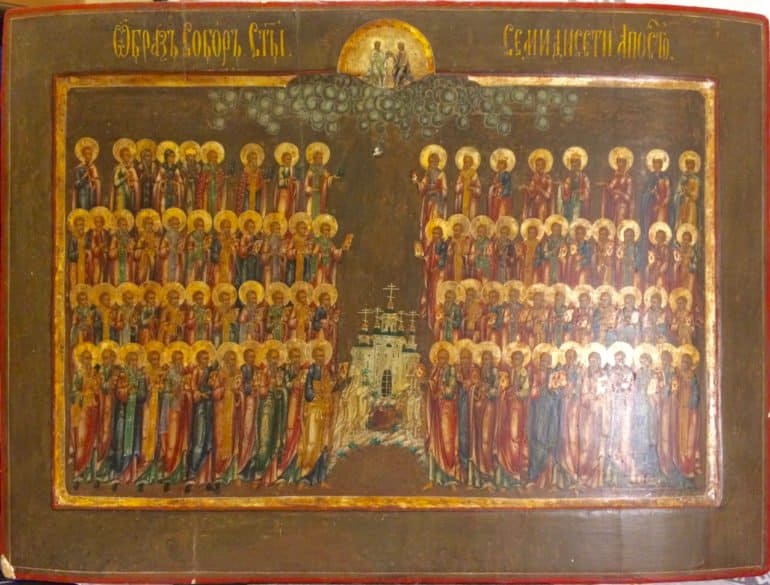
The Seventy are depicted in the Synaxis or "assembly" type: the whole company ranged in rows or in a great arc, each an apostle of the first generation — some vested as bishops in the phelonion and omophorion and holding the Gospel-book or a scroll, the deacons among them in the sticharion with the orarion, Stephen the Protomartyr with his censer — often gathered beneath a blessing Christ or about the enthroned Lord who sends them. Individual members keep their own settled types (Luke and Mark as evangelists with their books; Stephen as the first deacon and martyr; the bishop-apostles as hierarchs), and appear singly in the menologion miniatures for their own days; but the icon of the feast is the crowd of them together, the visible form of the "great harvest" and its many labourers.
The stored image is a Russian icon of the Synaxis type (before 1917), Sobor apostolov ot 70 — the Seventy set out in ranks, the apostle-bishops and deacons together — the assembly of the whole company that the feast commemorates (source, public domain, pd-old-work).