
Aquilina of Byblos
The Holy Martyr Aquilina of Byblos in Phoenicia
Martyr · Child Martyr · Virgin · b. c. 281 — d. 293
Commemorated 13 June — Martyrdom at Byblos in Phoenicia at the age of twelve
Aquilina of Byblos (c. 281–293) is the girl-martyr of Phoenicia: a Christian child of Byblos, the ancient coastal city that is the modern Jbeil in Lebanon, who at the age of twelve was denounced for having persuaded a pagan schoolfellow to believe in Christ. Brought before the governor Volusian, she refused every flattery and every threat, answering that the more she suffered the more strength the Lord invisibly gave her; she was beaten and had heated iron rods driven through her ears, and was cast out of the city for dead. Raised by an angel and returning to confess Christ a second time before the same tribunal, she was sentenced to beheading and gave up her soul in prayer before the sword could fall, in the year 293. Her tomb outside Byblos became a place of healings, and her relics were afterwards carried to Constantinople.

Byblos in Phoenicia
Aquilina was born about the year 281 in Byblos (Greek Βύβλος; Phoenician Gebal; today Jbeil, on the Lebanese coast north of Beirut), one of the oldest continuously inhabited cities of the world and, in the Roman period, a city of the province of Phoenice within the civil Diocese of the East. Ecclesiastically the region belonged then, as it belongs now, to the sphere of the Church of Antioch: the see of Byblos is today part of the Antiochian Orthodox Archdiocese of Byblos, Botrys and Mount Lebanon, so that Aquilina is not merely a saint of the universal calendar but a local saint of the Antiochian patriarchal territory, honoured on the soil where she suffered. Older Slavonic and English calendars style her "of Byblos in Syria," using Syria in the wide Roman sense for the whole Syro-Phoenician littoral; the Greek books say more precisely in Phoenicia.
Her parents were Christians and brought her up, as the synaxarion puts it, in piety; her father's name is transmitted as Eutolmius. She was catechised by Euthalius, Bishop of Byblos, and the passion is emphatic that what she received from him she did not keep to herself. She was a child of unusual seriousness, and the accounts present her as already a teacher — not in any formal sense, but in the way a devout child speaks among children.
The schoolfellow
The whole of her martyrdom turns on a single act of witness, and the tradition is unanimous about it: at the age of twelve she brought a pagan girl of her own age to faith in Christ. She spoke to her companions of the one God and of the emptiness of the idols, and one of them — a fellow-pupil — was persuaded and believed. It is the smallest possible scale of missionary work and, in the logic of the persecution, entirely sufficient: to detach a single subject from the religion of the ancestors was the offence of maiestas in its most feared form, because it was the form that spread.
A servant of the household of the imperial governor learned of it and informed his master that a girl of the city was "teaching others not to follow the religion of their fathers." The delation is characteristic of the last great persecution: not a sweep of the Christian community but the denunciation of one individual by a member of the official household.
Before Volusian
The governor is named Volusian (Οὐολουσιανός). He had Aquilina brought before him and began, as the acts relate, with persuasion and flattery — the standard first move of a magistrate faced with a child, and the move most likely to succeed. She met it with a plain confession of Christ and would not be moved to any word of renunciation. Seeing her steadiness, Volusian turned to force.
She was struck on the face, then scourged with whips; and when she still confessed, the executioners bored through her ears with heated iron rods. It is at this point that the passion places the words for which she is remembered: that the Lord was present with her invisibly, and that the more she suffered the more strength and endurance He would give her. The torture was pressed until she lay motionless, and the torturers, judging her dead, reported as much; the body of the twelve-year-old was carried outside the walls and thrown out unburied, as the corpse of a condemned criminal.
The angel and the second confession
There in the open, the account continues, a holy angel stood over her, roused her, and said, "Arise and be healed"; and she rose whole. She did not flee. She went back into the city, into the praetorium, and stood again before Volusian — and this second appearance is the theological centre of her passion, as it is of many of the Phoenician and Syrian acts: the martyr's return is itself the argument, the demonstration that the power of the empire over the body has been exhausted and the body has been given back.
Volusian, we are told, was thrown into confusion, and then did what magistrates in the acts regularly do when a miracle is undeniable: he reclassified it. She was condemned as a sorceress, and sentenced to be beheaded. Aquilina prayed, and gave thanks to God that she had been counted worthy to suffer for His holy Name; and before the sword fell she gave up her soul. She was twelve years old, and the year was 293.
Tomb, healings, and the relics
The Christians of Byblos took her body and buried it outside the city, near the place where it had been thrown out. The tomb became a place of resort and of cures, and the memory of the child-martyr was kept locally from that time — the ordinary pattern by which a Phoenician martyr's grave became a shrine long before any written passion existed.
Her relics were afterwards translated to Constantinople, where a great church was raised in her honour near the Forum of Constantine, one of the many martyria of provincial saints with which the capital furnished itself; that basilica was later destroyed by fire. The translation to Constantinople is what carried her name from a local Phoenician cult into the Constantinopolitan synaxarion and thence into the calendars of the whole Orthodox world.
Feast and commemoration
June 13 (church date; New Calendar civil June 13; Old Calendar civil June 26). Aquilina is the day's leading commemoration in the Greek and Slavonic Menaia alike, shared with Triphyllius of Leucosia and, in the Greek books, Antipater of Bostra. Depending on the date of Pascha, June 13 may fall before the Apostles' Fast or within it — the fast begins on the Monday after the Sunday of All Saints and so has no fixed start — and the day's position is therefore not asserted here.
She is kept universally, but her honour is properly local as well: Byblos/Jbeil is her own city and lies within the Patriarchate of Antioch, and Antiochian usage keeps her as one of the martyrs of its own coast, alongside the martyrs of Tyre, Sidon, Beirut and Emesa. Russian iconography and the Russian menologion know her well as Мученица Акилина, and she is a name-day patron in Slavic practice. Her tomb-site at Byblos and the vanished Constantinopolitan basilica near the Forum are the two historic centres of her cult.
Hymns
Apolytikion — Tone 4 (common of a woman martyr)
Thy lamb Aquilina crieth out to Thee with a great voice, O Jesus: I love Thee, O my Bridegroom, and seeking Thee I contend, and I am crucified and buried together with Thee in Thy baptism; I suffer for Thy sake, that I may reign with Thee; I die for Thee, that I may live in Thee. Receive me as a spotless sacrifice, offered to Thee in love. By her intercessions, O merciful One, save our souls.
Kontakion — Tone 2 (common of a virgin martyr)
Thou didst offer to Christ the first-fruits of thy years, O maiden, and the purity of a body untouched; and being a child in age thou wast found perfect in confession, and didst tread down the pride of the tyrant. Wherefore we cry to thee: rejoice, O Aquilina, bride of the Lord.
Original translation from the Greek
Iconography
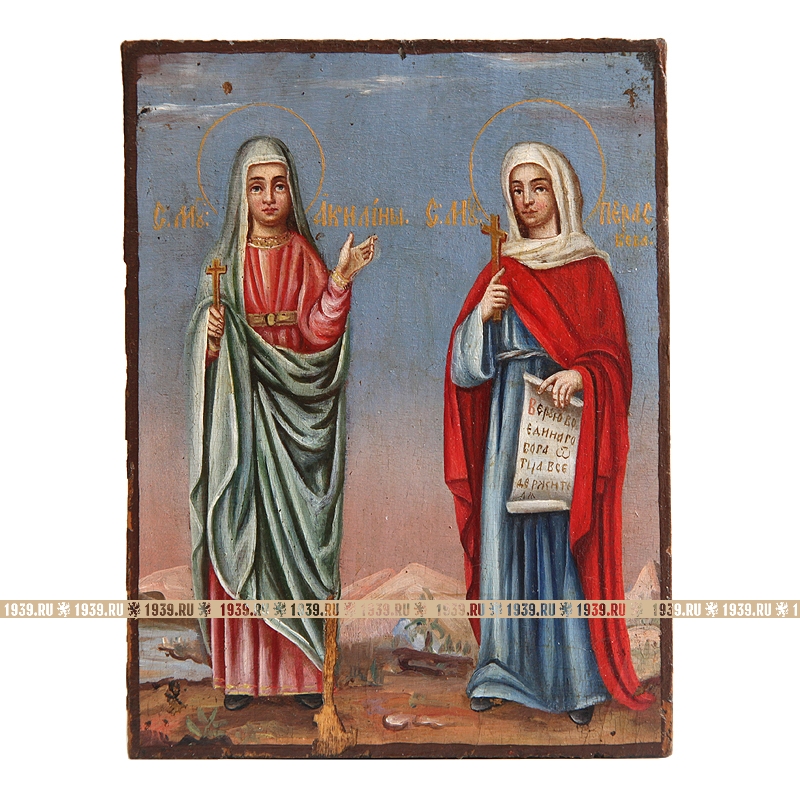
Aquilina is painted as a young girl — the iconography insists on her age, and she is regularly the smallest figure in a row of martyrs — bare-headed or veiled, in the long tunic and mantle of a virgin-martyr, holding the cross of martyrdom in her right hand and sometimes a martyr's palm; her left hand is often raised open in the gesture of confession and teaching, which in her case is exact, since she was condemned for teaching. Where the scene of her passion is shown, the instruments are the whips and the iron rods driven through the ears, and the angel raising her from the ground outside the city wall.
The stored image is a 19th-century Russian panel icon (anonymous, before 1917), showing two women saints side by side over a landscape: at the left the martyr Aquilina, inscribed С. МЦ. АКИЛИНЫ ("holy martyr Aquilina") — a young girl in a red tunic with a pale grey mantle drawn over her head, holding a small gold cross and with the right hand raised in the gesture of speech; at the right the martyr Paraskeva ("Pyatnitsa"), inscribed and holding a cross and an open scroll of the Creed. Such paired panels are family icons, painted to carry the name-day patrons of a household, and the pairing carries no calendrical meaning: the identification of the left-hand figure rests on the inscription, which was read and verified before the image was stored. The available reproduction is a photograph made for an antique dealer and carries a watermark band across its lower third; it is stored nonetheless because the underlying icon is pre-1900 and out of copyright, and because no cleaner public-domain reproduction of an Aquilina icon has been located. A cleaner alternative exists in the line engraving of Aquilina in the June volume of the Russian Lives of the Saints after Demetrius of Rostov (1903–1911), which is also in the public domain and may be added as a variant.
Two candidates were examined and rejected: a low-resolution GIF captioned only "an old icon of Saint Aquilina," of undetermined date and unverifiable origin; and images returned by searches for Aquilina of Zagliveri, which in fact depict this saint and belong here rather than there.
Disputed questions
- The year: 293 or 239. The prevailing tradition, followed by the OCA and by most English calendars, dates her martyrdom to 293 and places it "under Diocletian (284–305)" — the two statements agree, 293 falling in Diocletian's reign, though before the general edicts of 303. Some Greek synaxaristic notices instead give 239, which would put her under Gordian III and among the earlier Syrian martyrs. The difference is almost certainly a numeral corrupted in transmission rather than two traditions; this entry follows 293 and records 239 as a variant. With her birth about 281 the transmitted age of twelve fits the later date exactly, which is a modest argument for it.
- "Of Syria" or "of Phoenicia." See above: both are correct, in different senses of Syria. The city is not in the modern Syrian Arab Republic but in Lebanon, and readers of the older English calendars are regularly misled on this point.
- Not to be confused with the other saints of the name — the shared name Ἀκυλίνα is
productive of error, and this is the only one of them who is a child-martyr of the third
century:
- Aquilina of Zagliveri, the Greek virgin new-martyr beaten to death near Thessalonica in 1764 (September 27). A Commons image search for the new-martyr returns images of this Byblos martyr, and the confusion has already been recorded in her entry.
- the Aquilina martyred with the Great-Martyr Christopher in Lycia about 250 (May 9), one of the two women sent to seduce the confessor in prison and converted by him.
- the Aquilina listed in the Greek usage with the deacon Rufinus and two hundred soldiers at Sinope (April 7).
- The passion as a document. Her acts belong to the class of short Eastern martyr-acts shaped for liturgical reading, and their pattern — flattery, torture, presumed death, angelic raising, second confession, condemnation as magic — recurs across the Phoenician and Cilician passions. The names transmitted (Eutolmius her father, Euthalius her bishop, Volusian the governor) are the kind of concrete detail such acts often preserve accurately, but none of the three is independently attested; the local cult at Byblos and the translation to the capital are the firmer part of the record, and the Church's commemoration rests on them.