
Triphyllius of Leucosia
Our Father among the Saints Triphyllius, Bishop of Leucosia in Cyprus
Bishop · d. c. 370
Commemorated 13 June — Repose at Leucosia in Cyprus
Triphyllius (†c. 370) was Bishop of Leucosia — ancient Ledra, the modern Nicosia — in Cyprus, and the best-known disciple of Spyridon of Trimythous. Born at Constantinople and trained in law and rhetoric at Berytus (Beirut), he was by St Jerome's reckoning the most eloquent writer of his generation and the author of a commentary on the Song of Songs, now lost; yet he attached himself for a master not to a scholar but to the unlettered shepherd-bishop Spyridon, and the two stories the tradition tells best about him are both stories of Spyridon correcting his learning — the healing of the sick emperor, at which Triphyllius was recognised together with his teacher, and the rebuke in synod when he improved the Gospel's plain word for a sick man's bed. He founded a monastery at Leucosia out of his mother's inheritance, is counted among the Cypriot bishops at the Council of Sardica, and reposed in old age about the year 370.
_-_June_-_23_Triphyllius.jpg)
Constantinople and Berytus
Triphyllius was born at Constantinople, in the first generation of the new capital, and received the education of a man intended for public life. He studied at Berytus — Roman Beirut, the great law school of the East and the intellectual centre of Phoenicia, whose graduates staffed the imperial administration from Syria to Italy. The sources are unanimous that he was exceptionally able: "very intelligent and eloquent," in the phrase the calendars have kept, and St Jerome, writing his catalogue of Christian authors within living memory of him, ranks Triphyllius of Ledra as the most eloquent man of his age under the emperor Constantius, and records that he composed a commentary on the Song of Songs together with other works. Not one of them survives, which makes him one of the more considerable losses of fourth-century Cypriot literature.
The disciple of Spyridon
What the tradition finds remarkable is what he did with that formation. Crossing to Cyprus, he took as his spiritual father Spyridon, Bishop of Trimythous — a former shepherd, a man without letters, whose authority was of another order entirely; and he remained his disciple. The lives make the point plainly: the trained rhetorician of Berytus chose for a master a man who could scarcely have followed him in argument, and chose him for his holiness and not his learning. Spyridon in turn, according to the accounts, spent years turning his brilliant disciple's attention away from what was attractive in the world and towards what is heavenly.
The healing of the emperor
The best-attested episode of his life is the one recorded by the historian Sozomen. The emperor — Constantius, son of Constantine the Great — fell gravely ill, and no physician could help him; he was told in a dream, or a vision, that he would be healed by certain bishops, whose faces were shown to him. Bishops were accordingly summoned to the court, and among those who came from Cyprus were Spyridon and his disciple Triphyllius. The emperor recognised the two men as those he had been shown, received their prayer, and recovered. The story is one of the foundations of Spyridon's fame, and Triphyllius stands in it as the younger companion — the Cypriot pair, the shepherd and the rhetorician, brought together to the imperial bedside.
Sozomen adds a detail about Triphyllius himself on that journey: dazzled by the wealth and splendour of Antioch, he was rebuked by his teacher, who reminded him of the poverty of the Kingdom.
The word for a bed
The second story is the one the calendars never omit, and it is also from Sozomen. At a synod of the Cypriot bishops — held at Ledra, Triphyllius's own city — Triphyllius was invited to preach, and came in his sermon to the Lord's word to the paralytic, Take up thy bed and walk (Mark 2:11). The Gospel's word is κράββατος, the common camp-bed of the poor; and Triphyllius, out of an orator's instinct, substituted the more elegant and literary σκίμπους. Spyridon rose from his seat, interrupted him before the assembly and said, in effect: are you better than He who said "bed", that you should be ashamed of His words? — and walked out of the church. The rebuke is remembered as a piece of ascetic discipline exercised upon rhetoric itself, and it is the anecdote by which most Orthodox readers know Triphyllius at all. That the two men remained teacher and disciple afterwards is part of the point.
Bishop of Leucosia
Triphyllius was made Bishop of Ledra (Λέδρα / Λήδροι), the inland city of Cyprus that grew into medieval Leucosia and modern Nicosia; the calendars accordingly style him "of Leucosia," "of Ledra," or "of Nicosia" indifferently. He is counted among the Cypriot hierarchs who subscribed at the Council of Sardica (343), the western council convened to vindicate St Athanasius — placing him, with the Cypriot episcopate generally, firmly on the side of the Nicene faith in the Arian crisis of his lifetime.
From the inheritance left him by his mother he built a monastery at Leucosia; the detail is transmitted without further particulars, but it marks him as one of the earliest founders of organised monastic life on the island, in the generation after Spyridon and before the great age of Cypriot monasticism.
He reposed in old age, about the year 370, and was buried in his city. His name passed into the Constantinopolitan synaxarion for June 13, and thence into the Slavonic menologia, where he appears among the hierarchs of the month.
Feast and commemoration
June 13 (church date; New Calendar civil June 13; Old Calendar civil June 26), shared with the martyr Aquilina of Byblos, whose commemoration usually leads the day. Depending on the date of Pascha, June 13 may fall before the Apostles' Fast or within it — the fast begins on the Monday after the Sunday of All Saints and so has no fixed start — and the day's position is therefore not asserted here.
He is kept in the Greek, Slavonic, Antiochian and OCA calendars alike, but his cult is above all Cypriot: he belongs to the Church of Cyprus, ancient and autocephalous, and to its capital, and he is honoured on the island in company with Spyridon, whose December 12 feast is the greater of the two and in whose office Triphyllius is remembered as the disciple.
Hymns
Apolytikion — Tone 4 (common of a hierarch)
O God of our fathers, who dealest with us ever according to Thy gentleness: take not Thy mercy from us, but by the prayers of Thy hierarch Triphyllius, guide our life in peace.
Iconography
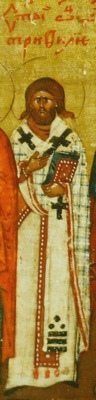
Triphyllius is painted as a hierarch: standing or bust-length, in phelonion — often the cross-patterned polystavrion — with the omophorion over the shoulders, the right hand raised in blessing and the jewelled Gospel book held in the left, covered by the mantle. He is shown in middle age or older, with a short dark or greying beard, and carries no attribute peculiar to himself; in Cypriot churches he appears among the local hierarchs of the island, and in the Russian menologia he takes his place in the June row. Where the two Cypriots are painted together, Spyridon is unmistakable in his shepherd's wicker cap and Triphyllius stands beside him bare-headed, the pupil beside the master.
The stored image is a detail from an early-17th-century Russian menaion icon for the month of June (Church-Archaeological Cabinet of the Moscow Theological Academy), in which each day's saints are ranged in registers across the panel. The figure is inscribed in Slavonic across the gold ground — the second line reads plainly трифилïи — and shows exactly the hierarch type described above: the polystavrion phelonion patterned with dark crosses, the crossed omophorion, the hand raised in blessing and the Gospel held at the breast. The inscription was enlarged and read before the image was stored, so the identification does not rest on the file's caption alone.
A second Commons candidate captioned simply "Saint Triphyllius" was rejected: it is of undetermined date, sourced from a private devotional website, and the uploader's public-domain claim rests on the assertion that "icons are copies of copies, they are not original art" — which is not a licence. If the underlying panel is a modern Cypriot icon, as its appearance suggests, the painter's rights are untouched by any uploader's declaration, and the image is not storable.
Disputed questions
- The name of the see. Ledra, Ledroi, Leucosia, Nicosia are one place at four stages of its name; there is no second bishopric involved. Jerome's Latin Ledrae and the Greek synaxarion's Λευκωσία are the two forms most often met, and the Greek books of the day print both.
- Which emperor. The healing is placed by Sozomen under Constantius II (337–361); some English lives render the name "Constantine II," which is a slip — Constantine II died in 340 and was never the emperor of Antioch and the East. The chronology of Spyridon (†348) requires the episode to fall in the 340s, which fits Constantius and excludes any later Constantine.
- His writings. Jerome is the only witness to the commentary on the Song of Songs and to the other works, and nothing of them is preserved; the judgement "most eloquent of his age" is Jerome's own and cannot now be tested. The synaxarion tradition, characteristically, remembers not his books but the sermon in which his eloquence was corrected.
- Not to be confused with the Martyr Tryphon (February 1) or with Triphyllius as a name occasionally attached elsewhere in the calendars; nor with the several Cypriot bishop-saints of the fourth century commemorated on other days.