
Arcadius of Novotorzhok
Our Venerable Father Arcadius of Vyazma and Novy Torg, fool-for-Christ and disciple of Saint Ephraim
Venerable · Fool for Christ · b. at Vyazma, early 11th century — d. 13 December 1077 (year uncertain), at Novy Torg
Commemorated 11 June — Uncovering of the relics, 1572, 11 July — Translation of the relics into the cathedral of Saints Boris and Gleb at Torzhok, 1677, 14 August — Reposition of the relics in the tomb of Saint Ephraim, 1798, 13 December — Repose at Novy Torg
Arcadius (†13 December 1077) was a young man of Vyazma who left his home to follow the Hungarian nobleman Ephraim, founder of the monastery of Saints Boris and Gleb at Novy Torg (Torzhok) on the upper Tvertsa. Before his tonsure he lived as a fool-for-Christ, begging his bread and sleeping in the forest or on a church porch; after it he was known for an obedience to his elder so complete that the Russian tradition holds it up as the pattern of the thing, and for silence, fasting and unbroken attendance at the services. He outlived Ephraim by nearly a quarter of a century. His relics were found in 1572 and enshrined in 1677, and he is kept with Ephraim as one of the two patrons of Torzhok and among the saints of Tver and Smolensk.

Vyazma and the coming to Novy Torg
Arcadius was born at Vyazma, in what is now Smolensk province, of pious and — the Life says — simple parents, in the first decades of the eleventh century, the generation after the baptism of the Rus. He was drawn from boyhood to prayer and to the church, and he left home still young, going north-east through the forests until he came to Novy Torg, "the new trading-place," on the Tvertsa at the head of the portage road between the Volga and Novgorod.
There he found the man who would shape him. Ephraim, a Hungarian by birth and formerly a groom in the service of the Rostov prince, had come to Novy Torg after the murder of his brother George with the passion-bearer Boris on the Alta in 1015 — George's head, which the murderers had struck off for the golden chain on his neck, Ephraim kept by him all his life and had buried with him. Ephraim built a wayfarers' hospice by the river and then, about 1038, the church and monastery of the passion-bearers Boris and Gleb, the first house of the Russian north to bear their name.
Fool-for-Christ, and then monk
Before he entered the monastery Arcadius lived in the town in folly for Christ's sake. The Life describes it in the terms the Russian tradition would use of Procopius of Ustyug and Basil of Moscow two and three centuries later: he owned nothing, took his food from those who would give it, spoke little and strangely, and slept where the night found him — in the forest outside the town, or on the open porch of the church, through the winters of the upper Volga. Ephraim knew what he was looking at and took him in.
Once tonsured, Arcadius turned the same absoluteness on the monastic road. What the sources single out is not a feat of asceticism but his obedience: he did nothing without his spiritual father's word, and the tradition preserves him as the model of a disciple. With that went the three marks the Russian Lives give to the quiet monastic saints — prayer, fasting and silence — and a devotion to the divine services in which, the Life says, he was never absent from the church and never late.
Ephraim reposed on 28 January 1053, having charged Arcadius with the keeping of the house he had founded. Arcadius lived on in the monastery "according to the last will of his elder" for another twenty-four years and died on 13 December 1077.
Relics and translations
His grave was in the monastery church. On 11 June 1572 — the date is that of the uncovering — the relics were found; the Russian accounts connect the finding with the deliverance of Torzhok in a time of plague. On 11 July 1677 they were solemnly translated into a stone crypt in the cathedral of Saints Boris and Gleb at Torzhok, and it is this translation that gives the saint his July commemoration and his place on this day in the Russian and OCA calendars. In 1798 the relics were laid in the stone tomb that had held those of Saint Ephraim, and that reposition is kept on August 14. The Boris and Gleb monastery at Torzhok — rebuilt in the classical style at the end of the eighteenth century by Nikolai Lvov, and one of the oldest monastic foundations in Russia — was closed under the Soviet regime and has been returned to the Church.
Feast and commemoration
July 11 (church date; Old Calendar civil July 24) is the translation of his relics into the cathedral of Saints Boris and Gleb at Torzhok in 1677, and is the day on which the Russian and OCA calendars most prominently list him; his principal feast, the day of his repose, is December 13, and the uncovering of the relics is kept on June 11 and their reposition on August 14. The commemoration is Russian: neither the Greek books nor Antiochian usage carry him. At Torzhok and Vyazma he is a local patron, and he is always named with Ephraim of Novotorzhok, with whom he is painted and to whose monastery both belong.
Hymns
Apolytikion — Tone 8 (common of a venerable father)
In thee, O father, was the divine image preserved with exactness; for taking up the cross thou didst follow Christ, and by thy deeds thou didst teach us to overlook the flesh, for it passeth away, but to care for the soul, which is a thing immortal. Wherefore, O venerable Arcadius, thy spirit rejoiceth with the angels.
Iconography
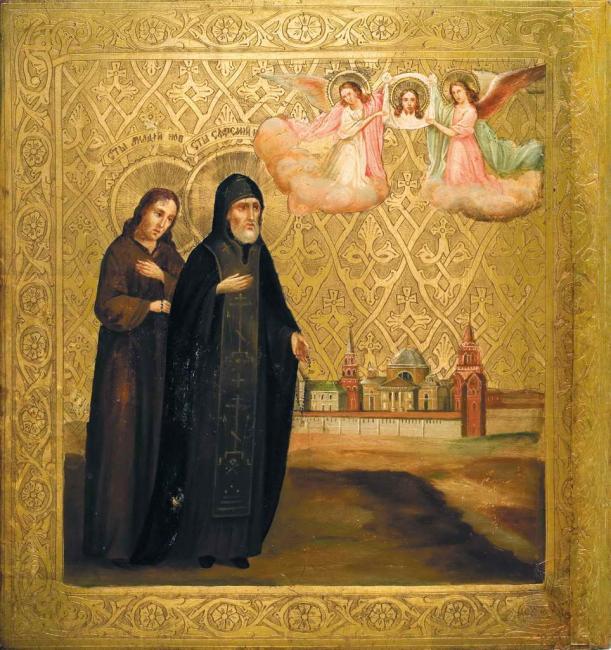
Arcadius is almost never painted alone. The standing Russian composition sets him beside his elder Ephraim: Ephraim the taller and older figure in the black mandyas and schema, with a long grey beard, and Arcadius at his left — younger, beardless or with the faintest down, in a plain dark monastic rason with the hands folded on the breast or one hand at the heart — and behind the two of them, in the middle distance, the walls, gates and domes of the Boris and Gleb monastery at Torzhok, which is the reason the pair are painted at all. The Saviour, or an angelic pair bearing the Mandylion, blesses from a cloud above. His youth and his bare head are his marks: they carry the memory of the years of folly for Christ, which the icon does not otherwise show.
The stored image is a Russian panel of the middle-to-later nineteenth century, oil and gold leaf on wood with an engraved gold ground, from the icon-collection of pravicon.com by way of Wikimedia Commons, and follows this composition exactly, the monastery of Torzhok standing at the right and two angels holding the image of Christ above. Arcadius is the younger figure at the left; the identification rests on the panel's inscriptions and its title of record, and on the monastery in the background, and not on any attribute peculiar to him. An inscribed earlier panel, or the seventeenth-century shrine-cover image from Torzhok, would be a better witness and is wanted in its place.
Disputed questions
- The dates. The year of his repose, 1077, and the day, 13 December, are transmitted by the Russian Lives; neither is documented from the eleventh century, and the whole Ephraim cycle is known only from a Life composed centuries after the events. The dating is received, not established.
- The uncovering of the relics. The commemorations for June 11 (uncovering, 1572) and July 11 (translation into the cathedral, 1677) are given differently by different Russian calendars, some of which attach the "finding and translation" jointly to July 11 and the year 1677. Both are recorded here as transmitted.
- The number of his feasts. Four dates are kept in Russian usage — 13 December, 11 June, 11 July and 14 August — and different calendars carry different subsets of them. He also falls within the Synaxis of the Saints of Tver and the Synaxis of the Saints of Smolensk, both movable.
- Not to be confused with Arcadius of Cyprus, the bishop, nor with the martyr Arcadius of Mauretania; and note that the epithets Vyazemsky (from his birthplace) and Novotorzhsky (from Novy Torg) belong to one and the same saint, though Vyazma and Torzhok are two hundred miles apart and both towns claim him.