
Boris and Gleb
The Holy Noble Passion-Bearers Boris and Gleb, Princes of Rus', named Roman and David in Holy Baptism
Passion Bearer · Prince · b. Boris c. 986–990; Gleb somewhat later, both sons of Vladimir of Kiev — d. 1015 (Boris on 24 July at the Alta; Gleb on 5 September at the Smyadyn)
Commemorated 2 May — The translations of the relics at Vyshgorod, 1072 and 1115, 24 July — The murder of Boris at the Alta (1015); the joint commemoration of both brothers, 5 September — The murder of Gleb at the Smyadyn near Smolensk (1015)
Boris and Gleb, sons of Vladimir the Baptizer of Rus' and named Roman and David at the font, were killed in the succession war of 1015 on the orders — so the tradition holds — of their elder brother Svyatopolk, and are honoured as the first canonised saints of the Christian Rus'. Neither died confessing Christ before pagans: both refused to lift a hand against an elder brother and accepted an unjust death in the meekness of the Lord, and for this the Slavic Church gave them a title of its own — passion-bearers (strastoterptsy). Their bodies were gathered at Vyshgorod beside the church of St Basil, where miracles began at once; the translations of their relics into new churches in 1072 and 1115 are kept on May 2, and their murder on July 24. Around them grew the earliest cycle of Russian hagiography — the Chronicle tale, the anonymous Tale and Passion and Encomium, and Nestor's Lesson — and with it the ideal of the innocent, non-resisting prince that shaped the sanctity of Rus' for six centuries.
.jpg)
Origins and early life
Boris and Gleb were among the younger sons of Vladimir Svyatoslavich, Grand Prince of Kiev, who received baptism for himself and his people about 988. They were therefore born into a house that was Christian only in its first generation, and were, in the words of the tradition, "the good fruit of an evil root" — children of the polygamous prince of the old religion who had become the apostle of the new. At baptism Boris was given the name Roman, and Gleb the name David; the hymnography and the liturgical books commonly address them by these baptismal names, and the pairing "Roman and David" in a service book or an icon inscription always means these two brothers.
Vladimir set his sons over the towns of his realm. Boris received Rostov, in the north-eastern forests, and Gleb received Murom on the Oka. Both are remembered as educated in the Scriptures and given to almsgiving and to the reading of the lives of the saints; the Tale says that Boris read the passions and martyrdoms of the holy martyrs and prayed with tears that God would grant him to suffer as they had — a prayer the hagiographer sets at the head of his narrative because it was so terribly answered. Boris was the father's favourite, and in his last years Vladimir kept him near him at Kiev; it was Boris whom the aged prince sent out with the household army against the Pechenegs in the summer of 1015.
The murder of Boris
Vladimir died on 15 July 1015 at Berestovo, near Kiev. His eldest surviving son, Svyatopolk — reckoned in the Chronicle a son "of two fathers," born of the Greek widow of Vladimir's brother Yaropolk and so of doubtful legitimacy — was at hand, and seized the city, distributing gifts to the men of Kiev to buy their allegiance. Boris was on the river Alta near Pereyaslavl with the army, having found no Pechenegs to fight, when messengers brought him word that his father was dead and that his brother held Kiev.
His retinue, the druzhina of Vladimir himself, urged him to march on the capital: the army was his, the city would open to him. Boris refused. "I will not lift my hand against my elder brother," he answered; "let him be to me in the place of a father." The soldiers left him and went over to Svyatopolk; Boris remained in his tent with a few servants, having been warned that men were coming to kill him. He spent the night in prayer, sang the office of matins and the psalter, read the passion of Christ and the passions of the martyrs, wept for his father and for his brother's soul, and prayed before an icon of Christ that he might be granted to suffer without hatred.
At dawn the men sent from Vyshgorod — Putsha and the boyars Talets, Elovit and Lyashko — came upon the tent and thrust their spears through its walls. A young Hungarian servant, George Ugrin, threw himself upon his master's body and was killed with him; the murderers cut off his head to get at the golden torque Boris had given him. Boris, still breathing, was carried out wrapped in the tent-cloth and set in a cart, and two Varangians whom Svyatopolk sent to make an end ran him through the heart. It was 24 July 1015. His body was brought secretly to Vyshgorod, the fortified town above Kiev, and buried by the wall of the wooden church of St Basil the Great — the church of Vladimir's own patron.
The murder of Gleb
Gleb was at Murom, far away, and knew nothing. Svyatopolk sent him a lying message that their father was ill and called for him. Gleb rode out with a small company; on the way, near Smolensk, a warning from his brother Yaroslav at Novgorod overtook him — their father was dead and Boris murdered. He wept aloud for both, and would neither turn back nor arm himself. At the mouth of the little river Smyadyn, where his boat lay off Smolensk, the men sent by Svyatopolk under Goryaser came alongside. Gleb greeted them, and asked only to be spared for his youth; then, seeing they were resolved, he prayed for his murderers and for his brother. His own cook, a Torkin (a man of the Turkic Torks) named in the sources Torchin, cut his throat with the kitchen knife. It was 5 September 1015. His body was left in the wilderness between two hollowed logs; hunters and passers-by afterwards saw a pillar of light and burning candles over the place, and heard singing, and so it was found. Yaroslav, when he had taken Kiev, had the relics brought to Vyshgorod and laid beside those of Boris.
A third brother, Svyatoslav of the Drevlyane, was hunted down and killed in the same season; he is not numbered among the passion-bearers, the Church having glorified those two whose deaths the sources describe as freely and consciously accepted.
The war that followed lasted four years. Yaroslav, later called the Wise, broke Svyatopolk at Lyubech (1016), lost Kiev to him again when he returned with Polish help (1018), and destroyed him at last on the Alta in 1019 — the Chronicle notes with awe that the field was the very place of Boris's murder. Svyatopolk fled westward and died, the Chronicle says, "in a waste place between the Poles and the Czechs"; the chronicler compares him to Cain and to Lamech, and the epithet he bears in Russian memory is Okayanny, "the Accursed."
Relics and translations
The tomb at Vyshgorod became the first great shrine of Rus'. Healings began — the lame and the blind, a woman with a withered hand, a man delivered in prison — and were gathered into a written Account of the Miracles that grew by stages through the eleventh century and into the twelfth. Yaroslav built a five-domed church over the graves, consecrated on 24 July 1026, into which Metropolitan John I of Kiev solemnly received the relics; a special chapel afterwards housed them. The rebuilt church became the family sanctuary of the Yaroslavichi, a standing monument to the brotherly love their uncles had died for, and the tradition dates the first keeping of a May 2 commemoration of the transfer to 1069, on Izyaslav's return to Kiev.
In 1072 the three sons of Yaroslav — Izyaslav, then Grand Prince, with Svyatoslav and Vsevolod — together with Metropolitan George of Kiev translated the relics into their new shrine; the Chronicle dates this translation to 20 May. Their descendants then vied piously in adorning the tombs, and Oleg Svyatoslavich built a great stone church at Vyshgorod, finished in 1111. On 2 May 1115, the Sunday of the Myrrhbearing Women, the relics were carried into it in the most solemn of the translations — "all the hierarchs, igumens, monks and priests came, filling the whole town," Vladimir Monomakh accompanying Boris with the metropolitan while David Svyatoslavich and the bishops bore Gleb. It is to this translation, and to the commemoration begun in 1069, that the feast of May 2 is referred.
The shrine was among the wealthiest in Rus', and princes came to it before campaigns. The relics disappeared in the catastrophe of the Mongol sack of 1240, and their fate is unknown; the church was destroyed. Portions had already travelled: particles are recorded as given in 1095 to the Slavonic-rite monastery of Sázava in Bohemia — the same house through which the cult of Wenceslaus of Bohemia had passed into Rus' — and set in one of its altars.
Veneration and later cultus
Veneration was immediate and, unusually, popular before it was official. Metropolitan John I of Kiev (c. 1008–1035), a Greek, is credited with composing the first service to them. The Account of the Miracles preserves the memory that a later Greek metropolitan — George, the same who presided at the 1072 translation — was at first "not firm in faith" toward these new and unmartyred saints, and was convinced only by the incorrupt bodies and the cures: a rare and candid record of Byzantine hesitation before a category of sanctity the Slavs had produced for themselves.
Once accepted, the two brothers became the household saints of the princely house and then of the whole land. Churches and monasteries called Borisoglebsky were founded from Kiev to Rostov, Turov, Chernigov, Novgorod, Smolensk and Moscow — several of them appear elsewhere in this collection as the houses of later saints, among them the Borisoglebsky monastery near Rostov of Irenarchus of Rostov, the monastery of Saints Boris and Gleb at Turov where Cyril of Turov was tonsured, the cathedral of Saints Boris and Gleb at Chernigov, and the Moscow church of the two princes where Maximus of Moscow was buried. They were invoked as defenders of the land in war: the vision granted before the battle of the Neva in 1240, in which the two passion-bearers were seen going to the help of their kinsman, belongs to the tradition of Alexander Nevsky, and later princes claimed their aid against the Horde.
The ideal of non-resistance
The theological interest of Boris and Gleb lies in what they were not. They were not put to death for confessing Christ before idolaters; they were killed in a dynastic murder, and the Church honoured them for the manner of their dying. The Slavic term coined or fixed for them, strastoterpets — "passion-bearer," one who bears the passion — names an imitation of Christ's own voluntary and unresisting suffering: the innocent victim who will not defend himself, who forgives his killer, and who refuses to purchase his life by shedding a brother's blood. The hagiographers grasped the novelty and reached for the one precedent they knew, the murdered Czech prince Wenceslaus, whom the Lives name explicitly as the pattern.
Two consequences followed for the culture of Rus'. First, a political theology: the sanctity of seniority and the sinfulness of fratricidal war, preached over the graves of its victims in a land whose princes would spend three centuries in exactly such wars. Second, a permanent type of holiness: the line of the passion-bearers runs from Boris and Gleb through Michael and Theodore of Chernigov and the murdered princes of the appanage age down to the last imperial family. The type also has a western cousin in Edward the Martyr of England, killed in the same generation and for the same kind of reason.
Hagiographic and literary legacy
Three eleventh- and early twelfth-century works make up what Russian scholarship calls the Borisoglebsky cycle, and together they are the beginning of literature in Rus':
- The Chronicle tale — the narrative under the year 1015 in the Russian Primary Chronicle, the Tale of Bygone Years, sober, dated, and heavy with biblical parallel.
- The anonymous Tale, Passion and Encomium of the Holy Martyrs Boris and Gleb (Skazanie i strastoterpchestvo i pokhvala), the fullest and most moving account, rich in the brothers' interior monologues and prayers, and traditionally attributed to a monk Jacob (Iakov Chernorizets); to it is appended the Account of the Miracles, compiled in layers and carried down to the translation of 1115.
- Nestor's Lesson on the Life and Murder of the Blessed Passion-Bearers Boris and Gleb (Chtenie), by Nestor the Chronicler of the Kiev Caves, written in the 1080s in a more rhetorical, Byzantine-monastic manner, and occasioned by the translation of 1072.
To these should be added the liturgical office, the paremii (Old Testament readings proper to their feasts — themselves a rarity for non-biblical saints), and a great body of later sermons and encomia.
Feast and commemoration
The principal feast is July 24 (Old Calendar civil August 6), the day of Boris's murder, on which both brothers are commemorated together. May 2 (Old Calendar civil May 15) keeps the translations of their relics at Vyshgorod in 1072 and 1115, and has its own proper service in the Russian books; on the same day the Church commemorates the repose and the translation of the relics of Athanasius the Great, so that the Slavic menaion for May 2 joins the great Alexandrian hierarch to the two young princes of Rus'. September 5 (Old Calendar civil September 18) is the day of Gleb's murder and his particular commemoration. Neither the July 24 nor the September 5 commemoration has yet been written up in this collection; both belong to this entry when they are.
They are kept by the Russian, Ukrainian and Belarusian Churches and by the Orthodox Church in America, and are named in the synaxis of All Saints of Rus'; the Greek calendars, which received the cult late and thinly, generally do not carry them. In the Latin West the two were entered in the Roman martyrology and confirmed by Benedict XIII in 1724, chiefly for the Uniate churches of the Ruthenian lands.
Hymns
Troparion — Tone 2
O true passion-bearers and faithful hearers of the Gospel of Christ, chaste Roman with the most blessed David: ye did not withstand the brother who set himself against you when he slew your bodies, yet had no power to touch your souls. Let the wicked lover of power therefore mourn, while ye rejoice with the angelic choirs; and standing before the Holy Trinity, pray for the sovereign kinsmen of your race, that they may be well-pleasing to God, and for the sons of Rus', that they may be saved.
Original translation from the Slavonic
Kontakion — Tone 3
Today hath your most glorious memory shone forth, O noble passion-bearers of Christ, Roman and David, and it calleth us together to the praise of Christ our God. Therefore, running to the shrine of your relics, we receive the gift of healing by your prayers, O holy ones; for ye are physicians indeed.
Original translation from the Slavonic
Magnification
We magnify you, O holy passion-bearers Boris and Gleb, who loved your brother more than your own life.
Appointed readings
Epistle — Romans 8:28–39
28And we know that all things work together for good to them that love God, to them who are the called according to his purpose. 29For whom he did foreknow, he also did predestinate to be conformed to the image of his Son, that he might be the firstborn among many brethren. 30Moreover whom he did predestinate, them he also called: and whom he called, them he also justified: and whom he justified, them he also glorified. 31What shall we then say to these things? If God be for us, who can be against us? 32He that spared not his own Son, but delivered him up for us all, how shall he not with him also freely give us all things? 33Who shall lay any thing to the charge of God’s elect? It is God that justifieth. 34Who is he that condemneth? It is Christ that died, yea rather, that is risen again, who is even at the right hand of God, who also maketh intercession for us. 35Who shall separate us from the love of Christ? shall tribulation, or distress, or persecution, or famine, or nakedness, or peril, or sword? 36As it is written, For thy sake we are killed all the day long; we are accounted as sheep for the slaughter. 37Nay, in all these things we are more than conquerors through him that loved us. 38For I am persuaded, that neither death, nor life, nor angels, nor principalities, nor powers, nor things present, nor things to come, 39Nor height, nor depth, nor any other creature, shall be able to separate us from the love of God, which is in Christ Jesus our Lord.
Gospel — John 15:17–16:2
17These things I command you, that ye love one another. 18If the world hate you, ye know that it hated me before it hated you. 19If ye were of the world, the world would love his own: but because ye are not of the world, but I have chosen you out of the world, therefore the world hateth you. 20Remember the word that I said unto you, The servant is not greater than his lord. If they have persecuted me, they will also persecute you; if they have kept my saying, they will keep yours also. 21But all these things will they do unto you for my name’s sake, because they know not him that sent me. 22If I had not come and spoken unto them, they had not had sin: but now they have no cloke for their sin. 23He that hateth me hateth my Father also. 24If I had not done among them the works which none other man did, they had not had sin: but now have they both seen and hated both me and my Father. 25But this cometh to pass, that the word might be fulfilled that is written in their law, They hated me without a cause. 26But when the Comforter is come, whom I will send unto you from the Father, even the Spirit of truth, which proceedeth from the Father, he shall testify of me: 27And ye also shall bear witness, because ye have been with me from the beginning. 1These things have I spoken unto you, that ye should not be offended. 2They shall put you out of the synagogues: yea, the time cometh, that whosoever killeth you will think that he doeth God service.
Iconography
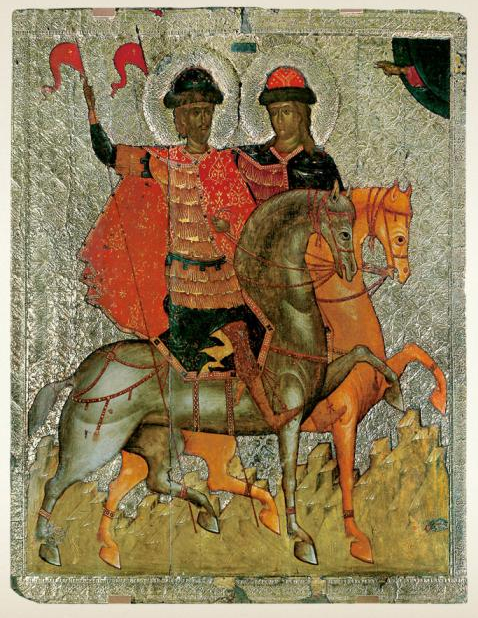
Boris and Gleb are almost never painted apart. The standard type shows the two brothers standing frontally side by side in princely dress: the fur-trimmed cap, the long korzno or mantle fastened at the right shoulder, boots of coloured leather; each holds a sword sheathed and held downward or across the body — the sword of lawful princely authority, deliberately not drawn — and in the other hand the cross of the martyr-confessor. Boris is the elder, dark-haired and bearded; Gleb the younger, beardless, with the loose hair of a youth. A second and specifically Russian type sets them on horseback, riding side by side, sometimes with a red banner, as heavenly defenders of the land — the form in which they appear in visions before battle. In narrative cycles the tent at the Alta, the boat at the Smyadyn, the two logs in the wilderness with the pillar of light, and the translation procession at Vyshgorod are all shown.
The stored image is the equestrian type from Novgorod, about 1377: Boris in front on the grey horse, bearded and in a dark cap, holding the red banner aloft; Gleb behind on the chestnut, youthful and in a red cap; both haloed against a silver ground, riding out over the rocks.
Disputed questions
- Their baptismal names. Boris was baptised Roman and Gleb David. The pairing is occasionally printed the other way round in popular reference works; the Chronicle, the Tale, the synaxaria and the proper hymnography agree in the order given here, and the troparion's sequence — "Roman with the most-blessed David" — follows the order of the brothers' deaths.
- Their mother. The Chronicle's list of Vladimir's sons assigns Boris and Gleb to a "Bulgarian" wife; a persistent later tradition, flattering to the dynasty, makes them sons of Anna the Porphyrogenita, Vladimir's Byzantine bride. The chronology is strained and most historians keep to the Chronicle.
- Who killed them. The Rus' sources are unanimous for Svyatopolk. The Norse Eymundar saga, however, has Varangians in the service of Yaroslav kill a prince "Burizleif," and Thietmar of Merseburg's account of the succession does not fit the Chronicle neatly; on this basis a minority of historians — the argument is associated in the twentieth century with N. de Baumgarten and later with a Soviet revisionist school — have proposed Yaroslav as the author of at least one of the murders. Others take "Burizleif" in the saga for the Polish ruler Bolesław. The question cannot be closed on the surviving evidence; the Church venerates the innocence of the victims, which no version of the succession war disturbs.
- The priority of the texts. Which came first, the anonymous Tale or Nestor's Lesson, is the classic problem of the cycle. A. A. Shakhmatov and his school argued for the priority of Nestor's Lesson; S. A. Bugoslavsky, and after him Ludolf Müller and much recent work, for the priority of the Tale, with Nestor reworking it. No consensus exists, and the dating of the layers of the Account of the Miracles is bound up with the same problem.
- Martyrs or passion-bearers. The service books and older synaxaria often style them simply "holy martyrs," and the Tale's own title does so. The precise Slavic classification, strastoterptsy, is the one adopted here, and the entry keeps both usages in view — as with Wenceslaus and Edward, the settled popular title is "martyr" while the type of the death is that of the passion-bearer.
- The dates of the translations. The Tale of Bygone Years places the 1072 translation on 20 May, while the great translation of 1115 fell on 2 May; a commemoration of the transfer on May 2 is already recorded for 1069, and the feast as kept today gathers all of these. Some Slavic books also note May 3, and the Vyshgorod church kept a local feast of its dedication on July 24. The divergence is one of dating within the sources, not of rival feasts.
- Not to be confused — as regards Gleb — with Gleb of Vladimir (†1174, June 20), the young son of Andrew Bogolyubsky, who was named after this passion-bearer and who is honoured not for a violent death but for a life of fasting and vigil begun at twelve years old, and for incorrupt relics preserved through the burning of the Dormition cathedral in 1238.