
Arsenius of Tver
Our Father among the Saints Arsenius, Bishop of Tver
Bishop · b. mid-14th century, at Tver — d. 1409, at the Zheltikov Monastery near Tver
Commemorated 2 March — Repose at the Zheltikov Monastery, 2 July — Uncovering of his relics (1483)
Arsenius (†1409) was Bishop of Tver and the founder of the Zheltikov Monastery of the Dormition on the river Tmaka near that city. Born at Tver, he was tonsured young in the Kiev Caves Monastery, and rose to be archdeacon to Metropolitan Cyprian of Kiev and Moscow, whose administration he helped govern. In 1390, over his own reluctance, he was consecrated bishop of Tver, a see torn by the feuds of its princes; there he laboured as a peacemaker, built churches and his monastery, and had copied for its monks the great manuscript collection later known as the Arsenian redaction of the Kiev Caves Paterikon. He reposed in 1409; his incorrupt relics were uncovered in 1483, and he was canonised by the Moscow Council of 1547. He is commemorated on March 2.
.jpg)
Origins and the Kiev Caves
Arsenius was born about the middle of the fourteenth century at Tver, one of the great principalities of the Russian land in the age of its subjection to the Horde and its long rivalry with rising Moscow. In his youth he went south to Kiev and received the monastic tonsure in the Monastery of the Caves, the mother-house of Russian monasticism. Even among the monks of that ancient and strict community he was marked out — the tradition says — for the holiness of his life and the rigour of his observance, and he gave himself to the study of the Scriptures and of the Church's liturgical order, in which he became deeply learned.
Archdeacon to Metropolitan Cyprian
His gifts drew him into the service of Cyprian, the learned Bulgarian-born hierarch who held the metropolitanate of the Russian Church in these years. Arsenius became Cyprian's archdeacon and a trusted administrator: when the metropolitan was absent, it is recorded, Arsenius was left to govern the affairs of the metropolitan see. When Cyprian was at last established as Metropolitan of Moscow and all Russia (from 1381, and securely from 1390), Arsenius continued at his side.
Bishop of Tver
The see of Tver in these years was troubled — its bishop Euthymius at bitter odds with the prince and the clergy, the church of the principality divided. In 1390 Cyprian went to Tver to hold a council on the matter; Euthymius was deposed, and the metropolitan resolved to set Arsenius in his place. Arsenius, the accounts say, shrank from the burden and refused, fearing the strife of the place; only when Cyprian pressed him — threatening ecclesiastical suspension — did he yield. He was consecrated bishop of Tver in the summer of 1390, with Stephen of Perm, the apostle of the Zyrians, among the consecrating hierarchs.
As bishop he proved what his hesitation had not foretold: a reconciler. He laboured to still the feuds of the Tver princes and to restore peace to the church and the land, and he adorned his see with building — churches, and above all his monastery. On the river Tmaka, a little way from Tver, he founded the Zheltikov Monastery, dedicating its cathedral to the Dormition of the Mother of God, and shaping it after the pattern of the Kiev Caves he had loved in his youth; there, it is said, he prepared his own tomb. For the instruction of its monks he had copied out a great body of the old writings of the Caves — the Kiev Caves Paterikon in the recension that bears his name, the Arsenian redaction, one of the treasures of early Russian letters.
Repose, relics, and glorification
Arsenius reposed on March 2, 1409, and was buried in his Zheltikov Monastery. In 1483 his relics were uncovered incorrupt and translated into the cathedral church; in that same year the hieromonk Theodosius composed his Life and his liturgical office (canon). The Council of Moscow in 1547, which set in order the veneration of the Russian saints, numbered Arsenius of Tver among those to be honoured throughout the Russian Church. He has remained one of the principal saints of the Tver land, venerated as its holy hierarch and the father of its monastic life.
Feast and commemoration
Arsenius is kept on March 2 (church date; Old Calendar civil March 15), the day of his repose — a commemoration proper to the Russian Church. A second feast on July 2 (Old Calendar civil July 15) keeps the uncovering of his relics in 1483. He is also numbered among the assemblies of the Saints of Tver and the Saints of the Kiev Caves (the Near Caves), commemorated on their synaxis-days. March 2 falls within Great Lent; his memory is observed with the Lenten office, and where the rank of the feast allows, his proper hymns are sung.
Not to be confused with the several other saints named Arsenius: Arsenius the Great (†c. 445, May 8), the Roman senator turned Egyptian desert father; Arsenius of Corfu (†c. 953, January 19), the first archbishop of Kerkyra; and Arsenios of Paros (†1877, January 31), the nineteenth-century Greek elder. This Arsenius is the bishop of Tver, the Russian hierarch of the early fifteenth century.
Hymns
Troparion — Tone 4
A rule of faith and an image of gentleness, a teacher of self-restraint, the truth of thy deeds revealed thee to thy flock; and so by lowliness thou didst gain the things on high, and by poverty, riches. O Father and Hierarch Arsenius, intercede with Christ our God that our souls may be saved.
Original translation from the Greek
Iconography
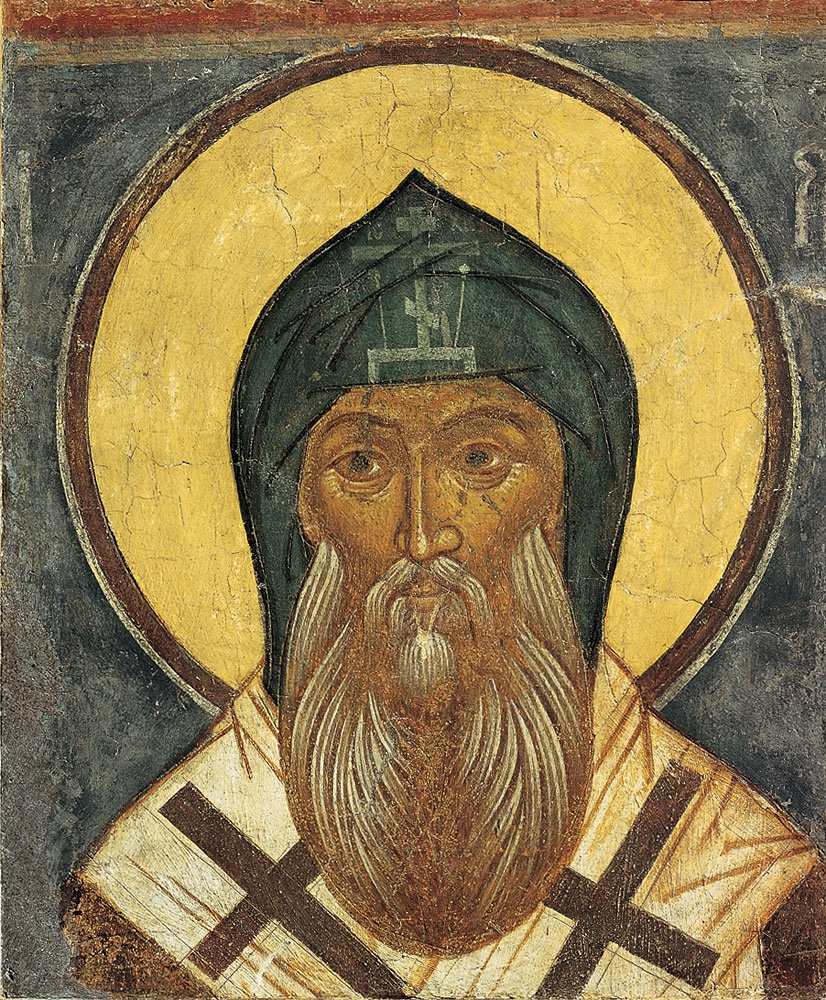
Arsenius is depicted as a Russian hierarch of venerable age: grey-bearded, vested in the sakkos or phelonion and omophorion and often the mitre, blessing with his right hand and holding the Gospel-book in his left; a scroll or a model of his Zheltikov Monastery may identify him. The stored image is a fresco of 1654 from the Trinity Cathedral of the Makariev Kalyazin Monastery, showing the saint at half-length in episcopal vesture — an identity-verified public-domain reproduction from the collection of the State Russian Museum (source, public domain, pd-old-work).