
Arsenius the Great
Our Venerable and God-bearing Father Arsenius the Great, of Scetis
Venerable · Deacon · b. c. 354, at Rome — d. c. 449–450, at Troe in Egypt
Commemorated 8 May — Repose at Troe near Memphis
Arsenius the Great (c. 354 – c. 449/450) was a Roman of senatorial rank, a deacon of the Church of Rome and tutor to the sons of the emperor Theodosius, who left the imperial palace of Constantinople in secret to become a monk of the Egyptian desert and there grew into one of the supreme figures of early monasticism. In Scetis he placed himself under John the Dwarf, lived fifty-five years in silence, tears, and unbroken vigil, and left the Apophthegmata Patrum its longest and best-known block of sayings, opening with the word he had received in prayer: "Arsenius, flee, be silent, be still." Driven from Scetis by barbarian raids, he ended his days at Troe near Memphis, nearly a hundred years old, and was already called "the Great" in his own century. His feast is May 8.

Origins and the imperial palace
Arsenius was born at Rome about the year 354, of a Christian family of the senatorial class, and received the full education of a Roman aristocrat: grammar, rhetoric, philosophy, and fluency in both Latin and Greek — a learning that the tradition never lets the reader forget, because Arsenius himself would later set it at nothing. He was ordained deacon of the Roman church, and it is said that he had already begun to withdraw from the ambitions natural to his rank when he was drawn, against his will, into the greatest of them.
The emperor Theodosius I, seeking for his sons a tutor of learning and piety from the old capital, applied to Rome; and Pope Damasus — or, in other lines of the tradition, his successor Siricius — pressed the reluctant deacon to accept. About the year 383 Arsenius came to Constantinople and was made paidagogos to the young Arcadius and Honorius, the future emperors of East and West. The tradition preserves the emperor's charge to him — that he was to teach the boys as a father, and to forget that they were the sons of an emperor — and it preserves also the honour in which he was held at court: he lived in the palace, was granted the state and household of a great officer, and was reckoned among the first men of the empire. The synaxaria say he passed some forty years in the world before he fled it, of which about eleven were spent in the palace.
The Church's memory of these years turns on a single scene, and on Arsenius's own shame at it. Coming in one day to teach, he found Arcadius seated while he, the teacher, stood; and he took it as a sign of the disorder of the whole arrangement — "the son of an emperor sits, and the servant of God stands" — and from that hour the thought of flight would not leave him. Standing at prayer, he begged, "Lord, lead me in the way of salvation," and heard the answer: "Arsenius, flee from men, and thou shalt be saved."
Flight to Scetis
He obeyed at once and secretly. Laying aside the dress of his office, he took ship for Alexandria, and went out from the city into Scetis — the wilderness of salt flats and rock south-west of the Nile delta, then in its first and greatest generation, the nursery of the monastic ideal. He was about forty years old, and came, in the phrase of the fathers, "with nothing that he had been."
At Scetis he asked to be received by Abba John the Dwarf (Kolobos). The elder, knowing what manner of man had come to him, set out to break the Roman's habit of honour: he sat the brethren down to eat and left Arsenius standing, without a word, and at last threw him a piece of dry bread on the ground, as one throws food to a dog. Arsenius went down on his hands and knees and ate it where it lay. Then John said to the brethren, "He will be a monk." He was clothed in the habit, and the tradition dates from this moment the beginning of the fifty-five years he would spend in the desert.
Once more he prayed to be shown how to be saved, and the second word came, which became the rule of his whole life and one of the most quoted sentences in Christian asceticism: "Arsenius, flee, be silent, be still" — φεῦγε, σιώπα, ἡσύχαζε — flight, silence, stillness, "for these are the roots of sinlessness."
The ascetic struggle
Arsenius kept that word with a severity that astonished even the desert. He lived alone at a distance from the other cells, came to the church only on Saturdays and Sundays, and answered visitors little or not at all; when Abba Mark asked him why he fled from them, he said, "God knows that I love you; but I cannot be with God and with men. The thousands and ten thousands above have but one will, and men have many wills; so I cannot leave God and be with men." He would sit at his weaving with a cloth over his knees, hiding even the labour of his hands; the fathers said he had a hollow worn in his breast by the falling of his tears, and that he wept so much in the memory of his sins and the fear of judgment that his eyelashes were gone. His craft was the common one of Scetis, the plaiting of baskets and mats from palm-leaf; and he was famous for never changing the water in which the leaves were steeped, so that his cell stank of it — because, he said, in the world he had had incense and sweet oils, and it was right that he should now have this instead.
Of sleep he allowed himself almost nothing: "One hour's sleep is enough for a monk, if he is a fighter," and the sayings show him sitting through the night at prayer, telling himself at daybreak, "Come, wicked body," and lying down only for a moment before rising again. He held that the labour of the body is worth nothing without the guarding of the heart, and warned those who came to him to look not to their fasting but to pride, avarice, envy, hatred of a brother, the remembrance of wrongs, and the judging of others. Two sayings that circulated everywhere came from this teaching: "I have often repented of having spoken, but never of having kept silent"; and, "Strive with all thy might to bring thine inner labour into accord with God, and thou shalt vanquish the passions that are without."
His learning he treated as a thing to be unlearned. He questioned an unlettered Egyptian peasant-monk about his thoughts, and when someone said in surprise that a man taught in Latin and Greek should ask such a one for counsel, he answered, "I have indeed learned the letters of the Greeks and the Romans, but I have not yet learned the alphabet of this peasant." By the same principle he refused the visits of the great. When the Archbishop Theophilus of Alexandria came with a company to see him and asked for a word, Arsenius asked whether they would keep it if he gave it; being told they would, he said, "Wherever you hear that Arsenius is, do not go near." A noble virgin of Rome who had travelled to Egypt only to see him forced her way to his cell and would not be turned away; he said to her, "Pray that God may take the memory of thy face from before my eyes," and she went back to Alexandria ill with grief until Theophilus consoled her — "Do you not know that you are a woman, and the enemy makes war on the fathers through women? It was for your soul's sake he said it, and he will pray for your soul always."
Repose
The peace of Scetis ended in the raids of the desert tribes — the Mazices — who sacked the monastic settlements early in the fifth century and scattered the fathers. Arsenius wept as he left: "The world has lost Rome, and the monks have lost Scetis." He withdrew to Troe (Tura) in the rock above Memphis, and passed some years also at Canopus near Alexandria, moving between the two as the times and his own love of hiddenness required; the customary reckoning of his fifty-five monastic years is forty in Scetis, ten at Troe, three at Canopus, and the last two again at Troe, though the figures vary a little among the witnesses.
There he died, about the year 449–450, aged some ninety-five years, or as the Greek notices have it not far short of a hundred. His disciples — the tradition names only three, Alexander, Zoilus (Zoilos), and Daniel — found him weeping in his last hours, and asked, "Art thou also afraid, father?" He said, "Indeed I am; and this fear has been with me from the hour that I became a monk until now." He charged them to make no memorial of his body: "Do you not know how to tie a rope to my feet and drag me to the mountain?" — for he had never in his life, he told them, done anything for which he was not answerable. To Daniel he left his leather tunic, his hair-shirt and his sandals of palm-fibre, and so departed. Theophilus of Alexandria, himself dying, is remembered to have said, "Blessed art thou, Abba Arsenius, for thou hadst this hour always before thine eyes."
Sayings and later influence
The alphabetical collection of the Apophthegmata Patrum opens with Arsenius, and gives him the longest single dossier of any father in that first section — some forty-four sayings — which is the measure of the place he held in the memory of the desert. Through the Apophthegmata, through the Latin Verba Seniorum of Pelagius and John, and through the compilations of the Byzantine monastic tradition, his words passed into the common language of Eastern and Western asceticism alike: the threefold rule of flight, silence, and stillness became a standing definition of the hesychast vocation, and the Greek Church's title for him — ὁ Μέγας, "the Great" — sets him beside Antony, Macarius, Euthymius, and Pachomius. The Latin West received him early: he is in the Roman Martyrology, and Cassian's readers found in him the type of the noble Roman who had exchanged the palace for a mat of palm leaves.
Feast and commemoration
Arsenius is commemorated on May 8 (church date; New Calendar civil May 8, Old Calendar civil May 21), together with the second feast of John the Theologian, whose service governs the day: the Menaion of May 8 joins the apostle's propers to a full set of stichera and two canons of Arsenius, so that in practice he is the second commemoration of a great apostolic feast. Antiochian, Greek, Slavic, and OCA calendars all keep him on this day. The Coptic Orthodox Church, which honours him as one of its own fathers of the desert, keeps him on 13 Pashons; the Roman Martyrology commemorates him in July (19 July in the older editions). No translation of relics is recorded — in keeping with his own command that his body be dragged to the mountain and left.
Hymns
Apolytikion — Tone 8
O dweller of the wilderness and angel in the body, thou wast shown forth as a wonderworker, our God-bearing father Arsenius: by fasting, vigil and prayer thou didst receive heavenly gifts, and thou healest the sick and the souls of them that run to thee with faith. Glory to him that gave thee strength; glory to him that crowned thee; glory to him that worketh healings for all through thee.
Kontakion — Tone 2
Having fled the palace and the noise of the world, thou didst embrace the silence of the desert, O father Arsenius, and watering the wilderness with thy tears thou wast made a vessel of stillness; wherefore we cry to thee: cease not to intercede for us who honour thy memory.
Original translation from the Greek
Iconography
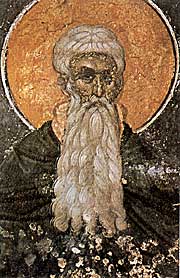
Arsenius is painted as a very old monk in the full monastic schema — tunic, analavos, mantle, and often the koukoulion drawn over the head — and his one unmistakable attribute is his beard: the painters' manuals prescribe an extremely long white beard, falling to the waist or below, and Byzantine and post-Byzantine iconography is consistent about it, so that he can be told from the other white-bearded fathers of the desert by its length alone. He holds a scroll, sometimes inscribed with the word he received — Φεῦγε, σιώπα, ἡσύχαζε — or with a counsel on silence, and where the type is fuller he is shown with a hand raised to his lips. He belongs to the standing rank of venerable fathers painted in the monastic refectories and narthexes of Athos and the Balkans, most often beside Antony the Great, Euthymius, and Sabbas, and appears in the menologion cycles under May 8.
The stored image is a fourteenth-century fresco from the Protaton at Karyes on Mount Athos — the aged ascetic in the cowl, haloed, with the enormous white beard of his iconographic type. A thirteenth-century Serbian fresco at the Mileševa Monastery pairs him with Euthymius the Great in the narthex, and is another public-domain witness to the same type (Commons).
Disputed questions
- The dates. The synaxarion and Slavic tradition place his repose in 449–450 and his age at some ninety-five to a hundred years; a good deal of modern scholarship, working from the chronology of the sack of Scetis and of Theophilus's episcopate (385–412), prefers c. 445 or even earlier, and puts his birth nearer 350. The entry keeps the traditional figures and records the alternative.
- Who sent him to Constantinople. The Greek accounts name Damasus of Rome (†384), which is consistent with a summons about 383; some notices name Siricius, and some make the initiative Theodosius's alone. The difference does not affect the substance.
- Forty years at court? The synaxaria's "forty years in the world and fifty-five in the desert" is a round scheme; historically his palace service can hardly have exceeded the eleven or so years between about 383 and his flight in the early 390s.
- Not to be confused with the other saints of the name: Arsenius of Corfu (January 19), Arsenius of Tver (March 2), Arsenios of Paros (January 31), and — on this very day — Arsenius the Lover-of-Labour of the Kiev Caves, a fourteenth-century Russian monk who shares Arsenius the Great's feast of May 8.