
Artemius of Verkola
The Holy and Righteous Youth Artemius, Wonderworker of Verkola
Righteous · Wonderworker · b. c. 1532, at Verkola on the Pinega — d. 23 June 1545, at Verkola
Commemorated 23 June — Repose in the field at Verkola, 1545, 20 October — Translation of the incorrupt relics into the church at Verkola
Artemius of Verkola was a peasant boy of twelve from the village of Verkola on the Pinega, in the far north of Russia, who was killed by lightning in a summer thunderstorm on 23 June 1545 while working in the field beside his father. Because a sudden death in a storm was read by his neighbours as a stroke of divine anger, his body was not buried in the churchyard but laid in a pine wood, covered with brushwood and birch bark, and left. Thirty-two years later, in 1577, a light was seen over the place; the body was found incorrupt, was carried into the church of St Nicholas at Verkola, and at once became the centre of an extraordinary series of healings during an epidemic that was then wasting the Pinega. A monastery grew up at the spot. He is one of the very few saints of the Russian Church glorified neither for martyrdom nor for asceticism nor for office, but simply as a righteous child, and he is a patron of children and of the Russian North.
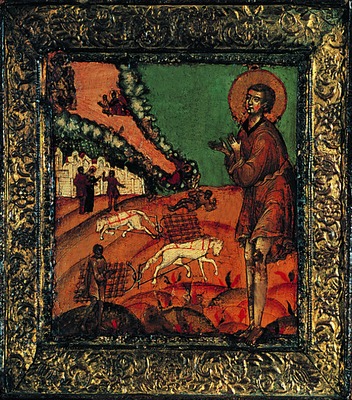

The village and the boy
Artemius was born about 1532 in Verkola, a village on the river Pinega in the Dvina lands — a country of forest, long winters and a short violent summer, evangelised late and only thinly supplied with churches. His parents, remembered in the tradition as Kosmas and Apollinaria, were peasants of the ordinary sort and are described as devout. The record of his short life is correspondingly slight and entirely moral: he was obedient, gentle, industrious beyond his years, shy of the roughness of the other boys, and from the age of five turned to prayer. That is all the sources say, and the entry is one of the places where the temptation to invent must be refused.
The storm in the field
On 23 June 1545, aged twelve, Artemius was in the field harrowing with his father when a thunderstorm came over. A clap of thunder broke directly above them and the boy fell dead where he stood. The Russian peasant reading of such a death was unambiguous and merciless: lightning was the visible stroke of God, and a man killed by it had been struck for his sins. The body of a person so killed was not received into consecrated ground.
So Artemius was not buried. His body was carried into a pine wood near the village, laid on the ground, covered over with brushwood and birch bark, and railed round with a low fence of poles; and there — unburied, unmourned, and by the reckoning of his own village accursed — he was left for thirty-two years. The severity of this is the point of the whole story. The Church's later judgement reversed the village's: what the peasants took for a sentence, the Church read as a swift and merciful taking of an innocent, and the office sung for him turns directly on that reversal.
The finding of the relics, 1577
In 1577 the reader (in some accounts the deacon) of the Verkola church, Agathonicus, passing through the wood, saw a light standing over the place. Going to it, he found the brushwood and the bark, and beneath them the boy's body whole and incorrupt, after three decades in the open air of a country of hard frosts and wet summers. The remains were carried to the village and laid in the porch of the church of St Nicholas at Verkola.
The Pinega was at that moment in the grip of an epidemic fever. The first healing is the one the tradition always tells: a man whose son was dying took a strip of the birch bark from the boy's resting-place, tied it to the cross the child wore at his neck, and the fever left him. From that the cult spread through the whole district within a season. Bark from the place, and afterwards shavings from the boards on which the first icons of the saint were painted, were carried through the villages and were reported to heal; the wasting fever abated; and the northern peasantry, who had refused the boy burial, took him for their protector. A local commemoration was authorised, and a proper office was written.
The monastery and the later history of the relics
The relics were translated from the church porch into the church itself, and afterwards into a chapel raised over the place of the finding. About 1645 the voivode of Kevrola, Athanasius Pashkov, whose son had been healed at the shrine, founded on the spot the Artemiev Verkola Monastery, which became the principal religious house of the Pinega and the point from which the veneration of the boy spread through the Archangel North. In the nineteenth century the monastery was rebuilt on a large scale with the help of St John of Kronstadt, who was born at Sura a little further up the same river and kept the veneration of Artemius all his life.
In 1918 the monastery was seized. The relics of the saint, which had survived thirty-two years in the forest and three centuries in the shrine, were taken by the authorities, broken up and thrown into a well; nothing certainly identifiable was recovered afterwards. The monastery was reopened in the 1990s and the saint is again served there, at the place of the finding, without relics.
Feast and commemoration
June 23 (church date; New Calendar civil June 23, Old Calendar civil July 6) is the day of his repose and his principal feast; the Old-Calendar Russian usage therefore keeps him on civil July 6. His second feast is October 20 (Old Calendar civil November 2), the translation of the relics.
He is also numbered in two collective commemorations of the Russian Church: the Synaxis of the Saints of Novgorod (the third Sunday after Pentecost, under whose metropolitan the Pinega then lay) and the Synaxis of the Saints of the Archangel Metropolia. The commemoration is Russian and OCA; it is not carried in the Greek or Antiochian Menaia.
Hymns
Troparion — Tone 2
By the command of the Most High thou wast taken from the earth in thy childhood, O blessed Artemius, and wast borne up in innocence to the mansions of heaven; and thy body, laid unhonoured in the wood, God glorified with incorruption and with wonders. Wherefore the land of the Pinega, once ashamed of thee, now rejoices in thee: entreat Christ our God that our souls may be saved.
Original translation from the Slavonic
Kontakion — Tone 8
As a pure and unblemished offering thou wast brought to the Lord in thy twelfth year, and the thunder that struck thee down was to thee the chariot of thine ascent; and now, O righteous Artemius, standing before the throne with the choirs of children, thou pourest out healings upon the sick who run to thy shrine, that we may cry to thee: Rejoice, O boast of the northern land.
Original translation from the Slavonic
Iconography
Artemius is painted as he died: a boy of twelve, beardless, with short dark hair, barefoot or in the light shoes of a northern peasant, in a plain belted shirt of red or white reaching to the calf — never in monastic or clerical dress, and never with the martyr's cross, since he is a righteous and not a martyr. His hands are usually raised in prayer, or he holds a small hand-cross. The setting is his own: the ploughed field, the dark fir wood behind, the storm cloud above him with the fire of the lightning coming out of it, and often the buildings of the Verkola monastery at the side; in later icons the Saviour blesses from a cloud in the upper corner. The northern workshops also produced vita icons of him with border scenes — the death in the field, the body under the birch bark, Agathonicus seeing the light, the healing of the sick child with the strip of bark.
The stored image is a seventeenth-century icon of the Russian North, in a carved and gilded frame: the boy stands at the right in a red shirt with a golden nimbus, against a green ground; the storm and the fire break out of the tree-line at the upper left; the village church and figures, the flock and the ploughed furrows fill the lower field. It is one of the earliest surviving representations of the saint and shows the composition already fixed within a lifetime of the finding of the relics.
Disputed questions
The manner of the death. The Russian sources say he was killed by the thunderclap itself rather than by a visible strike — the difference matters for the local reading of the event, since a boy killed by a noise was still, to his neighbours, one whom God had struck. No source suggests he was engaged in anything but ordinary work, and the later office is careful to say that he was taken "in innocence" rather than punished.
The dates. Birth c. 1532 and death 1545 at the age of twelve are consistent, and the finding of the relics is uniformly given as 1577 — "thirty-two years" after the death, which is what the arithmetic yields. Some Russian accounts date the founding of the monastery to 1645, others place the voivode's vow earlier and the building later.
The second feast. The Russian calendar gives October 20 as his second day. This is the feast of the Great-Martyr Artemius of Antioch, the boy's name-saint, and the northern translation of relics was deliberately set on it; the two are entirely different persons and are not to be confused. Some accounts explain the October day as the anniversary of the transfer of the relics into the church rather than as a name-day coincidence, and both readings are found in print.