
Artemius of Antioch
The Holy and Glorious Great-martyr Artemius of Antioch
Great Martyr · d. 362
Commemorated 20 October — Martyrdom at Antioch under Julian the Apostate
Artemius of Antioch (†362) was a high-ranking commander and imperial official under Constantine the Great and Constantius II, who rose to be dux (military governor) of Egypt and was entrusted with the solemn translation of the relics of the Apostles Andrew and Luke to Constantinople in 357. When Julian the Apostate set out to restore paganism, Artemius confronted the emperor at Antioch, openly rebuking his impiety and the torture of Christian bishops; for this he was stripped of rank, cruelly tortured, and beheaded. The Church venerates him as a great-martyr and wonderworker, and his healing shrine at the Oxeia in Constantinople — whose recorded "Miracles of Artemius" are a major source for Byzantine social history — made him the special patron of those suffering from hernia and diseases of the lower body. His feast is October 20.
.jpg)
Origins and rise under Constantine and Constantius
Artemius belonged to the senior military and administrative class of the fourth century, and both the hagiographic tradition and the secular historians agree that he was a man of the first rank. The Passio names him among the officers of Constantine the Great and has him present at the emperor's vision of the Cross; whatever the weight of that detail, his career is firmly attested under Constantine's son Constantius II (337–361), whom he served with distinction and who advanced him to be dux Aegypti — the military governor of Egypt, one of the great commands of the Eastern empire. In that office he was a powerful agent of imperial religious policy in Alexandria, the most turbulent see of the age.
The one act of his public life that the Church has fixed most gratefully in memory belongs to the year 357. The emperor Constantius, completing the adornment of his father's new capital, resolved to gather to the church of the Holy Apostles in Constantinople the bodies of the apostles; and it was Artemius who was charged with the translation — bringing the relics of the Apostle Andrew from Patras in Achaia and of the Apostle (and Evangelist) Luke from Thebes in Boeotia, which were laid up beneath the holy table of the church of the Holy Apostles, together with the relics of Timothy. This is among the earliest solemn translations of relics in Christian history, attested by Jerome and the church historians, and it links Artemius directly to the Antiochene evangelist Luke, whose repose the Church keeps two days before his own.
The confession under Julian
On the death of Constantius in 361 the throne passed to his cousin Julian — "the Apostate" — who, raised a Christian, had renounced Christ and bent the whole apparatus of the state to the revival of the old gods. Julian's persecution was subtler than Diocletian's and, where it came to blood, no less cruel: he stripped Christians of office, reopened the temples, and in the cities of the East pressed bishops and confessors to sacrifice. Passing through Antioch in 362 on his way to the Persian war, the emperor had two Christian bishops — the tradition names Eugenius and Macarius — put to torture for refusing to abjure the faith.
It was at this juncture that Artemius came to Antioch. Standing before the emperor, he denounced Julian to his face for his impiety and his cruelty to the Christians, and confessed Christ openly. Enraged that a man of such rank should defy him, Julian had him stripped of his dignities and subjected to a series of savage tortures which the Passio recounts at length — scourging, the laceration of his flesh, and the crushing of his body beneath a great stone, which the hymnography of his feast remembers when it sings of the martyr's "most enduring body" given over to torment. Through it all, the account says, he did not deny Christ nor sacrifice to the idols, but bore the anguish "as though another suffered," his eyes fixed on the reward to come. The tradition adds a vision in the prison: Christ, encompassed by angels, appearing to strengthen him and to promise him the crown. He also foretold to Julian the emperor's own imminent and violent death.
Martyrdom
Meeting only steadfastness, Julian at last ordered him beheaded. The synaxarion distich for the day plays on his name — Artemios, "the wholly excellent" — and on the manner of his end: "Wholly resplendent Artemius in his life, being beheaded, departed to the highest glory." Christians took up and buried his body. Within months the martyr's prophecy was fulfilled: Julian, drawn deep into the Persian desert near Ctesiphon and abandoned by a treacherous guide, was struck in battle by an unseen hand, and died — by the tradition preserved in Theodoret and others — with the cry, "Thou hast conquered, O Galilean." With the apostate dead and the Church again at peace, the relics of Artemius were translated with honour from Antioch to Constantinople.
The shrine at the Oxeia and the Miracles of Artemius
In Constantinople the relics of Artemius were enshrined in the church of Saint John the Baptist in the quarter called the Oxeia, and there grew up around them one of the most famous healing cults of the Byzantine capital. The saint became renowned above all for the cure of diseases of the genitals and of hernia and rupture — afflictions of which he is still invoked as patron — and pilgrims resorted to his shrine to keep vigil and to receive healing through the rite of incubation, sleeping in the church in hope of a dream-visitation of the saint.
Out of this cult came a remarkable document: the Miracles of Saint Artemius (Θαύματα τοῦ Ἁγίου Ἀρτεμίου), a collection of some forty-odd miracle accounts compiled at the shrine in the seventh century. Beyond their devotional purpose, the Miracles are a treasure for the social historian: they record the trades, households, ailments and daily anxieties of the ordinary people of seventh-century Constantinople — shipwrights, tavern-keepers, craftsmen and their families — with an incidental realism found almost nowhere else, and they document in passing the shared liturgical life of the Oxeia, where the vigils of Artemius were kept alongside those of the martyr Febronia of Nisibis (June 25), who had a chapel there.
Feast and commemoration
October 20 (church date; Old Calendar civil November 2) is the universal feast of the great-martyr, kept by the Antiochian, Greek, Slavic, OCA and all Byzantine-rite calendars, and marked in the Roman Martyrology on the same day. The Greek Menaion appoints a full proper service. In Greek and Slavic usage he is styled megalomartys, great-martyr, and invoked especially by the sick.
Hymns
Troparion — Tone 4
Made steadfast by the true faith of Christ, O passion-bearer, thou didst vanquish the impious and tyrant emperor together with his idolatrous arrogance. Therefore wast thou endowed by the Great King, who reigneth eternally, with a most radiant crown of victory. O great Artemius, healing all who are sick and who call upon thee, entreat Christ God to save our souls.
Original translation from the Slavonic
Kontakion — Tone 2
Gathered together, let us worthily praise in hymns the pious and crown-bearing martyr, who raised up the trophies of victory over the enemy — Artemius, the greatest among the martyrs and most abundant giver of miracles; for he intercedeth with the Lord on behalf of us all.
Original translation from the Greek
Sticheron
Let us honour Artemius, the noetic luminary of the faith, for he reproved the most hateful emperor; and with the blood of his martyrdom God empurpled the Church. Wherefore he received also the ungrudging grace of healings, to cure the diseases of those who with faith run to the shrine of his relics.
Appointed readings
Epistle — Colossians 1:1–2, 7–11
1Paul, an apostle of Jesus Christ by the will of God, and Timotheus our brother, 2To the saints and faithful brethren in Christ which are at Colosse: Grace be unto you, and peace, from God our Father and the Lord Jesus Christ. 7As ye also learned of Epaphras our dear fellowservant, who is for you a faithful minister of Christ; 8Who also declared unto us your love in the Spirit. 9For this cause we also, since the day we heard it, do not cease to pray for you, and to desire that ye might be filled with the knowledge of his will in all wisdom and spiritual understanding; 10That ye might walk worthy of the Lord unto all pleasing, being fruitful in every good work, and increasing in the knowledge of God; 11Strengthened with all might, according to his glorious power, unto all patience and longsuffering with joyfulness;
Gospel — Luke 9:23–27
23And he said to them all, If any man will come after me, let him deny himself, and take up his cross daily, and follow me. 24For whosoever will save his life shall lose it: but whosoever will lose his life for my sake, the same shall save it. 25For what is a man advantaged, if he gain the whole world, and lose himself, or be cast away? 26For whosoever shall be ashamed of me and of my words, of him shall the Son of man be ashamed, when he shall come in his own glory, and in his Father’s, and of the holy angels. 27But I tell you of a truth, there be some standing here, which shall not taste of death, till they see the kingdom of God.
Iconography
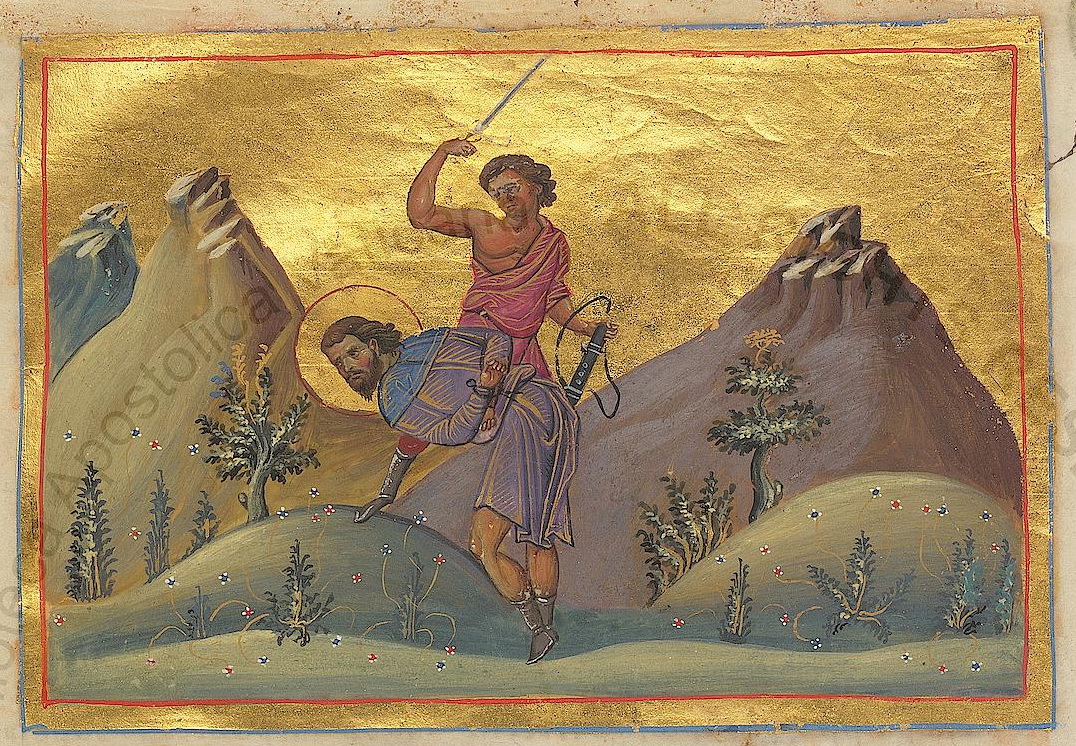
Artemius is depicted as a Byzantine officer and martyr: a mature, dark-bearded man, most often in the rich civilian dress of a high dignitary — a jewelled chlamys over a tunic — and holding the cross of martyrdom, sometimes shown as a soldier in armour in keeping with his rank of dux. In martyrdom cycles he is shown beheaded, or crushed beneath the great stone of his torture. In the Menologion of Basil II the miniature for October 20 shows his execution: the haloed saint bowed beneath the sword of the headsman. The stored image is that miniature (Constantinople, c. 985, Vatican Library, Vat. gr. 1613; public domain).
Disputed questions
- Artemius and the Arian party. Honesty about the historical Artemius is required and, as with Cornelius the Centurion and Gregory the Illuminator, does not overturn the Church's veneration. The secular sources — chiefly the Church History of the Arian historian Philostorgius, on which the martyr's Passio substantially draws — remember Artemius as an agent of Constantius's pro-Arian religious policy in Egypt: as dux he was involved in the violent suppression of the Nicene (Athanasian) party in Alexandria, and Julian's execution of him was prompted in part by the complaints of Alexandrians against his conduct there. The Church commemorates him for the manner of his end — a fearless confession of Christ and rebuke of an apostate emperor, sealed in blood — and classifies him as the calendars do, as a great-martyr, while the record of his earlier associations is set down here rather than suppressed.
- The sources. The Passio of Artemius (BHG 170–171) is transmitted under the name of a "John the Monk" (sometimes identified as John of Rhodes) and is of particular value because it preserves large portions of the lost Church History of Philostorgius; the seventh-century Miracles of Artemius form a separate and independent witness to the Constantinopolitan cult. The secular historians (Ammianus Marcellinus, Theodoret, Sozomen) corroborate his rank, his command in Egypt, and his death under Julian.
- Not to be confused with the righteous child Artemius of Verkola (†1545), a Russian boy-saint whose principal feast is June 23 and whose translation of relics is kept on this same day, October 20.