
Athanasia and her Daughters
The Holy Martyrs Athanasia, and her three daughters Theoctiste, Theodota and Eudoxia
Martyr · Virgin · d. c. 311
Commemorated 31 January — Martyrdom at Canopus near Alexandria, with the unmercenaries Cyrus and John
Athanasia and her three daughters — Theoctiste, Theodota and Eudoxia — were a Christian mother and her children martyred at Canopus near Alexandria about the year 311, in the last of the pagan persecutions, together with the holy unmercenaries Cyrus and John. Arrested for the faith, they were the very reason the two unmercenaries came forward: Cyrus and John, fearing that the youth of the girls — aged, the tradition says, fifteen, thirteen and eleven — and their mother's tenderness might be worked upon to draw them into apostasy, visited them in prison to strengthen them for their confession. The whole company was condemned together; the three daughters were beheaded before their mother's eyes, then Athanasia, and last the two unmercenaries. They are commemorated on January 31 with Cyrus and John.
.jpeg)
The four are known from the passion of the unmercenaries Cyrus and John, with whom they suffered and with whom the calendar always keeps them. Athanasia was a Christian woman of the region of Canopus (Greek Kanopos), the town at the western mouth of the Nile east of Alexandria; the synaxarion styles her a woman of standing. She had three young daughters whose names and ages the tradition preserves: Theoctiste, aged fifteen; Theodota (Theodote), thirteen; and Eudoxia, eleven.
In the persecution of Diocletian as it raged in Egypt (traditionally dated to about the year 311, at its end), the mother and her three girls were arrested for their Christianity and imprisoned at Canopus, held to be made an example and pressed to sacrifice to the gods. It was on their account that the unmercenary physician Cyrus of Alexandria and his companion John, the soldier of Edessa, came down to Canopus: knowing the danger that the tenderness of a mother and the fear of children might be turned against their faith, the two came openly to the prison to confirm and strengthen Athanasia and her daughters to endure to the end. This act of mercy betrayed the unmercenaries themselves, who were seized and cruelly tortured; and the governor, to break the resolve of the women, made them watch the torments and then condemned the whole company to the sword.
The three daughters were beheaded first, before their mother's eyes, that the sight might shake her; but Athanasia was not moved, and was beheaded after them, and last of all Cyrus and John. So a mother and her three children received the crown of martyrdom together with the two holy unmercenaries, about the year 311. The Church honours the girls among the virgin-martyrs, and their mother among the martyrs, and keeps all four with Cyrus and John on January 31.
Feast and commemoration
January 31 (church date; Old Calendar civil February 13), with the unmercenaries Cyrus and John, whose office in the Menaion carries the memory of Athanasia and her daughters. They have no separate proper service; the day's hymns of the two unmercenaries name them among the company of the martyrs. In the manuscript tradition the third daughter's name appears both as Theodota and Theodote, and the order of the three sisters varies; the names Theoctiste, Theodota and Eudoxia are those transmitted by the received synaxaria.
Hymns
Troparion — Tone 5
The wonders of Thy holy Martyrs Thou hast given us as an invincible rampart, O Christ our God. At their entreaties scatter the counsels of the heathen, and strengthen the scepters of the kingdom, for Thou alone art good and the Lover of mankind.
Original translation from the Greek
Iconography
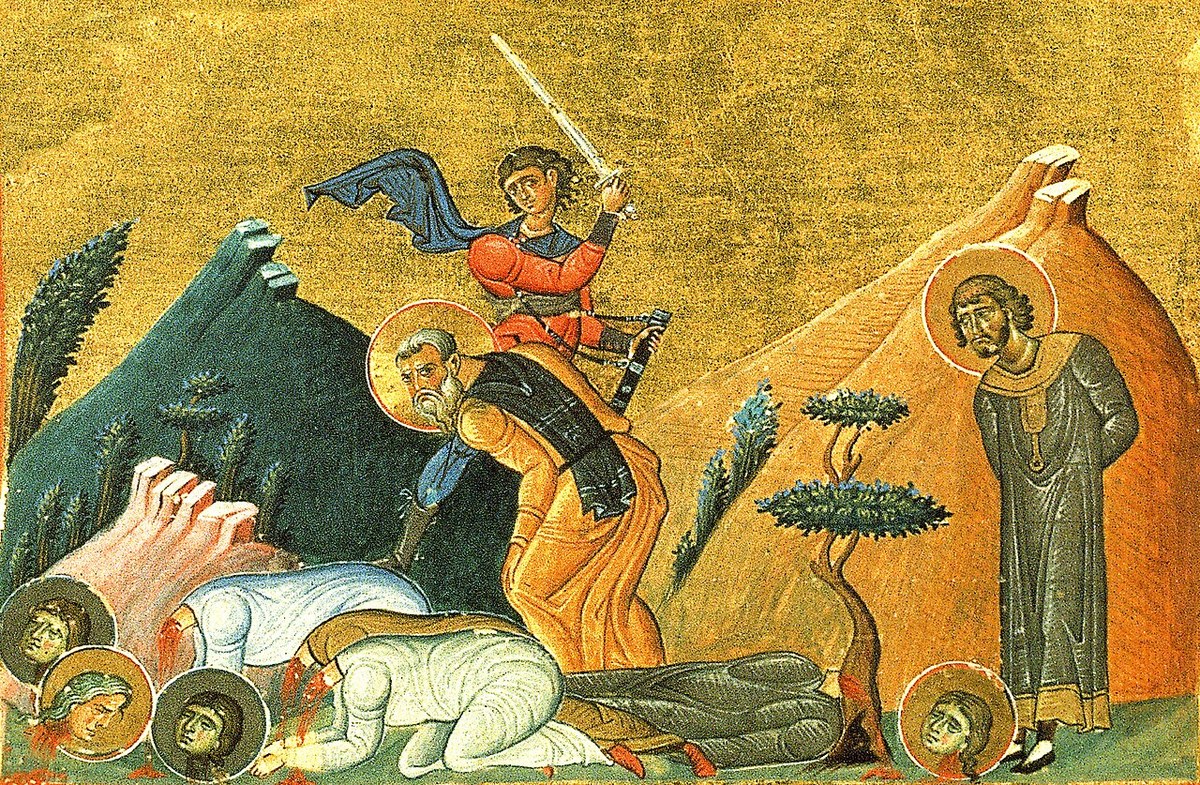
Athanasia and her three daughters are not painted alone but as part of the martyrdom of the company of January 31. In the stored miniature for that day from the Menologion of Basil II (Constantinople, c. 985), the four women appear in the foreground: the beheaded bodies of the daughters lie in white garments, and the haloed heads of the mother and her three girls are gathered at the lower left, while above them the unmercenary Cyrus is beheaded and John stands awaiting the sword — the whole company of the day in one scene (source, public domain, pd-old-work).