
Cyrus and John
The Holy Wonderworking Unmercenaries and Martyrs Cyrus and John
Unmercenary · Martyr · d. c. 311
Commemorated 31 January — Martyrdom at Canopus near Alexandria, with Athanasia and her three daughters, 28 June — Translation of the relics from Canopus to Menouthis under Cyril of Alexandria
Cyrus and John (†c. 311) are among the most beloved of the holy unmercenaries — the anargyroi, physicians who healed without payment in the name of Christ. Cyrus was a renowned physician of Alexandria who, when the persecution of Diocletian broke out, withdrew to the Arabian desert and there healed souls and bodies by prayer alone; John, a soldier of Edessa, sought him out and became his companion in the ascetic and healing life. Learning that a Christian woman, Athanasia, and her three young daughters — Theoctiste, Theodota and Eudoxia — had been seized at Canopus near Alexandria, the two came to strengthen them for their confession, were themselves arrested, and after cruel tortures were beheaded together with the mother and her daughters, about the year 311. Their relics, first laid in the church of the Evangelist Mark at Alexandria, were translated by Cyril of Alexandria to Menouthis, where their shrine displaced a famous pagan healing-cult and became one of the great healing sanctuaries of the Christian East — the setting of the Miracles recorded by Sophronius of Jerusalem. They are kept on January 31, and on June 28 for the translation of their relics.
.jpeg)
Cyrus, physician of Alexandria
Cyrus (Greek Kyros; in the Coptic and Arabic tradition Abba Kyr, whence the later Italian San Ciro) was, the tradition holds, a native of Alexandria, and by profession a physician — and not an obscure one, but a master of the healing art widely sought in that city of physicians, the seat of the most famous medical school of the ancient world. He was a Christian, and he practised medicine as a Christian of the unmercenary kind: he took no fee, and to the cure of the body he joined the cure of the soul, drawing those who came to him for healing toward faith in Christ, in whose name he worked his cures. So the surname the Church gives him — Anargyros, "the silverless one" — was earned in the ordinary exercise of his calling, before ever it was crowned by martyrdom.
When the persecution of Diocletian (reigned 284–305) fell upon Egypt — the fiercest and last of the great persecutions, which Egypt felt more terribly than any province — Cyrus was denounced as a Christian and a healer who turned the sick from the gods. He withdrew from the city into the Arabian desert (some accounts say to a place in the Egyptian nome bordering Arabia; others carry him as far as the Gulf), and there he exchanged the physician's craft for the monastic life, healing now not by medicines and the lancet but by prayer, the sign of the Cross, and the invocation of the Name of Christ. His reputation for cures worked without means, and without payment, spread the wider for his withdrawal, and drew the sick and the troubled to him in the wilderness.
John, soldier of Edessa
While Cyrus laboured in Egypt, a man named John, a soldier by profession and a native of Edessa in Mesopotamia (some accounts make him a citizen of Edessa serving in the imperial forces), heard of the holy physician's fame while he was at Jerusalem. Moved to seek him out, John travelled to Alexandria and then into the desert, found Cyrus, and attached himself to him as a disciple and fellow-ascetic. The pairing the Church loves to set side by side — the learned Alexandrian physician and the Mesopotamian soldier — became one company in the unmercenary life: the elder healing, the younger serving and sharing his prayer, the two of them together a single memorial of freely-given mercy.
Athanasia and her three daughters
The occasion of their martyrdom was an act of pastoral courage. In the persecution a Christian noblewoman of the region, Athanasia, had been arrested at Canopus (Greek Kanopos), the pleasure-city on the Nile mouth east of Alexandria, together with her three young daughters — Theoctiste, aged fifteen; Theodota, thirteen; and Eudoxia, eleven. Cyrus and John, fearing that the tenderness of the mother for her children, and the youth of the girls, might be worked upon by the tortures to draw them into apostasy, went down to Canopus to visit the four in their prison and to strengthen them to endure to the end. It is this — the deliberate coming-forward of two men already marked as Christians, to fortify others for martyrdom — that the synaxarion sets at the centre of their passion: they died not by accident of denunciation but by a freely chosen work of mercy, the last and greatest of their unmercenary cures.
Martyrdom
The visit was discovered, and Cyrus and John were seized and brought before the governor. Interrogated, they confessed Christ and refused the sacrifice; and the ruler, to break the resolve of the women and to punish the men, subjected the two unmercenaries to a succession of cruel tortures — the accounts speak of scourging, of burning with torches, of the pouring of vinegar and salt into their wounds, of exposure to fire and to boiling pitch — from all of which, the tradition holds, they came forth unbroken, that the watching mother and daughters might be confirmed rather than terrified by the sight. When neither the men nor the women would yield, the governor condemned the whole company to the sword. First Theoctiste, Theodota and Eudoxia were beheaded before their mother's eyes, and then Athanasia; and last of all the two unmercenaries, Cyrus and John, received the crown of martyrdom by the sword. The traditional date is about the year 311, at the very end of the persecution in Egypt, under the governor of the province. The thirty-first of January is the fixed day of their memory.
Relics and translations
Christians recovered the bodies of the martyrs and bore them into Alexandria, where they were laid in the church of the holy Evangelist Mark. There they rested until the days of Cyril of Alexandria (patriarch 412–444), and the translation that made their name great throughout the Christian world.
East of Alexandria, at the village of Menouthis near Canopus, there stood an ancient and notorious shrine of the goddess Isis — a pagan healing-oracle to which the sick still resorted for cures and dream-incubations, a survival of the old religion that drew even wavering Christians. To supplant it, the patriarch Cyril, fulfilling (the tradition says) a design of his predecessor Theophilus and moved by a vision, translated the relics of Cyrus and John from Alexandria to Menouthis and built there a church in their honour, that the Christian unmercenaries — physicians who healed freely in the name of Christ — might take the place of the demon-oracle as the healers to whom the people came. The translation is dated to about the year 412 (some reckon 414), and it is the event the calendar keeps on June 28. From that time the pagan shrine fell silent and the healing sanctuary of Cyrus and John at Menouthis became one of the most celebrated in the East, thronged by pilgrims seeking cures.
The renown of the shrine is preserved in a great literary monument: the seventy Miracles of Saints Cyrus and John, composed in Greek in the seventh century by Sophronius, the future patriarch of Jerusalem (634–638), who had himself been healed there of a disease of the eyes that the physicians had given up as incurable, and who set down in gratitude a detailed record of the cures worked at Menouthis together with an Encomium of the saints. Sophronius's collection is a document of the first importance both for the cult of the two martyrs and for the medical and social history of late-antique Egypt. In time the relics travelled further — carried west, portions came to Rome (the church of Santa Passera on the Via Portuense preserves their memory, its name a corruption of Abbas Cyrus, "Abba Kyr") and elsewhere in the West, so that the Alexandrian unmercenaries came to be venerated across the Mediterranean world.
Veneration and the unmercenary healers
Cyrus and John belong to the company of the holy unmercenaries (anargyroi) — the physician-saints who "freely received and freely gave" (Matthew 10:8), of whom Cosmas and Damian and the great-martyr Panteleimon are the most famous. Among these, Cyrus and John held a place of special honour in the Church of Alexandria and throughout the Greek East, where their shrine at Menouthis made them the patrons par excellence of physicians and of the sick, and their names entered the ordinary devotion of the faithful as healers to be invoked. The Byzantine hymnographers dwell on the paradox the tradition loves: that these "physicians set forth by God" cure not with drugs but "by an invisible surgery," cutting away the passions of the soul.
Feast and commemoration
The martyrdom is kept universally on January 31 (church date; Old Calendar civil February 13), the last day of the church-year month of January, on which the office of the two unmercenaries is sung in the Menaion. The translation of the relics to Menouthis under Cyril of Alexandria is commemorated on June 28 (Old Calendar civil July 11), the eve of the feast of the chief Apostles Peter and Paul. The Antiochian, Greek and Slavic calendars agree on both days. Athanasia and her three daughters, martyred with them, are commemorated on the same January 31 — in the Greek and Slavic books their memory is joined to that of the unmercenaries, so that the day keeps the whole company together; they are given their own entry at Athanasia and her daughters.
Cyrus and John are not to be confused with the other great unmercenary pairs and healers of the calendar: the three pairs of Cosmas and Damian (of Asia Minor, November 1; of Rome, July 1; of Arabia, October 17), and the great-martyr Panteleimon (July 27). All are anargyroi, physicians who healed without fee; but Cyrus and John are the Alexandrian pair, the physician and the soldier martyred at Canopus, whose shrine was at Menouthis.
Hymns
Troparion — Tone 5
The wonders of Thy holy Martyrs Thou hast given us as an invincible rampart, O Christ our God. At their entreaties scatter the counsels of the heathen, and strengthen the scepters of the kingdom, for Thou alone art good and the Lover of mankind.
Original translation from the Greek
Kontakion — Tone 3
Having received from divine grace the gift of wonders, O holy ones, ye work miracles without ceasing, cutting away all our passions by an unseen surgery, O godly-minded Cyrus, together with the divine John; for ye are physicians divine.
Original translation from the Greek
Sticheron
Most valiant champions, physicians set forth by God, Cyrus and John of great renown: as ye brought to nothing the godless insolence of the tyrants, so shatter the wanderings of my mind that tyrannize over me; heal the passions of my soul, and deliver me from the judgment to come, entreating the Redeemer.
Iconography
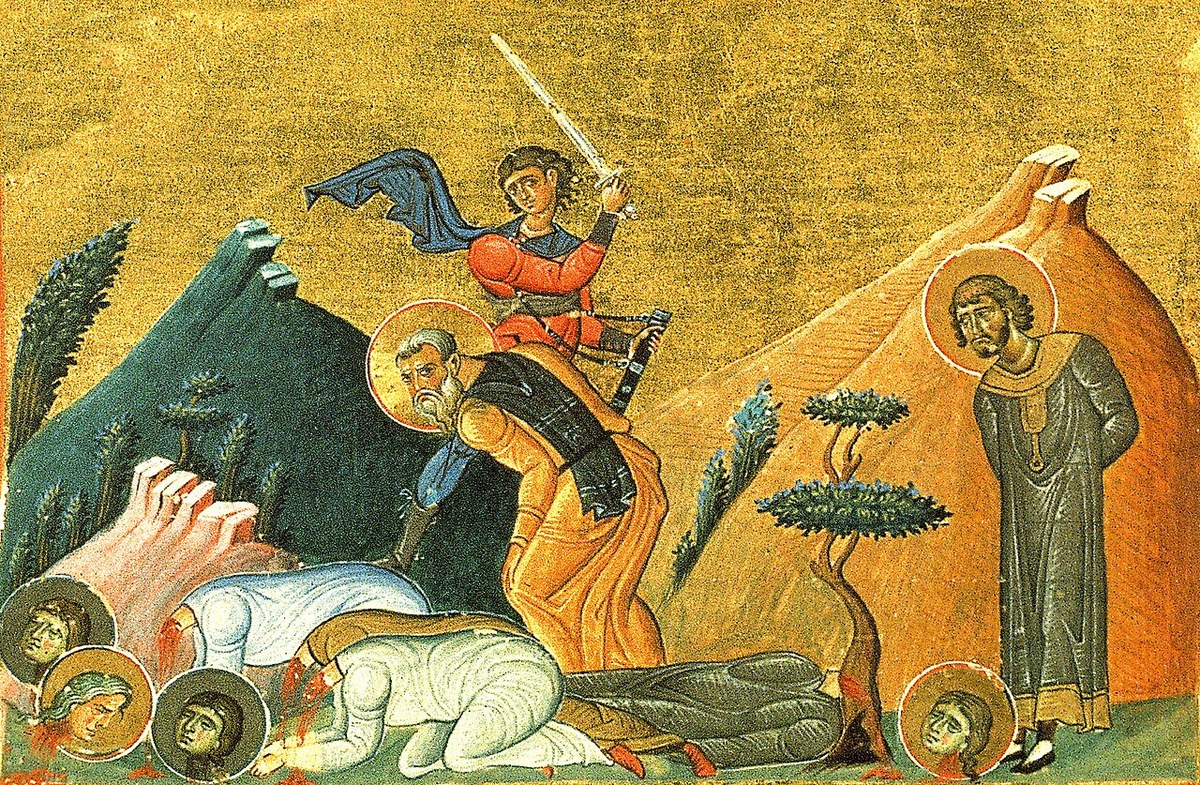
Cyrus and John are painted in the settled unmercenary type, but distinguished from Cosmas and Damian by their age and dress: Cyrus as an older, grey-bearded man — often in the dark mantle of a monk or ascetic, since he ended his life in the desert — and John as a younger, dark-haired or beardless man, sometimes with a hint of his soldierly origin. Both may carry the physician's attributes, the medicine-box and the slender spoon or probe. Their most characteristic narrative image is the martyrdom of the whole company: the two unmercenaries and, with them, Athanasia and her three young daughters, put to the sword.
The stored image is the miniature for January 31 from the Menologion of Basil II (Constantinople, c. 985; Vatican, Vat. gr. 1613): the executioner stands with sword raised; the aged Cyrus bows beneath it to receive the stroke; the younger John stands haloed at the right in a dark mantle awaiting his turn; and in the foreground lie the beheaded bodies of the women in white, with the haloed heads of Athanasia and her three daughters gathered at the lower left — the entire company of the day in a single scene (source, public domain, pd-old-work).