
Athanasius of Brest
The Holy Venerable Martyr Athanasius (Filippovich), Abbot of Brest
Venerable Martyr · New Martyr · Priest · b. c. 1595, in the lands of the Grand Duchy of Lithuania — d. 5 September 1648, shot in a wood near Brest
Commemorated 20 July — Uncovering of the relics, 1649, 5 September — Martyrdom near Brest
Athanasius Filippovich, abbot of the monastery of St Symeon at Brest, was the most uncompromising Orthodox voice in the Polish–Lithuanian Commonwealth in the generation after the Union of Brest (1596), and he paid for it with his life. A learned monk of the Vilna and Pinsk houses, he carried the case of the persecuted Orthodox of the Commonwealth to the Tsar at Moscow and, again and again, to the Diet at Warsaw, interrupting its sessions with prophetic denunciations of the Union and being imprisoned, beaten and deposed for it; his Diariush ("Diary") is a landmark of Ruthenian polemical literature. He was shot in a wood outside Brest on the night of 4–5 September 1648, having been made to dig his own grave. His body was found incorrupt eight months later and brought to his monastery; the Church keeps his martyrdom on September 5 and the uncovering of his relics on July 20. His saying — that the Union would perish and Orthodoxy flourish — is the sentence by which he is remembered.
.jpg)
Formation and the years of wandering
Athanasius was born about 1595 in the western lands of the Grand Duchy of Lithuania, into the Orthodox Ruthenian gentry or burgher class. He received an unusually good education for his station — he knew Latin, Polish, Greek and Church Slavonic, and wrote a vigorous, biting Ruthenian prose — and spent his young manhood as a tutor in noble households, including, by his own account, a period in the service of the great chancellor Lew Sapieha, where he was set to educate a boy presented as a claimant to the Muscovite throne. What he saw of that intrigue seems to have decided him against the world.
About 1627 he entered the monastery of the Descent of the Holy Spirit at Vilna, the stronghold of the Orthodox brotherhood movement in Lithuania, and was tonsured. He served afterwards at Kuteino, at Mezhigorye near Kiev, and at the monastery of Kupyatichi near Pinsk, where he was ordained hierodeacon and then hieromonk, and where he was attached to the wonderworking Kupyatichi icon of the Mother of God. In 1637–1638 his community sent him to Moscow to collect alms; he travelled with a copy of the icon, was received by Tsar Michael Feodorovich, and used the occasion to lay before the Muscovite court a memorandum on the sufferings of the Orthodox under the Union. The journey marked him permanently: from then on he saw his vocation as that of an advocate.
Abbot of Brest and adversary of the Union
In 1640 the brotherhood of Brest — Brest-Litovsk, the city whose name the Union of 1596 carries — elected him abbot of its monastery of St Symeon the Stylite. The position put him at the storm-centre. The Union had transferred the hierarchy, the endowments and the legal standing of the Ruthenian Church to the Uniate obedience; the Orthodox who refused it had, since 1596, existed in a condition of shifting and often merely tolerated illegality, and the restoration of an Orthodox hierarchy under Peter Mogila in 1632 had settled far less than it promised.
Athanasius's method was not diplomacy but denunciation. He petitioned the Diet (Sejm) at Warsaw in 1641 and again in 1643, seeking the confirmation of the ancient charters of his monastery and, beyond that, the abolition of the Union itself; when documents and procedure failed he resorted to prophecy, appearing before the assembled Diet with an icon of the Mother of God and crying judgement on the kingdom if the Union were not annulled. He was arrested, examined for insanity, imprisoned, released, deprived of his abbacy, held for a time in Kiev under the authority of the metropolitan, and restored again. Through it all he wrote: petitions, open letters, visions, and the running record of his own struggle which he called the Diariush, one of the most remarkable first-person documents of seventeenth-century Ruthenian literature — furious, biblical, and utterly certain. Its refrain is the sentence remembered as his prophecy: the Union will perish, and Orthodoxy will flourish.
Martyrdom
In 1648 the Cossack rising of Bohdan Khmelnytsky broke over the Commonwealth, and every outspoken Orthodox churchman in the western provinces became suspect. Athanasius was arrested at Brest in the summer of that year on the accusation of complicity with the Cossacks — of sending them powder and correspondence. Nothing was proved; a hostile witness was produced and withdrew. He was pressed under examination to curse the rising and to make his peace with the Union, and refused both.
On the night of 4–5 September 1648 he was taken out of the town under guard to a wood at Hershanovichi, made to dig a grave, shot twice — the tradition says by a servant who first struck the ground and then, under threat, fired — and buried where he lay. The soldiers were acting under the direction of the local authorities, and the Orthodox of Brest at once counted him a martyr for the faith.
The uncovering of the relics
The place of the burial was not known, and the body lay in the wood for eight months. In the spring of 1649 a boy of the town, who had seen the burial, showed the spot to the monks of the St Symeon monastery. They came by night — the ground belonged to the Jesuits — dug, and found the body whole and undecayed. The relics were carried secretly into the city and interred in the monastery church, and their fame spread at once through the Orthodox of the Commonwealth; the uncovering is dated in the sources to the beginning of May 1649, and the interment to the eighth of that month, while the Church keeps the commemoration on July 20.
The shrine survived the long suppression of Orthodoxy in the region. In a fire at the monastery on 8 November 1815 the copper reliquary was destroyed, but part of the relics was saved and placed in 1823 in a wooden vessel; portions are venerated today at Brest and at Grodno. Athanasius is numbered among the Synaxis of the Belarusian Saints, and he has become in modern Belarus and Ukraine the emblematic figure of the Orthodox resistance to the Union.
Feast and commemoration
September 5 (Old Calendar civil September 18) is his principal feast, the day of his martyrdom; July 20 (Old Calendar civil August 2) keeps the uncovering of his relics of 1649. He is commemorated by the Russian, Belarusian and Ukrainian Churches and by the OCA, and in the Synaxis of the Belarusian Saints. The July commemoration falls on the great feast of the Prophet Elijah and is in practice a secondary observance kept chiefly at Brest and in the Belarusian dioceses.
Hymns
Troparion — Tone 4
Thou wast a fearless advocate of the faith of thy fathers, and wouldst not be silent before kings and councils, O venerable martyr Athanasius; digging thine own grave, thou didst go down into it with a prayer, and the earth kept thy body incorrupt for a witness: intercede with Christ God that our souls may be saved.
Original translation from the Slavonic
Kontakion — Tone 8
Thou didst set thy face against the false union and wast not moved by prison or by blows, and when thy blood was shed in the night among the trees thou didst leave to thy people a word that has not failed: that falsehood shall perish and Orthodoxy shall flourish. Wherefore we cry to thee: Rejoice, O Athanasius, boast of the land of Brest.
Original translation from the Slavonic
Iconography
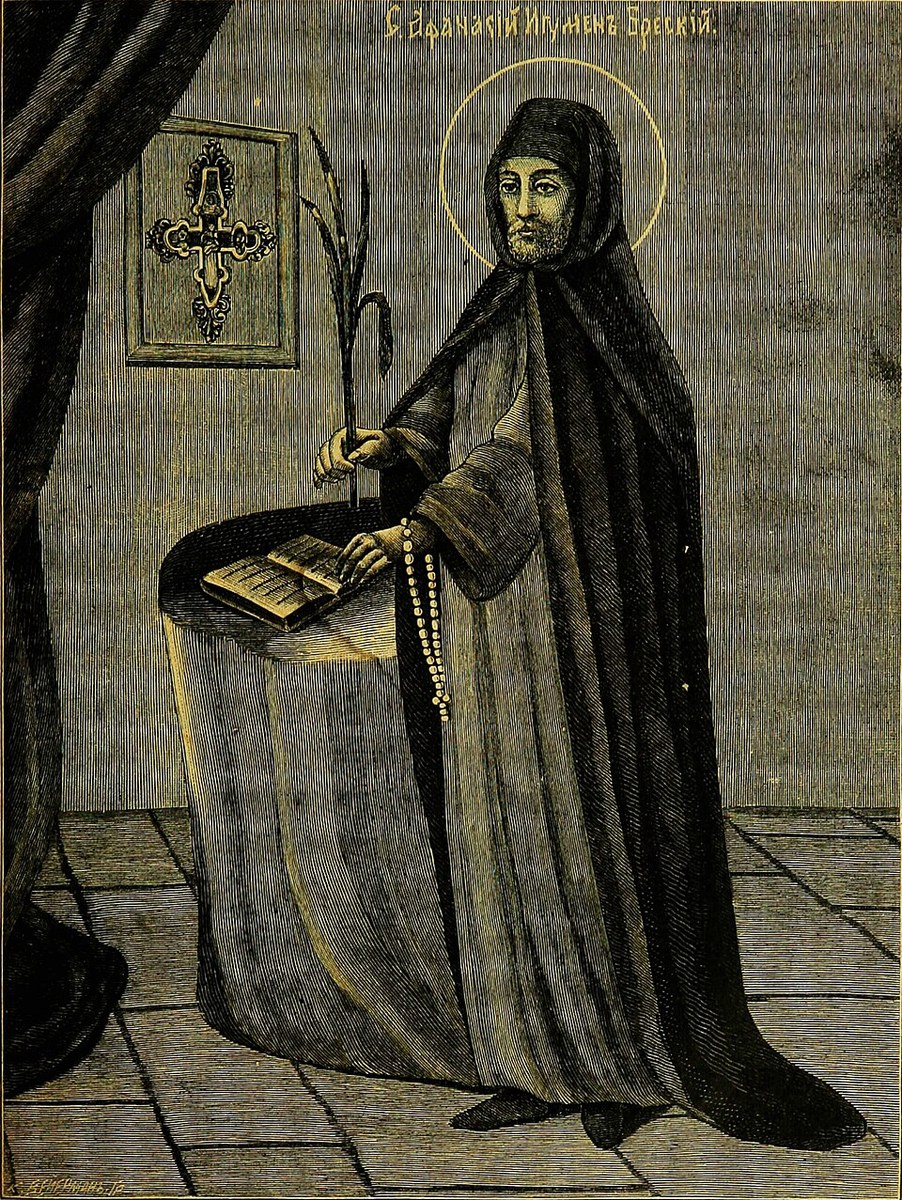
Athanasius is painted as a monastic priest of the seventeenth-century Ruthenian type: in the black mantiya and klobuk, with a full dark beard, holding a cross in the right hand — the martyr's attribute — and in the left either a scroll bearing his prophecy of the Union's downfall or a book, for his writings. Belarusian and Ukrainian icons of the modern period frequently place beside him the Kupyatichi icon of the Mother of God, the small cast image he carried to Moscow, and some show at his feet the scene of his death in the wood: the pit, the pine trees and the soldiers. He is also found in the composite icons of the Synaxis of the Belarusian Saints. Most painted icons of him in circulation today are modern works of living iconographers and are not reproduced here.
The stored image is a nineteenth-century engraving, published in 1890 in P. N. Batyushkov's Belorussia and Lithuania and reproducing the shrine image kept at Brest, inscribed Св. Аѳанасій Игуменъ Брескій — "St Athanasius, abbot of Brest": the saint standing in the black mantiya and pointed klobuk, haloed, at a reading-desk on which an open book lies, a quill (or palm) in his raised right hand and a long prayer-rope hanging from the left, with a processional cross on the wall behind him. It shows him as his own century remembered him — the writer and the petitioner rather than the martyr.
Disputed questions
- The date of the uncovering. The lives report the finding of the body at the beginning of May 1649 and its interment on 8 May, yet the calendar commemoration of the uncovering stands at July 20. No source consulted for this entry reconciles the two; the July date may represent a later solemn translation within the monastery, or a transfer of the observance away from the crowded days of early May. The discrepancy is recorded here rather than resolved.
- The circumstances of the killing. The number of shots, the identity of the executioner and the degree of Jesuit involvement differ between the Orthodox accounts (which are near- contemporary and hostile to the Union) and the Catholic records. That he was killed by official action, without a capital sentence for any proven crime, and for reasons inseparable from his religious agitation, is not in doubt.
- His title. Russian and Belarusian usage calls him prepodobnomuchenik, venerable-martyr, as a monastic put to death for the faith; because he was also a hieromonk, some lists style him hieromartyr. This entry follows the received Slavonic title and records his priesthood separately.
- Glorification. He was venerated as a martyr from the year of his death, and his cult was local and continuous thereafter; his formal glorification and his inclusion in the synaxis of the Belarusian saints belong to the modern period, and the dates given in popular sources vary.