
Elijah the Prophet
The Holy and Glorious Prophet Elijah the Tishbite
Prophet · b. Tishbe in Gilead, 9th c. BC — d. Taken up alive in the fiery chariot, c. 850 BC; the Church confesses that he did not taste death
Commemorated 20 July — Memory of the prophet and of his fiery ascent
Elijah the Tishbite is the greatest of the prophets before the Forerunner, and the one figure of the Old Covenant whom the Church calls an angel in the flesh. He appears in the Books of Kings without genealogy or preamble, standing before Ahab to shut up the heavens; he is fed by ravens at the brook Cherith and by a widow's inexhaustible meal and oil at Zarephath; he raises her dead son; he calls down fire on Mount Carmel before the four hundred and fifty prophets of Baal, and slays them at the Kishon; he flees Jezebel, fasts forty days to Horeb, and there meets God not in wind, earthquake or fire but in the sound of a fine stillness; he condemns Ahab over Naboth's vineyard; and at the last he divides the Jordan with his rolled mantle and is caught up in a chariot of fire while Elisha cries after him and catches the falling mantle. Because he was taken alive, the Church looks for him again: he stood with Moses beside the transfigured Christ on Tabor, and the prophecy of Malachi and the Apocalypse await him as forerunner of the Second Coming and martyr under Antichrist. His feast on July 20 is among the most universally and most popularly kept days of the fixed calendar, from the Mar Elias monasteries of Syria and Lebanon to the summit chapels of Greece and the Ilyin Day of the Slavs.
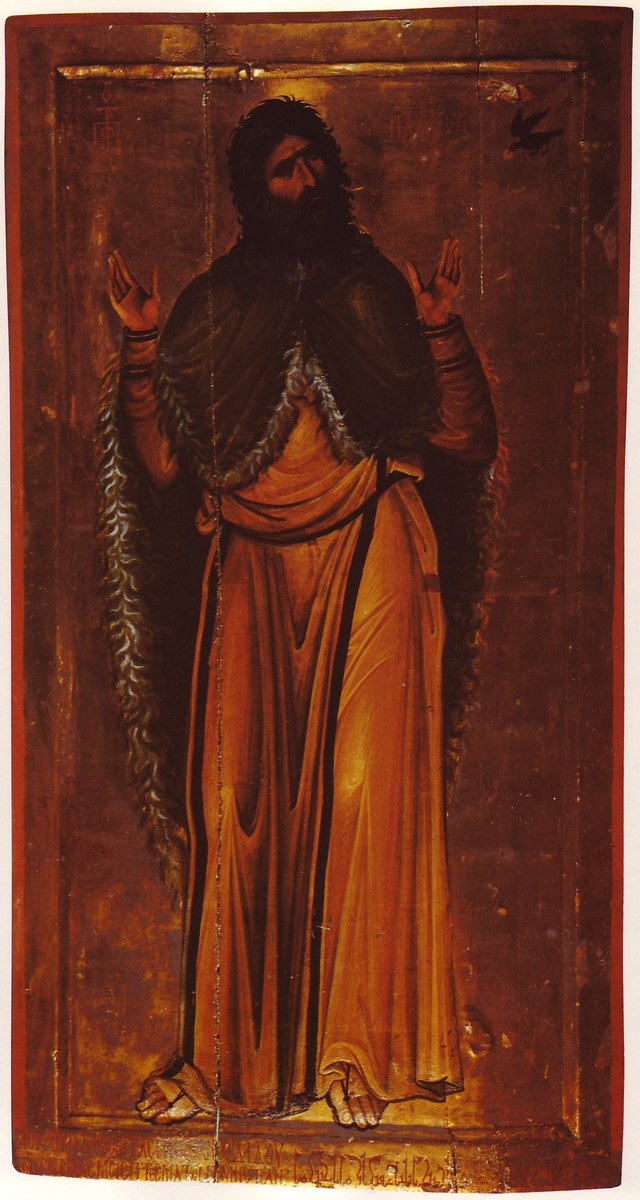

The Tishbite
The Scriptures give him no father, no tribe and no call-narrative. He walks into the third book of Kingdoms already formed: "And Elijah the Tishbite, of the inhabitants of Gilead, said unto Ahab, As the Lord God of Israel liveth, before whom I stand, there shall not be dew nor rain these years, but according to my word" (1 Kings 17:1). This abruptness is itself part of the tradition's portrait of him. He belongs to no school, is attached to no sanctuary, and holds no office; his authority is the naked formula the Lord liveth, before whom I stand — the stance of a servant in a royal presence-chamber, which the Fathers took as the very definition of the prophetic life and, later, of the monastic one.
His epithet marks him out as a man of Gilead, the rough highland east of the Jordan, and of a place called Tishbe; the Hebrew phrase is difficult and the Greek translators rendered it variously, so that the ancient authorities differ over whether Tishbe is a village of Gilead or the Thisbe of Naphtali named in Tobit. What is certain is the frontier character of the man: a highlander from beyond the river, dressed in a hairy garment with a leather girdle about his loins (2 Kings 1:8) — the same dress by which John the Baptist would be known — set against the cosmopolitan, Phoenician-influenced court of Samaria.
To this silence the later synaxaria added what they had received. The Lives of the Prophets ascribed to Epiphanius gives him priestly, Aaronic descent and names his father Sobach, and reports a portent at his birth: his father saw men in shining white greeting the child, swaddling him in fire and giving him flame to eat, and the priests at Jerusalem answered that the child's dwelling would be light, his word decision, and his judgement fire. The Church's hymnography is entirely at home with this: the canon and the stichera of the feast return again and again to fire as Elijah's element — fed on fire, speaking fire, calling down fire, and carried off by fire.
The drought and the ravens at Cherith
The reign of Ahab son of Omri (c. 874–853 BC) was the high-water mark of Baal-worship in the northern kingdom. Ahab had married Jezebel, daughter of Ethbaal king of the Sidonians, built a temple and altar for Baal in Samaria, and set up the sacred pole of Asherah; the prophets of the Lord were being hunted down and killed. Against a fertility-god whose whole claim was that he gave rain, Elijah's first word was to close the sky. The drought lasted, by the reckoning of the New Testament, three years and six months (Luke 4:25; James 5:17), and it was announced not as a natural calamity but as a matter of the prophet's word.
Hidden by God's command at the brook Cherith (Chorrath) east of the Jordan, Elijah drank from the torrent and was fed by ravens, which brought him bread and flesh morning and evening. The detail struck the Fathers on two counts: that God fed his prophet by the most unclean and rapacious of birds, which do not even feed their own young; and that the ravens brought meat in a famine and did not eat it themselves. The image became one of the two fixed iconographic types of Elijah — the prophet seated at the mouth of a cave, chin on hand, with a black bird descending to him — and one of the standard patristic proofs that providence governs even the appetites of beasts. When the torrent dried up, the same word sent him out of Israel altogether.
The widow of Zarephath
Zarephath (Sarepta) was a town of Sidon — Jezebel's own country, the heartland of Baal. There God sent his prophet, and there sustained him by a widow, a Gentile woman gathering two sticks at the gate to cook a last meal for herself and her son before they died. Elijah asked her first for water and then for bread, and promised in the name of the God of Israel that the barrel of meal should not waste nor the cruse of oil fail until the day rain returned. She believed the word of a foreign prophet against the evidence of her empty jar, and she and her household ate for many days.
Then her son sickened and died, and the woman turned on Elijah: had he come to bring her sin to remembrance? The prophet took the child from her bosom, carried him up to the loft where he lodged, stretched himself upon the boy three times, and cried, "O Lord my God, let this child's soul come into him again." And the soul of the child came into him again, and he lived (1 Kings 17:17–24). This is the first raising of the dead recorded in Scripture, and the model for Elisha's raising of the Shunammite's son, for the prophets' bones at Samaria, and — as the Church reads it — for the Lord's own raising of the widow's son at Nain.
The whole Zarephath episode carries a weight in the New Testament out of proportion to its length, because the Lord himself chose it as his text. Preaching in the synagogue at Nazareth he said: "Many widows were in Israel in the days of Elias… but unto none of them was Elias sent, save unto Sarepta, a city of Sidon, unto a woman that was a widow" (Luke 4:25–26). The mercy of God had passed over Israel to a Gentile woman; and it was that sentence, with its companion about Naaman the Syrian and Elisha, which turned the synagogue into a mob. It is for this reason that the Gospel read at the Liturgy on Elijah's feast is that passage of Luke 4, and the Epistle the passage of James 5 which names Elijah as the pattern of effectual prayer: "Elias was a man subject to like passions as we are, and he prayed earnestly that it might not rain."
Carmel: the contest with the prophets of Baal
In the third year the word came: "Go, shew thyself unto Ahab; and I will send rain upon the earth." Elijah met first Obadiah, the governor of Ahab's household, a secret servant of the Lord who had hidden a hundred prophets by fifties in caves and fed them with bread and water; and through him he summoned the king. Ahab greeted him, "Art thou he that troubleth Israel?" and got the answer that has been quoted at kings ever since: "I have not troubled Israel; but thou, and thy father's house, in that ye have forsaken the commandments of the Lord."
The whole people was gathered to Mount Carmel, the wooded headland over the sea, together with the four hundred and fifty prophets of Baal and the four hundred prophets of the grove who ate at Jezebel's table. Elijah put the question that gives the day its edge: "How long halt ye between two opinions? if the Lord be God, follow him: but if Baal, then follow him." Two bulls were prepared, laid on wood, and no fire put under; the god that answered by fire should be God. The prophets of Baal called from morning until noon, leaping about the altar, and Elijah mocked them — cry louder; perhaps he is talking, or pursuing, or on a journey, or asleep — and they cut themselves with knives and lancets till the blood gushed out, and there was no voice, nor any that answered.
At the time of the evening sacrifice Elijah repaired the broken altar of the Lord with twelve stones, according to the number of the tribes of Jacob, dug a trench about it, laid the wood and the pieces of the bull, and had the whole drenched three times with four barrels of water until the trench was full. Then he prayed briefly and without theatre — "Lord God of Abraham, Isaac, and of Israel, let it be known this day that thou art God in Israel… that this people may know that thou art the Lord God, and that thou hast turned their heart back again" — and the fire of the Lord fell, and consumed the burnt sacrifice, and the wood, and the stones, and the dust, and licked up the water in the trench. The people fell on their faces: "The Lord, he is the God; the Lord, he is the God." The prophets of Baal were brought down to the brook Kishon and slain there (1 Kings 18).
Then Elijah went up to the top of Carmel, cast himself down upon the earth and put his face between his knees — a posture the hesychast tradition later recognised as its own — and sent his servant seven times to look toward the sea. At the seventh time the servant said: "Behold, there ariseth a little cloud out of the sea, like a man's hand." Elijah told Ahab to harness and go down before the rain stopped him; the heaven grew black, there was a great rain, and the hand of the Lord came upon Elijah so that he girded up his loins and ran before Ahab's chariot to the entrance of Jezreel.
That little cloud, rising out of the barren sea and bearing the rain that ended the curse, is read by the whole tradition, East and West, as a figure of the Theotokos: the small, unlikely, human thing out of which comes the mercy that ends the drought. It is one of the oldest Marian types drawn from the prophets, and it is the seed of the peculiar bond between Carmel and the Mother of God.
Horeb: the sound of a fine stillness
Jezebel's answer to Carmel was a death-oath, and the prophet who had faced eight hundred and fifty men alone now ran for his life. He went to Beersheba in Judah, left his servant, went a day's journey into the wilderness, sat down under a juniper (broom) tree and asked to die: "It is enough; now, O Lord, take away my life; for I am not better than my fathers." Twice an angel woke him with a cake baked on hot stones and a cruse of water, the second time with the words, "Arise and eat; because the journey is too great for thee." In the strength of that food he walked forty days and forty nights to Horeb, the mount of God — the mountain of Moses. The Church notes the pairing constantly: Moses and Elijah are the two who fasted forty days and saw God on that mountain, and they are the two who stand with Christ on Tabor.
At Horeb he lodged in a cave, and the word came: "What doest thou here, Elijah?" His answer is the great complaint of the zealot: "I have been very jealous for the Lord God of hosts: for the children of Israel have forsaken thy covenant, thrown down thine altars, and slain thy prophets with the sword; and I, even I only, am left; and they seek my life, to take it away." He was told to stand upon the mount before the Lord, and there passed a great and strong wind that rent the mountains and broke the rocks — but the Lord was not in the wind; and after the wind an earthquake — but the Lord was not in the earthquake; and after the earthquake a fire — but the Lord was not in the fire; and after the fire, qol demamah daqqah, which the Greek renders "a voice of a fine breeze" and the older English "a still small voice." And when Elijah heard it he wrapped his face in his mantle and went out and stood in the mouth of the cave (1 Kings 19:9–13).
This passage is one of the pillars of Orthodox ascetic theology. The prophet of fire is taught that God, who had answered by fire on Carmel, is himself known in stillness; the man who had called down destruction is corrected, gently, and sent back to work. Twice the question is put to him and twice he gives the same answer, and God does not argue: he simply gives three commissions — anoint Hazael king over Syria, anoint Jehu king over Israel, and anoint Elisha son of Shaphat prophet in thy room — and one piece of information that answers the complaint entirely: "Yet I have left me seven thousand in Israel, all the knees which have not bowed unto Baal." The prophet is not alone, and never was.
Coming down, he found Elisha ploughing with twelve yoke of oxen and threw his mantle over him; and Elisha slaughtered his oxen, burned the plough for the fire, fed the people, and followed (1 Kings 19:19–21). See Elisha the Prophet, whose whole ministry is the sequel of this moment.
Naboth's vineyard
Of all the Elijah narratives the one that has echoed longest in political and moral theology is the shortest. Naboth the Jezreelite had a vineyard beside Ahab's palace; the king wanted it for a herb garden and offered a better vineyard or its price. Naboth refused: "The Lord forbid it me, that I should give the inheritance of my fathers unto thee" — the land was not a commodity but a patrimony held under the Law. Ahab went home sullen and would not eat, and Jezebel dealt with the matter in the manner of an efficient administration: letters sealed with the king's seal, a proclaimed fast, Naboth set on high among the people, and two suborned witnesses to swear that he had blasphemed God and the king; whereupon he was stoned outside the city (1 Kings 21).
Ahab rose to go down and take possession, and Elijah met him in the vineyard. "Hast thou killed, and also taken possession?" — and the sentence followed: in the place where dogs licked the blood of Naboth, dogs should lick his own; and of Jezebel, that the dogs should eat her by the wall of Jezreel. Ahab tore his clothes, put sackcloth on his flesh and fasted and went softly; and the word came again to Elijah that because the king had humbled himself the evil would not come in his days but in his son's. Even here the correction at Horeb is visible: the prophet's word of judgement is real, and it is also open to repentance.
Ahaziah, the fire from heaven, and the ascent
Ahaziah, Ahab's son, fell through a lattice in his upper chamber in Samaria and sent to enquire of Baal-zebub, the god of Ekron, whether he should recover. Elijah met the messengers on the road: "Is it not because there is not a God in Israel that ye go to enquire of Baal-zebub?" The king sent a captain with fifty men to fetch him; Elijah, sitting on the top of a hill, answered, "If I be a man of God, then let fire come down from heaven and consume thee and thy fifty" — and it did, twice over. The third captain came and knelt and begged for his life and the lives of his men, and the angel of the Lord told Elijah to go down with him (2 Kings 1).
The Church has never read this as a simple triumph. When James and John wished to call down fire on a Samaritan village "even as Elias did," the Lord rebuked them: "Ye know not what manner of spirit ye are of; for the Son of man is not come to destroy men's lives, but to save them" (Luke 9:54–56). The tradition holds both together: Elijah's zeal is genuinely of God and genuinely belongs to the Old Covenant, and the same prophet was himself taught at Horeb that God is in the stillness. He is honoured as the zealot; he is not proposed as a licence for zeal.
The mantle and the fiery chariot
The last journey is told with a formal, almost liturgical rhythm. From Gilgal to Bethel, from Bethel to Jericho, from Jericho to the Jordan, at each stage Elijah bade his disciple stay behind, and at each stage Elisha answered, "As the Lord liveth, and as thy soul liveth, I will not leave thee"; and at each stage the sons of the prophets came out to say, "Knowest thou that the Lord will take away thy master from thy head to day?" — and Elisha answered, "Yea, I know it; hold ye your peace." At the river Elijah took his mantle, wrapped it together and smote the waters, and they parted, and the two went over on dry ground.
Then: "Ask what I shall do for thee, before I be taken away from thee." And Elisha asked a double portion of his spirit — the share of the firstborn heir — and was told that it was a hard thing, and would be granted if he saw his master taken. "And it came to pass, as they still went on, and talked, that, behold, there appeared a chariot of fire, and horses of fire, and parted them both asunder; and Elijah went up by a whirlwind into heaven." Elisha saw it and cried, "My father, my father, the chariot of Israel, and the horsemen thereof!" and took up the mantle that fell from him, and with it parted the Jordan a second time (2 Kings 2:1–14). Fifty of the sons of the prophets searched three days in the mountains and the valleys and did not find him.
The Church confesses that Elijah did not die. The Greek synaxarion's distichs for the day turn on the paradox: the prophet who held back the rain and thrice brought fire down runs upward, and cleaves the stream on his way. He is, with Enoch, one of the two men taken living out of this world; and it is from this that the whole eschatological expectation follows.
The letter to Jehoram, and Elijah in the New Testament
The Second Book of Chronicles preserves one further act: a letter from Elijah the prophet to Jehoram king of Judah, denouncing his murders and his idolatry and foretelling his death by disease (2 Chron. 21:12–15). By the chronology of Kings this is written after the ascent, and the crux is discussed below.
The prophet's afterlife in Scripture is greater than his life. Malachi closes the Old Testament with him: "Behold, I will send you Elijah the prophet before the coming of the great and dreadful day of the Lord: and he shall turn the heart of the fathers to the children" (Mal. 4:5–6). Sirach devotes to him the longest of the praises of the fathers (Sirach 48:1–12): "Then stood up Elias the prophet as fire, and his word burned like a lamp… who wast taken up in a whirlwind of fire, and in a chariot of fiery horses."
In the Gospels the expectation is live and contested. The Forerunner goes before the Lord "in the spirit and power of Elias" (Luke 1:17); the Lord says of him, "if ye will receive it, this is Elias, which was for to come" (Matt. 11:14), and again, after the Transfiguration, "Elias is come already, and they knew him not" (Matt. 17:12) — while John himself, asked directly, "Art thou Elias?", answers, "I am not" (John 1:21). The tradition holds these together by distinguishing the two comings: John came in Elijah's spirit before the first, and Elijah himself will come before the second.
On Tabor, "there appeared unto them Moses and Elias talking with him" (Matt. 17:3; Mark 9:4; Luke 9:30–31, which adds that they spoke of his exodus to be accomplished at Jerusalem). The Fathers read the pair as the Law and the Prophets, and as the dead and the living, both alike subject to Christ — Moses from among the departed, Elijah from among those taken up — so that the Transfiguration displays the Lord's authority over both realms at once.
Finally, the two witnesses of Revelation 11, who prophesy in sackcloth, shut heaven that it rain not, and are killed by the beast, are identified by a strong current of tradition with Enoch and Elijah. Hence the Church's teaching, sung in her hymns and preached from Chrysostom onward, that Elijah will return as the forerunner of the Second Coming, will convert many, and will at last die a martyr's death under Antichrist, paying the debt of nature he has not yet paid.
Veneration: Carmel, Antioch and the Levant
Elijah's cult is one of the very few that runs unbroken from the Old Covenant through the synagogue to the Church, and it is anchored in places. Mount Carmel kept a sanctuary in his memory through antiquity; the cave on its western flank above Haifa, shown as the prophet's, has been venerated continuously by Christians, Jews and Muslims — the last knowing him under the figure of al-Khidr, "the Green One" — and the whole ridge is a place of pilgrimage on his feast. The Latin Carmelite order arose in the late twelfth century among hermits settled by the spring of Elijah in the Wadi 'ain es-Siah on that mountain, and from its beginnings claimed the prophet as its father and founder; the claim, pressed in the middle ages into a literal succession, is not one the Orthodox tradition makes in that form, but the underlying instinct — that Elijah is the archetype of the eremitical life — is common ground, and the Carmelite union of Elijah with the Mother of God under the sign of the little cloud has an exact counterpart in the Byzantine reading of 1 Kings 18:44.
Within the Antiochian world Elijah — Mar Elias — is among the most thickly venerated of all saints. Monasteries, churches and villages of the name are scattered through Syria, Lebanon, Palestine and Jordan; the Greek Orthodox monastery of Mar Elias between Jerusalem and Bethlehem is one of the oldest; and in the Arabic-speaking Orthodox and Melkite world the 'id Mar Ilyas on July 20 is kept with a popular solemnity — vigils, bonfires on the hills, and the blessing of the first fruits of the season — that belongs to few other saints' days. The name Ilyas is among the commonest Christian baptismal names of the Levant.
At Constantinople a church of the Prophet Elijah stood in the imperial quarter, and the Byzantine emperors kept his day with the customary solemnity. Among the Slavs his cult is older than the baptism of Rus': the treaty of Prince Igor with the Greeks (945) records that the Christian Rus' swore their oath in the church of St Elijah at Kiev — the first Christian church named in the Russian chronicles — and Olga is remembered as building in his honour.
Monastic and hesychast tradition
Long before Carmel became a monastic byword in the West, Elijah was the Eastern monks' own forefather. The desert fathers appealed to him constantly: he lived in the wilderness and was fed by a bird; he wore skins and a leather girdle; he dwelt in a cave; he fasted forty days; he had a disciple who served him and inherited his mantle; he was carried off without dying. The mandyas of the monastic habit and the sheepskin melote of the older ascetics were both explained by reference to his mantle. Where the Life of Antony sets the pattern of the monk, the Books of Kings supply its archetype: John of Damascus, Theodore the Studite and the hesychast writers all take Elijah and John the Baptist as the two poles of the ascetic vocation — the one before the Law's end, the other at it.
The Horeb theophany in particular became the classical scriptural text for hesychia. That God was not in the wind, the earthquake or the fire but in the "voice of a fine stillness" was read by Gregory of Nyssa, by the Sinaite tradition and, in the fourteenth century, by the defenders of the hesychasts as the charter of a prayer that seeks God in silence rather than in violent experience; and the prophet's posture on Carmel, head bowed between his knees, is the posture the hesychast masters describe. Athonite and Meteoran houses named for the prophet, and the Skete of the Prophet Elijah on Athos (founded by Paisius Velichkovsky's circle in the eighteenth century), carry the connection into the modern period.
Patronage, and the folk overlay
Because Elijah shut and opened the heavens, he is invoked everywhere for rain in drought and for deliverance from destroying storm, hail and fire; because of the fiery chariot he became in modern Russia the patron of airmen and of the airborne troops, whose day is his; and among farmers of both the Slavic and the Mediterranean worlds his feast is a turning-point of the agricultural year — the end of high summer, after which, as the Russian proverb has it, the water grows cold.
Around that thoroughly Christian core there gathered, in Slavic and Greek popular religion, a body of folk material that the Church has never taught and that should not be mistaken for doctrine. In the Russian, Ukrainian, Belarusian, Serbian and Bulgarian countryside, Ilya Prorok — Ilyin Day, kept on the Old Calendar civil date of August 2 — became the master of thunder and lightning: the thunder is his chariot rumbling across the sky, the lightning his arrows loosed at demons, and popular custom surrounded the day with prohibitions on swimming and on working in the fields. Folklorists since the nineteenth century have seen in this the inheritance of the pre-Christian thunder-god Perun, whose attributes and whose season were transferred to the biblical prophet of fire; the Perun–Elijah substitution is a commonplace of Slavic ethnography, and there is much in the record to support it, though the argument is often made more confidently than the evidence allows. In Greece, the very large number of chapels of Profitis Ilias on mountain summits has likewise been explained as the Christianisation of older hilltop cults of Helios or of Zeus, encouraged by the accidental assonance of Ilias with Helios; here the sober objection is that Elijah's own story is a story of mountains — Carmel, Horeb, the hill where he sat before Ahaziah's captains — and that a prophet caught up into heaven in fire needs no solar predecessor to explain a chapel on a peak.
The right description of all this is overlay, not origin. The Church's Elijah is the Elijah of the Books of Kings, of Malachi, of Tabor and of the Apocalypse; the thunder-arrows, the prohibitions and the summit-fires are popular accretions of the baptised countryside, of interest to the historian and the folklorist, tolerated with varying patience by pastors, and forming no part of the faith. Preachers in both the Slavic and the Greek worlds have said so plainly for centuries.
Feast and commemoration
July 20 (Old Calendar civil August 2). The day is universal, of the highest rank a non-dominical saint's day carries in most usages: a vigil with litya and artoklasia, three readings at Vespers from the Books of Kings, a polyeleos and a gospel at Matins, and two canons. In Greek and Antiochian parish practice it is one of the great popular feasts of the summer, and in many places the patronal feast of a hilltop chapel or of a whole village. It falls in the open season between the Apostles' Fast and the Dormition Fast, so no fast attaches to the eve.
The Epistle at the Liturgy is the passage of James 5 which sets Elijah before the faithful as the pattern of prayer that is heard — "a man subject to like passions as we are" — and the Gospel is Luke 4, the Lord's sermon at Nazareth naming the widow of Sarepta. The pairing is deliberate: the prophet of fire is proposed to the Church as a man like ourselves, and his greatest miracle is put at the service of a Gentile widow.
Elijah is commemorated again with all the righteous of the Old Covenant on the Sunday of the Holy Forefathers and the Sunday before the Nativity; he is named in the Great Blessing of the Waters and in the prayers for rain; and he is present at every celebration of the Transfiguration (August 6), where the icon shows him at the Lord's right hand facing Moses. His disciple Elisha is kept on June 14, where the Menaion appoints Elijah's own apolytikion because it sings the descent of his grace upon his successor; the two are honoured together as "the chief boughs of the prophets."
Hymns
Apolytikion — Tone 4
The angel in the flesh, the foundation of the prophets, the second forerunner of the coming of Christ, the glorious Elijah, sending down his grace from on high upon Elisha, drives away diseases and cleanses lepers; wherefore he pours forth healings upon those who honour him.
Kontakion — Tone 2
O prophet and foreseer of the mighty works of God, Elijah of great name, who by thy word didst stay the rain-bearing clouds: intercede for us with the only Lover of mankind.
Original translation from the Greek
Synaxarion
He held back the rain, and thrice brought fire down below; but Elijah, running upward, cleaves the stream. On the twentieth Elijah the horseman was caught up in a chariot.
Appointed readings
Epistle — James 5:10–20
10Take, my brethren, the prophets, who have spoken in the name of the Lord, for an example of suffering affliction, and of patience. 11Behold, we count them happy which endure. Ye have heard of the patience of Job, and have seen the end of the Lord; that the Lord is very pitiful, and of tender mercy. 12But above all things, my brethren, swear not, neither by heaven, neither by the earth, neither by any other oath: but let your yea be yea; and your nay, nay; lest ye fall into condemnation. 13Is any among you afflicted? let him pray. Is any merry? let him sing psalms. 14Is any sick among you? let him call for the elders of the church; and let them pray over him, anointing him with oil in the name of the Lord: 15And the prayer of faith shall save the sick, and the Lord shall raise him up; and if he have committed sins, they shall be forgiven him. 16Confess your faults one to another, and pray one for another, that ye may be healed. The effectual fervent prayer of a righteous man availeth much. 17Elias was a man subject to like passions as we are, and he prayed earnestly that it might not rain: and it rained not on the earth by the space of three years and six months. 18And he prayed again, and the heaven gave rain, and the earth brought forth her fruit. 19Brethren, if any of you do err from the truth, and one convert him; 20Let him know, that he which converteth the sinner from the error of his way shall save a soul from death, and shall hide a multitude of sins.
Gospel — Luke 4:22–30
22And all bare him witness, and wondered at the gracious words which proceeded out of his mouth. And they said, Is not this Joseph’s son? 23And he said unto them, Ye will surely say unto me this proverb, Physician, heal thyself: whatsoever we have heard done in Capernaum, do also here in thy country. 24And he said, Verily I say unto you, No prophet is accepted in his own country. 25But I tell you of a truth, many widows were in Israel in the days of Elias, when the heaven was shut up three years and six months, when great famine was throughout all the land; 26But unto none of them was Elias sent, save unto Sarepta, a city of Sidon, unto a woman that was a widow. 27And many lepers were in Israel in the time of Eliseus the prophet; and none of them was cleansed, saving Naaman the Syrian. 28And all they in the synagogue, when they heard these things, were filled with wrath, 29And rose up, and thrust him out of the city, and led him unto the brow of the hill whereon their city was built, that they might cast him down headlong. 30But he passing through the midst of them went his way,
Iconography
Elijah has two great fixed types, and the corpus stores one of each.
The first is the portrait of the prophet in the wilderness: an old man with a broad, disordered mane of dark hair and a heavy pointed beard, wearing the melote, the shaggy sheepskin, over a tunic; barefoot; either standing with hands raised in prayer or, in the most widespread Russian variant, seated at the mouth of a cave with his cheek on his hand, listening, while a black raven descends with bread in its beak. His scroll, when he holds one, carries the words of 1 Kings 19: "I have been very jealous for the Lord God of hosts." He is one of the few prophets never shown in the fillet or cap, and never in court dress; the hairy garment is his signature, and it deliberately rhymes with the Forerunner's.
The second is the Fiery Ascent (Ognennoe voskhozhdenie), one of the most spectacular compositions in the Orthodox repertory and a speciality of the Novgorod and northern Russian schools: the prophet stands or half-kneels in a chariot borne up inside a great red mandorla of flame drawn by winged fiery horses; an angel leads or drives; the blessing hand of God appears from the segment of heaven; and below, on the bank of the Jordan, Elisha reaches up and catches the falling mantle. Large northern panels of the sixteenth and seventeenth centuries combine the two types by setting the prophet in his cave at the centre and ringing him with klejma, small border scenes of the whole life — the ravens, Zarephath, the raising of the widow's son, Carmel, the angel at the juniper tree, Horeb, and the ascent. Elijah appears besides in every icon of the Transfiguration, at Christ's left or right facing Moses, gesturing in conversation; and in the prophet tier of the Russian iconostasis, where he and Elisha are regularly paired.
The stored primary image is the great panel of c. 1200 from the Monastery of St Catherine at Sinai, signed by the painter Stephanos and made as the counterpart of a Moses icon by the same hand: the prophet standing full-length on a gold ground in the sheepskin, both hands raised in prayer, the black raven approaching at the upper right, with the painter's inscription along the lower border.
The second stored image is a Novgorod-school panel of the late fifteenth century of the Fiery Ascent, inscribed in Slavonic СВ ПРОРОКЪ ИЛIА and, below, СВ ПРОРОКЪ ЕЛИСѢИ: the flaming red mandorla with the chariot wheels and the fiery horses, the archangel at the left, the hand of God at the upper right, and Elisha stretching up from the earth to seize the mantle.
Disputed questions
- Tishbe. The Hebrew of 1 Kings 17:1 ("Tishbite of the sojourners of Gilead") is difficult; ancient and modern authorities are divided over whether Tishbe was a village in Gilead itself, or the Thisbe of Naphtali named in Tobit 1:2, from which Elijah had migrated to Gilead. The Church's usage simply calls him the Tishbite, and locates him in Gilead.
- Tribe and parentage. The scriptural record gives none. The priestly (Aaronic) descent, the name of his father Sobach, and the fiery portent at his birth come from the Lives of the Prophets attributed to Epiphanius, a late and legendary compilation which the synaxaria transmit; they are pious tradition, not history.
- The letter to Jehoram (2 Chron. 21:12–15). Jehoram of Judah reigned after Elijah's ascent as the Books of Kings date it. The proposed solutions are that Elijah wrote the letter before he was taken and it was delivered afterwards; that the ascent is to be placed later than the usual reckoning; or that the Chronicler has preserved an independent tradition. No solution is binding, and the Fathers who notice the difficulty are content to leave it.
- Whether he died. The Church confesses that he did not taste death but was translated alive, and that he must therefore still die — hence the identification with one of the two witnesses of Revelation 11, slain by Antichrist. A minority of ancient writers preferred to read the ascent as a passing into paradise rather than into heaven itself, distinguishing it from the Lord's Ascension; the liturgical texts of July 20 keep the distinction by speaking of the ascent "as it were into the heavens."
- Chronology. The ninth century BC is the received dating, following the reigns of Ahab, Ahaziah and Jehoram of Israel; the OCA life's "900 years before the Incarnation" is a round figure of the same order. This entry indexes him in the ninth century BC.
- Not to be confused with the several later saints of the same name kept in this corpus: Elias Ardounis, the new-martyr of Kalamata; Elias of Murom, the warrior-monk of the Kiev Caves; and Elias the Hermit of Egypt. Note also that on this same July 20 the Church keeps Elias I, Patriarch of Jerusalem, a different person entirely.