
Athenogenes of Pedachthoe
The Holy Hieromartyr Athenogenes, Bishop of Pedachthoe, and his Ten Disciples
Hieromartyr · Bishop · Martyr · d. c. 303–311, at Sebastea in Armenia Minor
Commemorated 16 July — Martyrdom by fire with his ten disciples
Athenogenes was a bishop — in the older and more precise notices a chorepiskopos, a country-bishop — of Pedachthoe, a small place in Armenia Minor within the territory of Sebastea, who was burned alive with ten of his disciples in the Great Persecution, about the years 303–311. He is one of the very few martyrs of the fixed calendar whose passion may rest on the wording of an actual court record, and he is remembered for two things besides his death: the hymn he is said to have left his companions as he went to the fire — which a long tradition, following Nikodemos the Hagiorite, identifies with the evening hymn Phos Hilaron, "O Gladsome Light" — and the deer of Pedachthoe, which by the account of his synaxarion came down each year with her fawn to his shrine on the day of his memory. His witness is anchored in a single sentence of Basil the Great, who appeals to "the hymn of Athenogenes" as evidence of what the martyrs believed about the Holy Spirit.

Pedachthoe and Sebastea
Pedachthoe (Πηδαχθόη; in the Slavonic books Pidakhfoia) was a village or small town in the hill country of Armenia Minor, in the ecclesiastical orbit of Sebastea — the city that gave the Church the Forty Martyrs, and one of the most thoroughly Christianised regions of the East before the persecutions. Athenogenes presided over the Christians of this place. The Greek and Slavonic calendars style him simply bishop; the older strand of the tradition makes him a chorepiskopos, one of the rural bishops who governed the villages under the metropolitan of a city, and the account of his trial shows him at the head of a small disciplined community — the "ten disciples" of the title — living a common ascetic life around him. The later synaxaria, and the Slavonic and American calendars after them, speak of a monastery; the word is anachronistic for the first years of the fourth century but describes the shape of the thing accurately enough.
Athenogenes had also built, at Pedachthoe, an underground crypt on an octagonal plan to receive the bodies of martyrs. That detail — a bishop preparing a martyrium before there were relics to put in it — belongs to the atmosphere of the years in which he lived, when the Church of Armenia and Cappadocia was counting its dead by the score.
The arrest, and the accusation of sedition
The passion, in its oldest surviving form, opens not with Athenogenes but with two of his people. Ariston, a reader, and Severianos, a singer, were taken at Sebastea. The charge was not simply the confession of Christ: it was arson, and the circulation of Christian writings judged hostile to the government of the tetrarchs. Under torture Severianos named Athenogenes as the author of the offending books. Both men were condemned to the fire.
The bishop was then sought. In the version the Byzantine synaxaria transmit — the version the Slavonic and Antiochian calendars repeat — the persecution at Sebastea was set in motion by the governor Philomachos, who proclaimed a public festival with sacrifices; the citizens, being Christians in great number, refused, and many were cut down on the spot. Told that the faith was spreading through the preaching of the bishop, the governor sent soldiers to Athenogenes's house. They did not find him, but they took the ten disciples and put them in chains. Athenogenes came down of his own accord to answer for them and was arrested with them.
The trial and the burning
The record of the interrogation is unusually sober. There are no marvels of the ordinary hagiographic kind in it, no collapsing temples and no speeches of impossible length: there is a magistrate working through the standing procedure, an accusation of subversion, an offer of sacrifice, and a refusal. Athenogenes and his disciples all confessed themselves Christians and refused the sacrifice. The men of his household were tortured and then beheaded; the bishop, who had strengthened them in the prison and who is said to have been afraid for none of them so much as for the youngest, was reserved for the fire.
He asked one thing of his judges: that his own execution take place at his own place, among his people at Pedachthoe. It was granted. The account preserves the tradition that before he died the Lord's own voice was heard promising him what was promised to the thief — today thou shalt be with me in Paradise — and that he went to the flames giving thanks. Scholars who have worked on the surviving trial narrative put the opening of the proceedings on 12 July 303 and the execution five days later, that is on 16 or 17 July; the Slavonic and Greek calendars, which do not attempt so exact a reckoning, place his death broadly in the persecution and often give the round date 311.
The hymn left as a farewell gift
The one contemporary-sounding notice of Athenogenes outside his passion is a sentence of Basil the Great, in the twenty-ninth chapter of his treatise On the Holy Spirit (written in 375, and thus within living memory of the persecution). Basil is defending the doxology "with the Spirit" by an appeal to the Church's actual practice, and he says two things in quick succession. First, that the thanksgiving at the lighting of the lamps is an ancient form whose author no one can name, and that the people have always sung in it the praise of Father, Son and Holy Spirit. Second — and separately — that anyone who knows "the hymn of Athenogenes," which the martyr left behind him "as a kind of farewell gift" to his friends as he hurried on to his perfecting by fire, knows the mind of the martyrs concerning the Spirit.
Two facts of the martyr's life are fixed by that sentence, and they are the only ones fixed by a fourth-century witness: Athenogenes died by burning, and he left a hymn — a hymn whose words, whatever they were, glorified the Holy Spirit in a way that could still be quoted seventy years later as an argument in the Pneumatomachian controversy.
Relics, shrine, and the deer of Pedachthoe
His body — with those of his disciples — was carried from Sebastea to Pedachthoe and laid in the crypt he had himself prepared, and a shrine was raised over it. The Armenian tradition adds that a portion of his relics was brought to Etchmiadzin, and attaches the translation, with the freedom usual in such traditions, to the name of Gregory the Illuminator.
The most persistent memory of the shrine is not a relic but an animal. The synaxarion of Nikodemos the Hagiorite relates that Athenogenes, coming back to his own place to die, blessed a deer that belonged to the community and prayed that her young might be spared the hunters, on condition that one fawn be offered every year at his memorial; and that afterwards a doe would come with a fawn, of their own accord, into the church during the Divine Liturgy on his feast, present the fawn, and go — a thing which Nikodemos reports as still happening in his own time. The story is one of a small family of animal-offering traditions attached to the martyria of Asia Minor and the Caucasus, and whatever is made of it, it preserves the memory of a country shrine with a genuinely local cultus and an annual festival of its own.
Feast and commemoration
July 16 (church date; New Calendar civil July 16, Old Calendar civil July 29). The commemoration is universal in the Byzantine rite: Greek, Slavonic, Antiochian and Romanian calendars all keep the hieromartyr and his ten disciples on this day, and he stands as the principal fixed saint of it. The passion's own reckoning would put the execution on July 17, which is the day of the Great Martyr Marina (Margaret) of Antioch in Pisidia; the fresco cycles that paint the two together — Athenogenes with his disciples above their tomb on one side, Marina on the other — reflect that neighbouring of the days rather than any shared history. He has no proper office in most printed Menaia beyond the synaxarion notice, the verses, and a kontakion; where a service is sung it is the office of a hieromartyr. The Armenian Church, in whose territory Pedachthoe lay, keeps his memory independently.
Hymns
Apolytikion — Tone 4
Sharing in the ways of the Apostles and seated on their thrones, thou didst find in thy labours, O God-inspired one, the path to divine contemplation; wherefore, rightly dividing the word of truth, thou didst contend for the faith even unto blood, O hieromartyr Athenogenes: intercede with Christ God that our souls may be saved.
Kontakion — Tone 4
Thou didst go up to the fire as to a feast, bearing thy children with thee, O wise Athenogenes; and leaving to thy friends the song of thanksgiving thou hadst sung, thou didst pass over into the unwaning Light: with thy ten disciples entreat for us who honour thee.
Original translation from the Greek
Iconography
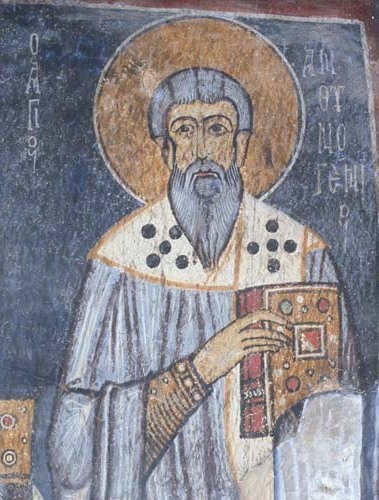
Athenogenes is painted as a hierarch of middle age, dark-haired and with a rounded, grey-streaked beard, vested in phelonion and omophorion and holding the jewelled Gospel; in the Cappadocian manner his phelonion is the polystavrion sown with black crosses. Because his passion is a passion by fire with a company, the narrative type shows him with his ten disciples in a single group — the martyrs crowded shoulder to shoulder, haloes overlapping, sometimes within or above the tomb — rather than in the single-figure execution scene usual for a beheaded martyr. Where his own legend is illustrated, the deer with her fawn may appear at the martyr's feet or at the door of his church.
The stored image is a fresco of the Gümüşler Monastery in Cappadocia, of the period between roughly the seventh and eleventh centuries: the bishop bust-length against the deep blue ground, holding the gemmed book in both hands, and inscribed at either side of the head Ο ΑΓΙΟC — ΑΘΗΝΟΓΕΝΗC. It is the oldest identified likeness of him in situ.
A second stored image is the fourteenth-century fresco of the martyrdom at Dečani in Kosovo (c. 1335–50), from the great menologion cycle of the katholikon: Athenogenes at the right in hierarch's vesture with the Gospel, his disciples pressed together beside him in monastic mantles, the whole company standing behind their sarcophagus, with the Slavonic inscription of his name and, at the right edge, the beginning of the notice of St Marina of the following day.
Disputed questions
-
Was Athenogenes the author of Phos Hilaron? The identification of Basil's "hymn of Athenogenes" with the evening hymn Φῶς ἱλαρὸν ἁγίας δόξης — "O Gladsome Light of the holy glory of the immortal Father" — is made explicitly by Nikodemos the Hagiorite in the Synaxaristes, and through him has passed into a great many Greek and English service books, which print the hymn over the martyr's name. The case for it is that Basil, in the very chapter where he discusses the lamp-lighting hymn, immediately invokes Athenogenes as a witness to the same doctrine; that Athenogenes's hymn was, like Phos Hilaron, plainly Trinitarian and in liturgical use; and that a hymn sung by a man walking to the fire suits a hymn of light.
The case against it is strong and, on the present state of the evidence, stronger. Basil does not say that the two are one; on the contrary, he says of the lamp-lighting thanksgiving that its author cannot be named, and calls the form ancient — an odd thing to write of a text composed by a man who had died perhaps sixty or seventy years earlier, and whom Basil names in the next breath. An evening hymn of this shape is already presupposed by the Apostolic Constitutions, whose material is of the late third or early fourth century, and therefore not obviously later than Athenogenes himself. And the Byzantine liturgical books themselves offer a different name: the Horologion and much Greek usage ascribe Phos Hilaron — at least in its received form — to Sophronius, Patriarch of Jerusalem (†638), who is more plausibly its reviser than its author. Modern scholarship therefore treats the ascription to Athenogenes as a later inference from Basil's sentence rather than as an independent tradition. What survives intact is the fact Basil actually asserts: that the martyr left a hymn, and that its testimony to the Spirit was worth citing. The hymn's text is lost unless Phos Hilaron is it.
-
Which Athenogenes, and which see? The Greek synaxaria call him bishop of Pedachthoe; the Slavonic books transliterate this as Pidakhfoia; but a widely circulated English rendering — followed by the calendar of the Orthodox Church in America — makes him bishop of Heracleopolis, a see in Egypt with which he has nothing to do. The Egyptian title appears to be a transmission error rather than a rival tradition, and the two are the same man: the martyr of the Sebastene country, burned with his ten disciples. Some calendars list, on this same July 16, both "Hieromartyr Athenogenes, bishop" and a bare "Martyr Athenogenes" — a doubling of one entry rather than two saints. He is also to be distinguished from Athenogenes the grandson of Gregory the Illuminator (†c. 331) and from Athenogenes of Petra (fl. c. 600), neither of whom is a martyr.
-
The date. The trial narrative points to 303, the first year of the Diocletianic persecution; the synaxaria and the calendars derived from them commonly give 311, the last. The corpus records both and prefers no single year.
-
The passion and its value. The oldest text of the martyrdom is the Passion ascribed to Anysius, surviving in a tenth-century manuscript of the Patriarchal Library at Jerusalem (Codex Sabaiticus 242) and thought to have been composed in about the sixth century. It is notable for the flat, procedural quality of its court scenes, which has persuaded several scholars that it rests on an authentic record of the proceedings — putting Athenogenes, with a small number of others, among the martyrs whose trial can still be partly heard.