
Basilissa of Nicomedia
The Holy Martyr Basilissa of Nicomedia
Martyr · Child Martyr · Virgin · d. 309
Commemorated 3 September
Basilissa was a girl of Nicomedia, nine years old in the received accounts, who confessed Christ before the governor Alexander during the persecutions at the opening of the fourth century. Scourged and given over to fire and to wild beasts, she remained unharmed, and her constancy so shook the governor that he repented, believed, and was baptized. Basilissa herself died shortly afterwards in peace, praying upon a rock outside the city, where tradition says a spring of water rose at her prayer; the Church nonetheless numbers her among the martyrs, crowned by her sufferings though not slain by them. She is commemorated on September 3.
.jpg)
The account of Basilissa is transmitted by the synaxaria and menologia; no early acts survive. Nicomedia, the eastern imperial capital, was the storm centre of the final persecution (see the entry for Anthimus of Nicomedia, martyred in the same city), and the tradition sets Basilissa's confession in those years, under a governor named Alexander.
Denounced as a Christian, the child — nine years old in the received texts — was arrested and commanded to renounce Christ. She answered with a firmness that the hagiographers set against her age, and Alexander turned to cruelty: she was beaten, the accounts say, and subjected to torments in ascending order, ending in fire and in exposure to wild beasts. Through all of it she was preserved whole, praying, and the spectacle overthrew her persecutor. The tradition relates that Alexander, brought to compunction, fell at the child's feet asking her forgiveness and her prayers, confessed Christ, and was baptized by Antoninus, bishop of the city; he died soon after in peace, reconciled to God.
Basilissa did not long survive her victory. Going out of the city, she stood in prayer upon a rock, and — so the tradition — a spring of water welled up at the place at her prayer; there, having given thanks, she surrendered her soul to God in peace. The bishop Antoninus buried her near the city. The spring was remembered as a place of healing.
Feast and commemoration
September 3 (church date; Old Calendar civil September 16), commemorated in the Byzantine calendars together with Anthimus of Nicomedia and Theoctistus. The Roman Martyrology likewise keeps her on September 3. She has no proper service; the common of a virgin-martyr is used where her memory is celebrated liturgically.
Hymns
Troparion — Tone 4 (from the common of a virgin-martyr)
Thy lamb Basilissa crieth unto Thee with a great voice, O Jesus: Thee, my Bridegroom, do I love, and seeking Thee I contest; I am crucified and buried with Thee in Thy baptism, and I suffer for Thy sake, that I may reign with Thee; I die for Thee, that I may live in Thee. Accept me, then, as a spotless sacrifice offered to Thee with love. By her intercessions save our souls, since Thou art merciful.
Original translation from the Greek
Iconography
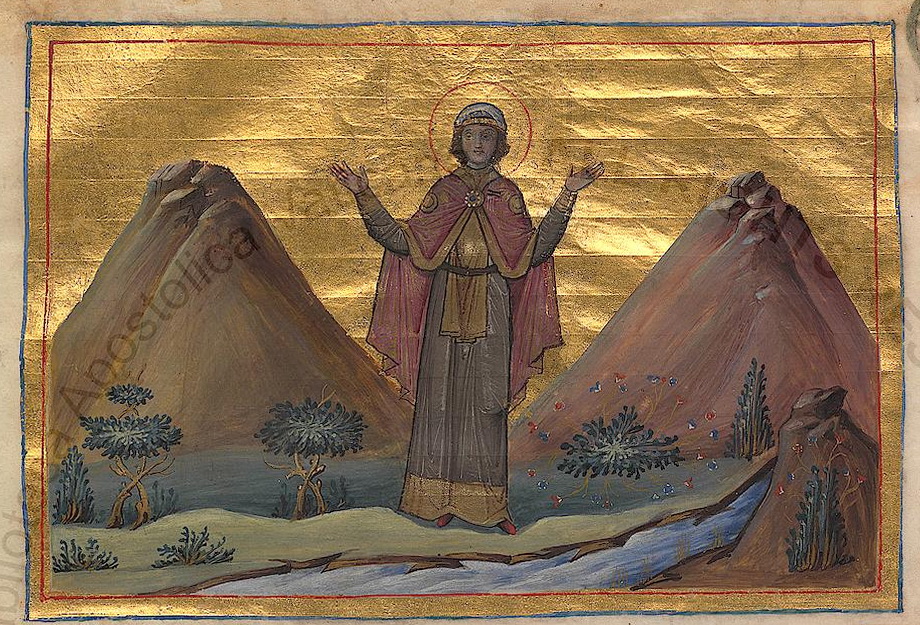
Basilissa is depicted as a young girl — often strikingly small beside her tormentors — in the simple tunic and mantle of a virgin, bearing the martyr's cross, sometimes beside the flames and beasts of her contest or the spring of her repose. The stored image is the miniature from the Menologion of Basil II (Constantinople, c. 985): the child stands alone in a rocky landscape in the orans posture of prayer, a stream at her feet — the moment of her peaceful repose at the spring rather than a scene of execution.
Disputed questions
- Manner of death and the title of martyr. Basilissa died in peace after her torments, not under the executioner; the Church nonetheless commemorates her as a martyr, holding that her confession and sufferings completed the martyr's contest. The Menologion of Basil II accordingly depicts her not in execution but standing in prayer.
- Date and reign. The Slavic tradition and the OCA give the year 309, yet the received account names Diocletian's persecution and his governor; since Diocletian abdicated in 305, either the account telescopes the persecution that continued in the East under Galerius and Maximinus (in whose years 309 falls), or the traditional date is approximate. Some Western catalogues place her suffering c. 302–303. The sources are recorded here without forcing agreement.
- Age. The received hagiography — Greek, Slavic, and the Roman Martyrology alike — gives her age as nine; retellings occasionally round her age or style her simply a "young virgin," but nine is the tradition's consistent figure.
- Not to be confused with other martyrs named Basilissa: Basilissa martyred at Rome with Anastasia (April 15), Basilissa the wife of Julian of Antinoe (January 8), or Basilissa of Aegina. The name (Greek for "queen") was common among early Christian women.