
Anthimus of Nicomedia
The Holy Hieromartyr Anthimus, Bishop of Nicomedia
Hieromartyr · Bishop · d. 302 (or 303)
Commemorated 3 September — Martyrdom at Nicomedia, with his companions
Anthimus was bishop of Nicomedia, Diocletian's eastern capital, when the Great Persecution broke upon the Church there at the opening of the fourth century. After fire in the imperial palace was blamed on the Christians and his flock was slaughtered in great numbers, he governed the survivors from hiding, strengthening the confessors by letter, until soldiers tracked him down; he fed his own captors, revealed himself to them, and went willingly to interrogation, torture, and beheading (302 or 303). Eusebius of Caesarea records his martyrdom within living memory. He is commemorated on September 3 together with the companions of his suffering.
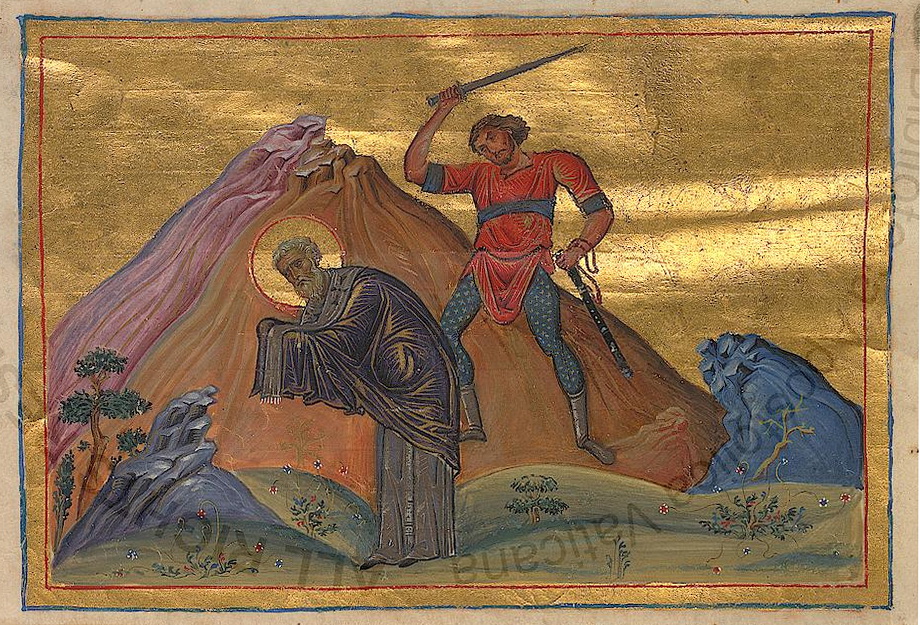
.jpg)
Origins and episcopate
Nothing certain is transmitted of Anthimus's origins. He appears in the record as bishop of Nicomedia in Bithynia at the end of the third century — a see of unusual weight, for Diocletian had made the city his principal eastern residence, and the imperial court, army command, and a large Christian community (including Christians of the palace household itself) lived side by side there. The church of Nicomedia stood on rising ground in full view of the palace, a visibility that would prove fatal.
The persecution at Nicomedia
In February 303 Diocletian, urged on by his caesar Galerius, issued at Nicomedia the first edict of the Great Persecution: the city's church was demolished, the scriptures burned, and Christians stripped of rank and legal protection. Within days fire broke out in the imperial palace — twice within a fortnight, according to Lactantius, who was then teaching in the city and laid the arson at Galerius's own door as a contrivance to inflame the emperor. The Christians were accused, and a massacre followed: courtiers, clergy, and people were executed by sword, fire, and drowning. Eusebius records that whole households of the palace — among them the imperial chamberlains Dorotheus, Gorgonius, and Peter — perished with great multitudes of the faithful.
The hagiographic tradition places Anthimus at the centre of this storm. At the entreaty of his flock he withdrew from the city to a village near Nicomedia (called Semana in the received accounts), not to escape his own death but to preserve a shepherd for the survivors; from there he governed the scattered church, sending letters that strengthened the imprisoned confessors and encouraged the wavering. The tradition connects him particularly with the martyrs Domna the virgin, a converted pagan priestess, and Indes, and with the deacon Theophilus, who carried his correspondence; the interception of such a letter is said to have set the authorities on his trail.
Martyrdom
When soldiers were sent to seize him, the accounts relate that they came unknowing to the very house where the bishop lodged. Anthimus received them, set a table, and served them himself; only afterward did he tell them that he was the man they sought. The soldiers, ashamed, offered to report that they had not found him; Anthimus refused to purchase his life with their lie, went with them willingly, and so instructed them on the road that they believed — the tradition says they received baptism at his hands. Brought before the emperor (the accounts name Maximian), he withstood both persuasion and a succession of torments with a serenity that the hagiographers dwell upon, and was finally beheaded. With him the calendar commemorates the company of his fellow sufferers: the deacon Theophilus, Dorotheus, Mardonius, Migdonius, Peter, Indes, Gorgonius, Zeno, the virgin Domna, and Euthymius.
The historical core is anchored by Eusebius, writing within a decade or two of the events: "Anthimus, who then presided over the church in Nicomedia, was beheaded" (Church History VIII.13), and with him "a whole multitude" of martyrs of that city.
Veneration
The martyrs of Nicomedia were among the most celebrated of the final persecution, and Anthimus's memory spread with theirs. The Byzantine calendar fixed his commemoration, with his companions, on September 3; the great company of the Nicomedian martyrs burned in their church is kept on December 28, where several of the companions named above (Domna, Indes, Gorgonius, and others) recur in the fuller Nicomedia cycle. The Menologion of Basil II (c. 1000) devotes a miniature to his beheading. In the West the older Roman Martyrology kept his memory on April 27.
Feast and commemoration
September 3 (church date; Old Calendar civil September 16), the principal commemoration, kept universally in the Byzantine rite as "the Hieromartyr Anthimus, Bishop of Nicomedia, and those with him." The Greek Menaion appoints him a proper apolytikion and kontakion and a canon by Joseph the Hymnographer. His companions recur within the December 28 commemoration of the martyrs of Nicomedia. The older Roman Martyrology commemorated him on April 27.
Hymns
Troparion — Tone 1
Becoming a firm protector of thy flock, O godly-minded one, thou didst readily shed thy blood on its behalf; and quailing not before the threats of the adversaries, thou now rejoicest in the heavens, standing beside the throne of the three-sunned Godhead. Glory to Christ who strengthened thee; glory to thy valiant soul; glory to thy martyr's steadfastness, O Anthimus.
Original translation from the Greek
Kontakion — Tone 4
Having shone in godliness among the priests and finished the course of martyrdom, thou didst quench the worship of the idols, becoming a champion of thy flock, O godly-minded one; wherefore she now honoureth thee, crying to thee mystically: deliver me ever from dangers by thy prayers, O Anthimus our father.
Original translation from the Greek
Iconography
Anthimus is depicted as an elderly bishop, white-bearded, in phelonion and omophorion, blessing or holding the Gospel; scenes of his martyrdom show him bowed beneath the executioner's sword. The stored image is the miniature of his beheading from the Menologion of Basil II (Constantinople, c. 985): the aged bishop, haloed and bowed in his dark episcopal mantle, awaits the stroke of the swordsman on a golden ground.
Disputed questions
- Year of death. The synaxaria transmit 302; Eusebius and Lactantius tie the Nicomedia massacre to the outbreak of the Great Persecution in February 303, and scholarship accordingly places the martyrdom in 303 or shortly after. Both dates are found in the calendars; neither can be pressed.
- The emperor. The accounts name Maximian as the interrogating emperor, but the events at Nicomedia unfolded under Diocletian and Galerius; the hagiographic use of "Maximian" (a name Galerius also bore) is loose, as often in acts of this period.
- The companions and December 28. The companions of September 3 overlap with the Nicomedian martyrs of December 28; the tradition distributes one body of sufferers across two commemorations, and the same names appear in both cycles without contradiction of persons.
- Another bishop-martyr of Nicomedia. Anthimus is not the only hierarch of Nicomedia martyred at the outbreak of the Great Persecution: the calendar keeps also Theopemptus, styled bishop of Nicomedia and martyred c. 303 with the converted magician Theonas (January 5). The tradition holds the two as distinct hierarchs and distinct feasts — Anthimus on September 3, Theopemptus on January 5 — and they should not be merged.
- The several martyr-companies of Nicomedia. Anthimus and his flock are distinct from the numbered companies the calendar keeps on other days: the 20,000 Martyrs of December 28, the 3,628 Martyrs of September 2, and the 1,003 Martyrs of February 7 — the many witnesses of the one city in the one persecution, kept on several days.