
Bassian of Lodi
Our Father among the Saints Bassian, Bishop of Lodi
Bishop · b. c. 320 — d. c. 409
Commemorated 10 June — Commemoration in the Orthodox calendar
Bassian was bishop of Lodi (Roman Laus Pompeia) in northern Italy for some thirty-five years at the turn of the fourth and fifth centuries, and is remembered chiefly as the friend and fellow-labourer of Ambrose of Milan, with whom he stood against Arianism in the Italian sees and at whose deathbed he was present in 397. Son of the pagan governor of Syracuse, he was sent to Rome for his education, was catechised there by a presbyter named Gordian, and was baptised against his father's will; he withdrew to Ravenna to live in seclusion, and was consecrated bishop of Lodi by Ambrose and by Ursus of Ravenna about 374. At Lodi he built and, in 381, consecrated a great church of the Holy Apostles. He reposed about 409. The Orthodox calendars keep him on June 10; Lodi and the Western books keep his repose on January 19.

Syracuse and Rome
Bassian was born about 320 at Syracuse in Sicily. His father — named Sergius in the Western tradition, and described in the Byzantine notices simply as the ruler or prefect of the city — was a pagan of standing, and sent his son to Rome to complete the education proper to his class.
At Rome, the account says, a presbyter named Gordian (Gordianus; the Italian tradition calls him Giordano) opened to him the substance of the Christian teaching, and he asked for baptism. The notice preserves a detail of the baptism itself: that as he came to the font he saw the figure of an angel standing by it. His father, learning that he had become a Christian, recalled him to Syracuse and pressed him to renounce the faith.
Ravenna
He would not, and left instead for Ravenna — where, in the Western version of the story, a kinsman of his, Ursus, was bishop. Ursus received him and settled him in seclusion at a church of St Apollinaris; there he lived as a solitary, and there the reputation for holiness began that would bring him a see.
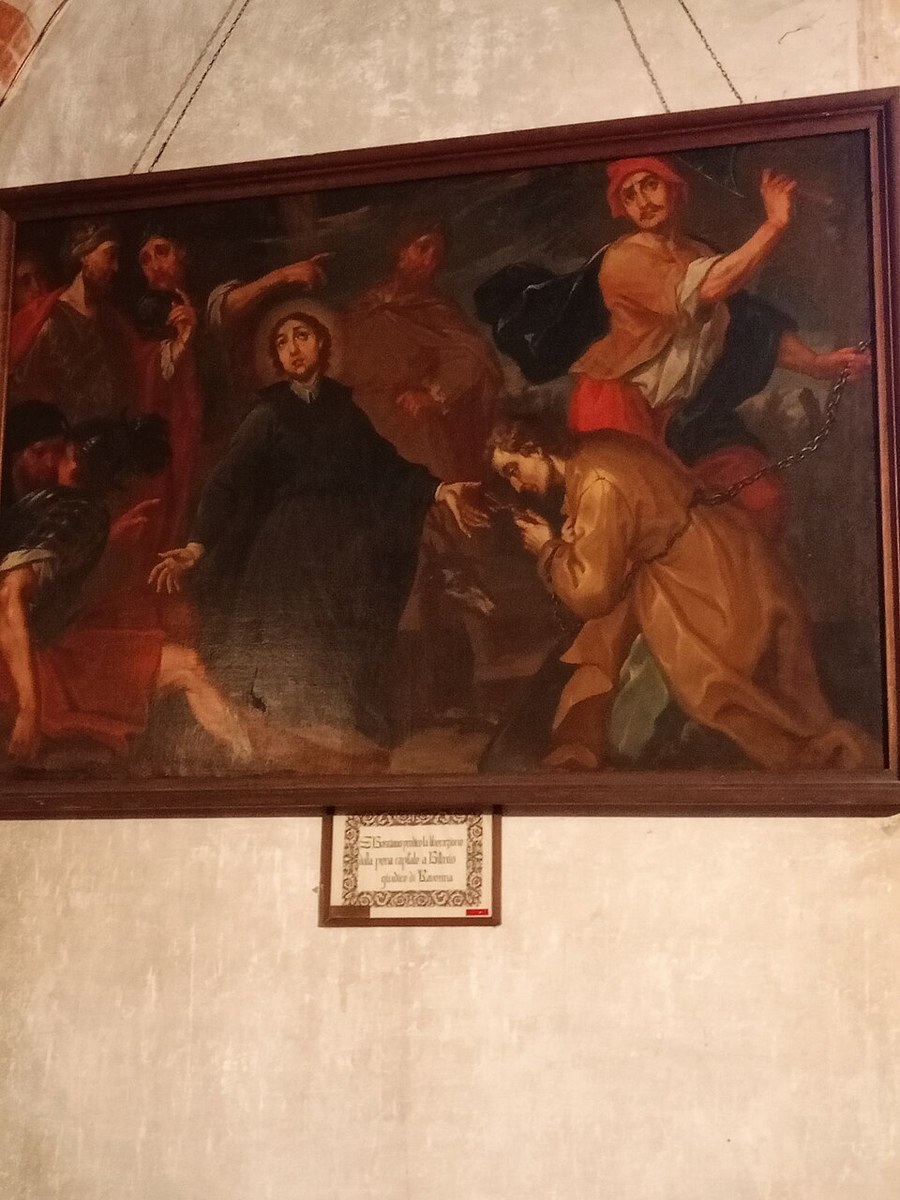
The notices attach to these Ravenna years the miracle by which he was first widely known: that at his prayer the swords of the executioners were repeatedly struck from their hands or turned aside, so that a condemned man they had been sent to behead could not be killed, and an unjust judge was brought to pardon him. It is the earliest of the deliverance-miracles for which he is invoked in the Lodigiano to this day.
Bishop of Lodi
When the see of Lodi fell vacant, about 373–374, Bassian was called to it. The notice says the call came by a vision, in which Clement — the Roman bishop and martyr — directed the choice. He was ordained presbyter and then consecrated bishop by Ambrose of Milan together with Ursus of Ravenna: a consecration by the metropolitan of the region and the bishop who had sheltered him, and the beginning of the long friendship with Ambrose that defines his episcopate.
At Lodi he built a church in honour of the Holy Apostles, which was consecrated in 381 in the presence of Ambrose and of Felix of Como — the date and the attendance are transmitted in the Western tradition, and the basilica that stands at Lodi Vecchio under Bassian's own name is its descendant. In the same year, 381, he took part in the Council of Aquileia, the synod at which Ambrose and the Italian bishops deposed the Arianising bishops Palladius and Secundianus: Bassian's subscription places him squarely in the Nicene party of northern Italy. He corresponded with Ambrose, and with him addressed himself to Pope Siricius on the affairs of the Italian churches.
Ambrose
The friendship is the centre of his memory. The tradition records that Bassian was present at the repose of Ambrose in 397 and that he took part in the burial of his body. In the Byzantine notices this is the fact by which Bassian is introduced — "a contemporary and friend of Saint Ambrose" — and it is the reason a Latin bishop of a small Lombard see came to be commemorated at all in the Greek calendars: the Eastern books received him as one of Ambrose's circle, in the generation of the Nicene victory in the West.
Repose and relics
He reposed in peace, after some thirty-five years as bishop. The Byzantine notices give the year 409; the Western tradition gives 413 (and Wikidata records 8 February 409). He was buried in his own church of the Apostles at Laus Pompeia. When Lodi was destroyed in 1158 in the wars of Milan, the relics were carried to Milan for safety, and in 1163 were brought back to the new city and laid in the cathedral of the Assumption, where they remain in the crypt. He is the patron of Lodi, and its cathedral keeps his feast as its chief day.
Feast and commemoration
June 10 (church date; Old Calendar civil June 23) in the Orthodox calendars, among the day's commemorations after the martyrs and ascetics; January 19 at Lodi and in the Western books, as the day of his repose. He is one of a small group of Latin bishops of the Ambrosian age whom the Byzantine synaxaria received — the criterion being, in effect, association with Ambrose and with the Nicene cause in Italy. He has no proper Byzantine office, and the common of a hierarch is sung. At Lodi his cult is entire and continuous: he is the city's patron, his relics lie in the cathedral crypt, and the Romanesque basilica at Lodi Vecchio that bears his name preserves the seventeenth-century painted cycle of his life described below.
Hymns
Apolytikion — Tone 4 (common of a hierarch)
O God of our fathers, who dealest ever with us according to Thy gentleness: take not Thy mercy from us, but by the prayers of Thy hierarch Bassian, guide our life in peace.
Iconography
Bassian is painted as a hierarch: in the Byzantine manner in phelonion and crossed omophorion, blessing and holding the Gospel-book; in the Western tradition of Lodi in mitre and cope with the crozier, and with the emblem the Lodigiano gives him — the model of his basilica, or a sword broken or falling from the hand, in memory of the deliverance of the condemned man. He is frequently painted beside Ambrose of Milan, the two bishops together, which is how the Ambrosian churches of Lombardy most often show him.
The stored image is a panel from the seventeenth-century painted cycle of the Storie della vita di San Bassiano in the Basilica di San Bassiano at Lodi Vecchio — his own church, on the site of the Roman Laus Pompeia. The scene is one of the deliverance miracles: the haloed bishop stands at the centre with the hand extended, the chained prisoner kneels at his right kissing his hand, and above them the executioner recoils with the sword arrested in mid-air, while soldiers and onlookers start back on the left. A painted cartouche beneath the frame carries the seventeenth-century Italian legend of the scene. The licence position is worth stating plainly: the painting itself is anonymous and out of copyright, but the photograph is an angled architectural shot of the framed canvas on the wall — not a flat faithful reproduction — so the photographer does own his photograph, and the image is stored under his Creative Commons Attribution licence (Giovanni Dall'Orto, 2025), not under the public-domain status of the painting. No pre-1900 Byzantine icon of Bassian exists to be found; the Eastern commemoration never generated one.
Disputed questions
- The year of repose: 409 or 413. The Byzantine and OCA notices give 409 (with thirty-five years in the episcopate); the Italian tradition and most Western reference works give about 413. The two are reconcilable only by moving the consecration, and the sources do not permit a decision. Both figures are recorded here; the entry's record gives c. 409 with the Byzantine notice, and the fifth century is certain either way.
- "In Liguria." The OCA styles him "Bishop of Lodi in Liguria." This reflects the late-Roman province of Liguria (in the sense of Liguria et Aemilia), which included Milan and Lodi — not the modern Italian region of Liguria on the Gulf of Genoa. The see is Lodi in Lombardy.
- Lodi Vecchio and Lodi. Bassian's city was Roman Laus Pompeia, the site now called Lodi Vecchio, six kilometres from the medieval and modern Lodi founded in 1158 after the old city's destruction. His basilica stands at Lodi Vecchio; his relics are in the cathedral of the new city.
- Two feast days. The Orthodox calendars commemorate him on June 10; Lodi, the Roman Martyrology and the Western calendars keep January 19, which the Italian tradition holds to be the day of his death. Why the Byzantine books settled on June 10 is not explained in the notices. Only June 10 is entered in the entry's record, that being the Orthodox commemoration and the calendar this corpus records; January 19 is a Western feast and is noted here in prose rather than listed as an Orthodox feast day.
- Not to be confused with Bassian of Constantinople, the fifth-century Syrian archimandrite of the capital, nor with Bassian of Pertominsk — nor with the fifth-century Bassianus of Ephesus, a bishop of the same name involved in the disputed elections of that see in the 440s, who is not a saint of the calendar.
- His father's name. Sergius is Western; the Byzantine notice gives only "the ruler of Syracuse."