
Bassus, Eusebius, Eutychius and Basilides
The Holy Martyrs Bassus, Eusebius, Eutychius and Basilides
Martyr · d. 303, at Nicomedia
Commemorated 20 January — Martyrdom at Nicomedia under Diocletian
Bassus, Eusebius, Eutychius and Basilides were four men of high rank at Nicomedia — wealthy members of the Senate, or great officers of the court of the emperor Diocletian — who were brought to Christ by the witness of Theopemptus, bishop of Nicomedia, whose steadfastness under torture and miracles they had seen. Denounced as Christians, they laid down the belts and insignia of their office before the emperor and confessed the faith, and were put to death by frightful tortures in the year 303, at the opening of the Great Persecution. They are commemorated on January 20.

The four belong to the terrible persecution that Diocletian and his colleagues unleashed from Nicomedia, the eastern capital, in the year 303 — the fiercest and last of the empire's assaults on the Church, of which Nicomedia, the seat of the imperial court, was the very centre. Bassus, Eusebius, Eutychius and Basilides were not men of the obscure classes but dignitaries of the first rank: the tradition describes them as of great wealth, holding the standing of senators, or (in another strand of the notice) as courtiers and officers of Diocletian himself, men who wore the belt of imperial office.
Their conversion is traced to the martyrdom of Theopemptus, bishop of Nicomedia (commemorated January 5), one of the first victims of the persecution in the city. Seeing the bishop endure the cruelty of his judges with an unshaken spirit, and — the account says — work wonders by the power of Christ, the four were persuaded of the truth of the faith he confessed, and believed and were baptised. When they were in turn denounced to the emperor as Christians and could not be moved from their confession, they unfastened the belts that were the badges of their rank and cast them aside, renouncing the honours of the world for Christ, and gave themselves up to their sufferings.
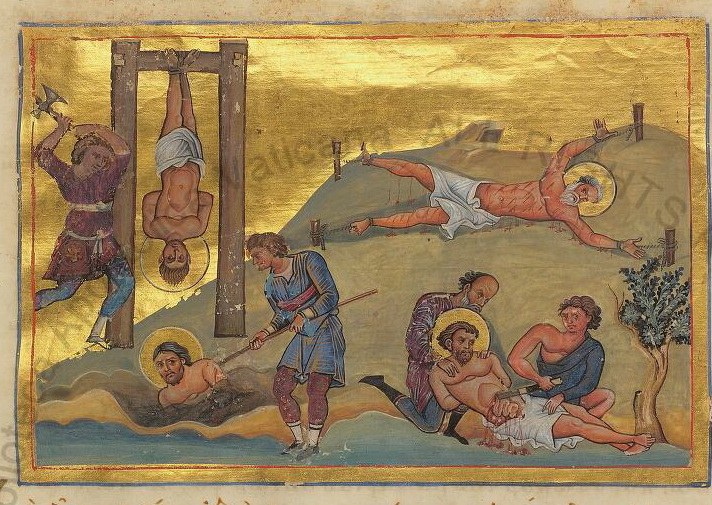
The synaxarion records the four deaths with grim particularity, each martyr perishing by a different torment: Bassus set in a pit to his waist and cut in pieces; Eusebius hung head downward and hewn with an axe; Eutychius stretched out and bound to four stakes and torn apart; and Basilides slain by the sword, his body opened with a knife. So the four went to God together in the year 303, at the beginning of the persecution, and the Church keeps their memory as of a single company of martyrs. Later tradition attaches to them a great multitude of their servants and households — the "1,003 martyrs of Nicomedia" (kept February 7) — who are said to have suffered for Christ in the same days, having followed their masters into the faith.
Feast and commemoration
January 20 (church date; Old Calendar civil February 2), kept in the Byzantine synaxaria and shared with the great desert father Euthymius the Great, who leads the day. The four are commemorated together as martyrs of Nicomedia, their sufferings set within the Diocletianic persecution that gave the Church of that city so many witnesses in the same season — among them the bishop Theopemptus (January 5) whose martyrdom won them, and the great company of the 1,003 (February 7) who are counted their followers.
Hymns
Troparion — Tone 4
Thy Martyrs, O Lord, in their contest received incorruptible crowns from Thee our God; for, possessed of Thy strength, they cast down the tyrants and shattered the feeble insolence of the demons. By their prayers, O Christ God, save our souls.
Original translation from the Greek
Iconography
The four would be depicted together as martyrs of the early Church — men of rank in the mantles and belted tunics of Roman officials, or stripped of these for their confession, each holding the cross of martyrdom, as is usual for a company of witnesses of one day. The stored image is the miniature of the Menologion of Basil II (Constantinople, 985), which shows the four in the distinct manners of their deaths as the synaxarion gives them — one hung and flayed, one buried to the neck, one staked to the ground, one dismembered — the manuscript's four-fold martyrdom scene for the day.