
Euthymius the Great
Our Venerable and God-bearing Father Euthymius the Great
Venerable · b. c. 377, at Melitene in Armenia — d. January 20, 473, aged 97
Commemorated 20 January — Repose at his lavra in the Judaean desert
Euthymius the Great (c. 377 – 473) is honoured by the Church as the father of lavriote monasticism in the Judaean desert — the forerunner and teacher whose discipline Sabbas the Sanctified would carry to its height. Born at Melitene in Armenia and raised under its bishop Otreius, he came to Palestine as a young priest about the year 406, settled first in the Lavra of Pharan and then, with his companion Theoctistus, in the wilderness east of Jerusalem, where he founded the great lavra that bears his name. He converted and baptised the Saracen phylarch Aspebetos — renamed Peter, and made the first bishop of the desert Arabs — and healed his paralysed son Terebon; he trained a generation of the desert's greatest fathers; and in the crisis that followed the Council of Chalcedon he stood immovable for the two natures of Christ, recalling the Empress Eudocia and, through her, a multitude of monks and laity from the Monophysite party to orthodox communion. A worker of many wonders, he reposed on January 20, 473, at the age of ninety-seven, and his Life was written within a lifetime by Cyril of Scythopolis.
.jpg)
The life of Euthymius is preserved with rare completeness. His biographer, Cyril of Scythopolis — a monk of the Judaean desert who lived in Euthymius's own lavra and in the Great Lavra of Sabbas in the 540s and 550s — composed a Life of Euthymius (the Vita Euthymii) as the first and greatest of his series of desert biographies, drawing on the living memory of aged monks such as Cyriacus the Hermit and John the Silent, who had themselves known the saint or his immediate disciples. What follows rests on that near-contemporary witness.
Origins and early life
Euthymius was born about the year 377 at Melitene, the capital of Armenia Secunda on the upper Euphrates — the city whose great martyr Polyeuctus was its glory. His parents, Paul and Dionysia, were Christians of noble Melitene stock, and for long childless. The tradition Cyril transmits is bound up with the saint's very name: praying at a martyr's shrine near the city for the gift of a child, Dionysia heard a voice bid her "Be of good cheer" (euthymei) — for a son would be given her, and given to God — and when the child was born they named him Euthymius, "good cheer," in memory of the joy of that promise. The name would become a theme of his whole cultus, and the hymnographers play on it endlessly: the man of gladness who made the barren desert rejoice.
His father died while he was still a small child. His mother, fulfilling her vow, brought the boy to Otreius, bishop of Melitene — a hierarch of note, who had sat among the fathers of the Second Ecumenical Council at Constantinople in 381 — who took him into the clergy, made him reader, had him educated in the Scriptures and the ascetic life, and in time ordained him priest and set him over the monasteries of the city. Even then Euthymius withdrew each year, at the beginning of Lent, into the solitude of a nearby mountain, so that the desire of the wilderness was in him from the first.
The journey to Palestine
At about the age of twenty-nine, unable any longer to bear the honour and the press of business his office brought him, Euthymius left Melitene secretly and came to the Holy Land. He venerated the holy places of Jerusalem, and then withdrew to the Lavra of Pharan — the semi-eremitic colony some six miles east of the city, the earliest of the Judaean lavras, founded a generation before by Chariton the Confessor. There he took a cell apart from the others, learned the craft of the desert — the plaiting of ropes and baskets — and gave himself to silence and prayer. In the neighbouring cell lived another young ascetic, Theoctistus, and between the two grew a friendship and a common purpose that would shape the whole later history of the desert.
The wilderness of Cutila and the coenobium of Theoctistus
After some years at Pharan, Euthymius and Theoctistus, seeking deeper solitude, went out together each year after Theophany into the utter desert toward the Dead Sea, staying until Palm Sunday. On one such retreat, about the year 411, they came upon a great wadi — the ravine the sources call Cutila — and in its cliff a large and high-mouthed cave, which they made their hermitage, living on the wild herbs of the wilderness and unknown to any but God. Shepherds of the Lazarium found them and carried word to Pharan, and disciples began to come, until the cave could not hold them. There the two founded a coenobium — a communal monastery — in the valley below the cave; and because Euthymius loved stillness above all and would not be an abbot, he set Theoctistus over the community as its superior, himself remaining its father and guide from a little apart. This house, the Lower Monastery or coenobium of Theoctistus, became the training-school of the desert: Euthymius made it his rule that no novice, and no young man, might be received directly into the solitary life, but must first be schooled in obedience and the common life under Theoctistus before being admitted to a cell of his own.
The conversion of the Saracens: Aspebetos and Terebon
The event that first made Euthymius famous was the conversion of a whole nation of the desert Arabs. Aspebetos, a Persian nobleman and chief (phylarch) of the Saracen foederati, had fled the persecution of the Christians in Persia and gone over to the Romans, who set him over the allied Arabs of Arabia. His son Terebon lay paralysed down one whole side of his body, and no physician could help him; but the boy was told in a dream to seek out "Euthymius, the servant of God," in the desert of the Lower Monastery. Aspebetos brought his son and a great company of his people to the saint; Euthymius prayed over the boy, signed him with the Cross, and Terebon rose up whole. At the sight of the miracle Aspebetos, his son, and his whole tribe believed in Christ and asked for baptism; Euthymius catechised and baptised them, giving Aspebetos the Christian name Peter. The converts settled in a permanent camp near the monastery — the Parembolai, "the Encampments" — and Euthymius, unwilling to leave them without a shepherd, obtained from the Patriarch of Jerusalem that Peter be ordained their bishop: the first bishop of the tent-dwelling Saracens, "bishop of the Encampments," who would sit as such among the fathers of the Council of Ephesus in 431. It is one of the earliest and most vivid records of the desert monks' mission to the Arab tribes of the frontier.
The great lavra
The fame of the miracle drove Euthymius, who dreaded honour as others dread disgrace, back into hiding. He fled with a single disciple into the deep desert of Rouba, wandered by the Dead Sea, on the crag of Marda (Masada) where he built a church, and at Ziph near Hebron, where again he healed and converted and could not be hidden. At length he returned to his own wilderness, and about the year 420 settled on a low hill on the road between Jerusalem and Jericho, north of the coenobium. Disciples gathered once more, and there Euthymius founded the monastery for which the Church chiefly remembers him — a lavra on the pattern of Pharan: a colony of solitaries, each in his own cell through the working week, plaiting rope and keeping silence, and gathering only on Saturday and Sunday at the central church for the common Liturgy and a common meal. Its church was consecrated by Juvenal, Patriarch of Jerusalem, in the year 428. The Lavra of Euthymius grew into one of the mother-houses of Palestinian monasticism, and its founder is honoured as the great forerunner of the lavriote life that Sabbas would perfect in the same desert a generation later.
Euthymius governed his lavra with the discipline of the perfect: unbroken silence, manual labour, obedience, the memory of death, and — for all his own severity — an unfailing hospitality and charity to the stranger and the poor. When his monks murmured that the little food in the storehouse could not feed the crowd of pilgrims who had come, the saint bade them serve all the same, and the loaves and oil multiplied and were not spent until all were filled and much remained — one of many wonders Cyril records: rain called down in drought, the barren made fruitful, demons cast out, the future foretold. He would say that the monk must above all things guard humility and the love of the brethren, and that discernment is the mother of the virtues.
Teacher of the desert
From the Lavra of Euthymius came a whole generation of the desert's fathers. The greatest was Sabbas the Sanctified, who came to Euthymius as a youth of eighteen; the old man, discerning his future greatness, called him a "child-elder," but — keeping his own rule — judged him too young for the solitary life and sent him to be trained in the coenobium under Theoctistus, foretelling that he would become a father of monks. Others formed in Euthymius's discipline, or won by him from error, include Cyriacus the Hermit, John the Silent (John the Hesychast, the bishop who became a monk of the desert), and Gerasimus of the Jordan, whom Euthymius recalled from the Eutychian error to the orthodox faith. His closest companion was his disciple Domitian, who served him for many years and would not be parted from him even in death. Two of his monks, Martyrius and Elias, would themselves become Patriarchs of Jerusalem — a succession Euthymius is said to have foretold. Through these disciples his spirit passed into the whole later tradition of the Holy Land.
The defence of Chalcedon and the Empress Eudocia
Euthymius lived through the gravest doctrinal crisis of the fifth-century East. The Fourth Ecumenical Council at Chalcedon (451) confessed Christ acknowledged in two natures, divine and human, in one person — against the teaching of Eutyches that after the union there was but one nature. In Palestine the definition was met by a violent Monophysite reaction: a monk named Theodosius seized the throne of Jerusalem, drove out the lawful Patriarch Juvenal, and carried a great part of the desert's monks into schism. Euthymius alone of the great fathers refused to be moved; he withdrew into the desert of Rouba rather than commune with the usurper, and his steadfastness held a remnant of the monks to the Council.
The turning of the tide is bound up with the Empress Eudocia — widow of Theodosius II, who after her fall from favour had settled in Jerusalem and, in her uncertainty, had been drawn into the anti-Chalcedonian party. Grieved and wavering, she sent to Simeon the Stylite for counsel, and Simeon directed her to "the man of God Euthymius," whose judgement she should follow. At the saint's word — conveyed when she sought him out in the desert, or through his disciples — Eudocia embraced the Council of Chalcedon and returned to communion with the Patriarch; and her conversion drew after it a great multitude of monks and laypeople, so that the empress's submission to the old hermit's counsel became the hinge on which the Holy Land turned back to orthodoxy. For this the Church honours Euthymius, with Theodosius and Sabbas after him, as one of the pillars who held Palestine to the faith of Chalcedon.
Repose
Euthymius governed his lavra to a very great age. On the eve of the feast of Antony the Great (January 17) he told the brethren, who had gathered as was their custom, that he would not be with them for next year's feast, for God was calling him within the week. He gave them his last counsels — to keep love and humility above all, never to close the monastery's doors to the stranger — set his affairs in order, and appointed for the lavra its future (asking that after his death it be made a coenobium, as in time it was). He reposed on January 20, in the year 473, having lived ninety-seven years, of which some sixty-eight had been spent in the desert. Anastasius, Patriarch of Jerusalem, came with a vast concourse of monks and people to his burial, which was delayed until evening by the press of the crowd. His faithful Domitian, refusing to leave the tomb of his master, reposed seven days later and was buried beside him. Miracles multiplied at his grave, and the Lavra of Euthymius kept his relics as its treasure for centuries.
Feast and commemoration
Euthymius is kept universally on January 20 (church date; Old Calendar civil February 2), the day of his repose. The Antiochian, Greek and Slavic calendars agree on the day, and he is one of the most celebrated of the desert fathers throughout the Orthodox world — very frequently named in one breath with Sabbas the Sanctified (December 5) and Theodosius the Cenobiarch (January 11), the three reckoned together as the great fathers of the Judaean desert: Euthymius and Sabbas of the lavra, the solitary life, and Theodosius of the coenobium, the common life. In the Greek books he is ὁ Μέγας, "the Great"; the whole of his office turns on the play of his name — euthymia, "good cheer" — set against the desert his labours made to rejoice. His day falls after the close of the afterfeast of Theophany, so that his own service is sung without festal interruption.
Hymns
Troparion — Tone 4
Rejoice, O barren wilderness that hast not borne; be of good cheer, thou that hast not travailed; for a man of desires for the things of the Spirit hath multiplied thy children, planting them in godliness and rearing them in temperance unto the perfection of the virtues. By his intercessions, O Christ God, grant peace to our life.
Original translation from the Greek
Kontakion — Tone 8
In thy honoured birth creation found its joy, and in thy divine memorial, O venerable one, it received the gladness of thy many wonders. From these bestow richly upon our souls, and cleanse away the stains of our sins, that we may cry to thee: Alleluia.
Original translation from the Greek
Appointed readings
Epistle — 2 Corinthians 4:6–15 (common of a venerable father; the OCA lectionary, 2026, appoints Hebrews 13:17–21 — recorded side by side)
6For God, who commanded the light to shine out of darkness, hath shined in our hearts, to give the light of the knowledge of the glory of God in the face of Jesus Christ. 7But we have this treasure in earthen vessels, that the excellency of the power may be of God, and not of us. 8We are troubled on every side, yet not distressed; we are perplexed, but not in despair; 9Persecuted, but not forsaken; cast down, but not destroyed; 10Always bearing about in the body the dying of the Lord Jesus, that the life also of Jesus might be made manifest in our body. 11For we which live are alway delivered unto death for Jesus’ sake, that the life also of Jesus might be made manifest in our mortal flesh. 12So then death worketh in us, but life in you. 13We having the same spirit of faith, according as it is written, I believed, and therefore have I spoken; we also believe, and therefore speak; 14Knowing that he which raised up the Lord Jesus shall raise up us also by Jesus, and shall present us with you. 15For all things are for your sakes, that the abundant grace might through the thanksgiving of many redound to the glory of God.
Gospel — Luke 6:17–23 (common of a venerable father)
17And he came down with them, and stood in the plain, and the company of his disciples, and a great multitude of people out of all Judæa and Jerusalem, and from the sea coast of Tyre and Sidon, which came to hear him, and to be healed of their diseases; 18And they that were vexed with unclean spirits: and they were healed. 19And the whole multitude sought to touch him: for there went virtue out of him, and healed them all. 20And he lifted up his eyes on his disciples, and said, Blessed be ye poor: for yours is the kingdom of God. 21Blessed are ye that hunger now: for ye shall be filled. Blessed are ye that weep now: for ye shall laugh. 22Blessed are ye, when men shall hate you, and when they shall separate you from their company, and shall reproach you, and cast out your name as evil, for the Son of man’s sake. 23Rejoice ye in that day, and leap for joy: for, behold, your reward is great in heaven: for in the like manner did their fathers unto the prophets.
Iconography
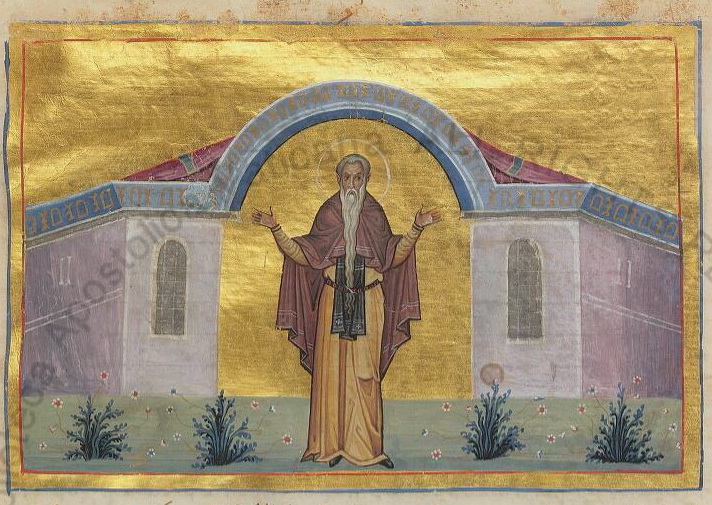
Euthymius is depicted as an aged desert father of the most venerable type: very old, gaunt with fasting, with a long, tapering white beard reaching nearly to his waist — one of the most distinctive beards in Byzantine iconography, by which he is recognised at once — vested in the monastic schema and mantle, holding a scroll or making the gesture of blessing. He is often set among the choir of the holy monastic fathers, and paired or grouped with Sabbas, Theodosius, and the other saints of the Judaean desert. Narrative scenes from his Life illustrate the healing of Terebon and the baptism of the Saracens, the multiplication of the loaves, and his repose.
The stored image is the miniature for January 20 from the Menologion of Basil II (Constantinople, c. 985; Vatican, Vat. gr. 1613), the standard first-resort portrait: Euthymius as an aged monk with his long white beard, the father of the desert (source, public domain, pd-old-work).
Disputed questions
- Chronology. The precise years of Euthymius's foundations vary a little in the reckoning of the sources and of modern scholars: his coming to Palestine is placed about 405–406, the retreat to the wadi and the coenobium of Theoctistus about 411, and the founding of the great lavra about 420, with its church consecrated by Juvenal in 428. The dates of his birth (c. 377) and repose (473, aged 97) are fixed by Cyril of Scythopolis, who counts his years exactly.
- "Armenian." Euthymius is often styled "the Armenian" from his birth at Melitene in Armenia Secunda; he was a Greek-speaking Roman of the eastern provinces, and the epithet is geographical, not a claim of a separate church allegiance — he was throughout his life a monk and priest of the imperial (Chalcedonian) Church.
- Not to be confused with the several later saints who bear the name Euthymius: Euthymius of Sardis, the iconodule hieromartyr-confessor (†c. 831, December 26); Euthymius the New of Thessalonica, the Athonite (†898, October 15); Euthymius, Patriarch of Trnovo, the Bulgarian (†c. 1402), who is in fact commemorated on this same day, January 20; Euthymius of Novgorod, the archbishop (†1458, March 11); and Euthymius Kereselidze, the Georgian confessor (†1944), also kept on January 20. "The Great" and "the father of the lavras" belong to this Euthymius alone.