
Bede the Venerable
Our Venerable Father Bede, Presbyter of Jarrow, the Church Historian
Venerable · Priest · b. c. 672–673, in the lands of Wearmouth–Jarrow, Northumbria — d. 25/26 May 735, at Jarrow
Commemorated 27 May — Commemoration of his repose (transferred from May 25/26)
Bede (c. 673–735), monk and presbyter of the twin monastery of Wearmouth–Jarrow in Northumbria, is the greatest scholar of the early English Church and the first historian of the English people. Given to the monastery at the age of seven, he never willingly left it, and in the ordered round of the offices he produced the biblical commentaries, the De temporum ratione that fixed the Church's science of the calendar, the two Lives of St Cuthbert, and above all the Ecclesiastical History of the English People (731), the book to which everything known about the conversion of England ultimately goes back. It is largely through Bede that reckoning from the Incarnation — anno Domini — passed into general use. He died at Jarrow on the eve of the Ascension in 735, dictating to the last, and his relics rest at Durham. The Church commemorates him on May 27; the epithet Venerabilis, attached to his name within a century of his death, has never been replaced by another.

Origins and the twin monastery
Bede was born about 672 or 673, as he tells us himself, "in the territory of this monastery" — the lands granted to Benedict Biscop for the foundation of St Peter's at Wearmouth (674) and St Paul's at Jarrow (682) on the coast of Northumbria, near the mouths of the Wear and the Tyne. Of his family nothing is known; the fact that he was handed over at seven years old to be brought up by monks suggests neither poverty nor nobility in particular, only the ordinary practice of oblation.
He was given to Benedict Biscop, the founder — the most travelled Englishman of his generation, who had been five times to Rome and came home with books, relics, glass and a chanter from St Peter's to teach the Roman use. That library, the best north of the Alps, made Bede possible. When Jarrow was founded Bede was transferred there, under Ceolfrith, and there he remained for the rest of his life.
The plague of 686
In 686 plague swept the Jarrow community and killed every monk who could read or sing the office except the abbot Ceolfrith and one small boy. Ceolfrith and the child kept the psalmody going alone, in tears, until the community could be rebuilt. The anonymous History of the Abbots records the incident; the boy is almost universally taken to be Bede himself, then about thirteen. It is the first thing we know about him after his oblation, and it is characteristic: the office was to be sung whatever happened, and he was the one who stayed to sing it.
Deacon, priest, and the life of the cell
He was ordained deacon at nineteen — well below the canonical age of twenty-five, which his abbot judged his gifts to justify — and priest at thirty, in both cases by St John of Beverley, bishop of Hexham. He recorded of himself that from the time he received the priesthood to his fifty-ninth year he had made it his business "to note briefly, out of the works of the venerable Fathers, what needed noting, or to add to it something after the manner of their sense and interpretation." He put the matter more simply elsewhere: it had always been sweet to him to learn, to teach, and to write.
His attachment to the choir offices was total. When illness came upon him at the end he was distressed less by dying than by the thought of being absent from the assembly: "What if they do not find me among the brethren when they gather? Will they not say, where is Bede?"
The works
Bede's output covers nearly the whole field of the learning available to him:
- Scriptural commentary, which he regarded as his principal work and which occupies the greatest part of it — on Genesis, Samuel, Kings, Ezra and Nehemiah, the Song of Songs, Tobit, Mark, Luke, Acts, the Catholic Epistles and the Apocalypse — always gathered from the Fathers, above all Augustine, Jerome, Ambrose and Gregory, and always in the patristic manner of spiritual as well as literal exposition.
- The computus. De temporibus (703) and the great De temporum ratione (725) are the standard medieval treatises on the reckoning of time: the divisions of the day and the year, the lunar cycle, the nineteen-year Paschal cycle of the Alexandrian and Roman tradition, and the calculation of the date of Pascha. Attached to the latter is a world-chronicle. Bede's advocacy of the Alexandrian–Roman Paschalion against the older insular reckoning — the controversy settled for Northumbria at the Synod of Whitby in 664, which he describes at length — was the practical purpose of the work. He also composed De natura rerum, a compact natural science drawn largely from Isidore and Pliny, in which he gives a correct explanation of the tides in relation to the moon.
- Anno Domini. Bede did not invent dating from the Incarnation — Dionysius Exiguus had computed it — but by adopting it consistently in his chronicles and in the Ecclesiastical History he made it the ordinary reckoning of the Latin world, and through it of the modern one. He also used, and effectively introduced, dating backwards ante incarnationem.
- Hagiography and history of his own house: a metrical and then a prose Life of St Cuthbert, a Life of Anastasius, the History of the Abbots of Wearmouth and Jarrow, and a martyrology — the first historical martyrology, giving not only the names but what was known of the passions.
- Grammar and metre: De arte metrica, De orthographia, De schematibus et tropis, textbooks for the monastic school.
- Letters, of which the most important is the Letter to Egbert (734), a hard and unsparing analysis of the failings of the Northumbrian Church: absentee and money-getting monasteries, dioceses too large to be pastored, bishops who never visited their people, and the remedy — more sees, more preaching, catechesis in the vernacular, and the Creed and the Lord's Prayer in English for those who had no Latin.
The Ecclesiastical History
The Historia ecclesiastica gentis Anglorum, finished in 731 and dedicated to King Ceolwulf of Northumbria, is a work of a different order from anything else written in the West for centuries. In five books it carries the story from Caesar's landing to Bede's own day, and its subject is the coming of the Gospel to the English: the mission of Augustine from Gregory the Great, the conversion of Kent, Northumbria, East Anglia and the rest, the Irish mission of Aidan from Iona, the labours of Cuthbert, the Synod of Whitby, the work of Theodore of Tarsus at Canterbury.
Two things distinguish it. The first is method: Bede states his sources in his preface, names the men who supplied him with information, sent to Rome for copies of the papal letters he wanted to quote, and reproduces documents in full — practices that would not become normal again for a thousand years. The second is judgement. Bede was a partisan of the Roman Paschal reckoning and says so, but he writes of the Irish ascetics he disagreed with — of Aidan above all — with an admiration that is plainly unfeigned, and he is candid about the sins of English kings and bishops. The History is the reason that the earliest English Christianity is knowable at all, and its incidental record of practice is of direct interest to Eastern readers: the fast on Wednesday and Friday, a forty-day fast before the Nativity, the frequency of the offices, all set down as matters of course.
Repose
In the spring of 735, as Pascha passed, Bede's breathing failed him — the Epistola de obitu Bedae of his disciple Cuthbert describes his last weeks in detail and is one of the great death-narratives of Christian antiquity. He continued to teach and to chant the psalms and antiphons of the season. He had two works in hand: a translation of the Gospel of St John into English, and a set of extracts from Isidore of Seville. On the Tuesday before Ascension he grew much worse but went on dictating through the day and into the night. The next day, the eve of the Ascension, the boy Wilbert who was writing for him said, "Dear master, there is one sentence left." "Write it quickly," said Bede. When the boy said, "It is finished," Bede answered, "You have spoken truly; it is finished." He asked to be lifted so that he could face the oratory where he had prayed; he distributed his few possessions — pepper, napkins and incense — among the priests of the monastery; and having sung the Gloria Patri he died as he came to the end of it, on the evening of 25 May, or in the reckoning that begins the day at sunset, 26 May 735.
Relics and afterlife
He was buried at Jarrow. About 1022 his bones were removed — carried off, in the frank account of the Durham tradition, by the sacrist Alfred Westou — to Durham, and laid with the relics of St Cuthbert, whose Life he had written; from 1370 they have rested in their own tomb in the Galilee chapel of Durham Cathedral, where the shrine, defaced at the Reformation, still marks the place.
The title Venerabilis appears in the ninth century and by the eleventh is inseparable from his name; a council at Aachen in 836 already cites "Bede the venerable." He was the only English writer whom the whole medieval West read as an authority, and the only Englishman Dante names among the doctors in the heaven of the sun (Paradiso X). His works were copied everywhere; the eighth-century Northumbrian manuscript of the Ecclesiastical History now in St Petersburg — the Codex Petropolitanus, the "Leningrad Bede" — contains what may be the earliest historiated initial in Western art.
Feast and commemoration
May 27 (church date; Old Calendar civil June 9), a transferred commemoration of his repose on 25/26 May 735 (see Disputed questions). In Orthodox use the day is kept by the Orthodox Church in America and in the calendars of Western saints maintained by the Russian Church Abroad and in Antiochian Western-rite parishes; there is no Greek observance. Since no Byzantine propers exist, the office is served from the common of a venerable father, and where a proper is used it is a modern composition. In England his day is also kept at Durham, at the shrine in the Galilee chapel, and at Jarrow.
Hymns
Troparion — Tone 8
From thy childhood thou wast offered to God in the house of the saints, and there, asking nothing of the world, thou didst learn and teach and write until thine evening; wherefore the Church of the English calls thee her father and the whole Church her teacher, O venerable Bede: entreat Christ God to enlighten our minds and to save our souls.
Original translation from the Latin
Kontakion — Tone 2
Dictating with thy last breath the word of the Gospel, thou didst finish thy book and thy life together, and singing "Glory to the Father" thou didst depart to the light thou hadst described; O Bede, teacher of the reckoning of times, pray that we may be found watchful in the hour that is ours.
Original translation from the Latin
Iconography
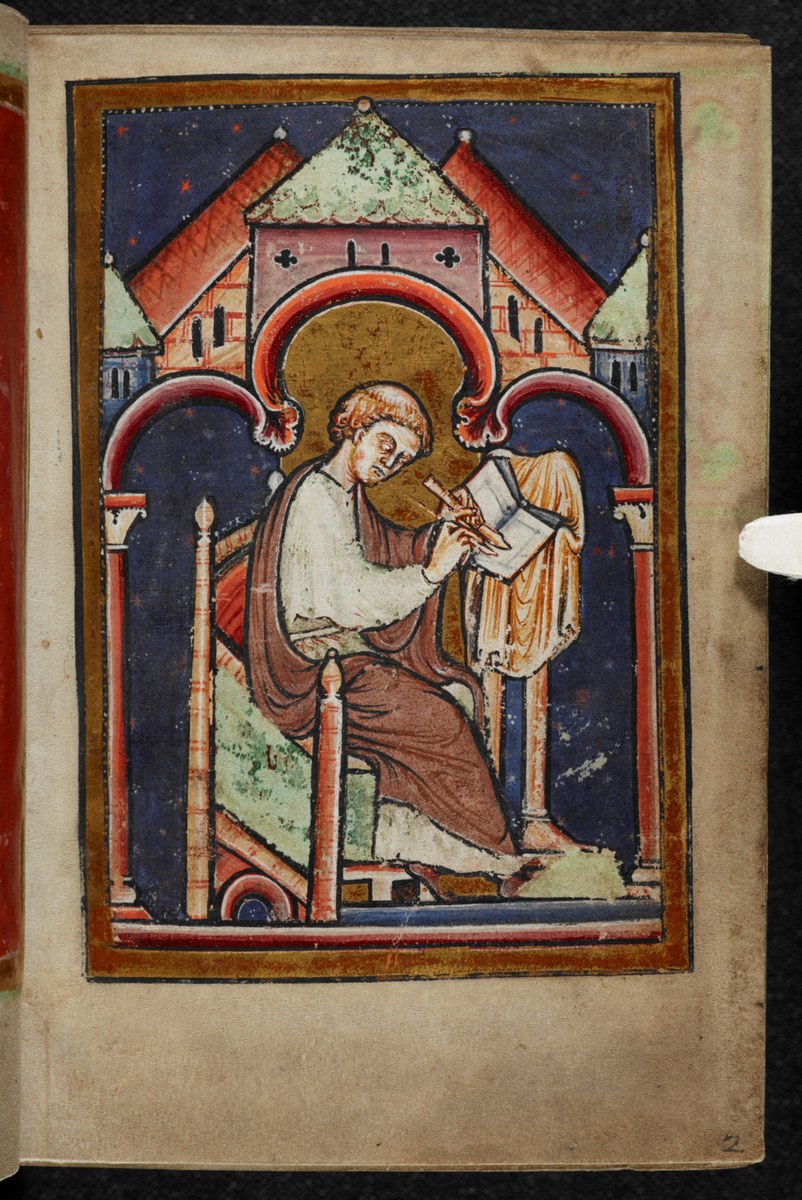
Bede is not a saint of the Byzantine painters, and his imagery is Western and literary: he is the scholar-monk at his desk. The type, fixed by the twelfth century, shows a tonsured monk in the black Benedictine habit seated on a bench or chair with a book open on a lectern before him, pen in the right hand and knife or scraper in the left, under an arcade or an architectural canopy that stands for the monastery; where he is treated as a saint rather than merely as an author, he is given the nimbus. In later Western painting he appears as a very old man, sometimes with the crozier of an abbot (which he never was), and there is a small tradition of the death of Bede, the dying monk dictating to the boy Wilbert. Modern Orthodox icons of him, painted since his reception into the Western-saints calendars, follow the manuscript type — the monk with book and pen — and often set the towers of Jarrow behind him or place a scroll in his hand inscribed with the opening of the Ecclesiastical History.
The stored image is the author-portrait from a late twelfth-century English copy of Bede's own prose Life of St Cuthbert (British Library, Yates Thompson MS 26, fol. 2r): the tonsured monk, nimbed, seated writing at a slanted desk beneath a gabled church, the sky of the miniature strewn with stars. It is the earliest well-known image of Bede and the source of the crops used for him generally; the same manuscript supplies the stored icon of Cuthbert of Lindisfarne. A second unambiguous public-domain likeness, inscribed Beda venerabilis, is the woodcut of the Nuremberg Chronicle of 1493, in which he is shown in cap and gown reading from an open book.
Disputed questions
- Orthodox veneration. Bede belongs entirely to the undivided Church: he died in 735, more than three centuries before the schism, and nothing in his theology bears on the later controversies — he knows nothing of a Filioque in the Creed, and his Paschal computus is the Alexandrian one the East also keeps. He has accordingly been received without difficulty in the Orthodox calendars of the pre-schism Western saints: he is in the menologion of the Orthodox Church in America at May 27, in the lists of Western saints kept by the Russian Church Abroad, and in the Western-rite usage of the Antiochian Archdiocese. He has no Byzantine office and appears in no Greek Menaion; his Orthodox commemoration rests on his pre-schism standing and on the reception of the British and Irish saints in the twentieth-century Orthodox West, not on an ancient Eastern cultus.
- May 25, 26 or 27? Bede died on the evening of Wednesday 25 May 735 — the vigil of the Ascension — which by the liturgical reckoning of the day is already 26 May, and the Western tradition long kept him on 27 May because 26 May was occupied by Augustine of Canterbury. The Roman calendar moved him back to 25 May in 1969; the Orthodox commemoration has stayed on 27 May, and that is the date used here. His church_date is therefore a transferred one, and no primary feast of his falls on the day of his actual death.
- "Doctor of the Church." Bede was declared a Doctor of the Church by the Roman Catholic Church in 1899 (the only Englishman so named). The title has no Orthodox equivalent and is recorded here only as part of his Western reception.
- The name. Bǣda in Old English, Beda in his own Latin; "the Venerable Bede" is the invariable English form and is used here, though name follows the repository's no-prefix rule.