
Cuthbert of Lindisfarne
Our Venerable Father Cuthbert, Bishop of Lindisfarne, Wonderworker of Britain
Venerable · Bishop · Wonderworker · b. c. 634, Northumbria — d. 687
Commemorated 20 March — Repose on the Inner Farne island
Cuthbert (c. 634 – 687) was the greatest saint of the early English Church and the wonderworker of Northumbria — a shepherd boy who, seeing in a vision the soul of Bishop Aidan borne to heaven, became a monk of Melrose, then prior of Lindisfarne, a tireless missionary among the villages of the north, and at last, drawn against his will from the solitude of the Farne islands, bishop of Lindisfarne. He united in one life the Celtic and the Roman streams of British Christianity, accepting the Roman usages of the Synod of Whitby while keeping the ascetic austerity of the Irish tradition, and he was famed in life and after death for miracles, for his gentleness, and for a familiarity with the wild creatures and the sea that the tradition treasures. He reposed on his hermit's island of Inner Farne on March 20, 687; his body was found incorrupt eleven years later, and his relics, carried through centuries of upheaval, came at last to rest at Durham. He is honoured throughout the Orthodox calendar as a father of the undivided Church.

Origins and early life
Cuthbert was born about the year 634, in the kingdom of Northumbria, in the generation that saw the northern English brought to the faith by the Irish monks of Iona and their mission at Lindisfarne under Saint Aidan. Orphaned or fostered young, he was raised in the countryside and set as a boy to keep sheep on the hills near the river Leader. The tradition, gathered by Bede within living memory of the saint, tells that one night in 651, as he watched his flock, Cuthbert saw the sky open and a soul of great brightness carried up by angels; learning afterward that Bishop Aidan had died in that very hour, he took the vision as his call, and gave himself to God.
Monk and missionary
He entered the monastery of Melrose, on the Tweed, under its holy prior Boisil, whose disciple he became and whose gentleness and gift of prophecy he inherited. Trained there in the Scriptures and the ascetic life, Cuthbert went out tirelessly to preach, travelling on foot and on horseback through the remote hill villages that other teachers neglected, reconciling the half-converted country people who in times of plague had fallen back to charms and idols, and drawing them by his patience and his evident holiness. When the abbot Eata was given the monastery of Ripon, Cuthbert went with him; but when Ripon was required to adopt the Roman observance, and Eata's community, still keeping the Irish customs, withdrew, Cuthbert returned north.
The great question of his age was the division between the Celtic and the Roman reckonings — of the date of Pascha, of the form of the tonsure, and of much custom besides. At the Synod of Whitby (664) the Northumbrian Church resolved to follow the usage of Rome, and Cuthbert, made prior of Lindisfarne soon after, accepted the decision and laboured with patience and firmness to lead his sometimes reluctant brethren into the common practice of the wider Church — a work of unity for which the tradition especially honours him, joining as he did the austerity of the Irish monastic life to the catholic order of the whole Body.
The hermit of Farne
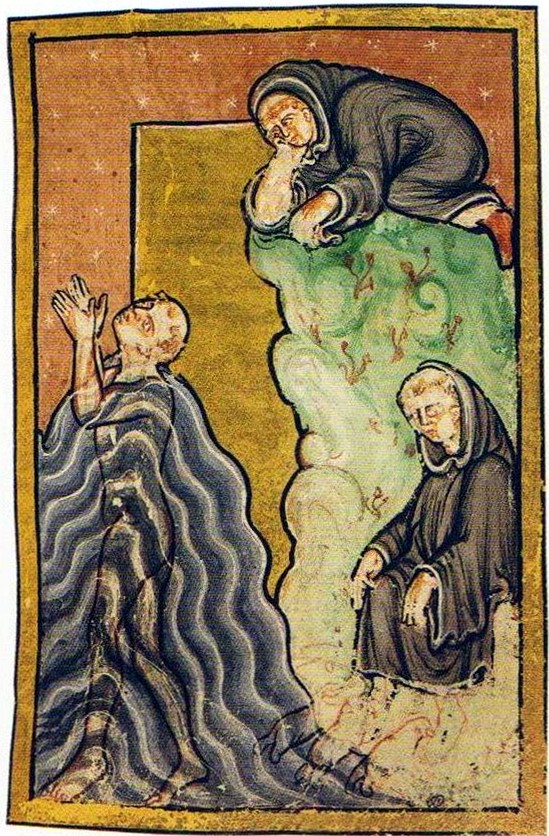
For all his labours among men, Cuthbert's heart was set on solitude. About 676 he withdrew, with his abbot's leave, to the bare and wind-scoured island of Inner Farne, off the Northumbrian coast, and there built himself a cell walled so high that he could see nothing but heaven, and lived as a hermit in prayer, fasting, and the working of the ground. The stories of these years are among the best-loved in English hagiography: how the sea-birds obeyed him and the eider ducks — "Cuthbert's ducks" — nested about his cell under his protection; and how, when he had spent a winter night standing in the cold sea in prayer, two otters came from the water at dawn to warm and dry his feet with their breath and their fur, and received his blessing before returning to the deep. In such tales the tradition sees the restoration, in the saints, of the peace between man and the creation that was lost in Eden.
Bishop of Lindisfarne, and repose
So great was his renown that in 684 a synod under King Ecgfrith and Archbishop Theodore of Canterbury chose Cuthbert bishop of Lindisfarne, and only the king's own coming to his island, with the bishops, moved him to leave his cell; he was consecrated at York at Easter 685. For two years he governed the see as he had lived, ceaselessly visiting his people, healing the sick, and giving to the poor, his episcopate marked by the same miracles and the same tenderness as his monastic life. Feeling his end near, he laid down the office after Christmas 686 and returned to Inner Farne, and there, ministered to by a few of his monks, he reposed on the night of 20 March 687, having received the Holy Mysteries. His body was carried to Lindisfarne and buried in the church.
Relics and translations
When his tomb was opened eleven years later, in 698, to translate his bones — as was the custom — the body of Cuthbert was found whole and incorrupt, the limbs supple and the vestments fresh, and this incorruption fixed his cult as the foremost in England. His shrine at Lindisfarne became the goal of pilgrims, and in his honour was made the masterpiece of Insular art, the Lindisfarne Gospels. When the Danish raids drove the monks from the island in 875, they bore the saint's body with them on a long wandering through the north, until it came to rest first at Chester-le-Street and at last, in 995, at Durham, where the great cathedral rose over his tomb. His relics — with his pectoral cross, his portable altar, and his wooden coffin, all still preserved — survived even the despoiling of the shrine at the Reformation, and Cuthbert remains the patron and glory of the north of England.
Feast and commemoration
Cuthbert is commemorated on March 20 (church date; New Calendar civil March 20, Old Calendar civil April 2), the day of his repose, kept within Great Lent. As a saint of the undivided Church — a father of Britain from the centuries before the schism between East and West — he is received into the Orthodox calendar and honoured in the Orthodox parishes of the British Isles and beyond; the OCA and other jurisdictions name him among the day's saints as "Cuthbert, Wonderworker of Britain." His translation and the finding of his incorrupt body are kept in the Western tradition on September 4. The feast falls in Lent, so that where it does not meet a Saturday or Sunday his memory is kept at the Lenten services rather than at a full Liturgy.
Hymns
Troparion — Tone 8
In thee, O Father, was preserved unfailingly that which is according to the image; for taking up thy cross thou didst follow Christ, and by thy deeds thou didst teach us to despise the flesh, for it passeth away, but to have care for the soul, a thing immortal. Wherefore thy spirit, O venerable Cuthbert, rejoiceth with the angels.
Original translation from the Greek
Iconography
Cuthbert is depicted as a bishop-monk of the early English Church: vested as a hierarch, with the omophorion and the Gospel, or in the monastic habit as the hermit of Farne; his emblems are the eider ducks that shelter under his care and the otters that warmed his feet, and in later English images the crowned head of King Oswald, whose relics were laid in his coffin. The stored image is a miniature from the illustrated Prose Life of Saint Cuthbert by the Venerable Bede (British Library, Yates Thompson MS 26), made in the late twelfth century, most likely at Durham: it shows the saint at the shore after his night of prayer in the sea, and the two sea-creatures come from the water to dry and warm his feet, while a watching brother looks on — the miracle by which the tradition remembers his fellowship with the creation.