
Benedict of Nursia
Our Venerable Father Benedict of Nursia, Father of Western Monasticism
Venerable · b. c. 480, at Nursia in Umbria — d. c. 547 (traditionally 21 March), at Monte Cassino
Commemorated 14 March — Repose at Monte Cassino (Byzantine commemoration)
Benedict of Nursia (c. 480 – c. 547) is honoured as the father of Western monasticism and one of the great ascetic fathers of the undivided Church. Born of a well-born Umbrian family and sent to study at Rome, he fled the corruption of the city while still young and became a hermit in a cave at Subiaco, where he was fed by the monk Romanus and slowly gathered disciples. From twelve small communities at Subiaco he passed to the mountain of Monte Cassino, where he destroyed the last shrine of Apollo, built his great monastery, and composed the Rule that bears his name — a "little rule for beginners," drawn from Scripture and from the Eastern fathers (Basil, Cassian, the anonymous Rule of the Master), which became the charter of monastic life throughout the Latin West. His life is known almost wholly from the second book of the Dialogues of Pope Gregory the Great (the Dialogist), which tells of his miracles, his gift of prophecy, his yearly meetings with his sister Scholastica, and his death standing in prayer before the altar. The Byzantine calendar keeps him on March 14.

The whole of what is securely told of Benedict comes from a single source: the second book of the Dialogues of Pope Gregory the Great (Gregory the Dialogist, commemorated in the Byzantine calendar on March 12), written about the year 593, less than fifty years after Benedict's death, and resting — Gregory insists — on the testimony of four of the saint's own disciples, abbots whom he names. It is a work of edification, ordered by the miracles it recounts rather than by a strict chronicle, and Gregory's own confessed aim is to show that the age of the saints was not past and that Italy too had its wonder-workers; but it preserves the shape of a real life, and it is corroborated at its centre by the one indisputable monument Benedict left behind him, the Rule.
Origins and early life
Benedict was born about the year 480 at Nursia (modern Norcia), a town of the Sabine and Umbrian uplands of central Italy, into what Gregory calls a family "of free rank" — provincial gentry of the still-Roman order that survived, for a generation more, the collapse of the Western Empire; the boy was born in the very decade in which the last emperor of the West was deposed. An early and tenacious tradition, already old by the ninth century, gives him a twin sister, Scholastica, consecrated to God from her childhood as he was to be. Sent in youth to Rome for the liberal studies proper to his rank, he found the city — still outwardly grand, inwardly dissolving — a school of vice rather than of wisdom, and "lest he too should be dashed against the same rocks," Gregory says, he withdrew from the schools "knowingly unlearned and wisely untaught" (scienter nescius et sapienter indoctus), abandoning both his studies and his inheritance to seek God alone.
Ascetic struggle: Enfide and the cave of Subiaco
He fled first to Enfide (Affile), some thirty miles east of Rome, where he lived quietly among a company of devout men and worked his first recorded wonder — the mending of a broken sieve his old nurse had borrowed, made whole again by his prayer, so that the townsfolk hung it up over the church door in memory. But even this small fame was more than he sought, and he fled again, deeper into the wild, to the narrow gorge of the Anio above Subiaco, where the ruined villas and reservoirs of the emperor Nero still stood among the crags. There he was met by a monk named Romanus, from a monastery on the height above, who clothed him in the monastic habit and kept his secret; and Benedict shut himself into a cave in the cliff-face, unknown to all, where for three years he lived as a hermit, Romanus letting down bread to him on a cord from the rock above, with a little bell to warn him. This cave — the Sacro Speco, the "holy grotto" — became the cradle of Western monasticism and remains a place of pilgrimage.
In that solitude he endured the classic combats of the desert. Gregory tells of the day a blackbird fluttered so persistently about his face that he drove it off with the sign of the Cross, and at once was seized by so violent a temptation of the flesh — the memory of a woman he had once seen — that he was on the point of leaving his solitude; whereupon he stripped himself and rolled naked in a thicket of nettles and briars, and rose with the fire of the body quenched by the pain of the wounds, "never again," he told his disciples, troubled by such an assault. Discovered at last by shepherds, who took him at first for a wild beast in his skins and then for a man of God, he began — against his will — to be sought out, and his solitude gave way to fatherhood.
The abbot: Vicovaro and the twelve monasteries of Subiaco
A community of monks at nearby Vicovaro, their own abbot dead, begged Benedict to rule them. He warned them that his manner of life would not suit theirs, and was proved right: chafing under his discipline, the monks mixed poison in his cup of wine, but when the young abbot made the sign of the Cross over it in blessing, the vessel shattered as if struck by a stone, "for it could not bear the sign of life." "God forgive you, brothers," he said; "did I not tell you that my ways and yours would not agree?" — and he returned to his cave.
But disciples now gathered to him in earnest, and Benedict founded at Subiaco twelve small monasteries, each of twelve monks under its own appointed prior, keeping some of the newer brethren about himself. Here the Dialogues gather many of the miracles the tradition loves: the boy-monk Placidus saved from drowning in the lake when Benedict sent Maurus to his aid, and Maurus — running out over the water at his command and only afterward realising he had walked upon it — drew the child to shore by the hair; the loosing of a rustic bound invisibly to his work by a stern gaze; the iron blade of a Goth's billhook, flown from the haft into the deep water, restored to its handle when Benedict thrust the wood into the lake and the iron rose to meet it; the rock too heavy for many men to shift, made light at his prayer because "the enemy" had been sitting upon it. Water sprang from the dry mountaintop at his prayer for the three monasteries perched on the height, that the brethren need not climb down for it.
His growing renown drew the envy of a worldly local priest named Florentius, who — the Dialogues say — first tried to destroy him with a poisoned loaf (carried off by a raven at Benedict's command and dropped where none could find it), and then to corrupt his monks. Rather than resist evil with evil, Benedict chose to depart; and while he was on the road, Florentius perished when a balcony of his house collapsed beneath him. Benedict wept for his enemy's death and did penance for a monk who had run rejoicing to tell him of it.
Monte Cassino and the Rule
Leaving Subiaco with a few disciples, about the year 529 Benedict came south to the great isolated mountain of Monte Cassino, rising above the town of Cassino on the road between Rome and Naples, where the country people still offered sacrifice in a grove and temple of Apollo. He shattered the idol, overturned the altar, cut down the grove, and made of the temple an oratory of Saint Martin and of another shrine an oratory of Saint John the Baptist, preaching to the peasants around; and there he built the monastery that was to be the mother-house of the West and the scene of his last years. The Dialogues set here his conflicts with the devil, who appeared to him visibly and railed at him and afflicted the building work, and here too the fullest of his miracles: the raising of a monk crushed by a falling wall, the discernment of a proud brother's hidden thoughts, the multiplication of flour in famine, the sending of Maurus and Placidus and others to found daughter-houses.
At Monte Cassino, in these years, Benedict wrote — for his own monks — the Rule (Regula), the seventy-three short chapters, with their long Prologue, that are his true and lasting monument. Gregory says of it that whoever would know the saint's life and character more fully may find them wholly in his Rule, "for the holy man cannot have taught otherwise than he lived." Its genius is its moderation and discretion — Gregory singles out that it is "remarkable for its discretion" (discretione praecipuam). Benedict calls it "a little rule for beginners," and orders the monk's whole day around the Opus Dei, the "work of God" — the round of the divine office at the appointed hours — balanced with manual labour and lectio divina, the prayerful reading of Scripture, in the rhythm later summed up as ora et labora, "pray and work." Its heart is the long twelve-step ladder of humility and the vow of stability — the monk binds himself to one community for life under one abbot, who is to rule as a father and a physician of souls, "to profit the brethren rather than to preside," tempering all things so "that the strong may have something to strive for and the weak nothing to run from."
The Rule did not fall from heaven. Benedict drew, openly and by name, on the tradition before him — above all on the Eastern fathers, whom his last chapter commends to his monks as the true masters of perfection: the Institutes and Conferences of John Cassian, who had carried the wisdom of the Egyptian desert to Gaul; the Rules of Basil the Great (Basil), whom Benedict names explicitly ("the Rule of our holy father Basil"); the lives and sayings of the desert fathers; and, as modern scholarship has shown, the longer and harsher anonymous Rule of the Master (Regula Magistri), which Benedict abridged, softened, and transfigured by his own discretion and charity. What was original in him was not a new theory of the ascetic life but a wise ordering of the old — a rule liveable by ordinary men, Roman in its sense of law and measure, evangelical in its spirit, which is why it outlasted every rival and became, within three centuries, the common law of Western monks.
Prophecy, Totila, and the vision of the world in a ray of light
Gregory dwells on Benedict's gift of prophecy. He knew the hidden sin of a brother from afar; he foretold to the town of Cassino, weeping, that his whole monastery would one day be overthrown by the barbarians — a prophecy fulfilled when the Lombards sacked Monte Cassino about 577, the monks escaping with the book of the Rule as Benedict had foretold they would escape with their lives. Most famous is his meeting with Totila, king of the Ostrogoths, about the year 546. To test the man of God's discernment the king sent ahead his sword-bearer Riggo dressed in the royal robes; Benedict saw through the disguise at once — "Put off, my son, put off that which thou wearest; it is not thine" — and when Totila himself came, he fell prostrate, and Benedict rebuked his cruelties and prophesied truly the course of his reign and the year of his death.
Near the end Gregory sets the greatest of the visions: standing at his window in the depth of the night at prayer, Benedict saw the whole world gathered up, as it were, into a single ray of the sun and set before his eyes, and in that light the soul of Germanus, bishop of Capua, borne up to heaven in a fiery globe. Gregory explains the wonder theologically — "to the soul that sees the Creator, all creation is narrow": not that the world shrank, but that Benedict's mind, caught up in God, was enlarged above the world.
Scholastica
Once a year Benedict came down to meet his sister Scholastica, who had consecrated her virginity to God and settled in a community of women a few miles below the mountain, and the two spent the day in the praise of God and holy conversation. At what proved their last meeting, as evening came and Benedict rose to return within his walls, Scholastica begged him to stay the night that they might speak on of the joys of heaven; and when he refused for his Rule's sake, she bowed her head in prayer, and at once so violent a storm broke that he could not set foot outside. "God forgive you, sister — what have you done?" he said; and she answered, "I asked you, and you would not hear me; I asked my God, and he heard me." Gregory draws the lesson that she prevailed because she loved more. Three days later, sitting in his cell, Benedict saw her soul rise to heaven in the likeness of a dove, and had her buried in the tomb he had prepared for himself, "so that not even death should divide those whose minds had always been one in God."
Repose
Six days before his death Benedict ordered his own tomb opened, and fell into a fever. On the sixth day he had himself carried into the oratory, received the Body and Blood of the Lord, and then — standing upright before the altar, supported in the arms of his disciples, his hands lifted to heaven — he gave up his spirit in the midst of prayer. The tradition places his death about the year 547, and keeps the day, in the West, on 21 March. Two of the brethren, one in his cell and one far away, saw in vision the same road stretching eastward from the monastery to heaven, paved and shining with countless lamps, and a man of shining aspect who told them it was "the way by which Benedict, the beloved of the Lord, ascended to heaven." He was buried, with his sister, in the oratory of Saint John the Baptist he had raised over the ruined altar of Apollo.
Relics and later cultus
After the Lombards destroyed Monte Cassino (c. 577) the site lay desolate for a century, and a persistent tradition holds that about the year 673 monks from Fleury (Saint-Benoît-sur-Loire) on the Loire carried the relics of Benedict and Scholastica to Gaul, where Fleury became a great centre of his cult under the name Saint-Benoît; Monte Cassino, restored, has always maintained that the chief relics remained on the holy mountain. The dispute between Fleury and Monte Cassino over the relics is old and unresolved, and the Church keeps the memory of both claims. Monte Cassino itself, rebuilt and destroyed again and again across the centuries — most terribly in the bombardment of 1944 — and each time raised anew, remains the enduring monument of his name.
Veneration and later cultus
From Gregory's Dialogues, translated into Greek within a century by Pope Zacharias (himself a Greek), the fame of Benedict passed into the Byzantine East as into the West, and he entered the Eastern synaxaria among the righteous fathers of the elder Rome — kept on March 14, a saint of the one undivided Church whom East and West alike confess. In the West his Rule, promoted by Gregory himself and later imposed across the Frankish realms under Charlemagne and Benedict of Aniane, became the single norm of monastic life for centuries, so that "the Benedictine centuries" are the whole early medieval history of Western monasticism; the monastic renewals of Cluny, of Cîteaux, and of the later reforms all sprang from his Rule. In 1964 the Roman Church named him patron of Europe. For the Orthodox he belongs to the shared pre-Schism heritage — one of the Latin fathers, with Gregory the Dialogist and Ambrose and Leo of Rome, in whom the West is still recognisably the West of the one Church, and whose ascetic wisdom is itself a debt repaid to the Christian East from which he drew it.
Feast and commemoration
Benedict is kept in the Byzantine calendar on March 14 (church date; Old Calendar civil March 27) among the righteous fathers of the West, a saint of the undivided Church honoured in East and West alike. In the Roman and Western calendars his principal feast is 21 March, the traditional day of his death, with a summer feast of the translation of his relics on 11 July — the day now kept as his principal feast in the Roman calendar since 1969 and observed as "Saint Benedict, Patron of Europe." The March 14 date of the Byzantine synaxaria falls one week before the Western death-day and one month and a few days after the February 10 feast of his sister Scholastica, with whom he is constantly named. March 14 commonly falls within Great Lent; on the weekdays of the fast the full Liturgy is not served, so where the day is a Lenten weekday no fixed Epistle and Gospel are appointed and the readings follow the Lenten cycle.
Hymns
Troparion — Tone 8
In thee, O Father, was the divine image faithfully preserved; for taking up thy cross thou didst follow Christ, and by thy deeds thou didst teach us to despise the flesh, for it passeth away, but to care for the soul as a thing immortal. Wherefore doth thy spirit, O venerable Benedict, rejoice together with the Angels.
Original translation from the Greek
Kontakion — Tone 2
Enriched with the grace of God from thy youth, thou didst flee the tumult of the world for the wilderness, and there, having planted the monastic way and raised up a fair company of ascetics, thou wast shown to be a rule of the venerable and a father of monks. Wherefore we cry to thee: Rejoice, O God-blessed Benedict.
Original translation from the Greek
Iconography
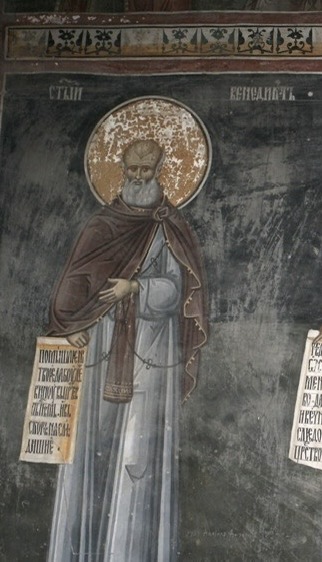
Benedict is depicted in two traditions that meet in this one saint of the undivided Church. In the Byzantine and Slavic manner he is shown as a venerable abbot-father — an aged monk with a full grey beard, in the dark monastic schema, holding a scroll (often inscribed with a sentence of his Rule) or blessing, in the settled type of the desert fathers to which his life assimilated him. In the Western tradition he is the black-cowled Benedictine abbot with crosier and book (the Rule), and often with the attributes drawn from the Dialogues: the broken cup and the raven carrying off the poisoned loaf — the two attempts on his life foiled by the sign of the Cross — and sometimes a birch or bundle of rods (for the nettles of his temptation) or the word pax, "peace," the Benedictine motto.
The primary stored image is a sixteenth-century fresco of Saint Benedict from the Patriarchate of Peć in Kosovo, the seat of the Serbian Church — a fitting witness that the Orthodox East kept and painted the father of Western monks as its own: Benedict as a venerable monastic saint, haloed and vested in the monastic habit (source, public domain, pd-old-work).
A second stored image gives the Western type: a panel of Saint Benedict from the Perugia Altarpiece of Fra Angelico (1438) — the saint in the black Benedictine habit, tonsured and haloed, holding a book (source, public domain, pd-old-work).
Disputed questions
- The historicity of the Dialogues. Because Benedict is known almost wholly from Gregory's second Dialogue, and because that book is frankly hagiographic — miracle upon miracle, patterned on Scripture and on the lives of the desert fathers — some scholars have doubted how much biography can be recovered from it, and a minority (notably F. Clark) has even questioned whether Gregory wrote the Dialogues at all, proposing a later forger. The great weight of scholarship upholds Gregory's authorship and accepts a historical Benedict behind the miracle-narratives; and the Rule, whose existence and character are beyond dispute, independently attests the man and matches to the life the ascetic Gregory describes.
- The Rule and the Rule of the Master. Since the mid-twentieth century it has been established that Benedict's Rule depends on the anonymous Regula Magistri, which it abridges and tempers. This once seemed to diminish Benedict's originality; it is now understood rather to display it, for the genius of the Rule lies precisely in the discretion with which he pruned the Master's severity into something humane and lasting.
- The relics. Whether the chief relics rest at Monte Cassino or were translated to Fleury about 673 is disputed between the two houses and cannot be resolved; both claims are recorded.
- Not to be confused with Benedict, the recluse of the Kiev Caves (a Russian venerable of the Near Caves, of much later date), nor with the several Popes and other saints named Benedict. "Of Nursia" and "the father of monks" belong to this Benedict alone.