
Basil the Great
Our Father among the Saints Basil the Great, Archbishop of Caesarea in Cappadocia, Great Hierarch and Ecumenical Teacher
Bishop · b. c. 330, at Caesarea in Cappadocia — d. 379, at Caesarea (January 1)
Commemorated 1 January — Repose of Basil the Great; kept with the Circumcision of Christ, on which day his Liturgy is served, 30 January — Synaxis of the Three Holy Hierarchs — Basil the Great, Gregory the Theologian, and John Chrysostom
Basil the Great (c. 330 – 379) was Archbishop of Caesarea in Cappadocia, one of the three Cappadocian Fathers and — with Gregory the Theologian and John Chrysostom — one of the Three Holy Hierarchs and Ecumenical Teachers of the Church. Born into a family that gave the calendar more saints than any other, he was educated at Athens, renounced a brilliant secular career at the urging of his sister Macrina, and founded the coenobitic monasticism of the Christian East, whose Rules he wrote. As bishop from 370 he led the defence of the Nicene faith through the darkest years of the Arian ascendancy, withstood the emperor Valens and his prefect Modestus to their faces, and forged the theological language — one ousia in three hypostases — by which the Church confessed the Trinity and the full divinity of the Holy Spirit, set out in his treatise On the Holy Spirit. He built at Caesarea the Basiliad, a whole city of mercy for the sick, the leprous, and the poor, and gave his name to the Liturgy served on the great days of the year. Worn out by asceticism, illness, and labour, he died on January 1, 379, not yet fifty, and was mourned by Christians, Jews, and pagans alike. The Church keeps him on January 1, with the Circumcision of Christ, and on January 30 among the Three Hierarchs.

A family of saints
No saint of the calendar comes of such a household. Basil was born about the year 330, at Caesarea in Cappadocia or on the family estates in Pontus, into a wealthy and deeply Christian family of Roman Cappadocia that had already given martyrs and confessors to the Church and would give it a whole company of saints. His paternal grandmother, Macrina the Elder, had sat at the feet of the disciples of Gregory the Wonderworker, the apostle of Cappadocia, and had suffered as a confessor in the last persecutions, hiding in the forests of Pontus; from her Basil received, he said, his first and truest instruction in the faith. His father, Basil the Elder, was a celebrated teacher of rhetoric at Neocaesarea; his mother, Emmelia, was herself the daughter of a martyr.
Of their ten children, the Church numbers five as saints. The eldest was Macrina the Younger (commemorated July 19), who after the death of the man to whom she was betrothed embraced virginity, turned the family estate at Annesi into a household of ascetics, and became the spiritual mother and teacher of her brothers — Gregory calls her, in the dialogue he named for her, "the Teacher." Basil was the eldest son. After him came Naucratius (commemorated June 8), a promising advocate who withdrew to the ascetic life and died young in a hunting accident; Gregory of Nyssa (commemorated January 10), the subtlest theological mind of the three Cappadocians; and Peter of Sebaste (commemorated January 9), the youngest, who became bishop of Sebaste. That one mother should be honoured as a saint together with four of her children — and her own mother and mother-in-law before her — is without parallel in the Church's memory, and the tradition rightly reads Basil's greatness as the flower of a whole sanctified household.
Education, and the friendship with Gregory
Basil was given the fullest education the age could offer. He studied first at Caesarea, then at Constantinople — where the tradition places him for a time under the great pagan rhetorician Libanius — and finally, from about 349, at Athens, still the crown of Hellenic learning, where he spent some five or six years mastering rhetoric, philosophy, astronomy, geometry, and medicine. It was at Athens that he sealed the friendship that runs through the whole of his life and is one of the great friendships of Christian history: with Gregory of Nazianzus, the future Theologian. Gregory has left the classic account of it — how, in the raucous student city, the two of them "knew only two streets, the one to the church and the one to the schools," how they shared one soul in two bodies, and how each spurred the other toward God and toward learning. Among their fellow-students, the tradition notes, was the young Julian, the emperor's cousin and the future Apostate; Gregory claims to have read even then the ruin in his face.
Basil returned to Caesarea about 356 crowned with every honour, and for a short time taught rhetoric with such brilliance that he was tempted, Gregory says, by the applause of the world. It was his sister Macrina who recalled him. Under her reproach he saw, as if waking, "the vanity of the wisdom of the princes of this world that come to nought," renounced his career, and gave himself wholly to Christ.
Baptism and renunciation
Like many of his generation, Basil had not yet been baptised; the sons of Christian houses were often enrolled among the catechumens and baptised only in adulthood. Now he received Baptism — at the hands, the tradition holds, of Dianius, bishop of Caesarea — and with it embraced a total renunciation. He distributed much of his inheritance to the poor, and, to learn the ascetic life from those who lived it, undertook a long journey through the monastic heartlands of the Christian East — Egypt, Palestine, Coele-Syria, and Mesopotamia — where he saw the anchorites and the coenobia, "men who bore about in the body the dying of the Lord Jesus," and marvelled at their fasting, their endurance, and their prayer. He came home resolved not to imitate the solitary life of the hermit but to gather ascetics into community — the coenobitic ideal that would be his great gift to the East.
The monastic foundation in Pontus
About 358 Basil withdrew to the family lands in Pontus, on the wooded banks of the river Iris at Annesi, across the water from the community his mother Emmelia and his sister Macrina had already established. There he founded a monastic settlement and there, joined for a time by his friend Gregory the Theologian, he passed some of the happiest years of his life in prayer, manual labour, study, and the ordering of the common life. Out of these years came two works of lasting weight. Basil and Gregory together compiled the Philocalia, an anthology of the writings of Origen — a discriminating rescue of what was best in that difficult master. And Basil composed the Asketikon, the body of ascetic teaching later transmitted as the Longer Rules and the Shorter Rules: not a code so much as a searching examination, in question and answer, of the whole coenobitic life — obedience, poverty, chastity, the balance of prayer and work, care of the sick, the reading of Scripture, the dangers of the solitary way. So completely did this teaching shape Eastern monasticism that Basil is honoured as its lawgiver: the monasteries of the Orthodox world to this day are, in root and principle, Basilian, and the Rule of Benedict in the West expressly commends "the Rule of our holy father Basil."
Priesthood and episcopate
The Church would not leave so great a light under a bushel. Ordained reader, and then, about 362, priest by Eusebius, bishop of Caesarea, Basil was soon the real strength of the Cappadocian church, though a coolness between the learned presbyter and his bishop drove him for a while back to his Pontic solitude, until Gregory the Theologian reconciled the two and Basil returned to bear the burden of the see through the famine of 368 — in which he sold his own remaining inheritance to feed the starving, and, it is said, organised a soup-kitchen and served at it with his own hands, gathering Jew and Christian alike.
On the death of Eusebius in 370, Basil was elected Archbishop of Caesarea, metropolitan of Cappadocia and exarch of the civil diocese of Pontus — one of the great sees of the East, with some fifty chorepiscopi under it. The election was contested, and Basil owed it in part to the exertions of the aged Gregory the Elder of Nazianzus; his episcopate of not quite nine years was one long labour under strain — against the Arian court, against the intrigues of rival bishops, against the division of his own province when the emperor split Cappadocia in two and Basil, to keep Nicene bishops in place, consecrated his brother Gregory to Nyssa and, more painfully, his friend Gregory the Theologian to the wretched little town of Sasima, a stroke that strained even that great friendship.
The struggle against Arianism: Modestus and Valens
Basil came to the throne of Caesarea at the worst hour of the Arian storm. The emperor Valens (364–378), a convinced Arian, was using the whole weight of the state to force the Homoian (Arian) creed on the East, deposing and exiling Nicene bishops one after another. In the winter of 371–372 he came into Cappadocia determined to break Basil, and sent ahead of him the Praetorian Prefect Modestus, the second man in the empire, to compel the archbishop's submission.
The confrontation that followed is one of the most celebrated scenes in the Church's memory, and Gregory the Theologian, who tells it in his funeral oration, was close enough to the events to be trusted. Modestus summoned Basil and, when courtesy failed, threatened him: confiscation of his goods, exile, torture, death. Basil answered — the words are Gregory's — that a man who had nothing could not be stripped: "You cannot confiscate what I do not possess, unless you want these few worn books and this threadbare cloak." Exile could not touch him, for "the whole earth is God's, and I am a stranger and a sojourner wherever I am sent." Torture could scarcely reach him, for his body was already so frail that "the first blow would be the last." And death he could only welcome, "for it would send me the sooner to the God for whom I live and to whom I hasten." The prefect, astonished, said he had never been spoken to so boldly. "Perhaps," Basil replied, "you have never before met a bishop." Modestus reported to Valens that the man was not to be moved by threats.
The sequel was as remarkable. When Valens himself came to Caesarea for the feast of the Theophany (January 6, 372), he entered Basil's great church and found it thronged, the psalmody thundering, the bishop standing at the altar "unbending as a pillar," and — Gregory says — the emperor was so overcome by the majesty of the worship that he swayed and had to be steadied, and when he came to bring his offering to the altar the trembling Valens could scarcely place it in Basil's hands. The emperor, half-won, let the archbishop alone; the edict of banishment he had signed against Basil was, the tradition says, torn in his hand, the pen breaking, before it could take effect. Basil held Caesarea, a Nicene fortress in an Arian empire, until Valens fell at Adrianople in 378 and the tide turned.
The Basiliad: the works of mercy
Basil's greatness was not only in doctrine and in courage but in a boundless practical love. Outside the walls of Caesarea he raised a vast complex of charity that men soon called simply the Basiliad (ἡ Βασιλειάς) — a "new city," Gregory says, with a church at its heart and around it a hospital, a hospice for travellers and the homeless, workshops that gave the poor a trade, and, above all, a house for lepers, the most feared and abandoned of the sick. Basil did not merely fund it; he served in it, and — the detail the tradition never forgets — he embraced and kissed the lepers whom all others shunned, honouring Christ in them. This foundation is reckoned among the first true hospitals in the history of the world, and it stands at the fountainhead of the Christian institution of organised care for the sick and the poor. In his homilies — "To the Rich," "I Will Pull Down My Barns," in the sermons preached during the famine — Basil taught a doctrine of wealth as fierce as any in the Fathers: the surplus of the rich is the property of the poor, and the bread you hoard belongs to the hungry, the cloak in your chest to the naked.
The trinitarian theology and the Cappadocian settlement
Basil's enduring theological achievement was to give the Church the language in which she confesses the Trinity. Nicaea (325) had confessed the Son homoousios, "of one essence" with the Father, but had not distinguished clearly the words for the one Godhead and the three who are God, so that ousia and hypostasis were still used almost interchangeably, and the door stood open both to those who divided the Godhead and to those who blurred the Persons. With his brother Gregory of Nyssa and his friend Gregory the Theologian, Basil fixed the distinction that has been the Church's ever since: one essence (ousia) in three persons (hypostases) — μία οὐσία, τρεῖς ὑποστάσεις — the one Godhead common to Father, Son, and Holy Spirit, and the three really distinct in their personal properties (unbegotten, begotten, proceeding). This "Cappadocian settlement" made it possible at last to confess the full and equal divinity of the three without either tritheism or the confounding of the Persons; it is the grammar of the Nicene-Constantinopolitan Creed.
The sharpest battle of his last years was over the Holy Spirit. A party later called the Pneumatomachi ("Spirit-fighters") or Macedonians, willing to grant the divinity of the Son, denied it to the Spirit, making him a creature or a servant. Against them Basil wrote his treatise On the Holy Spirit (De Spiritu Sancto, c. 375), the classic defence of the Spirit's divinity — arguing it not by bluntly calling the Spirit "God" (a reticence for which some zealots reproached him, and which he defended as pastoral economy) but by demonstrating from Scripture and from the Church's worship that the Spirit is worshipped and glorified together with the Father and the Son, sanctifies, deifies, and is nowhere ranked among creatures. Its occasion was itself liturgical: Basil had used at prayer the doxology "Glory to the Father with the Son together with the Holy Spirit," beside the more usual "through the Son in the Holy Spirit," and was attacked for the innovation; the treatise vindicates the coordinating doxology as the Church's own confession that the three are of equal honour. Basil did not live to see the vindication of his whole cause: he died in 379, and it was the Second Ecumenical Council (Constantinople, 381), two years after his repose, that set the seal of the Church on the faith he had defended, confessing the Spirit "the Lord, the Giver of life… who with the Father and the Son together is worshipped and glorified." Against Eunomius, the boldest of the neo-Arians, who claimed a rational comprehension of the very essence of God, Basil wrote the three books Against Eunomius, teaching that the divine essence is unknowable and that we know God from his energies and his names, not by prying into what he is — a distinction of essence and energies that would become a pillar of Orthodox theology.
Basil's labours were not only doctrinal but ecclesiastical, and here the Antiochian tradition has a particular stake in him. Through the long Meletian schism of Antioch — in which the Nicene party of the great see was itself divided between the followers of Meletius of Antioch and the rigorist party of Paulinus — Basil laboured tirelessly to secure the recognition of Meletius as the rightful bishop of Antioch and to heal the breach, writing letter after letter to Athanasius of Alexandria, to the bishops of the West, and to Pope Damasus of Rome, pleading for the unity of the churches and the common confession of the faith. That the West was slow and cool to his appeals was one of the sorrows of his last years; but his vast correspondence — some three hundred and seventy letters survive — remains one of the great monuments of the fourth-century Church, and its constant care for the peace and order of the see of Antioch binds him closely to the Antiochian memory.
The Liturgy and the Rules
Two enduring institutions bear Basil's name. The first is the Divine Liturgy of Saint Basil the Great — the eucharistic service whose great anaphora, longer and more theologically ample than the more usual Liturgy of John Chrysostom, the tradition ascribes to Basil's own ordering and prayer. It is served only ten times in the year — on the five Sundays of Great Lent, on Holy Thursday and Holy Saturday, on the eves (or feasts) of the Nativity and the Theophany, and on Basil's own feast, January 1 — so that the Church prays his Liturgy on the greatest and most solemn days, and his name is spoken in her worship as often as any save the Lord's own. (The Liturgy is treated here in prose only; a fuller entry for it awaits a decision on how the liturgical-rite texts are to be housed in this reference.) The second is his monastic Rules, the Asketikon, described above — the charter of coenobitic monasticism in the Christian East. Beyond these he left the nine homilies On the Hexaemeron, on the six days of creation, a masterpiece of Christian natural philosophy read and imitated for a thousand years; homilies on the Psalms; the Address to Young Men on the right use of pagan literature; and the ascetic and dogmatic works already named.
Repose
Basil's austerities, his chronic ill health — a liver ailment tormented him for years — and the unremitting toil of his episcopate wore him out early. He died at Caesarea on January 1, 379, not yet fifty years old. The whole city poured out to his burial, and — the tradition dwells on it — not Christians only but the Jews and the pagans of Caesarea mourned him as a common father, so that men were crushed in the press of the multitude that came to touch his bier. Gregory the Theologian, who had loved him from their Athens days and had been wounded by him and never ceased to love him, delivered or wrote for him the great Funeral Oration (Oration 43) that is at once the chief source for his life and one of the summits of Christian eloquence, in which he ranked his friend with the greatest of the saints and confessed that in losing Basil he had lost the better half of his own soul.
Veneration and the title "the Great"
Basil was called "the Great" within living memory of his death, and the title has never left him — he is, with Athanasius, one of only two Eastern fathers whom the Church so styles by universal consent. His memory was kept at once at Caesarea and spread through the whole Church. His relics were venerated in the East and, in part, carried westward in later centuries; his head is among the treasures shown at the Great Lavra on Mount Athos, and portions of his relics are honoured in many places. Since the eleventh century his memory has been joined to those of Gregory the Theologian and John Chrysostom in the common feast of the Three Holy Hierarchs (January 30), established at Constantinople about the year 1100 under the emperor Alexius I Comnenus to still a dispute over which of the three was greatest, the three appearing (the tradition says) to Bishop John Mauropous of Euchaita to declare themselves equal before God. In the Slavic and Greek worlds Basil's January 1 feast has long carried a particular popular warmth — the "Vasilopita," the cake of Saint Basil with a coin hidden in it, and the folk-figure of Saint Basil as the giver of New Year gifts, keep his name alive in the homes of the Orthodox East on the first day of the civil year.
Feast and commemoration
Basil is kept universally on January 1 (church date; Old Calendar civil January 14), the day of his repose, joined to the feast of the Circumcision of Christ, the eighth day of the Nativity. The two commemorations share a single office in the Menaion, and the Divine Liturgy of Basil is appointed for the day — one of the ten days of the year on which it is served — so that on his feast the Church prays the very Liturgy that bears his name. On January 30 (Old Calendar civil February 12) he is honoured among the Three Holy Hierarchs with Gregory the Theologian and John Chrysostom; that feast, established at Constantinople in the eleventh century, has its own file, Synaxis of the Three Holy Hierarchs, and Basil's part in it is only noted here. The Antiochian, Greek, and Slavic calendars agree on both days. The Roman calendar keeps Basil (with Gregory the Theologian) on January 2.
Hymns
Troparion — Tone 1
Thy proclamation hath gone forth into all the earth, which received thy word; thereby thou didst teach the faith in a manner worthy of God, and make plain the nature of things that are, and adorn the ways of men. O royal priesthood, venerable Father, entreat Christ God to grant us great mercy.
Original translation from the Greek
Kontakion — Tone 4
Thou wast shown forth as an unshaken foundation of the Church, dispensing to all mortals a lordship inviolable and sealing it with thy decrees, O Basil, revealer of the things of heaven.
Original translation from the Greek
Appointed readings
Epistle — Hebrews 7:26–8:2
26For such an high priest became us, who is holy, harmless, undefiled, separate from sinners, and made higher than the heavens; 27Who needeth not daily, as those high priests, to offer up sacrifice, first for his own sins, and then for the people’s: for this he did once, when he offered up himself. 28For the law maketh men high priests which have infirmity; but the word of the oath, which was since the law, maketh the Son, who is consecrated for evermore. 1Now of the things which we have spoken this is the sum: We have such an high priest, who is set on the right hand of the throne of the Majesty in the heavens; 2A minister of the sanctuary, and of the true tabernacle, which the Lord pitched, and not man.
Gospel — Luke 6:17–23
17And he came down with them, and stood in the plain, and the company of his disciples, and a great multitude of people out of all Judæa and Jerusalem, and from the sea coast of Tyre and Sidon, which came to hear him, and to be healed of their diseases; 18And they that were vexed with unclean spirits: and they were healed. 19And the whole multitude sought to touch him: for there went virtue out of him, and healed them all. 20And he lifted up his eyes on his disciples, and said, Blessed be ye poor: for yours is the kingdom of God. 21Blessed are ye that hunger now: for ye shall be filled. Blessed are ye that weep now: for ye shall laugh. 22Blessed are ye, when men shall hate you, and when they shall separate you from their company, and shall reproach you, and cast out your name as evil, for the Son of man’s sake. 23Rejoice ye in that day, and leap for joy: for, behold, your reward is great in heaven: for in the like manner did their fathers unto the prophets.
Prayers
Iconography
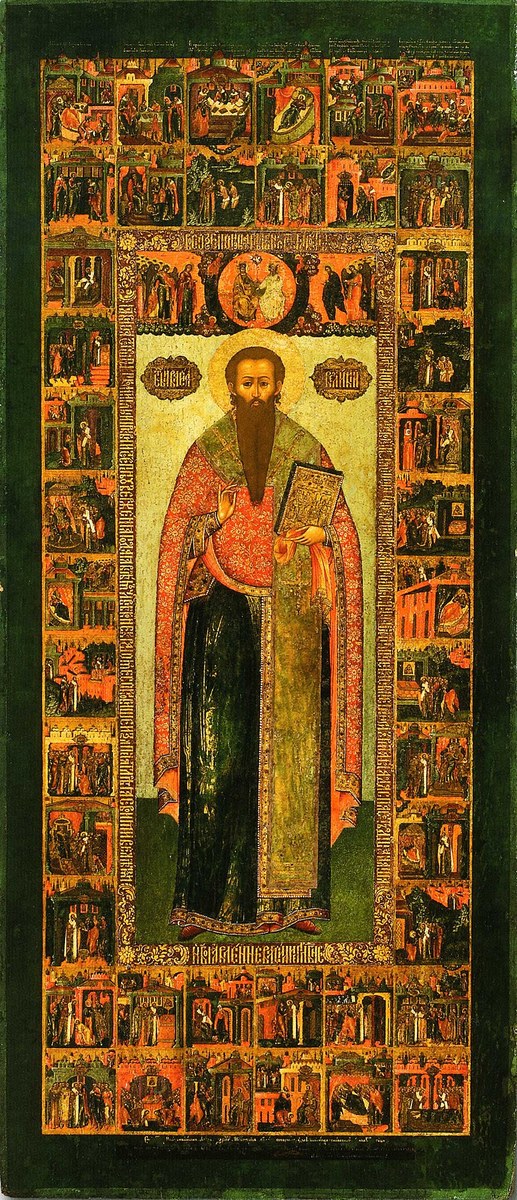
Basil is depicted as the very type of the ascetic theologian-bishop: tall and lean, with a long, narrow, dark pointed beard and a high, often balding forehead — the "thinker's" brow — his face gaunt with fasting, in marked contrast to the fuller face of John Chrysostom and the white-bearded gravity of Nicholas. He is vested as a hierarch in the phelonion or the cross-figured polystavrion and the omophorion, holding the Gospel-book and raising his hand in blessing, or bearing a scroll inscribed with a line of his Liturgy — most often the prayer "No one is worthy…" (Οὐδεὶς ἄξιος). In the composition of the Three Holy Hierarchs he stands to the right (the viewer's left) of the central Chrysostom, balancing Gregory the Theologian; in the sanctuary of many churches the three great liturgists — Basil, Chrysostom, and Gregory the Dialogist — are painted concelebrating about the altar. A distinct scene shows the emperor Valens and the prefect Modestus before the unbending bishop, or Valens fainting at the Theophany Liturgy.
The stored image is a Russian icon of 1674 by Semyon Spiridonov Kholmogorets — a full-length hierarch of the Yaroslavl school, Basil vested in a jewelled sakkos and omophorion, blessing and holding the Gospel, his lean face and dark tapering beard the fixed marks of his type, the panel bordered (in Spiridonov's manner) with small scenes of his life.
Disputed questions
- Not to be confused with the other Basils of the calendar. This Basil — "the Great," the Cappadocian archbishop and Ecumenical Teacher — is distinct from Basil of Ancyra, the martyr under Julian the Apostate kept on this same day (January 1); from the fourth-century homoiousian bishop Basil of Ancyra, a leader of the semi-Arian party (a different figure again, and no saint of the calendar); and from the much later Russian Basil the Blessed, the fool-for-Christ of Moscow (†1557, kept August 2), for whom the great cathedral on Red Square is named; and from Basil the Confessor, the eighth-century monastic companion of Procopius of Decapolis who suffered under the iconoclasts (kept February 28). Where a source says simply "Saint Basil," it is almost always this Basil, Basil the Great, that is meant.
- The date of birth. The year of Basil's birth is given variously between about 329 and 331; the entry follows the common "c. 330." His age at death is reckoned accordingly at about forty-nine or fifty.