
Bessarion the Great
Our Venerable Father Bessarion the Great, Wonderworker of Egypt
Venerable · Wonderworker · d. c. 466
Commemorated 20 February — Repose in the Egyptian desert (Greek Menaion usage), 6 June — Slavonic and OCA usage, where he heads the day with Hilarion the New of Dalmatia
Bessarion the Great (died c. 466) was one of the great desert fathers of fifth-century Egypt, a wonderworker of Scetis and disciple, the tradition holds, of Anthony the Great and of Macarius the Great. He is known above all from the Apophthegmata Patrum, the Sayings of the Desert Fathers, where a chapter of his sayings and a memoir by his disciple Doulas preserve both his teaching and his miracles: how on a waterless shore he prayed and the salt sea grew sweet to drink; how, to reach an elder before nightfall, he prayed and the sun stood still in its course; how he crossed a river dry-shod. He owned nothing and stayed nowhere, passing his life homeless "like a bird," sleeping in the open among the rocks and thorns, so poised in unceasing prayer and self-denial that his brethren likened him to the bodiless powers. He reposed in extreme old age. The day of his memory is not agreed: the Greek Menaion keeps him on February 20, the Slavonic books and the OCA on June 6, where he heads the day together with Hilarion the New of Dalmatia.
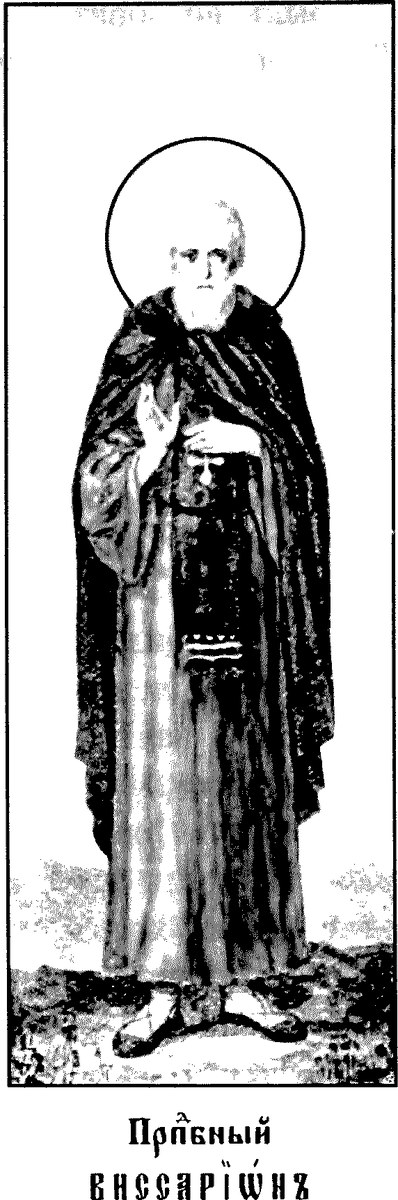

The ascetic of Scetis
Bessarion belongs to the second generation of the great Egyptian monasticism — the age when the deserts of Nitria, Kellia, and Scetis were peopled by the disciples of Anthony and of Macarius, and when the sayings of the fathers were first being gathered. The tradition makes him a disciple of Anthony the Great in his youth and afterward of Macarius the Great of Egypt, and sets his long life in the Egyptian desert across the fifth century, to his repose about the year 466. His memory is preserved not in a formal Life but in the far older and more precious form of the Apophthegmata — the collected sayings and deeds of the desert fathers — where the sayings under his name, and a short account by his disciple Doulas who served him and walked with him, are our whole record of him.
A life like a bird's
What the sayings press above everything is the completeness of his renunciation. Bessarion owned nothing and settled nowhere: he kept no cell of his own, held no possession, carried no book, but wandered the desert homeless, sleeping where night found him — on the bare ground, among the rocks, in the reeds by the river, in the open air of the cold nights and the burning days — so that Doulas could say of him that "he passed his whole life like a bird of the air, or like the beasts, free of every care of this world." The tradition tells of his standing at prayer for many days together without rest — forty days and nights on end among the thorn-bushes, in one account, neither sitting nor lying nor sleeping. To a brother who asked how one ought to be saved he answered with the saying the desert remembered: the monk ought to be "all eye," like the Cherubim and Seraphim — wholly watchful, wholly turned to God.
His mercy matched his austerity. The most beloved of his sayings tells how, when a brother who had sinned was put out of the church, Bessarion rose and went out with him, saying, "I too am a sinner" — refusing to sit in judgement, and taking the shame of the fallen upon himself. Another remembers his teaching that the monk should keep silence, should not compare himself with any man, and should hold himself the least of all.
The wonders
To Bessarion the tradition attaches a cluster of miracles that place him among the great wonderworkers of the desert — Doulas the eyewitness for several of them:
- The sweetened sea. Journeying with his disciple along the seashore, Doulas was overcome with thirst and there was no fresh water; Bessarion prayed, made the sign of the Cross over the salt sea, and told him to drink, and the water was sweet. When Doulas then filled a flask to carry some away against future thirst, the elder asked him why, since "God is here, and God is everywhere."
- The sun stood still. Hastening to reach the cell of a certain elder and fearing the light would fail before he arrived, Bessarion prayed, "I beseech thee, O Lord, let the sun stand still until I reach thy servant" — and the sun halted in the sky until he came, as once for Joshua son of Nun.
- The river crossed dry-shod. Coming to the river (the tradition names the Nile, or the Chrysorrhoas) and needing to pass, he prayed and walked over the water on foot without wetting himself.
- Rain by prayer in a time of drought, and other healings and deliverances, are told of him besides.
The desert fathers, and the Church after them, told these wonders not for their marvel but for what they showed: a man so emptied of self and so filled with God that the elements themselves obeyed his prayer. He reposed in great old age, and the Greek Menaion keeps his memory on February 20 with the distich: "For his many sweats and toils, Bessarion, having died, has found rewards in plenty."
Feast and commemoration
The calendars differ, and the difference is real. The Greek Menaion keeps Bessarion on February 20 — «Τῇ αὐτῇ ἡμέρᾳ, Μνήμη τοῦ ὁσίου Πατρὸς ἡμῶν Βησσαρίωνος», a "same day" commemoration alongside Leo of Catania, Sadok of Persia and Agathon of Rome — and that is the primary feast followed here, with the day falling in most years within Great Lent so that his office is sung with the Triodion. The Slavonic books and the OCA instead keep him on June 6, where he stands at the head of the day with Hilarion the New of Dalmatia; the printed Greek Menaion for June 6 does not name him at all. Neither placement is asserted here as the correct one; both are entered, on the pattern used for Diodorus and Rhodopianus (the project's record of open questions). The sung office is in either case that of a venerable father.
Hymns
Troparion — Tone 8
In thee, O Father, that which is according to the image was preserved with exactness; for taking up thy cross thou didst follow Christ, and by thy deeds thou didst teach us to despise the flesh, for it passeth away, but to care for the soul, a thing immortal. Therefore doth thy spirit, O venerable Bessarion, rejoice together with the angels.
Original translation from the Greek
Iconography
Bessarion is depicted as an aged desert ascetic — long white beard, the monastic schema, a scroll in his hand — after the settled type of the elders of the Egyptian desert; his narrative images illustrate the wonders of the sayings, most often the halting of the sun or the drinking from the sweetened sea. The stored image is the captioned plate of the illustrated Zhitiya Svyatykh (1903–1911).
Disputed questions
- His teachers and dates. The discipleship under Anthony and Macarius is the tradition of the synaxaria; because his record is the Apophthegmata rather than a dated Life, the year of his repose (c. 466) is approximate, resting on his placement in the fifth-century desert.
- Not to be confused with Bessarion, Archbishop of Larissa (†1540, kept September 15), the Greek wonderworker and monastery-founder of Thessaly; with Bessarion (Sarai), the eighteenth-century Transylvanian confessor of Orthodoxy; or with the Renaissance cardinal Bessarion of Nicaea (1403–1472), who is no saint of the Church. "The Great," the wonderworker of the Egyptian desert, belongs to this Bessarion of the Apophthegmata alone. He is likewise distinct from his own disciple Doulas, through whom his sayings and wonders are transmitted.