
Hilarion the New of Dalmatia
Our Venerable Father and Confessor Hilarion the New, Abbot of the Monastery of the Dalmatians
Venerable · Confessor · Priest · b. c. 775, in Cappadocia — d. 845, at the Dalmatian monastery in Constantinople
Commemorated 6 June — Repose at the monastery of the Dalmatians after the Triumph of Orthodoxy
Hilarion, surnamed "the New" because he took the ancient Hilarion the Great for his model, was abbot of the monastery of the Dalmatians — the oldest monastery of Constantinople — through the whole of the second Iconoclasm, and one of the sternest confessors of the holy icons. Born in Cappadocia about 775, tonsured at twelve, he was drawn from his cell to govern Dalmatou at the urging of the Patriarch Nikephoros, ruled it eight years in peace, and then for a quarter of a century was imprisoned, starved, flogged and exiled in turn by Leo V the Armenian and Theophilos for refusing to sign against the images. Freed by the Empress Theodora at the Triumph of Orthodoxy in 843, he returned to his monastery and reposed there in 845, in his seventieth year.
_-_June_-_11_Hilarion_the_New_of_Dalmatia.jpg)
Origins and tonsure
Hilarion was born about 775, of Cappadocian stock, to devout parents named Peter and Theodosia. His father held a post in the imperial household — the Greek notice makes him a provisioner of the palace — and the family raised the boy in the Scriptures and in the fear of God. At twelve years of age he was tonsured, entering a monastery of the capital which the sources name variously (the Greek synaxarion gives Xeroneseia, the Slavonic tradition the monastery "of Hesychios," near Constantinople). There he learned the alphabet of the monastic life: fasting, silence, obedience, and the memorising of the Psalter.
From that house he passed to the monastery of the Dalmatians (ἡ Μονὴ τῶν Δαλμάτων, Dalmatou), which lay within the walls near the Golden Gate and was reckoned the first monastery ever founded in Constantinople — the house of Isaac of Dalmatia (†c. 383), the Syrian ascetic who rebuked the emperor Valens to his face, and of Isaac's successor Dalmatus, from whom it took its name. In this ancient and archimandritical house Hilarion was clothed in the great schema and, in time, ordained presbyter.
Abbot of Dalmatou
When the abbacy fell vacant the brotherhood chose Hilarion by common voice. He resisted, pleading his unworthiness, and yielded only when the Patriarch Nikephoros of Constantinople (806–815) himself pressed the charge upon him. His governance was remembered as gentle and exact together: he asked of the brethren nothing he did not first do, and the house prospered under him. This peaceful period lasted about eight years, and ended in 813, with the accession of Leo V the Armenian and the revival of the war against the icons.
The confession under Leo V
Leo, having resolved to renew the iconoclast policy of the Isaurians, worked upon the great monasteries of the capital, since it was the monks who were the icons' chief defenders. Hilarion was summoned and required to cease venerating the images. He refused; the emperor's own account of the matter — that the images were idols and their honour idolatry — he answered by distinguishing the worship due to God alone from the honour that passes to the prototype through the image, the argument of the confessors of that age. He was therefore imprisoned, and deliberately deprived of food and water, that hunger might do what argument could not.
Pressure was applied through the hierarchy as well. The intruded patriarch — named in the Slavonic notices as Theodotos (Theodotos I Kassiteras, 815–821), and in the Greek as Theodotos the Melissenos — demanded his subscription and his abandonment of the Orthodox confession. Released for a time when his monks, wishing to spare him, gave assurances of compliance in his name, Hilarion returned to Dalmatou, resumed the veneration of the icons openly, and was seized and tortured again. Twenty-two years of his life, the Greek notice says, were passed under this regime of prison, exile and blows, borne — and this is the note his synaxarion insists upon — without a word of complaint, so that men marvelled less at his endurance than at his cheerfulness under it.
Exile under Theophilos
Under Theophilos (829–842), the last and in some ways the most methodical of the iconoclast emperors, Hilarion was brought out again, severely beaten, and banished to the island of Aphousia in the Propontis — the same sea-prison to which other iconodule abbots of the capital were sent. There he remained until the death of Theophilos.
The Triumph of Orthodoxy and repose
In 842–843 the Empress Theodora, regent for her son Michael III, restored the veneration of the icons, deposed the iconoclast patriarch John the Grammarian, and recalled the confessors from their exiles. Hilarion came back to Dalmatou and was restored to the abbacy. He lived, the Greek notice says, some three years more, and reposed in peace in 845, about seventy years old. He is numbered among the confessors whose sufferings the Church commemorates on the Sunday of Orthodoxy, and the Synodikon of that day pronounces the "everlasting memory" over such abbots by name.
Miracles and traditions
Two traditions attach to him. The first is a vision: Hilarion is said to have seen the soul of Theodore the Studite (†826), his fellow-confessor and the leader of the iconodule monks, borne up to heaven by angels at the hour of his death — a story that binds the two great confessing houses of the capital, Studios and Dalmatou, in a single testimony. The second is the gift of foreknowledge of his own end, with which he set his house in order and took leave of his brethren.
Feast and commemoration
June 6 (church date; Old Calendar civil June 19). In the Greek Menaion for June 6 Hilarion the New is the second of the day's two chief venerable fathers, coupled with Bessarion the Wonderworker of Egypt; the office sung is that of a venerable father, with the day's other commemorations — Attalus, Anoub, Photius, Gelasius, the five virgins of Caesarea — carried in the synaxarion notice only. The Slavic calendars keep the same day and give him the same rank, adding the Russian saints of June 6. He is honoured throughout the Orthodox world without jurisdictional variation, and his name is read among the confessors on the Sunday of Orthodoxy.
Hymns
Apolytikion — Tone 8 (common of a venerable father)
By the streams of thy tears thou didst make the barren desert to bear fruit, and by thy sighings from the depths thou didst bring thy labours to hundredfold increase; and thou wast made a beacon to the world, shining with miracles, O Hilarion our father: intercede with Christ God that our souls may be saved.
Kontakion — Tone 2
Thou didst shepherd the ancient flock of the Dalmatians and wast proved gold in the furnace of prison and of exile; unshaken before emperors, thou didst honour the venerable image of Christ, and didst return in gladness to thy fold, O father Hilarion, boast of confessors.
Original translation from the Greek
Iconography
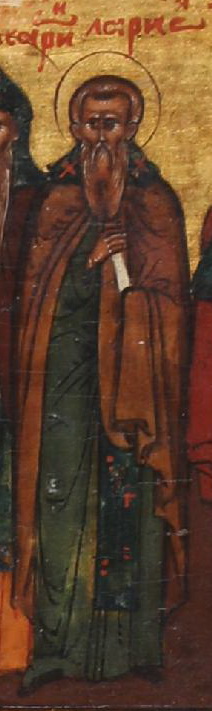
Hilarion is painted as a venerable abbot in the monastic habit — the mantle and analavos of the great schema over the tunic, the head bare, the hair and the long tapering beard grey or brown, one hand raised in blessing or laid on the breast and the other holding a scroll, sometimes unrolled with a monastic admonition. He is of the confessor type as well as the ascetic, and in fuller compositions the attributes of his passion may accompany him: the prison, or the icon of Christ held or venerated, which is the sign of the iconodule confessors of his century. Because his feast falls in June, he appears in the June leaf of the painted menologia and in the Russian menaion icons for the month, in the cell for the sixth day; he does not appear in the Menologion of Basil II, whose miniatures cover only September to February.
The stored image is a cropped cell from a Russian menaion icon for the month of June, Central Russia, first quarter of the seventeenth century (Church-Archaeological Cabinet of the Moscow Theological Academy). The figure is inscribed ИЛАРИѠ[НЪ] and stands in a brown monastic mantle over a green tunic, an aged monk with a long pointed beard, holding a small scroll before his breast — the standard formula for a venerable abbot in the month-icons.
Disputed questions
- Not to be confused with Hilarion the New of Pelekete, March 28 (†c. 754) — the confusion most likely to occur, and it is a real one in the calendars, since both men are called "Hilarion the New," both were abbots of monasteries near Constantinople, and both were iconodule confessors imprisoned by an iconoclast emperor. They belong to the two different Iconoclasms and are certainly distinct: the Pelekete Hilarion governed the monastery of Pelekete on the Asian shore of the Sea of Marmara and suffered under Constantine V Copronymus in the first Iconoclasm, dying about 754; this Hilarion governed Dalmatou inside Constantinople and suffered under Leo V and Theophilos in the second, dying in 845. Where a calendar prints "Hilarion the New" without further qualification, the day decides: March 28 is Pelekete, June 6 is Dalmatou.
- Not to be confused, further, with Hilarion the Great, October 21 (†371), the founder of Palestinian monasticism, from whom both of the above are distinguished by the epithet "the New"; nor with Hilary the Wonderworker, a distinct name (Ἱλάριος, not Ἱλαρίων).
- The monastery's identity. That Dalmatou was the house founded by Isaac of Dalmatia and named after his successor Dalmatus is the tradition of the synaxaria and is not seriously contested; the two saints' feasts (May 30 and August 3) and Hilarion's therefore belong to one continuous history of a single Constantinopolitan monastery, which by Hilarion's day carried the dignity of the archimandritate over the monasteries of the city.
- The elder who clothed him. Some accounts, following the Slavonic tradition, make Hilarion receive the great schema under the direction of Gregory the Decapolite (†c. 842). The chronology is awkward — Gregory was a younger contemporary, and his own arrival at Constantinople belongs to the 830s — and the detail is more probably a later harmonisation of two celebrated confessors than a fact of Hilarion's youth. The Greek notice names no such elder.
- The first monastery of his tonsure. Greek and Slavonic notices disagree (Xeroneseia against "the monastery of Hesychios"); neither house is otherwise well documented, and the discrepancy is probably a corruption of one name into the other in transmission.