
Boniface of Tarsus
The Holy Martyr Boniface of Tarsus, and the Righteous Aglaïa of Rome
Martyr · d. c. 290
Commemorated 19 December — Martyrdom at Tarsus
Boniface of Tarsus (died c. 290) is remembered for one of the most striking conversion stories in the Church's calendar. A dissolute household steward living in sin with his mistress Aglaïa, a wealthy woman of Rome, he was sent east to bring back the relics of a martyr — and, jesting as he set out that he might himself come home a martyr, was so moved by the sufferings of the confessors he found at Tarsus in Cilicia that he confessed Christ on the spot, endured fearful tortures, and was beheaded. His relics, carried back to Rome, brought about the repentance of Aglaïa, who gave away her wealth and ended her days as a nun. The two are commemorated together on December 19, and in Russian piety Boniface is invoked especially against the passion of drunkenness.

Origins and early life
The account of Boniface comes down entirely in the form of a hagiographic passio — a narrative more concerned with the pattern of sin, repentance, and martyrdom than with names and dates — and it must be read as such. According to this tradition, Boniface was the steward and slave of a rich and highborn young Roman woman named Aglaïa (Greek Ἀγλαΐς; Slavonic Aglaïda), the household's manager and also her lover, the two of them living openly in unlawful union. Both were troubled by their consciences and longed to be freed of their sin, without yet finding the resolve to abandon it.
Aglaïa had heard the pious teaching that whoever keeps in the home the relics of the holy martyrs, and venerates them, is aided toward salvation, sin being lessened and virtue strengthened by their nearness. She therefore resolved to obtain such a treasure, and sent Boniface eastward — to the provinces where the persecution then raged most fiercely — to purchase and bring home the relics of some martyr who might become the household's protector.
Conversion and martyrdom
As he was leaving, Boniface asked her half in jest: "My lady, if I find no relics, and if I should myself suffer for Christ, would you receive my body with the same reverence?" Aglaïa rebuked him for treating so lightly a sacred errand. The words, however, worked in him; the whole way east he was seized by the thought that he was not worthy so much as to touch the bones of the martyrs, and a change began in him that he did not yet understand.
Arriving at Tarsus in Cilicia, Boniface left his companions at the inn and went straight to the public square, where Christians were at that moment being tortured. The sight overwhelmed him: the horror of the torments, and the faces of the sufferers shining with grace and joy. He pressed forward, embraced the confessors, kissed their feet, and begged them to pray that he too might be counted worthy to suffer with them. Questioned by the governor as to who he was, he answered simply, "I am a Christian," and refused to sacrifice to the idols.
The tortures visited on him are recounted in the fullest detail: he was stripped and hung head-downward and beaten until the flesh fell from his bones; sharp reeds or needles were driven under his nails; and molten lead (or tin) was poured down his throat, which by the power of God left him unharmed, so that the watching crowd cried out, "Great is the God of the Christians!" The next day he was cast into a cauldron of boiling pitch, and again came out unhurt — an angel, the tradition says, descended and bedewed him, and the pitch boiled over and scalded the executioners. At last he was sentenced to be beheaded; and when the sword fell, blood and a milk-white fluid are said to have flowed together from the wound. The number of those who believed in Christ at the sight — some five hundred and fifty, in the tradition — belongs to the martyrological manner of the account. His death is placed around the year 290, in the persecutions that preceded and accompanied the reign of Diocletian.
Relics and the repentance of Aglaïa
Boniface's companions, meanwhile, waited two days at the inn and then set out to look for him, half-persuaded that he had gone off drinking somewhere — the last trace of the man they had known. A bystander who had witnessed the execution led them to the body. Weeping and begging his forgiveness for their unworthy thoughts, they ransomed the relics and carried them back toward Rome.
On the eve of their arrival, the tradition relates, an angel appeared to Aglaïa in a dream and bade her go out to receive her former servant, now "the brother and fellow-servant of the angels." She summoned the clergy and received the holy relics with great reverence, built a church over the place of his burial and enshrined them there, where they became a source of many miracles. Then, recognising in his end the summons to her own conversion, she distributed all her wealth to the poor, withdrew into monastic life, and spent some fifteen years in repentance before her own falling-asleep. She was buried beside Boniface. The tradition draws the moral plainly: the sin of the one was washed away in his blood, the sin of the other in her tears and asceticism, and both came at last unstained before Christ, "who desires not the death of a sinner, but that he should turn from his wickedness and live" (Ezekiel 33:11).
Veneration and later cultus
The Roman shrine associated with Boniface is the church on the Aventine hill later dedicated jointly to Saints Boniface and Alexis (Alexius the Man of God) — Santi Bonifacio e Alessio — long a centre of his veneration in the West as in the East. His feast entered the Byzantine synaxaria on December 19, and his service in the Menaion (a proper canon, stichera, and apolytikion) develops the paradox that a servant "sent to bring back a martyr came home himself a martyr," and sets his death within the very approach of the Nativity — the kontakion addressing him as one who offered himself as a sacrifice "to Him who for your sake was about to be born of the Virgin."
In Russian popular piety Boniface acquired a distinctive patronage: because the last thing his companions supposed of him was that he had fallen to drink, and because his whole life turned from bondage to the passions toward freedom in Christ, he is invoked above all others for deliverance from drunkenness, and prayers and an akathist to him for that intention are widely used to this day.
Feast and commemoration
December 19 (church date; Old Calendar civil January 1), kept universally in the Byzantine rite. The day falls within the Nativity Fast and on the eve of the Forefeast of the Nativity, and the hymnography of Boniface is deliberately coloured by the approaching feast. Boniface and Aglaïa are commemorated together, though it is Boniface the martyr whom the calendars name first; Aglaïa is venerated with him as a righteous penitent, without a separate feast or proper service of her own.
Hymns
Troparion — Tone 1
Having honoured God, by Him you were honoured in return, O beauty of the martyrs, blessed Boniface; for He adorned you with the crown of divine glory. And so, as we today keep your all-holy memory, we entreat you to make intercession for us before the Lord.
Original translation from the Greek
Kontakion — Tone 4
As an unblemished sacrifice you willingly offered yourself to Him who for your sake was about to be born of the Virgin, O holy and wise crown-bearer Boniface.
Original translation from the Greek
Iconography
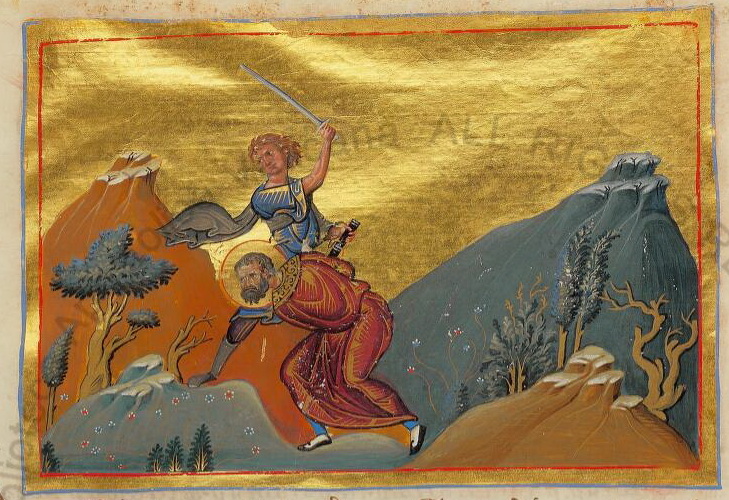
Boniface is depicted as a young beardless or lightly bearded man, often richly dressed in the manner of a servant of a great house, and — as a martyr — carrying a cross; the scenes of his passion (the cauldron of pitch, the beheading) are the usual narrative subjects. The stored image is the miniature for December 19 from the Menologion of Basil II (Constantinople, c. 985; Vatican Library, gr. 1613, fol. 272), showing his martyrdom by the sword: the executioner stands with raised blade over the fallen, haloed saint. (The scan carries a faint Vatican digital-library watermark.)
Disputed questions
- Historicity. The passio is a work of edifying hagiography, and its historical kernel — a martyr Boniface venerated at Tarsus and at Rome — is wrapped in the conventional apparatus of the genre (the numbered converts, the doubled and escalating tortures, the milk-and-blood at the beheading). The pairing with Aglaïa and the details of her repentance belong to the legend as transmitted; the Bollandists and later critics treat the romance cautiously.
- Date. The repose is given variously as c. 290 and (in some witnesses) c. 307; Wikidata records both 14 May 290 and 306. The Byzantine calendar keeps December 19.
- Not to be confused with Boniface the Merciful, bishop of Ferentino in Tuscany, an entirely different sixth-century saint commemorated on this same December 19; nor with Boniface (Wynfrith) of Mainz, the Apostle of the Germans (†754, June 5), the Anglo-Saxon missionary-martyr of a much later age — who received the name Bonifatius at Rome precisely from the Roman veneration of this martyr of Tarsus.