
Boniface of Mainz
The Holy Hieromartyr Boniface, Archbishop of Mainz and Enlightener of the Germans
Hieromartyr · Bishop · b. c. 675 — d. 754
Commemorated 5 June — Martyrdom at Dokkum in Frisia with his companions
Boniface (c. 675 – 754), born Wynfrith in the West Saxon country at Crediton in Devon, is the Apostle of the Germans: the English monk who spent nearly forty years preaching to the pagan tribes east of the Rhine, felled the sacred Oak of Donar at Geismar and built a church of its timber, organised the sees of Bavaria, Hesse and Thuringia, founded Fulda, held the reforming councils of the Frankish Church, and was made Archbishop of Mainz. In his eightieth year he laid down his see, returned to the Frisian mission where he had begun, and on June 5, 754, at Dokkum, was killed with fifty-two companions by an armed band — holding up, it was said, a gospel-book against the sword; the book, slashed through, is still kept at Fulda. He is commemorated on June 5.

Wynfrith of Wessex
He was born about 675 at Crediton in Devon, in the West Saxon kingdom, into a prosperous family, and was christened Wynfrith (Winfrid, Wynfreth). Against his father's will he entered monastic life as a boy — first at the monastery of Exeter (Adescancastre), then at Nursling (Nhutscelle) in Hampshire, near Winchester, under Abbot Winbert. There he became the master of the monastic school and a scholar of some weight: he composed the earliest Latin grammar written by an Englishman, a treatise on metre, a collection of verse riddles in the Aldhelmian manner, and letters that survive in quantity. He was ordained priest at about the age of thirty, and was already trusted enough to be sent by the synod of his province on business to the Archbishop of Canterbury.
He might have remained a schoolmaster and abbot. What turned him was the Northumbrian and West Saxon missionary impulse of that generation — the same current that had already carried Willibrord to Frisia — and in 716 he crossed to Frisia on his own first attempt. It failed: the pagan duke Radbod was at war with Charles Martel, the churches were shut and the mission destroyed, and Wynfrith returned to Nursling. Elected abbot there, he refused the office and went instead to Rome.
The Roman commission and the name Boniface
At Rome in 718–719 Pope Gregory II received him, examined him, and gave him a general commission to preach to the heathen east of the Rhine — a mission not tied to any existing diocese. It was then, by the tradition, that he received the name Bonifatius, after the martyr Boniface of Tarsus, on whose feast the commission is said to have been given. He never saw England again, though he wrote to it constantly and drew from it, all his life, the monks and nuns who staffed his work.
Three years (719–722) he spent in Frisia under Willibrord, the aged Apostle of the Frisians, who wished to make him his successor; Boniface declined, holding himself bound to the wider commission, and went south to Hesse and Thuringia. In 722 he was recalled to Rome and consecrated bishop by Gregory II, taking the oath of loyalty to the Roman see and receiving letters of recommendation to Charles Martel, whose protection made the whole enterprise possible.
The Oak of Donar
The best-remembered scene of his life is set at Geismar, near Fritzlar in Hesse, about the year 723. There stood a great oak sacred to Donar (Thor), the "Oak of Jupiter" in his biographer Willibald's Latin, the centre of the local cult. Boniface, before a crowd assembled to see the god defend himself, struck at the tree; the account has a great wind take it and bring it down in four pieces at the first strokes, and the watching heathen, seeing no thunderbolt, professed Christ. Of the timber he built an oratory of Saint Peter on the spot, the germ of the monastery of Fritzlar. Whatever allowance is made for hagiographic shaping, the episode records the actual method of the mission in Germany: the public, physical demonstration that the old powers were powerless.
Bishop, archbishop, and organiser
From Hesse and Thuringia the work spread. Boniface planted monasteries as mission-stations — Amöneburg, Fritzlar, Ohrdruf — and, drawing on the English houses, established convents of women whose abbesses were his own kinswomen and pupils: Leoba (Lioba) at Tauberbischofsheim, Thecla at Kitzingen and Ochsenfurt, Walburga. In 732 Pope Gregory III sent him the pallium and made him archbishop, with authority to consecrate bishops for Germany but still with no fixed see. On a third visit to Rome in 737–738 he was made papal legate for Germany, and with that authority he set in order the Bavarian church in 739, regularising the four sees of Salzburg, Freising, Regensburg and Passau, and then erected the German sees of Würzburg, Büraburg, Erfurt and Eichstätt.
In 742–743 he presided at the Concilium Germanicum, the first of the great reforming councils of the Frankish Church, and followed it with the councils of Estinnes, Soissons and others: canons against simony and the loose lives of the clergy, restoration of the metropolitan structure, annual synods, the binding of the Frankish Church to the discipline of Rome. In 745 he was at last given a metropolitan see, Mainz. In 744 his disciple Sturm founded, at his direction and with a papal exemption, the abbey of Fulda, in the wilderness between his Hessian and Thuringian missions — chosen by Boniface as the place of his own burial and destined to become the mother house of German monasticism.
Martyrdom at Dokkum
Old — near eighty — and having handed the see of Mainz to his disciple Lull, Boniface went back in 754 to the mission of his youth, Frisia, with a company of clergy and monks. On the eve of Pentecost, June 5, 754, encamped by the river Boorne near Dokkum, he was awaiting a company of neophytes who were to come for the laying-on of hands. Instead an armed band — pagan Frisians, or, as the earliest accounts prefer, a gang of robbers — fell on the camp. Boniface forbade his people to fight, telling them to render good for evil and that the day long looked for had come, and he was cut down with fifty-two companions.
Among the companions the Orthodox usage names them: the bishop Eoban; the presbyters Wintrung, Walthere and Ethelhere; the deacons Hamund, Scirbald and Bosa; and the monks Wachar, Gundaecer, Illehere and Hathowulf.
The most eloquent relic of the scene is a book. Three codices were found in the camp, and one of them — the Ragyndrudis Codex, a collection of apologetic texts — survives at Fulda bearing deep incisions across its boards, consistent with the blow of a sword or an axe. The tradition that Boniface held up a gospel-book to shield his head is later than the earliest Life, but the damaged book is old and real, and the two have been associated at Fulda since the Middle Ages.
Relics
The bodies were recovered by the Christian Frisians. Boniface's own was taken first to Utrecht, then up the Rhine to Mainz — where Lull wished to keep it — and at last, in accordance with his own wish and, it was said, at the saint's own posthumous insistence, to Fulda, where it was laid in the abbey church. His relics lie there still, in a shrine beneath the high altar of Fulda cathedral, and Fulda has been the centre of his cult and (in the modern period) the meeting-place of the German episcopate for that reason.
Legacy
Boniface's importance is not only missionary. His correspondence — one of the largest and most vivid letter-collections of the early Middle Ages — shows him constructing an ecclesiastical order out of nothing, appealing to Rome for rulings, rebuking kings, begging books and cloaks from English abbesses, and worrying about the validity of baptisms performed in broken Latin. Through his councils he re-made the Frankish Church; through Fulda and its daughter houses he gave Germany its monastic and literary culture; through his insistence on the metropolitan structure and the Roman communion he shaped the Church of the eighth-century West. The judgement that he had a deeper influence on the history of Europe than any other Englishman is a commonplace of the historians and is not much of an exaggeration.
Feast and commemoration
June 5 (church date; Old Calendar civil June 18) — the day of his martyrdom, kept in the West since the eighth century and in Orthodox Western-rite and local British and German usage today. In the Byzantine calendar June 5 belongs principally to Dorotheus of Tyre, and where Boniface is added it is as a commemoration of the saints of the undivided West. Fulda keeps him as its patron with the highest rank, and Devon — his birthplace — as the patron of the county; in Orthodox British usage he is reckoned among the patrons of England. No Byzantine proper is appointed; the common of a hieromartyr is used, and in the Western Rite the Latin propers of his day.
Hymns
Troparion — Tone 4 (common of a hieromartyr-bishop)
Sharer in the ways of the Apostles and successor to their thrones, thou didst find in action the ladder to divine contemplation, O God-inspired Boniface; therefore, rightly dividing the word of truth, thou didst contend for the faith even unto blood. Intercede with Christ our God that our souls be saved.
Original translation from the Greek
Kontakion — Tone 2
Thou didst leave thine island and its schools for the forests of the heathen, and the oak of the demons fell at thy word; and having built of its timber a house for Christ, thou didst water Germany with the streams of the Gospel and at the last with thine own blood. Wherefore, O hieromartyr Boniface, we honour thee as an apostle.
Original translation from the Greek
Iconography
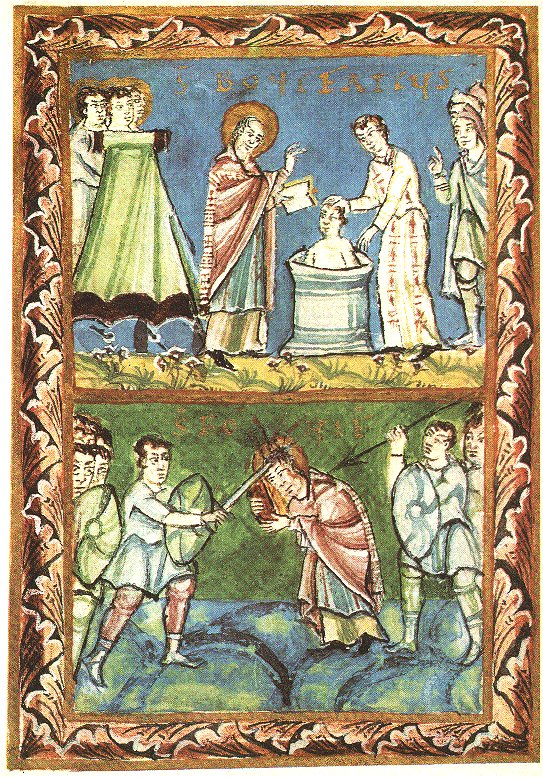
The oldest and still the governing image of Boniface is the double miniature of the Sacramentary of Fulda (eleventh century), reproduced above, inscribed S BONIFATIVS at the head. In the upper register the saint stands in chasuble and pallium, book in hand, baptising a convert who is set in a font while an assistant pours over his head and the newly-clothed neophytes wait at the left; in the lower register he is struck down, still holding his book, by soldiers with swords and spears. The two scenes together are the whole of his hagiography: the font and the sword, the mission and its price.
Byzantine-style icons of Boniface, written for Orthodox parishes in Britain, Germany and the diaspora, follow the hierarch's pattern — phelonion and cross-marked omophorion, blessing hand, gospel-book — with two attributes proper to him: the axe or the felled oak, and the book cleft by a sword, in memory of the Ragyndrudis Codex. Western art since the Middle Ages adds the oak with an axe laid to its root and, occasionally, a scourge or a fox. All such modern icons are the copyrighted work of living iconographers and are not stored here; the eleventh-century Fulda miniature, which is out of copyright, serves instead.
Disputed questions
- Orthodox commemoration. Boniface belongs to the undivided Church — he died three centuries before the schism — and is kept as a saint in Orthodox usage on June 5: he appears in the Orthodox calendars of Western-rite and British-Isles usage, in ROCOR's British and German lists, and in the general Orthodox enumerations of the day (OrthodoxWiki), where he is styled hieromartyr, Archbishop of Mainz and Enlightener of Germany, with the names of his companions. He is not in the Orthodox Church in America's June 5 synaxarion, nor in the Greek Menaion; the commemoration is a local Western-saints one rather than a universal Byzantine one, and is recorded here as such in jurisdictions. In the Antiochian Archdiocese he is kept in the Western Rite Vicariate.
- Manner of death. Willibald's Vita (written within a decade or two of the event, at Mainz) presents the killers as a multitudo of armed men and their motive as plunder; later accounts make them pagan Frisians defending their gods, which turns a robbery into a persecution. Both readings are ancient, and the Church's designation of him as hieromartyr rests on his death in the act of the mission rather than on the assailants' theology.
- Number of companions. Fifty-two is the received figure (some sources give fifty-three, counting Boniface himself). Eleven or twelve are named, with considerable spelling variation across the lists.
- The anointing of Pepin. Boniface is often said to have anointed Pepin the Short king at Soissons in 751. The earliest sources do not name the officiant; the attribution is probable but not certain.
- Not to be confused with Boniface of Tarsus (†c. 290, December 19 in Byzantine usage), the martyr from whom he received his name — the two are entirely distinct, and it was precisely the Roman veneration of the earlier Boniface that gave the English missionary his. Nor with the several popes of the name.