
Carpus, Papylus, Agathodorus and Agathonica
The Holy Martyrs Carpus, Bishop of Thyateira, Papylus the Deacon, Agathodorus, and Agathonica
Martyr · Hieromartyr · Bishop · Deacon · d. c. 251
Commemorated 13 October — Martyrdom at Pergamon under Decius
Carpus, Papylus, Agathodorus and Agathonica (†c. 251) are the chief martyrs of October 13: in the Byzantine tradition, Carpus the bishop of Thyateira, his deacon Papylus, Papylus's sister Agathonica, and Agathodorus their servant, who suffered together at Pergamon in Asia Minor during the persecution of Decius. Their passion is also transmitted in one of the very earliest surviving martyr-acts — a document some scholars date a century before Decius — so that this small company stands both at the head of the day's synaxarion and near the head of the whole literature of the Acts of the martyrs. The kontakion of their feast celebrates their relics as "a treasure of great price" welling up healings.
.jpg)
Two accounts of these martyrs have come down: the ancient Martyrdom of Carpus, Papylus and Agathonica, among the oldest of all Acta martyrum, and the later hagiographic and synaxarion tradition, which the Orthodox calendars follow and which alone knows the fourth member of the company, Agathodorus. Both are given here, and their differences are recorded rather than smoothed away.
Martyrdom
The ancient Acts. In the Greek recension of the Martyrdom, Carpus and Papylus are examined at Pergamon before the Roman proconsul. Carpus, asked his name, answers first and repeatedly, "I am a Christian," confessing Christ and refusing the sacrifice demanded by imperial command; he mocks the demons that pass for gods, and is hung up and scraped with claws until his strength fails. Papylus, questioned in his turn, says that he is a citizen of Thyateira and that he has many children — meaning, as he explains, children in God in every province and city — and endures the same scraping in silence. Both are then nailed to stakes and burned alive. Carpus, dying in the fire, smiles; asked why, he answers that he has seen the glory of the Lord and is glad. A woman named Agathonica, standing in the crowd, beholds the same glory, recognises it as a call from heaven, and casts herself onto the pyre of her own accord, crying to the Lord for help, while the bystanders lament at so terrible a judgment. The Latin recension, which sets the trial under Decius before the proconsul Optimus, gives Agathonica a family and a formal sentence — she dies by the executioner rather than by her own leap — and styles Carpus a bishop and Papylus a deacon, the offices the whole later tradition transmits.
The synaxarion account. The Byzantine tradition, followed by the Greek and Slavic calendars and the OCA, tells the story so: in the persecution of Decius (249–251), Carpus, bishop of Thyateira, and his deacon Papylus were denounced to the governor of the district because they did not keep the pagan festivals. Refusing to worship the gods of the empire, they were bound in iron chains and led through the city, then tied to horses and dragged from Thyateira to Sardis. Agathodorus, their servant, and Agathonica, the sister of Papylus, followed them of their own free will and shared their confession: Agathodorus died under a multitude of scourges — the Slavic tradition specifies beating with ox-hide whips — and Agathonica and the two clergy were put to death by the sword (the OCA's notice has Agathonica strangled with ox sinews; the Greek distich for her says she found her end "by the sword"). The hymnographic tradition of the Menaion preserves further episodes of the passion: the martyrs scraped on their sides and burned; Papylus hung on high and scraped, and pelted with stones which fell harmless "as the arrows of infants"; wild beasts loosed on them whose mouths were stopped as in the den of Daniel; the confessors cast into burning quicklime unharmed, and made to walk in boots driven through with nails; and Agathonica, seeing the flame prepared, crying out, "Deprive me not of the choir of thy athletes." During his lifetime Papylus was known for the gift of healing the sick, a grace the Church holds he has continued to exercise since his martyrdom.
Relics and translations
The kontakion and oikos of the feast — sung over the martyrs' shrine — attest a flourishing cult of their relics: the Master has given them to those on earth "as a treasure of great price and a fountain gushing streams of healings," and the oikos pictures the crowds of the faithful encircling the coffer of the relics and "reaping health" at the annual festival. Constantinople possessed a sanctuary of Carpus and Papylus: a late-Roman rotunda in the Samatya quarter of the city, surviving as a substructure beneath the later church of Saint Menas, has long been identified with their martyrium, which tradition dated to the age of Constantine and Helena. The identification of the surviving remains rests on topographical scholarship rather than an inscription, and is noted here as received.
Hymnographic and literary legacy
The ancient Martyrdom was known to Eusebius of Caesarea, who mentions Carpus, Papylus and "a woman, Agathonica" as having died gloriously at Pergamon (Ecclesiastical History 4.15.48); the Greek recension of the Acts was recovered and published in the nineteenth century, and the text now stands in every modern collection of the earliest Acts of the martyrs. In the Menaion the company has a full proper service: a canon in Tone 6 by Theophanes the Hymnographer, bearing the acrostic "To Carpus with Papylus I bring praise"; stichera at Vespers in Tone 1; a kathisma hymn in Tone 3; and a doxastikon in Tone 6 addressed to Carpus — "as one worthy among the seers of God, thou didst behold the heavens opened and the Lord seated on his throne, with the Cherubim and the Seraphim around him" — a direct echo of the vision of glory in the ancient Acts. The exapostilarion salutes Carpus as "hierarch of Christ."
Feast and commemoration
October 13 (church date; Old Calendar civil October 26), the principal commemoration of the day in the Greek, Slavic and OCA calendars alike; the proper service of the day in the Menaion is theirs. The Greek books head the day "the holy Martyrs Carpus and Papylus," with Agathodorus and Agathonica named in the synaxarion; the Slavic books name all four in the title of the day.
Hymns
Troparion — Tone 4 (from the common of the martyrs)
Thy martyrs, O Lord, in their contest received incorruptible crowns from thee, our God; for possessing thy strength they cast down the tyrants and shattered the feeble insolence of the demons. By their intercessions, O Christ God, save our souls.
Original translation from the Greek
Kontakion — Tone 4
As a treasure of great price, and a fountain gushing streams of healings, the Master hath given your relics to those on earth: they cleanse away the diseases of manifold sufferings, and bestow grace unceasingly upon our souls. Wherefore with one accord and with love, O Carpus and Papylus, we keep your festival.
Original translation from the Greek
Iconography
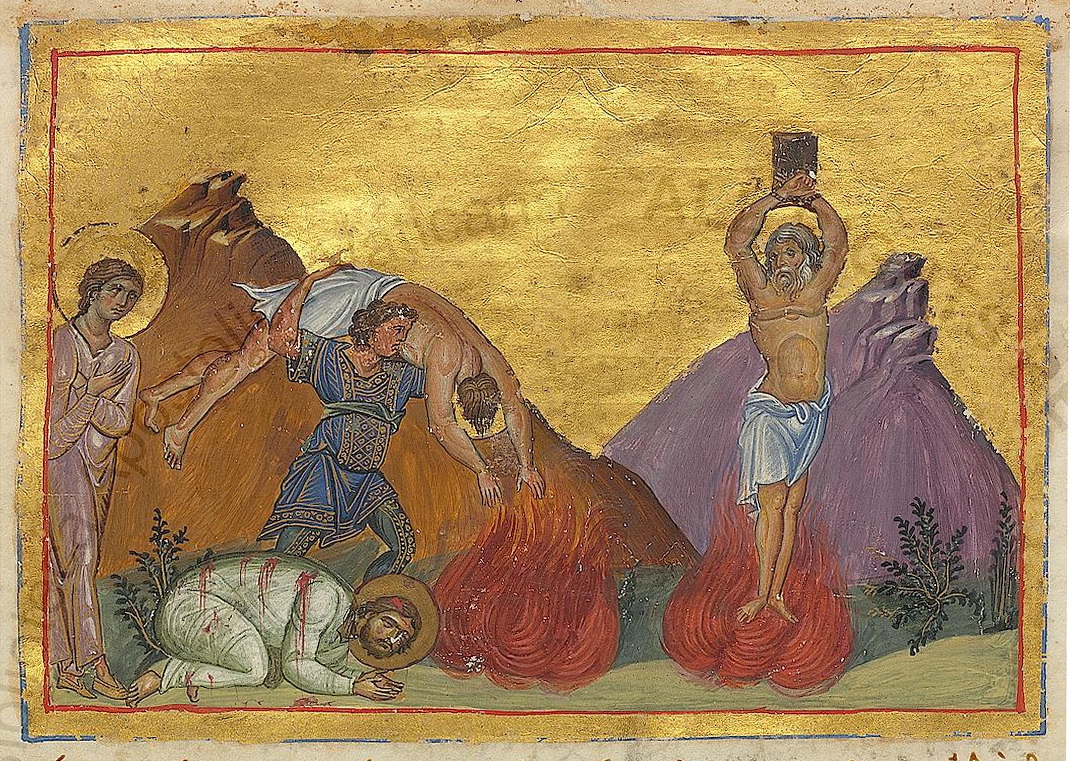
The Byzantine tradition shows the company at their martyrdom or as a standing group: Carpus in the omophorion of a bishop, Papylus in the sticharion of a deacon (sometimes with the censer or the healing-box of an unmercenary, in memory of his gift of healing), Agathodorus as a young servant, and Agathonica in the maphorion of a matron or the veil of a virgin. The stored image is the miniature of the Menologion of Basil II (c. 985; Vat. gr. 1613), the manuscript's commemoration for October 13: a double scene of the passion in which two of the martyrs are given to the fire — one held over the flames by an executioner, one bound upon them — while a third lies scourged and bleeding on the ground and the haloed Agathonica stands by with her hand pressed to her breast.
Disputed questions
- The date — Decius or Marcus Aurelius. The entire Byzantine calendar tradition, the Latin recension of the Acts, and the modern jurisdictional calendars place the martyrdom under Decius, c. 251, and this entry keeps that date. But Eusebius sets his notice of the three martyrs of Pergamon in his account of the persecutions under Marcus Aurelius (161–180), immediately after Polycarp of Smyrna, and a long line of scholars since the nineteenth century has argued that the Greek recension of the Acts — with its archaic simplicity and its unpunished voluntary martyrdom — is a pre-Decian, second-century document. Others answer that the proconsul's insistence on a universal imperial command to sacrifice fits the edict of Decius exactly. The question remains genuinely open in the scholarship; the calendars' Decian date is retained as transmitted.
- The membership of the company. The ancient Acts know three martyrs only: Carpus, Papylus, Agathonica. Agathodorus appears solely in the later hagiographic tradition, as the servant of the confessors; the synaxaria and all the Orthodox calendars commemorate the four together, and this entry follows them, recording the difference.
- The place of death. The ancient Acts set the whole martyrdom at Pergamon; the synaxarion tradition followed by the OCA and the Slavic calendars has the martyrs dragged from Thyateira and perfected at Sardis — whence the Russian calendar's occasional epithet "of Sardis" for Agathodorus. The Menologion of Basil II, for its part, paints the scene with the fire of the older account.
- Agathonica's death. By her own leap into the fire (Greek Acts); by formal execution (Latin Acts); by the sword (the Greek distich); strangled with ox sinews (the Slavic tradition and the OCA). The variance is ancient and is left standing.
- Not to be confused with Carpus of Beroea, one of the Seventy Apostles — the Carpus at whose house in Troas the Apostle Paul left his cloak and his books (2 Tim. 4:13) — who is commemorated with the Apostle Alphaeus on May 26 and who reposed about the year 100. The Byzantine calendar keeps the two Carpi on separate days and does not confuse them; but the Latin martyrologies, having only the October name, drew the disciple of Paul into it, so that Western reference works sometimes give the Carpus of Second Timothy a feast on October 13 and a martyrdom at Pergamum. That conflation is late and Western, and is followed neither here nor in the Greek and Slavic books.
- Not to be confused, further, with Agathonike of Carthage, the virgin-martyr of August 10 in the Greek calendar, of whom no life at all is transmitted — only the name, the epithet παρθενομάρτυς, and the African city. The Agathonica of this entry is Asian, second-century, and perfected by fire; the two share nothing but the name and the identical icon-inscription.
- Offices and styling. The Greek Menaion styles the company simply "the holy Martyrs"; the Slavic calendars style Carpus and Papylus "hieromartyrs" (bishop and deacon). Both stylings are recorded; the entry carries the offices of bishop and deacon after the common tradition.