
Carpus and Alphaeus of the Seventy
The Holy and Glorious Apostles of the Seventy Carpus, Bishop of Beroea, and Alphaeus
Apostle of the Seventy · Apostle · Bishop · d. c. 100 (Carpus); 1st century (Alphaeus)
Commemorated 4 January — Synaxis of the Seventy Apostles, 26 May — Joint memory of the two apostles of the Seventy
On May 26 the Church keeps the joint memory of two of the Seventy Apostles: Carpus, the host at whose house in Troas the Apostle Paul left the cloak and the books he asks Timothy to bring to him (2 Tim. 4:13), afterwards a preacher in Crete and first bishop of Beroea; and Alphaeus, of Capernaum in Galilee, whom the tradition names as the father of the Apostles James and Matthew, and whose own children Abercius and Helen are commemorated with him on this day as martyrs. Both belong to that second and wider apostolic company whom the Lord "appointed and sent two and two before his face" (Luke 10:1), and both are counted in the ancient rolls of the Seventy; of the events of their lives the record is slender, and the honour paid them rests on the New Testament's brief notices and on the memory of the churches they founded.

The two apostles of May 26
The Byzantine synaxarion joins these two names under one day without joining their histories: the Greek books head the commemoration "of the holy and glorious Apostle Carpus, one of the Seventy Apostles," and add, "on the same day, of the holy Apostle Alphaeus, and of the holy Martyrs Abercius and Helen." The Slavic and OCA calendars title the day "the Apostles Carpus and Alphaeus of the Seventy." They are thus a liturgical pair rather than companions in life, and are treated here in one entry because neither has a separate feast, a separate service, or a separate cultus.
Carpus of Troas and Beroea
Carpus enters the record in the last surviving letter of the Apostle Paul. Writing from prison to Timothy, Paul asks: "The cloak that I left at Troas with Carpus, bring when thou comest, and the books, especially the parchments" (2 Tim. 4:13) — a household note that has preserved the name of an otherwise unrecorded disciple, and with it the memory of a Christian house at Troas on the Asian coast where the Apostle lodged and left his few possessions behind him. The tradition draws from the request what it plainly implies: that Carpus was Paul's host and trusted friend, that he kept the books of the Apostle, and that Paul's departure from Troas was sudden.
The lists of the Seventy that circulated in the Greek Church under the names of Dorotheus of Tyre and Hippolytus — late compilations, but the source of the calendar's roll — number Carpus among the Seventy and make him bishop of Beroea. Byzantine hagiography adds that he preached the Gospel in Crete before his episcopate, and describes him as a man of prayer and of great purity of life, serving the Liturgy daily. Of his episcopate at Beroea nothing circumstantial has come down. The synaxarial distich for the day plays on his name — Carpus, καρπός, "fruit" — and says that having borne fruits acceptable to the Lord he was gathered in his season like a vintage: language which the Greek tradition understands of a peaceful repose, about the year 100, rather than a martyr's death, although some notices place him among those who suffered under Nero.
The Carpus of the Areopagitic letters
The Cretan connection is almost certainly drawn from a famous passage of the Areopagitic corpus. In the eighth letter, addressed to the monk Demophilus, the author writes that when he was in Crete he lodged with "the holy Carpus," a man of surpassing purity, who never celebrated the Divine Mysteries without first receiving a vision in prayer; and he recounts at length Carpus's vision of the pit and of Christ stretching out his hand to the lost, told as a rebuke to Demophilus's harshness. Since the corpus presents itself as the work of Dionysius the Areopagite, the first-century convert of Paul at Athens, Byzantine readers identified this Carpus with the Carpus of Second Timothy, and so brought Crete into his life. Modern scholarship dates the Areopagitic writings to the late fifth century, and the identification is therefore a pious inference rather than an independent witness; it is recorded here because it is the source of a detail the synaxaria repeat.
Alphaeus of Capernaum
Of Alphaeus the tradition transmits a family rather than a career. He came, the synaxaria say, from Capernaum on the Sea of Galilee — the town of Peter and Andrew, and the centre of the Lord's Galilean ministry — and he was the father of two of the Twelve: James the son of Alphaeus, named in every list of the Apostles (Matt. 10:3; Mark 3:18; Luke 6:15; Acts 1:13), and the publican Matthew the Evangelist, whom Mark calls "Levi the son of Alphaeus" sitting at the receipt of custom (Mark 2:14). The Orthodox calendars reckon Alphaeus himself among the Seventy, so that a single Galilean household gave the Church two of the Twelve and one of the Seventy.
Two of his other children, according to the synaxarion, suffered for Christ: Abercius and Helen, the son bound naked to be stung to death by bees, the daughter stoned. They share their father's day.
Nothing else is transmitted of Alphaeus — no place of episcopate, no manner of death, no relics. The Menaion appoints him no proper hymn, and the Greek synaxarion gives him no distich of his own; his memory hangs entirely on the name preserved in the Gospels and on the household it stands for.
Feast and commemoration
May 26 (church date; Old Calendar civil June 8) is the joint feast, kept by the Greek, Slavic, Antiochian and OCA calendars alike, with Carpus named first and Alphaeus, Abercius and Helen following in the synaxarion. Both apostles are also commemorated on January 4 with the whole company in the Synaxis of the Seventy Apostles. The service of the day is small — the Menaion appoints the common of an apostle with Carpus's name, and the day's proper material is confined to the synaxarion notice and its distichs. Where the day falls in the movable cycle varies widely with the date of Pascha — it may stand anywhere from the third week of Pascha to the week after Pentecost — and in years of the earliest Pascha the Russian books for the day note the opening of the Apostles' Fast falling near it.
Hymns
Synaxarion
Having borne fruits acceptable unto the Lord, O Carpus, thou dost bear thine end in its season, as a vintage. On the twenty-sixth, Carpus flew away from the wide earth.
Apolytikion — Tone 3 (common of an apostle)
O holy Apostle Carpus, intercede with the merciful God, that he grant to our souls forgiveness of offences.
Kontakion — Tone 4 (common of the apostles)
As initiates of the Word and unwearied heralds of the Gospel, O Carpus and Alphaeus, ye were shown forth apostles of the Saviour; wherefore we keep your memory with love, and glorify Christ who crowned you.
Original translation from the Greek
Iconography
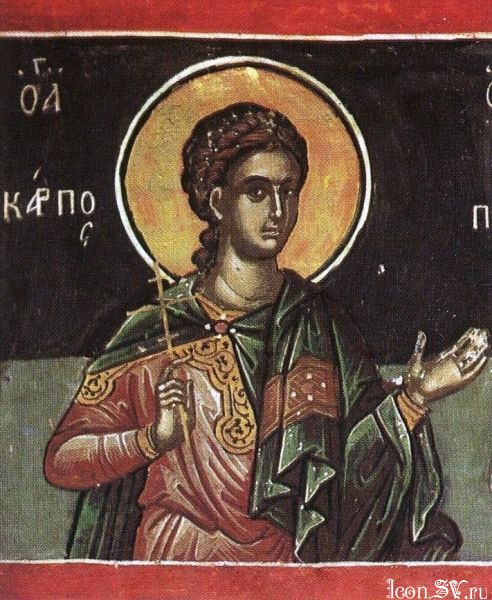
Carpus is painted after the type of an apostle of the Seventy: young or middle-aged, without the bishop's omophorion in the older frescoes and with it in the Russian menologia that follow the roll's title "bishop of Beroea," holding a scroll or a small cross and with the free hand raised in address or acclamation. The stored image is a pre-nineteenth-century wall-painting inscribed Ο ΑΓΙΟΣ ΚΑΡΠΟΣ: the saint beardless and youthful against a dark ground, in a red-brown tunic and a green mantle worked with gold, holding a slender cross in the right hand and lifting the left palm outward — the martyr-and-apostle gesture — his hair bound in the classicising Byzantine manner. Where the whole year is painted on one board, as in the Russian Menaion-icons, the day's saints appear in the May register in the small standing figures proper to that form.
Alphaeus, having no proper service and no distinctive attribute, is rarely painted alone; where the day is illustrated he stands beside Carpus as an elder apostle in tunic and mantle, holding a scroll. No pre-1900 image of Alphaeus alone has been identified for this collection.
Disputed questions
- Which Carpus? Carpus of Beroea, kept on May 26, is not Carpus the bishop-martyr of Pergamum, who suffered with the deacon Papylus, Agathodorus and Agathonica about 251 and is commemorated on October 13. The two are separated by some hundred and fifty years and by their manner of death, and the Byzantine calendar keeps them on different days; but the Latin martyrologies, which have only the October name, drew the disciple of Paul into it, so that Western reference works sometimes give "Carpus" of 2 Timothy a feast on October 13 and even a martyrdom at Pergamum. The conflation is Western and late, and is not followed here.
- Beroea in Thrace or Beroea in Macedonia? The roll of the Seventy as the Greek Church received it styles him bishop of Beroea of Thrace; the OCA's notice makes him bishop of Verria in Macedonia — that is, the Beroea of Acts 17:10–13, where Paul and Silas preached and where the Jews "searched the scriptures daily." The confusion is old and turns on the several ancient cities of the name. The Macedonian Beroea is much the likelier home of a companion of Paul, and Greek usage at Veria has long claimed him; the Thracian attribution is recorded as transmitted.
- Repose or martyrdom? The distich and the general Greek tradition speak of a natural end, gathered "as a vintage in its season"; some Slavic notices make him a martyr under Nero. The calendars do not style him martyr, and this entry follows them.
- Which Alphaeus? The Alphaeus of this day is not Alphaeus the Reader of Caesarea in Palestine, martyred with the deacon Zacchaeus in 303 and commemorated on November 18; the shared name is coincidence. Whether the father of James and the father of Levi (Matthew) are one man is a genuinely open question in exegesis — the Gospels never say so — and whether either is the Clopas of John 19:25 (Aramaic Ḥalpai has been read behind both names) is a further and older dispute. The Orthodox synaxarion tradition takes the simplest course and makes one Alphaeus the father of both apostles; that is the tradition commemorated on this day, and the exegetical question is left standing.