
Cassian the Greek of Uglich
Our Venerable Father Cassian the Greek, Wonderworker of Uchma and Uglich
Venerable · Wonderworker · b. c. 1440s, in the principality of Theodoro (Mangup) in the Crimea — d. 2 October 1504, at the Uchma hermitage near Uglich
Commemorated 21 May — Commemoration on the feast of Constantine and Helen, the saint's name-day before his tonsure, 2 October — Repose at the Uchma hermitage, 1504
Cassian was a Greek prince of the Crimea who became a Russian hermit. Born into the ruling house of Mangup — the principality of Theodoro in the Crimean highlands, the last fragment of Byzantine Gothia — and baptised Constantine, he came to Moscow in 1472 in the retinue of Sophia Palaiologina, the Byzantine bride of Ivan III, in the very years when his homeland was being extinguished by the Ottomans. He refused the estates and the boyar's rank the grand prince offered him, followed Archbishop Ioasaph of Rostov into the Ferapontov monastery on the White Lake, and was tonsured there with the name Cassian. Afterwards he withdrew to the Volga and founded, on the little river Uchma below Uglich, the hermitage of the Dormition that bore his name for four and a half centuries. He reposed on 2 October 1504, and is invoked in Russia especially for diseases of the eyes and the teeth and in fevers. He is kept a second time on May 21, because that is the feast of the emperor whose name he bore in the world.

The prince of Mangup
He was born about the 1440s in Mangup (Mangup-Kale), the rock-city that was the capital of the small Orthodox principality of Theodoro in the south-western Crimea — a survival of Byzantine Gothia, ruled by a Greek dynasty traditionally connected with the Gavras family of Trebizond, and one of the last independent Christian polities of the Black Sea. His baptismal name was Constantine. He was of the princely house, and by his own service-texts he "left his principality for Christ's sake."
The immediate occasion of his leaving was the marriage of Zoe (Sophia) Palaiologina, niece of the last emperor, to the grand prince Ivan III of Moscow. Constantine travelled to Russia in 1472 in the party that brought her from Rome — a company of Greeks that included several men of rank who never went home. Within three years of his departure Mangup was besieged and taken by the Ottomans (1475) and the dynasty destroyed; whether he knew when he set out that he was leaving for good, the sources do not say.
From court to monastery
At Moscow the grand prince received him with honour and offered him lands, revenues and a place among the boyars. He refused — the Life is emphatic on this point, and it is the hinge of the whole story. Instead he attached himself to the household of Ioasaph, archbishop of Rostov, a man of the princely Obolensky family who was himself soon to lay down his see; and when Ioasaph retired to the Ferapontov monastery on the White Lake in the far north, Constantine went with him.
There, in the community founded by Ferapont of Belozersk and formed by Martinian, the disciple of Cyril of White Lake, he asked for the habit. He resisted for a time, the Life says, and was brought to it by a vision; and he was tonsured with the name Cassian, after John Cassian the Roman, on whose feast-day (February 29, kept in leap years) he had evidently been received or professed.
The hermitage at Uchma
After some years at Ferapontovo, Cassian was moved to go south to the Volga. He came into the principality of Uglich, then held by Andrei Vasilyevich the Great, brother of Ivan III, and settled in the woods at the mouth of the little river Uchma, about twenty versts below the town — first with a single companion, in a cell of branches. The Life relates that the Mother of God appeared to him there and bade him build a church in her honour, and that the flooding of the Volga at the first site obliged him to move a short distance to higher ground. The prince of Uglich gave him the land, timber and money; the church of the Dormition was raised, brethren gathered, and there came into being the Cassianov Uchemsky hermitage, a small, poor and strict house of the northern kind, which Cassian governed without ever, so far as the record goes, accepting the title of igumen.
He lived there some thirty years. The tradition remembers him as gentle with the brethren and unsparing with himself, and as keeping to the end the courtesy and bearing of the court he had left — the Russians called him simply the Greek, and the epithet stuck to his name and to his monastery.
He reposed on 2 October 1504 and was buried in his own church. His relics remained there, and the hermitage kept his memory and his rule.
Miracles and later history
The Uchma house became a place of pilgrimage for the country round Uglich. The recorded healings at the tomb cluster, unusually specifically, around diseases of the eyes and of the teeth, and around fevers — and it is for these that he is still invoked in Russian practice. The most celebrated of his posthumous interventions belongs to the Time of Troubles: in 1609 Polish and Lithuanian troops sacked Uglich and burned the Uchma monastery, and both the town's chronicle and the Life relate that the saint appeared during the assault, and that his intercession was credited with such deliverance as the district had. The monastery was rebuilt, and existed until the Soviet closures.
Its site is now under water. When the Rybinsk reservoir was filled in the early 1940s the whole low ground at the mouth of the Uchma was flooded, and the monastery — already suppressed and largely demolished — went with it. A chapel over the traditional place of the relics stands on the surviving bank, and the memory of Cassian the Greek is kept at Uglich and in the parishes of the region.
Feast and commemoration
Two fixed days:
- October 2 (Old Calendar civil October 15) — the day of his repose in 1504, his principal feast.
- May 21 (Old Calendar civil June 3) — kept with Constantine and Helen, the feast of his own baptismal patron.
Both are Russian; he is kept in the Russian Church and by the OCA, and the Greek and Antiochian books do not carry him — an irony, since he was a Greek by birth and died a Russian saint. At Uglich and in the Yaroslavl diocese he is also honoured among the local saints, and the older service-books style him Uchemsky from his hermitage rather than from the town.
Hymns
Troparion — Tone 4
Thou didst come from the east into the west, O father Cassian, and for Christ's sake didst forsake thy princely rank and the land of thy fathers, that thou mightest gain the one thing needful; and settling in the wilderness of Uchma thou didst raise up a house to the Mother of God, and wast shown to be a physician of the sick and a helper of the afflicted: pray to Christ God that our souls may be saved.
Original translation from the Slavonic
Kontakion — Tone 8
Having left a princely throne for a cell of branches, and riches for holy poverty, thou didst find in the wilderness what the courts of kings could not give thee, O venerable Cassian; wherefore the Mother of God herself appointed thee the place of thy labours, and we who have thee for our physician and our intercessor cry to thee: rejoice, O boast of Uglich and stranger who art become our own.
Original translation from the Slavonic
Iconography
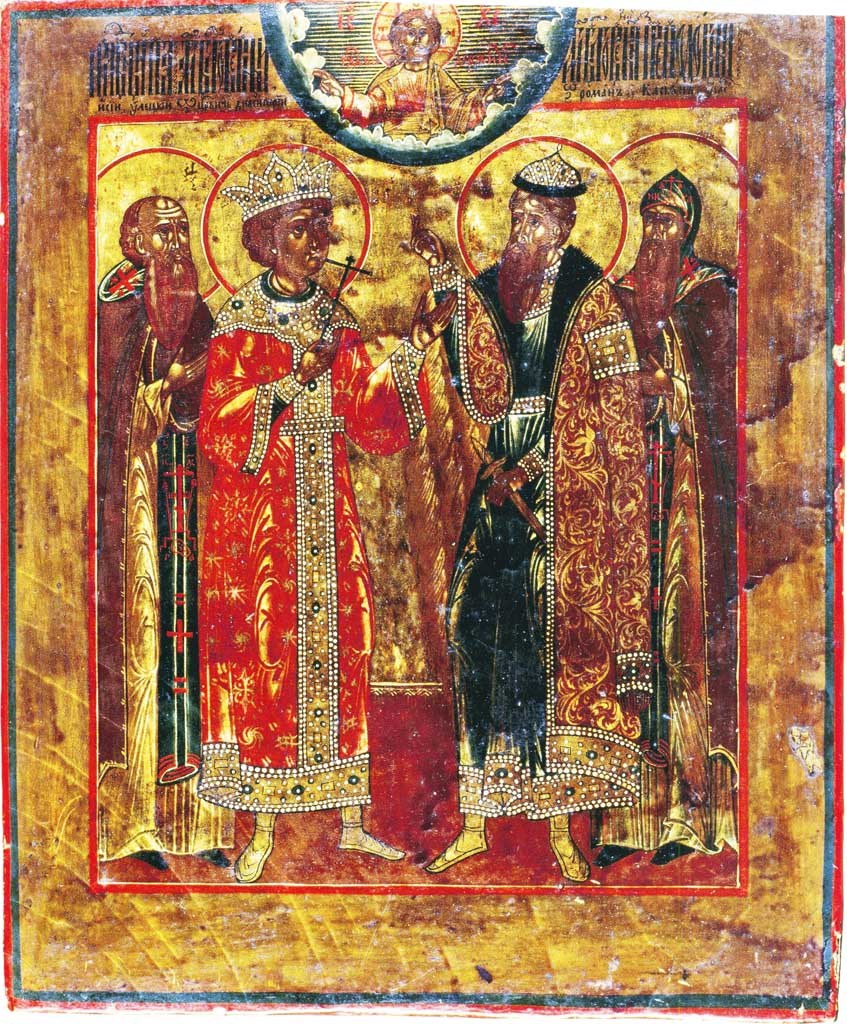
Cassian is painted as a Russian monastic elder — hooded in the koukoulion or bare-headed with a long grey beard, in the dark mantiya, one hand raised in blessing or in prayer, the other holding an unrolled scroll with a text of exhortation — and is distinguished from his fellows chiefly by his setting: the standard Uglich composition shows him standing above his hermitage, the small white church of the Dormition with the Volga and the mouth of the Uchma behind him, and in some versions the appearance of the Mother of God to him in the upper corner, directing him to the place. His princely origin is very seldom shown, though a few later provincial icons give him a discarded crown at his feet. He also appears among the ranks of the Saints of Uglich and of the Rostov and Yaroslavl synaxes.
No pre-1900 image of him could be located and verified; the entry is listed in the the list of icons still being sought index.
The stored image is a late-19th-century icon of the Saints of Uglich, each named by inscription — Cassian the Greek among Paisius, Tsarevich Demetrius and Roman of Uglich.
Disputed questions
Which prince, and which house. That he came from Mangup and was of its ruling family is the constant statement of the service-texts and the Life; the attempt to give him a precise place in the genealogy of the princes of Theodoro, and the identification of the family as the Gavras, rest on inference rather than on documents, and the Crimean sources for the last decades of the principality are very thin.
The date of the tonsure and the name. The name Cassian is given by the sources as taken in honour of John Cassian the Roman, but they do not agree on whether he was tonsured at Ferapontovo immediately on arriving with Ioasaph or after some years, nor on the year.
Why May 21? The second commemoration is not a translation of relics or a local dedication but a name-day: the calendars keep the monk on the feast of the emperor whose name he bore in the world, and the OCA day-list makes the point explicitly, noting that his patron was Constantine the Great. The practice of giving a saint a second commemoration on his pre-monastic patronal feast is uncommon, and the arrangement is worth noting as such.