
Constantine and Helen
The Holy, Glorious, God-crowned and Equal-to-the-Apostles Great Sovereigns Constantine and Helen
Equal to the Apostles · King · Queen · b. Constantine c. 272–273 at Naissus in Upper Moesia; Helen c. 248–250, by tradition at Drepanum in Bithynia — d. Constantine 22 May 337, at Achyron near Nicomedia; Helen c. 327–330, in her son's presence
Commemorated 21 May — Joint commemoration of the two Equal-to-the-Apostles
Constantine the Great (c. 272–337) and his mother Helen (c. 248–330) are commemorated together on May 21 as Equal-to-the-Apostles — the only sovereigns to whom the Byzantine calendar gives that title jointly. Constantine is the emperor who saw the sign of the Cross in the sky before the battle of the Milvian Bridge, ended three centuries of persecution by the agreement published from Milan in 313, founded Constantinople and gave it to the Theotokos, summoned and sat in the First Ecumenical Council at Nicaea in 325, and was baptised only at the very end of his life, dying in the white robes of the newly illumined on Pentecost 337. Helen, raised from obscurity to the rank of Augusta, went as an old woman on pilgrimage to Palestine, and in the tradition of the Church found there the True Cross and raised over the holy places the churches of the Resurrection at Jerusalem and of the Nativity at Bethlehem. The Church honours them not for personal blamelessness — the record of Constantine's household is dark, and the calendars have never pretended otherwise — but because through them the Church passed out of the catacombs into the open day.

The house of Constantius, and Helen
Flavius Valerius Constantinus was born at Naissus (Niš, in Serbia) about 272–273, the son of the officer Constantius, later called Chlorus, who rose under Diocletian's reorganised empire to be Caesar of the West in 293 and Augustus in 305. His mother was Helena, a woman of no family: Ambrose of Milan, writing some seventy years later, says frankly that she had been a stabularia — a servant in an inn or a post-house, probably at Drepanum on the gulf of Nicomedia in Bithynia, the town her son afterwards rebuilt and renamed Helenopolis in her honour. Whether she was Constantius's lawful wife or his concubine (concubina) was disputed in antiquity and remains so; the sources use both words, and the question mattered to later writers chiefly because Constantine's own legitimacy hung on it. What is not disputed is that when Constantius was raised to the purple in 293 he put her aside to marry Theodora, the stepdaughter of the Augustus Maximian, and that Helen then vanishes from the record for some thirty years, until her son was master of the world and brought her back to court as Augusta.
Constantine spent his youth as a hostage-guest at Diocletian's court at Nicomedia, where he saw the persecution of 303 begin, and then joined his father in the West. When Constantius died at Eboracum (York) on 25 July 306, the army of Britain proclaimed his son Augustus over his body. The eighteen years that followed were a long and violent consolidation: the defeat of Maxentius at Rome in 312, the uneasy partnership with Licinius in the East, and finally the wars of 316–317 and 324 that left Constantine sole ruler of the Roman world.
The vision of the Cross and the Milvian Bridge
The turning-point of his life, and of the Church's history, is the sign given before the battle for Rome. Eusebius of Caesarea, who says he had it from the emperor's own mouth under oath, relates that as Constantine marched south he and his whole army saw about midday a cross of light in the sky above the sun, with the words joined to it, ΤΟΥΤῼ ΝΙΚΑ — "By this, conquer" (in Latin, in hoc signo vinces); and that the following night Christ appeared to him with the same sign and bade him make a standard in its likeness for use against his enemies. That standard is the labarum: a long gilded spear crossed by a bar, with a wreathed monogram of the first two letters of Christos, chi and rho, at its head, and beneath it a jewelled banner bearing the portraits of the emperor and his sons.
On 28 October 312 the armies met at the Milvian Bridge on the Tiber, two miles north of Rome. Maxentius, who held the city and much the larger force, came out beyond the walls and was destroyed; he drowned in the river in the rout, and Constantine entered Rome the next day as its deliverer. He did not go up to the Capitol to sacrifice, as every triumphing emperor before him had done. On the triumphal arch the Senate raised for him three years later the victory is attributed, in words carefully chosen to offend nobody, to instinctu divinitatis — "by the prompting of the Divinity."
The Edict of Milan and the end of the persecutions
The persecution begun by Diocletian in 303 had already been broken off in the East by the deathbed edict of Galerius in 311, which grudgingly permitted Christians to exist again. What Constantine and Licinius agreed at Milan in the winter of 312–313, and published in the rescript issued from Nicomedia in June 313, went much further: it granted liberty of religion to all men, Christians named first and by name, ordered the restitution of every church, cemetery and piece of corporate property confiscated in the persecutions, and provided compensation to the present holders out of the imperial treasury. It is not a declaration that Christianity is the religion of the Empire — that came sixty-seven years later, under Theodosius — but it is the legal end of the age of the martyrs, and the Church has always read it so.
Constantine went on to give the Church a public standing of a wholly new kind. The clergy were exempted from the ruinous civic liturgies; bishops were given jurisdiction and their sentences the force of law; churches were empowered to receive legacies; manumission of slaves could be performed in church before the congregation; Sunday was made a day of rest for the courts and the city trades in 321; crucifixion was abolished as a penalty, the branding of criminals on the face forbidden, the exposure of infants discouraged by public relief, and the games of the gladiators condemned, though not in fact suppressed. He built on a scale nobody had attempted: the Lateran basilica and Old St Peter's at Rome, the churches of the Holy Land, and at Antioch the great octagonal Domus Aurea, the "Golden Church," begun by him and completed and dedicated under his son in 341 — the cathedral of the Antiochian Church for three centuries and the setting of much of its later history.
The founding of Constantinople
After the defeat of Licinius in 324 Constantine determined on a new capital on the Bosphorus, on the site of the old Greek colony of Byzantium. The ground was consecrated on 8 November 324; the city was dedicated with forty days of festival on 11 May 330, and in the act of dedication the emperor committed it and its people to the protection of the Most Holy Theotokos. The Church keeps that dedication as its own commemoration — see the Founding of Constantinople (May 11) — and it is the single act of Constantine's reign with the longest consequences: a capital founded from its foundations as a Christian city, without a temple of the old gods at its centre, which for eleven centuries was the heart of Orthodox Christendom.
Nicaea and the First Ecumenical Council
Constantine found the East, which he had just conquered, torn by the teaching of the Alexandrian presbyter Arius, that the Son of God was a creature made out of nothing before the ages and not of one being with the Father. Having failed to compose the quarrel by letter through Hosius of Cordoba, he did what no emperor had ever done: he summoned a council of the whole Church, put the imperial post at the bishops' disposal to bring them, and lodged and fed them at his own expense in his palace at Nicaea in Bithynia. Rather more than three hundred bishops came — the tradition fixes the number at 318, a figure taken from the servants of Abraham in Genesis 14:14 and treated as symbolic rather than counted — many of them, as the fathers of the council remarked, still bearing in their bodies the marks of the persecution that had ended twelve years before.
The council opened on 20 May 325. Constantine entered the hall last, in purple and gold, and would not sit until the bishops bade him; he addressed them in Latin, urging them to peace, and then took a low seat among them. His role was that of convener, host and executor, not of judge: the presidency in the proceedings belonged to the bishops, and the sources point variously to Hosius of Cordoba and to Eustathius of Antioch, whom the Antiochian tradition remembers as delivering the opening address to the emperor. Among the fathers were Athanasius, then a young deacon of Alexandria, Nicholas of Myra, and Spyridon of Trimythous, and — by the legates Vito and Vincentius — Silvester of Rome.
The council condemned Arius, promulgated the Creed of the first seven articles with the decisive word ὁμοούσιος ("of one being with the Father"), which Constantine himself is said to have urged upon the assembly, settled the computation of Pascha on a rule independent of the Jewish reckoning, ended the Melitian schism in Egypt, and issued twenty canons on the order of the Churches. Constantine then gave the decrees the force of imperial law and sent Arius into exile. It was, for the Church, the first exercise of that conciliar authority on which all her subsequent dogmatic definition rests, and Constantine's part in making it possible is a principal ground of his title isapostolos.
The sequel is less edifying, and the honest sources do not conceal it. Within a few years the emperor, worked on by the party of Eusebius of Nicomedia, had allowed Arius to be received back on an ambiguous confession, permitted the synod of Tyre in 335 to depose Athanasius, and sent the great defender of Nicaea into his first exile at Trier. Constantine's grasp of the theology was never firm; what he wanted was concord, and he was ready to purchase it from whichever party seemed likeliest to keep the peace.
Helen's pilgrimage: the finding of the Cross
Helen, having been proclaimed Augusta about 324 and given her own household, her own coinage and the free disposal of the imperial treasury, went in about 326 — at nearly eighty years of age — on pilgrimage to Palestine. Eusebius, who saw her there, describes her progress through the eastern provinces: she gave alms with both hands, freed prisoners, recalled exiles, relieved whole cities, prayed in the churches with the congregations, and behaved, he says, as if she were a servant of the servants of God rather than the mother of the master of the world.
The tradition of the Church, received from the later fourth century onward, adds the discovery for which she is chiefly remembered. Hadrian, after the Jewish war of 135, had buried the site of Golgotha and the Lord's tomb under a platform and raised over it a temple of Aphrodite; Helen had the fill cleared away and the temple thrown down, and beneath it were found the sepulchre and, in a cistern nearby, three crosses, with the titulus and the nails. Which of the three was the Lord's was determined, in the received account, by a miracle: a sick woman — in other versions a corpse being carried to burial — was touched with each in turn and was healed, or raised, by one only. Bishop Macarius of Jerusalem then lifted the wood up before the people, who cried Kyrie eleison; and that first elevation is the origin of the feast of the Elevation of the Cross on September 14. In the Byzantine expansion of the story a Jew named Judas, who alone knew where the tradition of the place had been kept, is compelled to point out the spot, is converted, and becomes bishop of Jerusalem under the name Cyriacus. Helen left a portion of the wood at Jerusalem, sent a portion with the nails to her son at Constantinople, and carried the titulus to Rome.
The buildings of the Holy Land
Over the cleared site Constantine, at his mother's prompting and by his own order to Macarius, raised the great complex at Golgotha: the rotunda of the Anastasis over the tomb, the courtyard with the rock of Calvary, and the basilica called the Martyrion, dedicated in 335 — a feast the calendar still keeps, the Dedication of the Anastasis (September 13). Helen is credited with the church of the Nativity over the cave at Bethlehem and with the Eleona on the Mount of Olives over the cave of the Lord's teaching and Ascension; Eusebius names these two as her own foundations and says she adorned them at her own charge. With them the whole later pattern of Christian pilgrimage begins: within a generation the anonymous pilgrim of Bordeaux and then Egeria were walking the stations she had marked.
Helen returned to her son and died in his presence about 327–330, in her eightieth year. Her body was brought to Rome and laid in the mausoleum on the Via Labicana, in the great porphyry sarcophagus carved with mounted soldiers which is now in the Vatican Museums; her relics were afterwards divided, and are claimed at Rome (Santa Croce and the Ara Coeli), at Hautvillers in Champagne, and at Venice.
The baptism and repose of Constantine
Constantine, though he had governed the Church's affairs for twenty-five years, built her basilicas, presided at her council and called himself the servant of God, remained through all of it an unbaptised catechumen. This was not unusual in the fourth century — baptism was widely deferred, in the hope of dying soon after it and so of never again defiling the seal — but in an emperor it is startling, and it left him the pagan priesthoods and the title pontifex maximus to the end.
In the spring of 337, at Nicomedia, preparing a campaign against Persia, he fell ill. He went first to the hot springs at Helenopolis, prayed in the church of the martyr Lucian there, and was received as a catechumen with the laying-on of hands; then, moving to the imperial villa of Achyron in the suburbs of Nicomedia, he called the bishops, laid aside the purple for the white robe of the newly illumined, and was baptised. He never wore the purple again. He died on the day of Pentecost, 22 May 337, still in the white garments, having said, in Eusebius's report, that he now knew himself to be truly blessed and counted worthy of immortal life. His body was carried to Constantinople and buried in the church of the Holy Apostles, which he had built for the purpose, in a porphyry sarcophagus set among cenotaphs of the Twelve — a placing that expressed, in the plainest way, what his own age already thought of him.
The bishop who baptised him was Eusebius of Nicomedia, the ablest and most persistent patron of Arius, and therefore the standing embarrassment of the story for every later writer (see Disputed questions).
Veneration and later cultus
The cult of Constantine at Constantinople was immediate: his son struck coins showing him veiled and ascending in a chariot, the City kept his memory on the anniversaries of his death and of the dedication, and by the sixth century the joint feast of mother and son on May 21 is fixed in the calendars. The Byzantines called him the thirteenth apostle and their emperors took his name as a programme; every later Orthodox ruler who converted a people was measured against him, and the title isapostolos passed from him to Nina of Georgia, Naum of Ohrid and the enlighteners of the Slavs, and above all to Vladimir of Kiev, whose service calls him a new Constantine and his grandmother Olga a new Helen. In the West the two were venerated no less, but along a different track, through the legend of the baptism by Pope Silvester and the forged Donation; and the Anglo-Norman chroniclers made Helen a British princess, daughter of a King Coel of Colchester, which is why so many English churches bear her name. Their names are among the commonest baptismal names in the Greek, Slavic, Romanian and Arabic-speaking Orthodox worlds; in Greece and in the Antiochian parishes of the diaspora May 21 is one of the great name-days of the year.
Feast and commemoration
May 21 (church date; New Calendar civil May 21, Old Calendar civil June 3). The feast is universal and of high rank: in Greek and Antiochian use it is kept with a festal doxastikon and polyeleos, and where a church or a parish bears the saints' names with a vigil. Both are commemorated in the single office; there is no separate day for Helen in Byzantine use, though the West keeps her on August 18. The commemoration falls always within the Pentecostarion — between the Sunday of the Paralytic at the earliest and the week after Pentecost at the latest, depending on the date of Pascha — and in years when it coincides with a movable feast (the Ascension, the Sunday of the Blind Man, Mid-Pentecost) the movable office takes precedence and the saints are combined with it.
The connection with the Cross is felt throughout the office: the apolytikion is built on the vision, the kontakion on Helen's finding, and the readings and stichera return continually to the wood of salvation. In Russian use May 21 also carries the Vladimir Icon of the Mother of God, and the two commemorations are served together.
Hymns
Apolytikion — Tone 8
Beholding in the heavens the figure of thy Cross, and receiving his calling not from men, as Paul did not, thine Apostle among sovereigns, O Lord, entrusted the Imperial City to thy hand. Keep it always in peace, at the intercessions of the Theotokos, O thou who alone lovest mankind.
Kontakion — Tone 3
Today Constantine, together with his mother Helen, sets forth the Cross, the all-venerable wood: a reproach to the unbelieving Jews, and to faithful sovereigns a weapon against their adversaries. For our sake it has been shown forth as a great sign, and terrible in battle.
Original translation from the Greek
Iconography
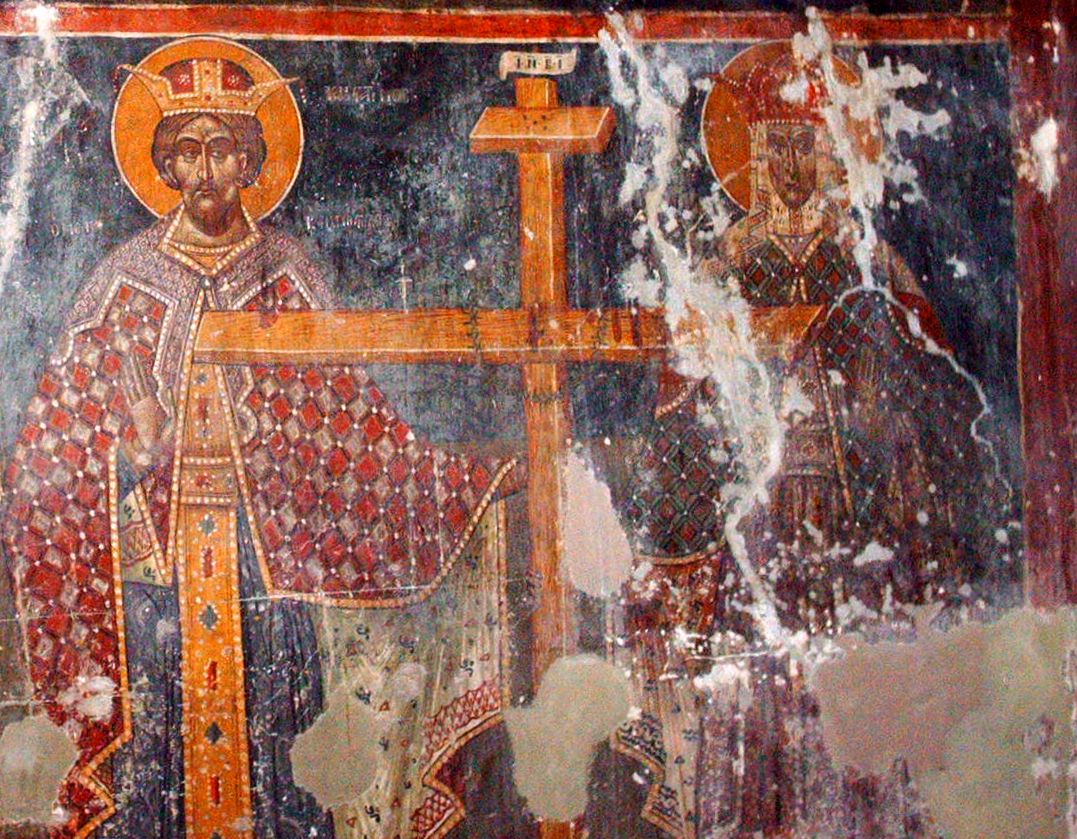
The great feast-day type is the Exaltation pair: Constantine and Helen standing on either side of a large upright Cross, both crowned and haloed, Constantine bearded and in the imperial loros or the jewelled chlamys, Helen in the empress's crown, pearled collar and long dalmatic; both hold the shaft of the Cross with one hand, or support it together, so that the composition reads as a single act of offering. The Cross is generally the plain wooden Cross of the finding, often with the titulus, and not the crucifix. This is the type used for the church-plate and the icon-screens of the very many churches dedicated to them in the Greek, Balkan and Antiochian worlds, and it is the type reproduced in the first image below: a fresco of the second half of the sixteenth century by Nikolla, son of Onouphrios, in the church of the Theotokos Vlacherna at Berat in Albania — the plaster badly lost on Helen's side, but the imperial costume, the crowns and the great Cross with its titulus wholly legible.
Two other types are important. The first is Constantine at the Council of Nicaea, in which the emperor sits enthroned among the assembled fathers, the Gospel-book set on an empty throne in the midst as the true president of the council, and Arius cast down and disgraced at the bottom of the field; this is the icon of the Fathers of the First Council, kept on the seventh Sunday after Pascha, and Constantine is always at its centre. The second image stored here is the finest surviving example, painted in 1591 by Michael Damaskinos of the Cretan school and now in the collection of St Catherine of Sinai at Heraklion: the inscription across the top reads Ἡ ἁγία καὶ ἱερὰ πρώτη σύνοδος ἐν Νικαίᾳ, the haloed emperor sits at the right of the throne in red and gold, and Arius lies below with his rejected scroll.
The third type belongs to the vision: Constantine on horseback or standing before his army, looking up at a cross of light in the sky bearing the legend ἐν τούτῳ νίκα, with the labarum carried before the troops. It is commoner in post-Byzantine Greek and Russian work and in wall-painting cycles of the emperor's life, which also give the Milvian Bridge, the Council, Helen's excavation at Golgotha and the deathbed baptism as narrative scenes. Constantine is also shown alone offering a model of his City to the Theotokos — the type of the Founding of Constantinople, of which the Hagia Sophia vestibule mosaic is the classic example. Helen alone, with the Cross in her right hand, appears in the deesis rows and on the north walls of many churches.
Disputed questions
The vision: what was seen, and when. The two earliest witnesses do not agree. Lactantius, writing about 315 — within three years of the event — knows only a dream on the night before the battle, in which Constantine was told to mark "the heavenly sign of God" on his soldiers' shields, and describes the mark as a staurogram rather than a chi-rho. Eusebius, writing after 337, gives the midday vision in the sky seen by the whole army, the words τούτῳ νίκα, and the dream as a second confirmation, and stakes his own credit on the emperor's sworn testimony. Numismatists add that the chi-rho does not appear on Constantine's coinage until 315 at the earliest and not commonly until the 320s. The liturgical tradition of the Church follows Eusebius, and the troparion of the feast is built directly on his account; the discrepancy is nevertheless real, and the honest statement is that something happened before the Milvian Bridge which Constantine himself understood as a summons from the God of the Christians, and that the precise form in which it came cannot now be recovered.
The lateness of the baptism, and by whom. That the first Christian emperor was baptised only on his deathbed, in the year 337, is not in doubt: Eusebius, his panegyrist, records it, and no earlier baptism is claimed by any fourth-century source. That he was baptised by Eusebius of Nicomedia, the leader of the party that had procured Arius's rehabilitation and Athanasius's exile, is likewise the plain report of the sources — Jerome states it, and the Arian historian Philostorgius makes much of it. The Orthodox tradition has never denied it and has never drawn from it the conclusion that Constantine died an Arian: he died in communion with the Church whose creed he had promulgated at Nicaea, at the hands of a bishop then in that communion, and the deferral of baptism was the common practice of his generation. But the two facts together — the delay and the minister — are the reason no serious account of him can be written in the register of pure hagiography, and the Church's own service for the day praises what he did for the Church, not the tenor of his private life.
The Western legend of the baptism at Rome. The fifth-century Actus Silvestri has Constantine cleansed of leprosy and baptised at Rome by Pope Silvester, in gratitude for which he grants the Roman see the primacy and the rule of the western provinces. The legend is historically impossible — Silvester died in 335, two years before Constantine's illness, and no fourth-century writer of either language knows the story — and the East never received it; its interest is that it became the foundation of the next item.
The Donation of Constantine. The Constitutum Constantini, purporting to be the emperor's grant to Silvester and his successors of the Lateran, the city of Rome, all Italy and the western provinces, together with imperial insignia and precedence over all other sees, is a forgery, composed in the Frankish or papal chancery in the eighth century and used from the eleventh onward in support of the papal monarchy. It was exposed in the fifteenth century by Nicholas of Cusa, Lorenzo Valla and Reginald Pecock, and is now universally admitted to be spurious. No Orthodox claim about Constantine has ever depended upon it, and it forms no part of his veneration in the East; it is recorded here because the document travels under his name and readers meet it there.
Crispus and Fausta. In 326, on his way to or from Rome, Constantine had his eldest son Crispus — a capable young Caesar, victor of the naval battle of the Hellespont — put to death at Pola in Istria, and within months his wife Fausta, Crispus's stepmother and the mother of his three heirs, also died by his order; Zosimus says she was suffocated in an overheated bath. The causes are unknown. Eusebius, writing a decade later, passes both deaths over in complete silence and even excises Crispus from his revised text — the most eloquent silence in ancient historiography. The pagan and Arian writers supply an accusation of adultery between stepmother and stepson, but the shape of that story is exactly the tale of Phaedra and Hippolytus and is very likely a literary construction rather than a report. Earlier, in 325, Constantine had also put to death Licinius, his defeated colleague and brother-in-law, and afterwards his young son Licinianus, after sparing their lives on oath. None of this is denied in this entry and none of it can be excused: an Orthodox account of Constantine must hold together the emperor who gave the Church her freedom and the man who killed his son, his wife and his sworn prisoner, and must say plainly that the Church's veneration of him is a judgement about his public work and his final repentance, not a certificate of character. The service of the day, significantly, praises his faith, his zeal and his crown, and says nothing at all of his justice.
Was his Christianity sincere? The nineteenth century, following Burckhardt, read Constantine as a calculating politician who used the Church; twentieth-century scholarship (Baynes, Jones, Barnes) largely reversed the verdict, pointing to the consistency of his own letters, his private religious language, the scale of his building, and the sheer political cost of what he did. The retention of pagan titles, the sol invictus coinage of the 310s and the deferred baptism are genuine complications; the current consensus is that he was sincerely convinced of the power and favour of the Christian God from 312 onward, while remaining for a long time theologically uninstructed and politically ecumenical.
Helen's status and origins. Wife or concubine of Constantius; the sources are divided and the Church takes no position. Her supposed British royal descent is a twelfth-century invention of Geoffrey of Monmouth and has no support whatever. Her birthplace at Drepanum rests on the plain inference from Constantine's renaming of the town, which is strong but not explicit in the sources.
Did Helen find the Cross? The difficulty is that Eusebius, who describes her pilgrimage at length and who was bishop of the neighbouring see, says nothing about a discovery of the Cross, and that Cyril of Jerusalem, writing about 350, knows that the wood of the Cross is at Jerusalem and distributed through the world but does not connect it with Helen. The first surviving text to name her as the finder is Ambrose's funeral oration for Theodosius in 395; Rufinus, Socrates, Sozomen and Theodoret follow, each with variations, and the Judas Cyriacus expansion is later still. What is securely early is that a relic venerated as the Cross was at Jerusalem by the 340s and that the site was excavated on Constantine's order in the later 320s. Whether the association of the finding with Helen is historical memory or pious inference from her presence at the excavation cannot be settled from the sources; the tradition of the Church holds it, the earliest witnesses are silent, and both facts are stated here. See the Elevation of the Cross for the relic's later history.
The number of the Nicene fathers. 318 is the traditional figure, first found in Hilary and Ambrose; the earlier witnesses (Eusebius, Athanasius, Constantine's own letter) give "more than 250," "about 300," and "300." The figure is best taken as a symbol drawn from Genesis 14:14 rather than a count.
Why May 21 and not May 22? Constantine died on 22 May. The Byzantine synaxaria and the printed Menaia nevertheless fix the joint commemoration on 21 May, and none of them explains the displacement; the usual conjecture is the crowding of the calendar at that point, or a reckoning from the eve. The divergence is noted rather than resolved.