
Chariton the Confessor
Our Venerable and God-bearing Father Chariton the Confessor
Venerable · Confessor · b. 3rd century, Iconium — d. c. 350
Commemorated 28 September — Repose at the Souka lavra
Chariton the Confessor (†c. 350) was a citizen of Iconium who suffered torture for Christ under the emperor Aurelian, survived, and became the founding father of desert monasticism in Palestine. Delivered by a miracle from robbers who had imprisoned him in a cave near Jerusalem, he turned that cave into a church and around it grew the lavra of Pharan, the first of the three great lavras he founded — Pharan, Douka above Jericho, and Souka, the "Old Lavra." His rule of cell-dwelling hermits gathered for common worship set the pattern of Judean-desert monasticism a century before Euthymius and almost two before Sabas. He reposed in great old age and is commemorated on September 28.
.jpg)
Origins and confession under Aurelian
Chariton was born in the third century at Iconium in Lycaonia (the city of the Apostle Paul's preaching and of the protomartyr among women, Thecla), of a distinguished Christian family. The Life makes him a devoted client of Thecla, his fellow citizen, whose boldness before the persecutors he took as his own pattern. When persecution reached Iconium in the reign of Aurelian (270–275) — the sources connect it with the edict Aurelian was preparing at the end of his reign — Chariton, by then a man of standing in the city, was among the first seized. Before the governor he refused to sacrifice, denounced the idols, and confessed the one God and Christ the Saviour; he was racked, torn, and burned, and was left in prison expecting death. The emperor's own death intervened: the persecution lapsed, the prisoners were released, and Chariton came out of prison a living martyr — a confessor, bearing in his body the marks of torture but denied, as the hagiographer has him lament, the crown of martyrdom itself. The Life adds a second arrest and release under a later persecution before he left his homeland for good.
The robbers' cave
Free, and now regarding his life as no longer his own, Chariton gave away his property and set out on pilgrimage to Jerusalem. On the road through the desert hills north-east of the city he fell into the hands of a band of robbers, who bound him and threw him into their cave in the gorge of Pharan (Wadi Fara, at the springs of Ein Fara) until they should return and deal with him. Chariton prayed, not for deliverance, but that God's will be done. While he lay bound, the Life relates, a viper drank from the robbers' wine jar and spat its venom into it; the band returned, drank, and died to a man. The captive found himself heir of the cave and of the robbers' accumulated gold, which he distributed to the poor and to the churches, keeping the cave itself: he consecrated the den of thieves into a house of prayer and settled there as a hermit, about the years of Constantine's peace of the Church.
The three lavras
Disciples gathered, as they always gather in these deserts, and against his love of solitude Chariton organised them. Around the cave-church of Pharan he laid out the first lavra of the Judean desert: a loose colony of solitary cells strung along the gorge, each monk praying and working alone through the week, all assembling on the Lord's Day (and later also Saturday) for the common Eucharist. His rule for Pharan — remembered as strict and simple — prescribed the round of psalmody, night vigil, manual labour (rope- and basket-work bought the monks' bread), a single daily meal of bread, salt and water toward evening, hospitality to strangers, and almsgiving from the work of the monks' own hands. It is the earliest monastic rule of Palestine, and the lavriote pattern it fixed — hermit cells around a common church, the balance of solitude and synaxis — is precisely the form that Euthymius the Great inherited in the next century and Sabas the Sanctified brought to its height in the Great Lavra: the whole Judean tradition, down to Mar Saba today, builds on Chariton's foundation. Tradition further ascribes to him the arrangement of the office of the monastic tonsure, the rite by which the Church clothes a monk.
Fleeing the crowds his fame drew, Chariton withdrew from Pharan — leaving the community under a chosen steward — first to the cliffs above Jericho, where beside the spring of Douka on the Mount of the Temptation he founded his second lavra, Douka (its Byzantine successor is the present monastery of the Temptation); and when pilgrims found him there too, he moved on south to the ravine below Tekoa, where about 345 he founded his third and most enduring community, Souka — called in later centuries simply the Old Lavra (Palaia Lavra), as Sabas's was the Great — in the wadi that still bears his name, Wadi Khureitun. To the end he kept the oversight of all three communities.
Repose
In extreme old age Chariton withdrew to a cave in the cliff above Souka — the "hanging cave" of the later pilgrims, reachable only by ladder (two centuries later the last dwelling of Cyriacus the Hermit) — and there, having gathered the monks of his three lavras, given them his last instruction, and appointed his successors, he reposed in peace on September 28, in or about the year 350. At his own wish he was carried back to his first home in the desert and buried at Pharan, in the church built in the robbers' cave of his deliverance.
Veneration and later cultus
Chariton's cultus is as old as Palestinian monasticism itself: the monks of the desert kept his memory as their common patriarch, and the Old Lavra of Souka was known by the sixth century simply as the lavra "of Chariton." His Life was written in the sixth century by a monk of that house, who says he drew on the community's living tradition; through the Constantinopolitan synaxaria his feast on September 28 passed to the whole Byzantine world. In the later Byzantine rite he stands among the great monastic fathers: the Typikon honours his day, and — a singular distinction — the canon of his feast is interwoven in the Menaion with the memory of the hymnographers, since the September 28 canon is an acrostic work of Joseph the Hymnographer. The monastery of Souka/Old Lavra survived into the Middle Ages; its ruins and the hermit caves of Wadi Khureitun remain, and the modern Russian convent at Ein Fara continues monastic life at Pharan on the site of his first foundation.
Feast and commemoration
September 28 (church date; Old Calendar civil October 11) is Chariton's universal feast, kept by all Orthodox calendars as the principal commemoration of the day; the Menaion appoints him a full service with proper troparion and kontakion, and the day's canon is by Joseph the Hymnographer. On the same day the Slavic calendars keep the synaxis of the venerable fathers of the Kiev Caves who rest in the Near Caves — a fitting conjunction, the Russian tradition observes, of the father of the Palestinian cave-monks with the cave-fathers of Rus'. In the Roman Martyrology Chariton is likewise commemorated on September 28.
Hymns
Troparion — Tone 8
With the streams of thy tears thou didst till the barren desert, and with sighs from the depths of thy soul thou madest thy labours bear fruit an hundredfold; and thou becamest a beacon to the whole world, shining with miracles. O Chariton our venerable father, intercede with Christ God that our souls may be saved.
Original translation from the Greek
Kontakion — Tone 2
Come, ye faithful, let us crown with hymns and acclaim with praises the ascetic of abstinence and athlete of piety, Chariton, whose very name is grace: shepherd and teacher, and martyr of Christ, the world-wide beacon of the world.
Original translation from the Greek
Appointed readings
Epistle — 2 Corinthians 4:6–15
6For God, who commanded the light to shine out of darkness, hath shined in our hearts, to give the light of the knowledge of the glory of God in the face of Jesus Christ. 7But we have this treasure in earthen vessels, that the excellency of the power may be of God, and not of us. 8We are troubled on every side, yet not distressed; we are perplexed, but not in despair; 9Persecuted, but not forsaken; cast down, but not destroyed; 10Always bearing about in the body the dying of the Lord Jesus, that the life also of Jesus might be made manifest in our body. 11For we which live are alway delivered unto death for Jesus’ sake, that the life also of Jesus might be made manifest in our mortal flesh. 12So then death worketh in us, but life in you. 13We having the same spirit of faith, according as it is written, I believed, and therefore have I spoken; we also believe, and therefore speak; 14Knowing that he which raised up the Lord Jesus shall raise up us also by Jesus, and shall present us with you. 15For all things are for your sakes, that the abundant grace might through the thanksgiving of many redound to the glory of God.
Gospel — Luke 6:17–23
17And he came down with them, and stood in the plain, and the company of his disciples, and a great multitude of people out of all Judæa and Jerusalem, and from the sea coast of Tyre and Sidon, which came to hear him, and to be healed of their diseases; 18And they that were vexed with unclean spirits: and they were healed. 19And the whole multitude sought to touch him: for there went virtue out of him, and healed them all. 20And he lifted up his eyes on his disciples, and said, Blessed be ye poor: for yours is the kingdom of God. 21Blessed are ye that hunger now: for ye shall be filled. Blessed are ye that weep now: for ye shall laugh. 22Blessed are ye, when men shall hate you, and when they shall separate you from their company, and shall reproach you, and cast out your name as evil, for the Son of man’s sake. 23Rejoice ye in that day, and leap for joy: for, behold, your reward is great in heaven: for in the like manner did their fathers unto the prophets.
Iconography
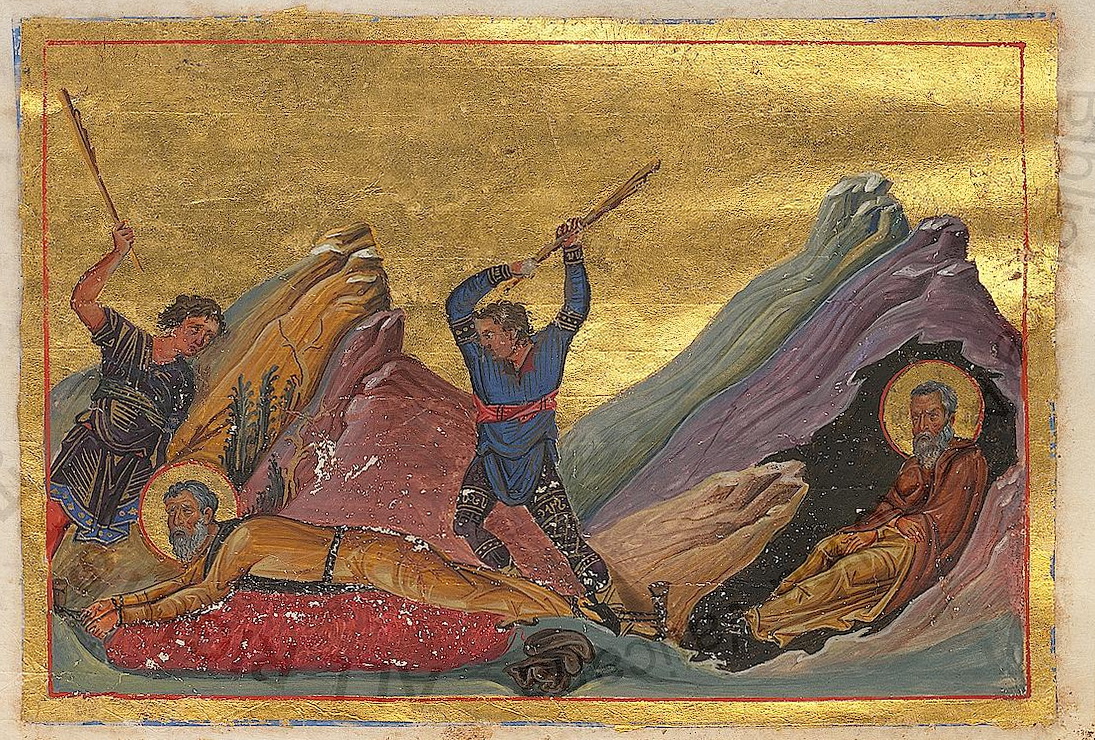
Chariton is painted as a desert father of the great schema: an aged monk with a pointed grey beard, in mantle and analavos, blessing or holding a scroll or cross; in the festal menologia his torture under Aurelian is also shown. The stored image is the miniature for September 28 from the Menologion of Basil II (Constantinople, c. 985, Vatican Library): a two-scene composition in which the young confessor, haloed, is beaten with rods by two executioners, while at the right the same saint, grown old, lies at repose in his desert cave — his confession and his cave-dwelling old age gathered into one image.
Disputed questions
- Which persecution? The Life places Chariton's confession under Aurelian, whose planned persecution most ancient sources say was cut short by his death (275); some manuscripts and derived notices instead name the persecutions of Diocletian or Galerius, and modern scholars have observed that a confession c. 275 requires Chariton to have lived very long indeed if he died c. 350. The Byzantine tradition keeps Aurelian, and the chronological strain is noted rather than resolved.
- Chronology of the foundations. The Life gives no absolute dates; the conventional reckoning (Pharan c. 330, Douka c. 340, Souka c. 345, repose c. 350) is a modern harmonisation, and the year of his death is variously given as c. 350 or a few years either side. The OCA notice states the repose precisely as September 28, 350.
- The Life is anonymous and was written some two centuries after the saint (6th century, at Souka); scholars treat its pre-Palestinian chapters (the Iconium confession) as the least historically secure part, while its desert topography is exact and plainly first-hand.
- Not to be confused with the Roman martyr Chariton who suffered with Justin the Philosopher about 165 and is commemorated June 1 among Justus, Justin and their Companions — a layman of Justin's school at Rome, sharing with this Chariton only the name.