
Cyriacus the Hermit
Our Venerable Father Cyriacus the Anchorite
Venerable · Priest · b. January 9, 448 — d. September 29, 556
Commemorated 29 September — Repose at the Old Lavra of Souka
Cyriacus the Hermit (448–556) was one of the great anchorites of the Judean desert: a Corinthian who came to Palestine at eighteen, was clothed in the schema by Euthymius the Great, trained under Gerasimus of the Jordan, and spent some seventy years of his hundred-and-seven-year life in the lavra of Souka — the "Old Lavra" of Chariton — and the wildernesses beyond it, living at the last in Chariton's own hanging cave. A healer and strict faster who said the sun had never seen him eat or grow angry, he was in extreme old age a pillar of the Orthodox resistance to the Origenist movement among the desert monks. His life was written by his younger contemporary Cyril of Scythopolis, who knew him personally. He is commemorated on September 29.
.jpg)
The Life of Cyriacus is among the best-documented of any desert saint, because its author, Cyril of Scythopolis — the sober, chronology-minded historian of Judean-desert monasticism — visited the aged anchorite in person, questioned him, and set down his account within a few years of the saint's death. What follows rests on that contemporary witness, supplemented by the synaxaria.
Origins and early life
Cyriacus was born at Corinth on January 9 in the year 448, the son of a priest of the city, John, and his wife Eudocia. Peter, the bishop of Corinth, was a kinsman of the family, and seeing the boy quiet and capable he made him a reader of the church. Constant reading of the Scriptures did its work; and when Cyriacus was about eighteen the word of the Gospel read in church — "If any man will come after me, let him deny himself, and take up his cross, and follow me" (Matthew 16:24) — struck him as spoken to himself. Cyril relates that he did not even return home: he went straight from the church to the harbour of Corinth, found a ship, and sailed for the Holy Land. After venerating the holy places he passed the winter of his arrival in obedience to the abba Eustorgius, whose monastery stood near holy Sion in Jerusalem.
Formation in the desert
With Eustorgius's blessing the young man made his way into the desert to Euthymius the Great, then in his last years the patriarch of Palestinian monasticism. Euthymius discerned what was in him and clothed him in the monastic schema with his own hands, but would not keep him: after a costly early experience he admitted no beardless youths to his lavra, and he sent Cyriacus down to the Jordan, to Gerasimus. Gerasimus likewise judged the youth unripe for the solitary cell and set him to the common life of his cenobium, where Cyriacus fulfilled his obediences with a severity beyond his years — praying through the night hours, eating bread and water only every other day. Gerasimus, seeing his abstinence, took the young monk with him on his Great Lent withdrawals into the desert of Rouba, where the elder communicated his disciple with the Holy Mysteries each Sunday.
When Gerasimus reposed in 475, Cyriacus — now twenty-seven — returned to the lavra of Euthymius, who had himself died two years before, and asked for a solitary cell. There he lived in silence, conversing only with his neighbour Thomas; and when Thomas was sent to Alexandria and consecrated a bishop there, Cyriacus kept complete silence for ten years more. At thirty-seven he was ordained deacon.
The Old Lavra of Souka
When a quarrel broke out between the monasteries of Euthymius and of Theoctistus, Cyriacus would not remain amid the strife. He withdrew to the lavra of Souka — the first-founded and by then already called the Old Lavra, established a century and a half earlier by Chariton the Confessor (September 28) — where it was the custom to receive even tonsured monks as beginners. Cyriacus accepted this humbling and served the community's obediences in the bakehouse, the infirmary and the guest-house; in time he was ordained to the priesthood and appointed canonarch, the director of the church's chanting and order, an obedience he carried for eighteen years. He served thirty years in all at Souka, and Cyril preserves the elder's own summary of them: in all that time the sun never saw him eating, nor angry with any man.
The desert years
At seventy, thirsting for deeper stillness, Cyriacus went out with his disciple John into the wilderness of Natoufa, where the only food was the bitter squill, which — the Life relates — became edible at the elder's prayer. After five years a local man discovered the hermits and brought his demon-possessed son, whom Cyriacus healed; and as the sick and the troubled began to find the way to his cave, he fled to the desert of Rouba, where he had kept Lents with Gerasimus a half-century before. Five years later, now eighty, he withdrew to the remotest solitude of all, Sousakim, at the confluence of two dried torrent-beds — the tradition of the desert applied to the place the verse "Thou hast dried up the rivers of Etham" (Psalm 73:15 LXX). After seven years there, the fathers of Souka came to him in a time of famine and sickness and begged his return; he yielded, and settled in the cliff-side hanging cave of Chariton, where the founder of the lavra had ended his own days two centuries before.
The Origenist controversy
Cyriacus's last decades coincided with the gravest doctrinal storm the desert ever knew: the spread among the Palestinian monks, above all at the New Lavra, of speculative Origenist teaching — the pre-existence of souls and the apokatastasis, the universal restoration, with the factions the sources call protoktistoi and isochristoi. The aged anchorite threw his whole authority against it. Cyril of Scythopolis, then a young monk of the lavra of Euthymius, was sent to Cyriacus and heard from him a vigorous refutation of the Origenist positions, which he records in the Life at first hand — the one extended dogmatic discourse of the old ascetic literature of the desert set down from a living anchorite's lips. Cyril also records that Cyriacus foretold the imminent deaths of the movement's chiefs, Nonnus and Leontius, and the collapse of the heresy — fulfilled when the Origenist teachings were condemned in the time of the Fifth Ecumenical Council (553) and the desert returned to peace.
To the same years belongs the vision transmitted by his disciple John: the Mother of God, appearing to Cyriacus with John the Forerunner and John the Theologian, refused to enter his cell because it held a book containing writings of Nestorius — "my enemy is in your cell" — whereupon the elder cast the volume out. The Russian church keeps a separate commemoration of this appearance on June 8.
Final years and repose
In his hundredth year Cyriacus went out once more to Sousakim with his disciple John and lived there in his old solitude. The Life describes a huge lion that kept the hermits company, guarded them and their little garden from robbers, and took food from the elder's hand; and it relates that when their winter store of water in a rock-hollow failed in the summer heat, rain fell at Cyriacus's prayer and filled it. Cyril, who saw him in these final years, describes him with an eyewitness's wonder: tall, erect and vigorous, standing at prayer and working with his hands in extreme old age, gentle and accessible, with nothing in him dimmed. Two years before his death the elder returned to the hanging cave of Chariton; and there, having gathered and blessed the brethren, he reposed in peace on September 29, 556, having lived a hundred and seven years.
Feast and commemoration
September 29 (church date; Old Calendar civil October 12), the day of his repose, kept universally in the Byzantine rite; Cyriacus is the principal saint of the day, with a full proper service in the received Menaion. The Russian church additionally commemorates on June 8 the appearance of the Theotokos to him. The day's service is joined in the synaxaria with the memory of the Persian martyrs Dada, Gabdelas and Casdoa and other martyrs of the day.
Hymns
Troparion — Tone 1
Thou wast a citizen of the desert and an angel in the body, and thou wast shown forth a wonderworker, O our God-bearing father Cyriacus. By fasting, vigil and prayer receiving heavenly gifts of grace, thou healest the sick and the souls of them that run to thee with faith. Glory to him that gave thee strength; glory to him that crowned thee; glory to him that worketh healings for all through thee.
Original translation from the Greek
Kontakion — Tone 8
As a mighty champion and helper, the sacred Lavra that honoureth thee keepeth thy memorial with festival year by year; but as thou hast boldness before the Lord, guard us from the enemies that rise against us, that we may cry to thee: Rejoice, thrice-blessed father. Divinely armed with purity of soul, and firmly grasping unceasing prayer as a spear, thou didst cut down the hosts of the demons, O Cyriacus our father: pray without ceasing for us all.
Original translation from the Greek
Iconography
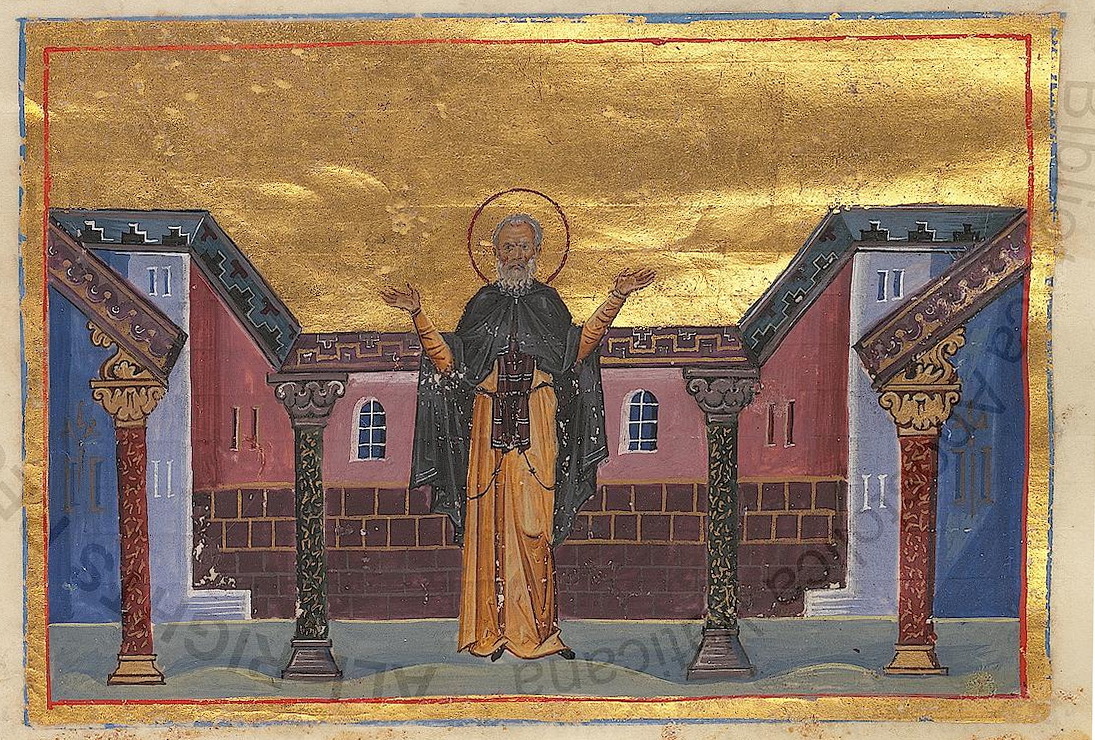
Cyriacus is depicted as a very aged anchorite — the Lives give him more than a century — in the monastic habit and schema, with a long white or grey beard, most often with hands raised or extended in prayer; later Greek and Russian menaion-icons for September show him among the venerable fathers of the month. The stored image is his miniature in the Menologion of Basil II (Constantinople, c. 985), which shows the white-bearded elder in a dark mantle, arms lifted in the orans posture before the buildings of his lavra, beneath a gold sky.
Disputed questions
- Age at death. Cyril of Scythopolis's chronology gives a life of 107 years (born January 448, died September 556), and this is the figure of the Greek tradition; the Slavic menologia and the OCA account transmit 109 years. The difference appears to arise from later copyists' inclusive reckonings; the account above follows Cyril, the contemporary source.
- Chronological details. Cyril's precise framework (departure from Corinth at eighteen, the death of Gerasimus in 475, the diaconate at thirty-seven, thirty years at Souka, the desert withdrawals at seventy, eighty and ninety-nine) is internally consistent to within a year or two; the synaxaria simplify and occasionally displace these figures.
- Not to be confused with other saints of the name: the martyr Cyriacus who suffered with Faustus the presbyter and companions at Alexandria (commemorated September 6), or the hieromartyr Cyriacus of Jerusalem (October 28). The name (from Κύριος, "the Lord's own") is common in the calendar.