
Christodoulos of Patmos
Our Venerable and God-bearing Father Christodoulos the Wonderworker of Patmos
Venerable · Wonderworker · b. c. 1020, near Nicaea in Bithynia — d. March 16, 1093, on Euboea
Commemorated 16 March — Repose on the island of Euboea
Christodoulos (c. 1020 – 1093), baptised John, was a Byzantine monk and abbot of the eleventh century and the founder of one of the great houses of Aegean monasticism, the Monastery of Saint John the Theologian on Patmos. Formed in the ascetic tradition of Mount Olympus in Bithynia, the Lavra of Saint Sabbas in Palestine, and above all Mount Latros in Caria — where he became the superior of its monks — he was driven westward through the islands by the Seljuk Turkish advance. In 1088 the emperor Alexios I Komnenos, by a golden bull, granted him the deserted island of Patmos, where the Apostle John had received the Revelation, in exchange for his lands on Kos; there Christodoulos built and fortified his monastery and gave it the rule (Hypotyposis) that still governs it. A fresh Turkish raid drove him at the last to Euboea, where he wrote his Testament and reposed on March 16, 1093. His relics were carried back to Patmos, where they remain incorrupt and work wonders, and he is honoured as the Wonderworker of Patmos.

Origins and early monastic life
Christodoulos was born about the year 1020 in the region of Nicaea in Bithynia, in north-western Asia Minor, and received in baptism the name John — the name of the Theologian whose island he would one day make his own. Drawn to the monastic life from his youth, he left the world and took the habit, and the sources place his early ascetic formation on Mount Olympus in Bithynia, one of the celebrated monastic mountains of the Byzantine world. From there, in the manner of the seekers of his age, he made a pilgrimage to the Holy Land, where he entered the ancient Lavra of Saint Sabbas in the Judaean desert and drank at the deep well of Palestinian monasticism — the tradition of Sabbas whose typikon and spirit he would later carry into his own foundation. The disorders of Syria and Palestine under the advancing Turks, however, did not allow him to remain, and he returned to Asia Minor.
Superior of Mount Latros
His return brought him to Mount Latros (Latmos), the monastic mountain rising above the Carian coast near ancient Miletus, honeycombed with lavras and cells and crowned by the famous Lavra of Saint Paul the Younger. There Christodoulos so shone in the ascetic struggle that the monks chose him as their superior (protos, or hegumen), and from this office he carried through the rest of his life the surname "the Latrine" — Christodoulos of Latros. But the same wave that had unsettled the Holy Land now broke over Asia Minor: after the disaster of Manzikert (1071) the Seljuk Turks overran Anatolia, and the monastic mountains, undefended, emptied before them. Christodoulos was forced to abandon Latros, and with a company of monks he withdrew to the islands of the eastern Aegean — to Kos, where he laboured to establish monastic life, and to Leros and the neighbouring isles — always a step ahead of the raiders, seeking a refuge secure enough to house a settled community.
The grant of Patmos
That refuge he found, at last, in the small and deserted island of Patmos — the rocky Dodecanese island, all but uninhabited in his day, on which the Apostle and Evangelist John the Theologian had been exiled under Domitian and had received the Revelation. To obtain it Christodoulos went to the source of all such grants, the emperor himself. In 1088 the emperor Alexios I Komnenos — the founder of the Komnenian dynasty, then in the early and precarious years of his reign — received the monk favourably, and by an imperial chrysobull (golden bull) made over to him and to his monks the whole island of Patmos in perpetuity, in exchange for the monastic lands Christodoulos held on Kos. The grant was generous and deliberate: the island was ceded free of taxation and of all interference by imperial and provincial officials, with the right to bring settlers and workers and to hold the neighbouring islets, so that the community might be self-sustaining and, so far as possible, independent. The emperor's mother, the pious Anna Dalassene, is remembered in the tradition as a patron of the undertaking. In this act of Alexios and Christodoulos the great Monastery of Saint John the Theologian was born.
The monastery of Saint John the Theologian
On the island's high central hill, on the site of a ruined ancient sanctuary and an early Christian basilica dedicated to the Theologian, Christodoulos began to build. From the outset the monastery rose as a fortress as much as a house of prayer — girt with high walls and towers against the pirates and Turkish raiders who still swept the Aegean — and this fortified katholikon and its refectory, the oldest surviving parts, remain to this day the core of the great grey pile that crowns Patmos. Within the walls Christodoulos gathered a cenobitic community and gave it, in May 1091, its Rule — the Hypotyposis (Ὑποτύπωσις), a monastic typikon drawing on the Sabbaïte and Studite traditions he had known, prescribing the common life, the daily cycle of prayer, the fasts, and the governance of the house. To this he would add, at the end of his life, his Testament (Διαθήκη) and a Codicil, documents that together fixed the monastery's constitution and its cherished independence — self-governing, answerable to no bishop or lord but only to the emperor's protection and to God. These three texts of Christodoulos survive and are among the most valuable documents of Byzantine monasticism; they have governed the Monastery of Saint John from his day to our own, and Patmos has kept, almost alone among such foundations, an unbroken monastic life of more than nine centuries.
Flight to Euboea and repose
Christodoulos did not die on the island he had won. About the year 1092, a renewed Turkish raid on the Aegean — the fleet of the emir Tzachas (Chaka) of Smyrna was ravaging the islands in these years — fell upon Patmos, and the aged abbot was compelled once more to flee, leading his monks to the safety of the great island of Euboea (Evia) off the coast of Greece. There, knowing his end near, he set his house in order: in March 1093 he composed his Testament and Codicil, commending the monastery to his disciples and to the emperor's protection and binding them to his Rule. He reposed in peace on Euboea on March 16, 1093, an old man full of labours, having in a single lifetime carried the monastic tradition from Bithynia and Palestine to the very island of the Apocalypse and planted there a house that would outlast the empire that endowed it.
Relics and later cultus
The monks did not leave their founder in exile. His relics were carried back to Patmos and enshrined in the monastery he had built, where they remain to this day — held to be incorrupt — in a chapel dedicated to him beside the katholikon, in a silver reliquary that is the goal of the pilgrims who come to the island. From his relics the tradition records a stream of healings and wonders, and it is for these that he bears throughout the Greek world the title "the Wonderworker of Patmos" (ὁ θαυματουργός); the OCA account and the Greek tradition alike remember him also as a physician of soul and body, whose prayers cured the sick. Patmos keeps his memory not only on the day of his repose but with a local feast of the return of his relics to the island, and venerates him as its founder, its protector, and — with the Theologian himself — its patron. His monastery, raised to the rank of a stauropegial and later patriarchal house, became one of the intellectual centres of the enslaved Greek nation under the Turks, its library among the richest in the Orthodox world; and all of it descends from the chrysobull of Alexios and the labour of the monk of Latros.
Feast and commemoration
Christodoulos is commemorated on March 16 (church date; Old Calendar civil March 29), the day of his repose on Euboea. Because the date falls within Great Lent, whose bounds are movable, his memory ordinarily lands on a weekday of the Fast, when the full Liturgy is not served and no fixed Epistle and Gospel are appointed; his office is then joined to the Lenten order, or — where his feast is kept with solemnity, above all on Patmos itself — transferred to a day when the Liturgy may be celebrated. His principal veneration is Greek and Aegean, but his feast stands in the universal Byzantine calendar, and the OCA keeps him among the saints of the day. On Patmos the monastery observes, besides his repose, the return (translation) of his relics to the island as a second, local commemoration.
Hymns
Troparion — Tone 1
The offspring of Nicaea and the boast of Patmos, and the glory of monastics, the God-bearing Christodoulos, let us honour with hymns, O brethren, embracing his holy tabernacle, that we may receive the healing of our souls and bodies, and crying aloud: Glory to him who has given thee strength; glory to him who has crowned thee; glory to him who works through thee healings for all.
Original translation from the Greek
Kontakion — Tone 8
To thee who by thy venerable teachings hast led thy flock out of the dread vanity of the world, we thy children inscribe a hymn, O blessed one; but as one who hast boldness before the Lord, deliver us from punishments of every kind, that we may cry: Rejoice, O father Christodoulos!
Original translation from the Greek
Iconography
Christodoulos is depicted as an aged monastic father and abbot — a small, spare old man, long white beard, in the black mandyas and koukoulion (the monastic schema and cowl) of a hegumen — most often holding a scroll (bearing words of his Rule or a monastic admonition) or a model of his monastery, and frequently paired with the Apostle John the Theologian or set against the fortress-monastery of Patmos rising on its hill. His developed iconography is a creation of the Patmian and post-Byzantine Cretan tradition, where he appears among the founder-saints; the monastery preserves portable icons and wall paintings of him.
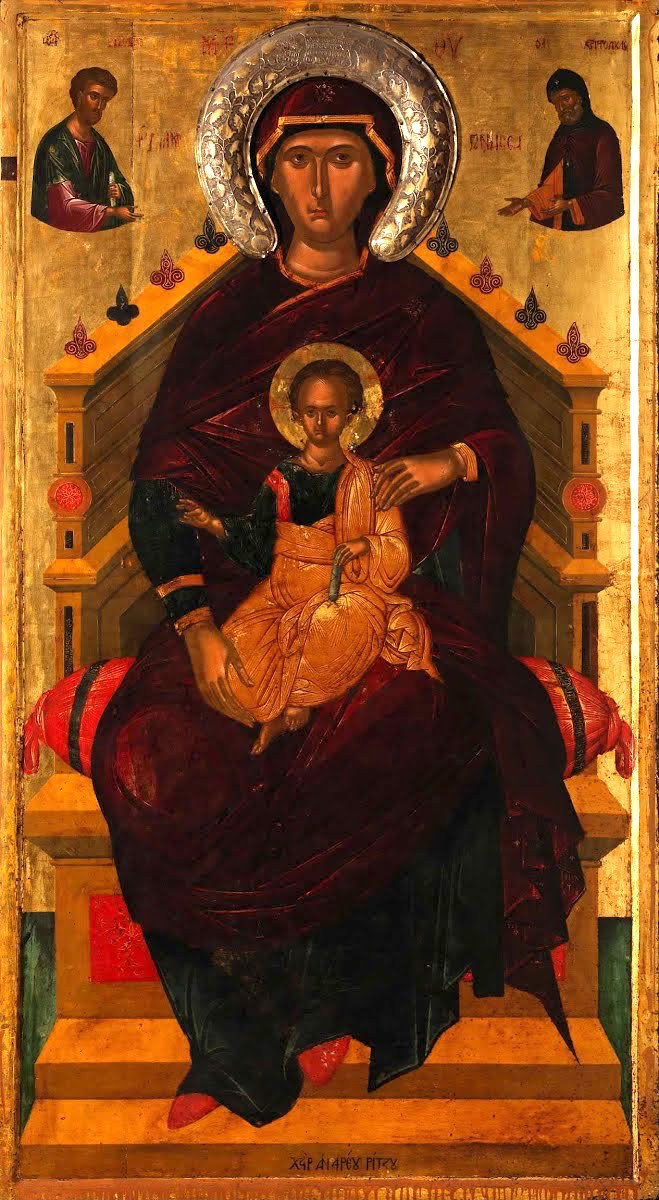
No public-domain, securely identity-verified pre-modern portrait icon of Christodoulos was located for storage at the time of authoring — the candidates found on Wikimedia Commons are either modern or depict him only as a subsidiary figure. The subsidiary figure below is nevertheless inscribed and secure — better a small Christodoulos by Ritzos than none.
The stored image is the Pantanassa icon of Andreas Ritzos (before 1492): the enthroned Virgin flanked in the upper corners by John the Theologian and, at the right, the small inscribed figure of Christodoulos himself, offering his church — the monastery of Patmos pairing its patron-apostle with its founder.