
Chrysogonus of Aquileia
The Holy Martyr Chrysogonus
Martyr · d. c. 304
Commemorated 22 December — Martyrdom at Aquileia
Chrysogonus (†c. 304) was a learned and devout Roman Christian, the teacher and lifelong spiritual guide of the great-martyr Anastasia the Deliverer-from-Bonds, who sustained her by his counsel through the persecution of Diocletian. Himself imprisoned for the faith, he was brought before the emperor at Aquileia, refused to sacrifice, and was beheaded, his body cast into the sea and recovered by the presbyter Zoilus. He is commemorated on December 22, together with Anastasia, whose passion is bound up with his own.

Chrysogonus appears in the tradition as an educated Roman Christian to whom the young Anastasia was entrusted for instruction by her mother, the secret Christian Fausta. He formed her in the Scriptures and in the discipline of the faith and remained, through all that followed, the guide she turned to. When the persecution of Diocletian filled the prisons of Rome, Chrysogonus was among those confined; and it was from prison that he answered the letters Anastasia sent him during her confinement by her pagan husband, exhorting her to patience and to the Cross and foretelling her coming deliverance.
The received Life relates that when Diocletian ordered the Christian prisoners of Rome put to death in a single night, he had Chrysogonus singled out and brought to him at Aquileia, in the north of Italy, where the emperor was then holding court. Interrogated in person, Chrysogonus would neither sacrifice to the gods nor deny Christ; the emperor therefore commanded that he be beheaded. His body and severed head, cast into the sea, were carried by the waves to shore and there found — by the providence recounted in Anastasia's Life — by a presbyter named Zoilus, who hid the relics reverently in his house. Chrysogonus afterward appeared to Zoilus in a vision, foretelling the martyrdom of the three sisters Agape, Chionia and Irene and the presbyter's own approaching repose. The Greek synaxarion's distich salutes the martyr's constancy: "Chrysogonus gives his neck to the sword — golden in spirit, and of bronze in strength."
Feast and commemoration
December 22 (church date; Old Calendar civil January 4), his martyrdom, kept within the forefeast of the Nativity and joined in the Menaion to the office of the great-martyr Anastasia, with whom his memory is inseparably linked. In the West his feast is November 24. No proper service is appointed to him in the East; he is commemorated in the synaxarion of the day with a distich, and in the hymns of Anastasia's service.
Hymns
Troparion — Tone 4 (from the common of a martyr)
Thy martyr Chrysogonus, O Lord, in his sufferings hath received an incorruptible crown from thee our God; for, possessed of thy might, he cast down the tyrants and broke in pieces the powerless boldness of the demons. By his intercessions save thou our souls.
Original translation from the Greek
Iconography
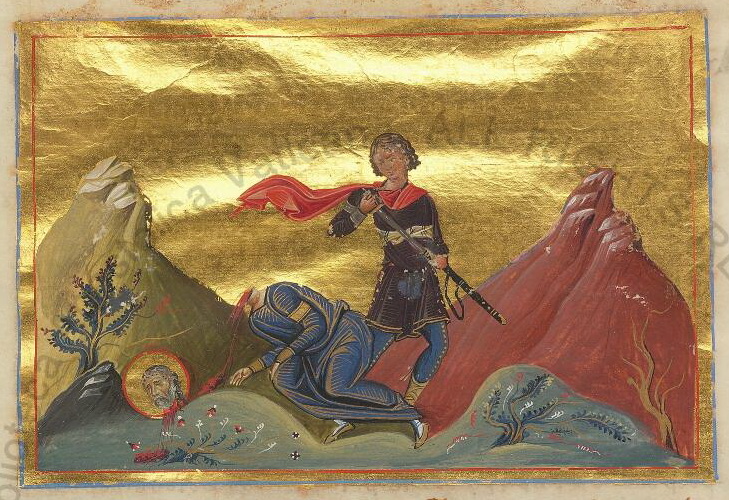
Chrysogonus is depicted as a martyr, most often as a mature bearded man in the tunic and cloak of a Roman layman, holding the cross of martyrdom; scenes of his passion show his beheading and the recovery of his relics from the sea. The stored image is his miniature from the Menologion of Basil II (Constantinople, c. 1000, Vatican Library), where he is inscribed and shown at his martyrdom.
Disputed questions
- Office and origin. The Byzantine tradition remembers Chrysogonus as a lay teacher and catechist of Anastasia, martyred at Aquileia. The Western tradition, in which he is likewise venerated and named in the Roman Canon of the Mass, in places styles him a cleric or even a bishop of Aquileia; the historical connexion of his cult with that city is early and firm, whatever his rank. The divergence is recorded; this entry follows the Eastern usage, which does not number him among the ordained and so classes him simply among the martyrs.