
Clement of Rome
The Holy Hieromartyr Clement, Bishop of Rome
Hieromartyr · Bishop · d. c. 101
Commemorated 25 November — Martyrdom at Chersonesus in the Crimea
Clement was bishop of Rome at the end of the first century (episcopate c. 92–101) and one of the Apostolic Fathers — the generation taught directly by the Apostles. The tradition makes him a disciple of the Apostle Peter, who is said to have ordained him, and reckons him the third or fourth bishop of the Roman church. His enduring monument is the Epistle to the Corinthians (1 Clement, c. 96), written in the name of the Roman church to quell a schism at Corinth: the earliest datable Christian writing outside the New Testament, and for centuries read aloud in the churches. A later passio relates that Trajan exiled him to the marble quarries of Chersonesus in the Crimea and had him drowned with an anchor about his neck; his relics, recovered there by Cyril and Methodius in the ninth century, were carried in part to Rome and in part to Kyiv. He is commemorated on November 25.

Origins and the Roman episcopate
Clement belonged to the church of Rome in the apostolic age, and the whole of antiquity numbers him among the immediate heirs of the Apostles. Beyond that the record is thin and much overlaid. The passio makes him a Roman of noble and wealthy family, raised apart from his parents and educated in the letters and philosophy of the capital, restless amid its luxury until the preaching of Christ reached Rome and drew him east to seek the Apostles — meeting Barnabas at Alexandria and being baptised by Peter in Palestine, whose companion and fellow-labourer he then became. How much of this reflects history and how much the romance of the pseudo-Clementine literature (see Disputed questions) cannot now be recovered; what is early and firm is that Clement was a leading presbyter, then bishop, of Rome within living memory of Peter and Paul.
The order of the first Roman bishops was already discussed in the second century and remains disputed. Irenaeus and, following him, Eusebius set the succession Linus, Anacletus (Cletus), then Clement — making him the third bishop after the Apostles, and the fourth if Peter is counted; Tertullian, by contrast, reports that Peter ordained Clement directly, as his immediate successor. Eusebius dates his episcopate from the twelfth year of Domitian to the third of Trajan — roughly 92 to 101 — a span of some nine to twelve years. The tradition also, from Origen and Eusebius onward, identified him with the Clement "whose name is in the book of life" of Philippians 4:3, Paul's fellow-worker; modern scholarship treats that identification, and a further confusion with the consul Titus Flavius Clemens (a kinsman of Domitian put to death about 95), as later conjecture rather than fact.
The Epistle to the Corinthians
Clement's certain and towering legacy is his letter. About the year 96, in the aftermath of Domitian's reign, the church of Rome — its spokesman, by ancient and unanimous attribution, Clement — wrote a long letter to the church of Corinth, where younger members had risen up and deposed the established presbyters. The Epistle to the Corinthians, now universally called 1 Clement, urges the restoration of the ousted elders and the healing of the schism, grounding its appeal in the peace and good order (the famous harmonia and taxis) that God has set through creation, in the Old Testament examples of envy and humility, in the Resurrection, and in the ordered ministry handed down from Christ through the Apostles. It is the earliest Christian document that can be securely dated outside the canon, a witness of the first rank to the ministry, worship, and self-understanding of the sub-apostolic Church — and, in its concern for an orderly succession of ministers, a text much cited in later discussion of the episcopate. So highly was it esteemed that it was read publicly at Corinth generations later (as Dionysius of Corinth attests c. 170), was copied at the end of the New Testament in the great Codex Alexandrinus, and hovered for a time on the edge of the canon itself.
A second work, the so-called 2 Clement — in fact the earliest surviving Christian sermon — was attached to his name but is not his; and a large body of later apocrypha, the Recognitions and Homilies known as the pseudo-Clementine literature, together with several pseudonymous church-order texts, gathered about the figure of Clement precisely because of his fame. His authentic voice is 1 Clement alone.
Exile and martyrdom
The account of Clement's end is preserved in a Martyrium (Passio) considerably later than his lifetime, and is the source of his fame as a martyr. According to it, the success of his preaching in Rome — he is said to have baptised converts from every rank, including members of the imperial household — moved the pagans to denounce him to the emperor Trajan, who banished him to the Tauric Chersonese (Chersonesus, near modern Sevastopol in the Crimea), to hard labour in the marble quarries. Many of his disciples followed him into exile. There he found some two thousand Christians already condemned to the same labour and suffering from want of water; at his prayer the Lord appeared to him in the form of a lamb and showed him a hidden spring, from which a river burst forth. The miracle and his preaching converted the region in multitudes, and churches were raised. Trajan, hearing of it, ordered him drowned: he was cast into the sea with an iron anchor tied to his neck — the anchor that became his emblem in Christian art. His disciples, named in the account as Cornelius and Phoebus, prayed, and the sea drew back to reveal a shrine "not made with hands," a marble chamber in the form of a church, where the martyr's incorrupt body lay; thereafter, the tradition says, the sea receded each year on the anniversary to give the faithful seven days to venerate his relics.
His repose is placed about the year 101. The historicity of the exile and drowning is treated under Disputed questions.
Relics and translations
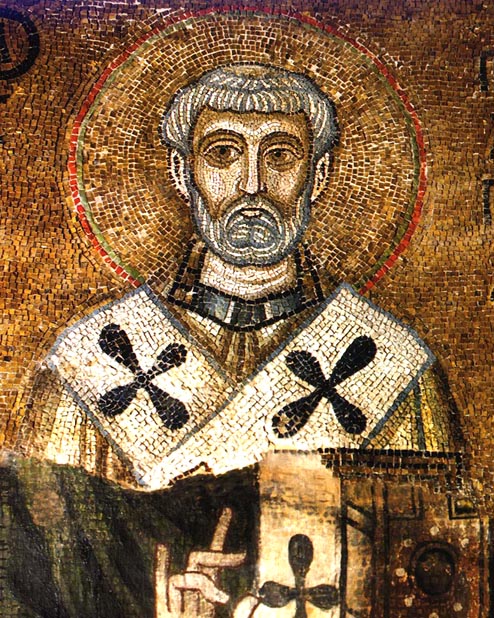
The relics of Clement re-enter firm history in the ninth century. About the year 861, Constantine the Philosopher — Saint Cyril — with his brother Methodius, on their mission by way of Cherson, sought out and recovered from an island in the bay the bones and the anchor venerated there as Clement's. Cyril carried a portion of the relics with him thereafter, and when the brothers came to Rome in 868 they gave them to the Pope; they were enshrined in the ancient basilica on the Caelian Hill that bears Clement's name — San Clemente — where Cyril himself was buried in 869 and where the relics remain. Another portion, by the Slavic tradition, came to Kyiv: Prince Vladimir, after his baptism at Cherson (988), is said to have brought relics of Clement to his new capital and laid them in the Church of the Tithes, so that Clement became one of the first and most venerated saints of Rus'. The mosaic of the saint in the Cathedral of St Sophia at Kyiv, from which this entry's image is taken, belongs to that early Rus' devotion.
Veneration and later cultus
Clement was venerated at Rome from an early date — the titulus Clementis, the church of his name, is among the oldest in the city — and his cult spread through both halves of Christendom. In the East he is kept on November 25, the Byzantine books joining his memory to that of Peter of Alexandria and, from the eleventh century, singing it together with the leavetaking of the Entry of the Theotokos. In the West his feast settled on November 23, and his name entered the Roman Canon of the Mass among the martyrs. His importance for the Slavic world is peculiarly great: recovered by the Apostles of the Slavs and enshrined at Kyiv, he stood at the very font of Rus' Christianity, and churches without number were dedicated to him across the Russian land.
Feast and commemoration
November 25 (church date; Old Calendar civil December 8), a universal commemoration of the Byzantine rite, kept together with the Hieromartyr Peter of Alexandria and joined — since the Great Feast took its place in the calendar — to the leavetaking (apodosis) of the Entry of the Most Holy Theotokos into the Temple, whose whole service is sung again in full on this day. The two hierarchs' office is therefore celebrated within the festal frame of the leavetaking. The day falls within the Nativity Fast. The Western (Roman) calendar keeps Clement on November 23; the Byzantine East, followed by the Antiochian Archdiocese, keeps November 25.
Hymns
Troparion — Tone 4
O God of our Fathers, who ever deal with us according to Your forbearance: take not Your mercy from us, but by the supplications of the holy hierarchs Clement and Peter, govern our life in peace.
Original translation from the Greek
Kontakion — Tone 2
As a branch of the divine Vine you were shown forth, all-holy Clement, bearing the clusters of true worship and distilling upon us the sweetness of salvation; therefore we honour your all-venerable memory, and we cry to you: intercede with Christ our God that our souls may be saved.
Original translation from the Greek
Iconography
Clement is depicted as an aged bishop — grey-haired, with a rounded beard, in episcopal vestments and the omophorion, holding the Gospel — and is often distinguished by his emblem, the anchor, the instrument of his martyrdom; narrative cycles show the lamb revealing the spring in the Crimean quarry, the drowning, and the sea drawn back to disclose the marble shrine. The stored image is the eleventh-century mosaic of the saint in the Cathedral of St Sophia at Kyiv: a frontal bust of the hierarch against gold, the white omophorion with its dark crosses falling across the shoulders — a fitting witness, in the mother-church of Rus', to the saint whose relics Vladimir brought to Kyiv (the lower part of the composition was made good in oil paint in the eighteenth century).
Disputed questions
- Was Clement martyred? The earliest witnesses — Irenaeus, Eusebius, Jerome — say nothing of an exile or a martyr's death; Rufinus (c. 400) is among the first to call him a martyr, and the Martyrium with the anchor and the Crimean miracles is later still and legendary in character. Many historians therefore doubt the exile and drowning, while the Church keeps his memory as a hieromartyr. The entry records the tradition as tradition.
- Third, fourth, or immediate successor? Irenaeus and Eusebius place Linus and Anacletus before him (third after the Apostles, fourth counting Peter); Tertullian makes him Peter's direct successor. The ancient sources already differ; both streams are given above.
- Which Clement? He is not the Apostle Clement of the Seventy of Philippians 4:3 (see Apelles, Lucius and Clement of the Seventy, September 10), with whom antiquity identified him but modern scholarship does not; nor Clement of Alexandria, the second–third-century theologian and teacher of Origen (a distinct person, not a saint of this day); nor Clement of Ohrid, the disciple of Cyril and Methodius, who is also commemorated on this same day (November 25) in the Slavic churches; nor Clement of Ancyra, the much-suffering hieromartyr-bishop of Galatia (†c. 312, kept January 23). The relics-finder Cyril should not be confused with the theologian either.