
Clement of Ancyra
The Holy Hieromartyr Clement, Bishop of Ancyra
Hieromartyr · Bishop · b. c. 258, at Ancyra in Galatia — d. c. 312, at Ancyra (some accounts 296)
Commemorated 23 January — Martyrdom at Ancyra, with Agathangelus
Clement of Ancyra (c. 258 – c. 312) was bishop of Ancyra in Galatia and one of the most enduring of all the martyrs of the synaxarion: the tradition holds that his passion lasted some twenty-eight years, dragged through a succession of emperors, governors, and cities from the persecution of Diocletian to its very last flickerings under Maximinus. Orphaned young and raised by a Christian woman named Sophia, he was made bishop of his city at twenty; when the persecution broke out he was seized and sent from tribunal to tribunal — Ancyra, Rome, Nicomedia, Amisus, Tarsus — enduring torture after torture without yielding, and by his constancy converting many, including his fellow-martyr Agathangelus, a young Roman who joined himself to the bishop to suffer with him. After nearly three decades of chains and torments the two were at last beheaded at Ancyra, on a day the Church keeps as January 23. For the length and severity of his contest the Greek Church calls him polyathlos, "of many struggles."

Origins and upbringing at Ancyra
Clement was born about the year 258 in Ancyra (Ánkyra, modern Ankara), the chief city of Roman Galatia — the country to which the Apostle Paul had written, and a Christian centre of long standing. His father was a pagan, his mother a Christian named, in the tradition, Euphrosyne; the father died while Clement was still an infant, and the mother raised the boy alone in the faith of Christ. The account of his life dwells on a scene at her own deathbed, when the boy was about twelve: foreseeing the days of persecution to come, she is said to have foretold her son's martyrdom and blessed him for it, counting it the highest honour that could befall him — that he should be found worthy to suffer and die for Christ. The mother's prophecy sets the key of the whole life that follows; the son would spend the better part of it making it good.
Left an orphan, Clement was taken in and brought up by a Christian woman named Sophia, who reared him "in the fear of God" and in the ascetic discipline he kept to the end. He grew up given to fasting, prayer, and works of mercy; and during a famine that struck the region, the tradition remembers, the young Clement gathered up children who had been abandoned or orphaned by the hunger, fed and clothed them, and raised them in the faith — so that before he ever held an office in the Church he was already a father to many, and many of those he had saved became Christians and, in time, confessors themselves.
Priest and bishop of Ancyra
His holiness and learning marked him out early. He was ordained reader, then deacon, then — at the uncanonically young age of eighteen — presbyter; and at twenty, on the death of the city's bishop and by the acclamation of clergy and people, he was consecrated Bishop of Ancyra. The youth of the new hierarch is stressed by all the accounts, and it is of a piece with the picture they draw: a bishop already seasoned in asceticism and charity, who governed his church with a maturity beyond his years in the uneasy calm before the last and fiercest of the imperial persecutions.
The persecution, and the beginning of the long passion
The storm broke under Diocletian (284–305) and his colleagues in the Tetrarchy — the "Great Persecution," the most systematic assault the Roman state ever mounted against the Church. Clement, the conspicuous young bishop of a Christian city, was among the first sought out. He was arrested and brought before the governor of Galatia (the accounts name Dometian, or Domitius), and when neither flattery nor the promise of high honour would move him to sacrifice, the tortures began — and, with them, the extraordinary feature that makes his passion unlike almost any other in the calendar: it did not end. Governor succeeded governor and city succeeded city, and each new magistrate, unwilling or unable to break the bishop and unwilling to be the one who killed him, sent him on to the next. The tradition, following the ancient Passion, carries Clement through a long circuit of tribunals — Ancyra itself, then Rome (where, according to the account, he was shown to Diocletian, who marvelled at his endurance), Nicomedia under the co-emperor Maximian, Amisus on the Black Sea coast, Tarsus in Cilicia, and back again to Ancyra — under a succession of officials whose names the Passion preserves (Agrippinus, Curicius, Sacerdon, Maximus, Aphrodisius, Lucius, and others). The torments heaped on him across these years are catalogued in grim detail: he was scourged and racked, his flesh torn with iron combs and hooks, his teeth broken and his mouth crushed with stones, he was flung into quicklime, burned, hung up and beaten, thrown to be trampled and cut — and each time, the account insists, he was healed of his wounds and lived to be tortured again, so that his very survival became a standing miracle and a sermon.
Early in this long ordeal, the Passion relates, Clement received a revelation that he would suffer for Christ for a full twenty-eight years before receiving his crown — and the twenty-eight years are the frame on which the whole account is built. Whatever allowance a modern reader makes for the shaping of a much-loved martyr's legend, the memory the Church has kept is precise and consistent: a passion of exceptional length, spanning the reigns of Diocletian, Maximian, and Maximinus, in which the martyr outlasted his persecutors one after another.
Agathangelus, the fellow-martyr
It was in the course of these journeyings that Clement was joined by the young man the tradition calls Agathangelus ("good messenger"), a native of Rome who, moved by the bishop's constancy — some accounts have him one of a company of confessors at Rome, spared the sword that took his companions — attached himself to Clement to share his chains and his death. From that point the two are inseparable in the record: taken together, tortured together, and at last put to death together. The bond of the aged bishop and his young disciple is the human heart of the story, and it is Agathangelus whom the proper hymnography names at Clement's side as his "fellow-contestant."
Martyrdom
At the last, after the long round of tribunals, Clement was back in his own city of Ancyra. There — the Passion says, while he was celebrating the Liturgy in a cave-church, or newly risen from it — soldiers sent by the authorities fell upon him, and he and Agathangelus were beheaded by the sword. The tradition sets the bishop's death on January 23, the day the Church keeps his memory; the year is given, by the reckoning that fixes his end under Maximinus (Daia), about 312, as the persecution guttered out in the East a year or two before the peace of the Church. His foster-mother Sophia, who had raised him, is said to have recovered the bodies of the two martyrs and buried them with honour.
Veneration and later cultus
Clement's cult was early and wide. His Passion — one of the longer and more elaborated in the Greek hagiographical corpus — circulated in numerous manuscripts and fed the synaxaria of Constantinople; the Menologion of Basil II (c. 1000) carries his notice and image for January 23, and the great Menaia of East and West alike keep his day. In the Christian East he is one of the best-known hieromartyrs of Asia Minor, honoured with a proper office and the distinctive title polyathlos, "of many struggles" — the martyr of the longest passion. His relics were venerated at Ancyra and elsewhere; portions were carried westward in the medieval period. For the churches of the Greek world he remains a favourite patron, and his name (Clement, klēmatis, the vine-branch) gave the hymnographers the image they never tire of: the branch of the true Vine that, cut and pruned by every torment, bore all the more fruit.
Feast and commemoration
Clement is kept universally on January 23 (church date; Old Calendar civil February 5), together with his fellow-martyr Agathangelus, and on the same day the Greek and Slavonic calendars keep the memory of the Fathers of the Sixth Ecumenical Council and several ascetic fathers (see the day's calendar file). His office in the Menaion is a full one, with proper apolytikion and kontakion built on the vine-branch play of his name and on the theme of the "many struggles." The Antiochian, Greek, and Slavic calendars agree on the day.
Hymns
Troparion — Tone 4
A vine-branch of holiness and a stem of contest, a most sacred flower and a God-given fruit, thou didst blossom most sweetly for the faithful, O all-hallowed one. But as a fellow-contestant of the Martyrs and a sharer of the throne of the Hierarchs, intercede with Christ our God that our souls may be saved.
Original translation from the Greek
Kontakion — Tone 4
Thou didst become a precious branch of the Vine that is Christ, O all-praised Clement, shown forth as a martyr of many struggles; and together with thy fellow-contestants thou didst cry aloud: O Christ, the radiant gladness of the Martyrs.
Original translation from the Greek
Iconography
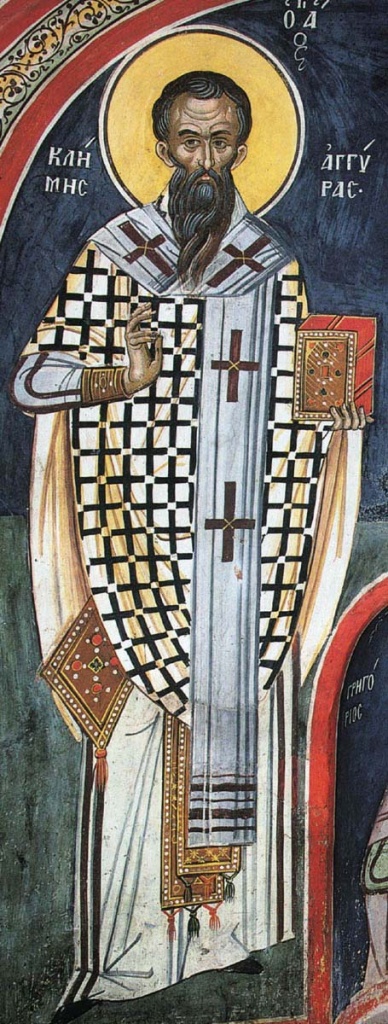
Clement is depicted as a bishop — vested in the phelonion and omophorion, holding the Gospel-book — in the manner of a hierarch, often middle-aged rather than aged, since the tradition makes him a young bishop; he is sometimes shown with the wounds or instruments of his long passion, or paired with the youthful, beardless Agathangelus at his side, the two martyrs together. The narrative type illustrates one of the tortures of his passion or the beheading of the two.
The stored image is a sixteenth-century hierarch portrait of Clement of Ancyra by the Cretan-Athonite master Zorzis (Zorzis Fuka), the saint vested as a bishop and blessing (source, public domain, pd-old-work).
Disputed questions
- The year of martyrdom (296 vs. 312), and the twenty-eight years. The Greek and Slavonic synaxaria that stress the twenty-eight-year passion place its end under Maximinus, about 312 — the reckoning followed here and by the Russian (azbyka) calendar, which styles him "the Much-suffering." Some Western and English notices (and the Ancient Faith / OCA "296") give an earlier date, under Diocletian and Maximian alone. The discrepancy follows directly from the twenty-eight-year tradition: an arrest at the outbreak of the Great Persecution (303) cannot yield twenty-eight years before 312, so accounts that keep the full span push its beginning back into the earlier persecuting years, while those that compress it settle on the 290s. The day, January 23, is constant; the entry gives the year as "c. 312" and records the variant.
- The elaborated Passion. The surviving Martyrdom of Clement of Ancyra is a long, highly developed text of the classic "epic Passion" type, and the roll of governors, cities, and serial tortures bears the marks of hagiographical amplification. The historical core — a young bishop of Ancyra martyred in the Great Persecution, remembered above all for the exceptional endurance of his suffering — is secure; the twenty-eight years and the full itinerary are the tradition's way of magnifying that endurance, and are received as such.
- Not to be confused with Clement of Rome (†c. 101, kept November 25), the Apostolic Father and third bishop of Rome; nor with Clement of Ohrid (†916, also November 25), the disciple of Cyril and Methodius and enlightener of the Slavs; nor with Clement of Alexandria, the early theologian, who is not a saint of the calendar. "Of Ancyra," "the Much-suffering," belongs to this Clement alone.