
Cleopatra and her son John
The Blessed and Righteous Cleopatra of Palestine, and John her son
Righteous · d. c. 327
Commemorated 19 October — With the martyr Varus, whose relics she enshrined
Cleopatra was a widow of Edra near Mount Tabor in Palestine who, living in Egypt, witnessed the martyrdom of Varus (†c. 307), buried his body in secret, and carried his relics home to her village under the guise of her husband's remains. She built a church for the martyr; on the day of its completion her only son John, newly raised to an officer's rank, died — and the grieving mother, reproaching the martyr at his shrine, was answered with a vision of Varus and John together, radiant and crowned in the Kingdom. Consoled, she gave away her goods and lived seven more years in prayer and fasting beside the church, where she reposed in peace (c. 327; John, c. 320). Mother and son are commemorated with Varus on October 19.

Cleopatra came from the village of Edra near Mount Tabor in Galilee and was the widow of a Roman officer, living with her young son John in Egypt when the great persecution broke over the Egyptian church at the opening of the fourth century. A Christian in secret like the soldier Varus himself, she watched his voluntary confession and death under torture; by night she took up the body the judge had ordered cast to the beasts, and buried it in her own bedchamber, keeping the martyr thereafter as the protector of her widowhood.
When the persecution slackened and she resolved to return to Palestine, her husband's rank served the martyr: as a soldier's widow she sought and received leave to carry "her husband's remains" home for burial, and brought back to Edra not the officer's bones but the relics of Varus. There she buried them with honour; the truth soon became known, for healings began at the grave, and the villagers venerated the martyr with her. Cleopatra then set about building a church over the relics, and asked for her son — now grown, and granted the officer's rank and belt that were his father's — a future in the emperor's service.
On the day the church was finished and the relics of the martyr solemnly enshrined, John fell suddenly ill; that night he died. The mother's grief turned to reproach: she cast herself down at the martyr's shrine and cried out that this was her reward for all her service — the saint had suffered her to lose the one thing she loved. She would not leave the church until she was answered. And falling asleep at last beside the reliquary, she saw Varus and John together, radiant in bright garments, with crowns upon their heads: the martyr asked whether he had wronged her — for he had enrolled her son not in the earthly army but in the army of the King of heaven, and the young man himself begged his mother not to grieve him by mourning. Cleopatra awoke consoled, and asked only — the Lives add — to be counted worthy of the same company.
She buried John beside the martyr, distributed her property to the poor, and lived out her days beside the church in prayer and fasting, keeping the martyr's feast each year with gladness. After seven years she reposed in peace and was laid with her son at the shrine she had built. The Russian tradition dates John's death to about 320 and hers to about 327.
Her story never detached itself from the martyr's: the Greek Menaion sings her by name in the stichera of Varus — "the wondrous Cleopatra, anointing thee with myrrh, laid thee beneath the earth and raised up an all-holy temple" — and the Life of Varus is told through her eyes from the burial onward. It was likewise her recorded prayer for her pagan forebears, and the martyr's answer, that seeded the later Russian invocation of Varus on behalf of those who died outside the faith (see the Varus entry).
Feast and commemoration
October 19 on the church calendar (Old Calendar civil November 1), together with the martyr Varus. The separate calendar listing of "Blessed Cleopatra and John her son" is carried by the Slavic books and the OCA; the Greek synaxarion commemorates her within the notice and hymns of Varus rather than by a distinct entry — a difference of listing, not of substance, recorded here. No proper hymns to Cleopatra are transmitted; the service of the day is the martyr's.
Iconography
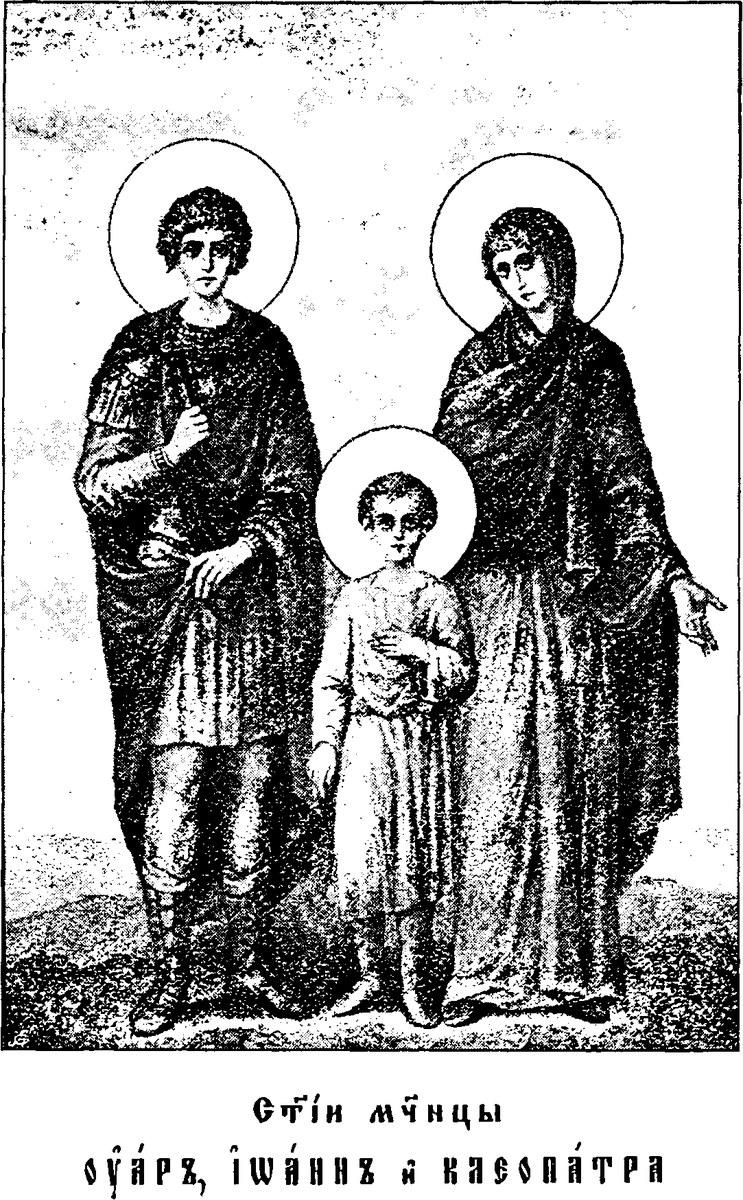
Cleopatra has no independent iconographic type: she appears in the imagery of Varus — kneeling at the martyr's shrine, burying his body, or beholding the vision of Varus and John crowned in glory, a scene beloved in Russian vita icons and menology engravings of the martyr. The stored image is the plate of the illustrated Zhitiya Svyatykh (1903–1911), captioned in Slavonic "the holy martyrs Uar, John and Cleopatra" — the soldier-martyr standing with the widow and her son.