
Varus of Egypt
The Holy Martyr Varus of Egypt, and with him the Seven Ascetic Teachers
Martyr · d. c. 307
Commemorated 19 October — Martyrdom in Egypt, with the seven ascetic teachers
Varus (in Slavic usage Uar) was a soldier in Egypt at the opening of the fourth century, a secret Christian who ministered by night to confessors in prison. Keeping vigil with seven imprisoned ascetic teachers of the desert, one of whom had died of his sufferings, he took the dead man's place among them, was tortured before their eyes, and died under the torments, about the year 307; the monks were beheaded after him. The widow Cleopatra buried his body, carried it home to Palestine, and built a church over it — the setting of the beloved story of her son John and her consoling vision. In Russian piety Varus became, uniquely, the saint entreated on behalf of those who died outside the faith. He is commemorated on October 19.
_01_by_shakko.jpg)
The soldier and the seven teachers
Varus served in Egypt as a military officer — the Life calls him a commander of soldiers — during the great persecution that fell upon the Egyptian church in the first years of the fourth century, in the reigns of Diocletian's successors in the East. He was a Christian in secret. His rank gave him access to the prisons, and he used it: by night he visited the confessors, brought them food, dressed their wounds, kissed their chains, and begged their prayers, counting himself unworthy of the sufferings he only tended.
At that time seven ascetics of the desert — the accounts call them teachers of the Christians, monks who had instructed many in the faith — were seized and thrown into prison, where they were starved and beaten for days before their execution. Varus spent a whole night among them, serving them and listening to their teaching, and lamented aloud that he had not the courage to confess Christ openly and share their crown. The elders answered that no man is crowned who does not contend. When morning came and the guards arrived to lead the teachers to the tribunal, only six could be found — one had died in the night of his torments — and Varus, casting off concealment, declared himself a Christian and took the dead man's place in the company.
Martyrdom
Before the judge, Varus refused to sacrifice, and the judge — enraged, the Life says, above all that a soldier of his own should shame the tribunal — had him tortured with a cruelty meant as an example: he was beaten with rods, stretched on the ground and flayed with scrapers, and at last hung upon a tree, where his flesh was torn from him piece by piece while the aged teachers stood by encouraging their new brother. The Menaion's stichera dwell on the scene: seeing his own flesh fall with his blood, he bore it "as though another suffered," and after some five hours of torment he gave up his soul into the hands of God while still upon the tree. The judge ordered the body cast out unburied, to be devoured by beasts; the six surviving teachers were beheaded thereafter. Their names are not transmitted; the Church commemorates them with Varus as the seven ascetic teachers, counting among them the one whose death opened the place Varus filled.
Cleopatra and the relics
Among the secret Christians of the place was Cleopatra, the widow of a Roman officer, a native of the village of Edra near Mount Tabor in Palestine, then living in Egypt with her young son John. She had watched the martyrdom; by night she recovered the body of Varus and buried it in her own chamber, honouring the martyr as her protector. When the persecution eased she resolved to return home, and — since a soldier's widow might lawfully carry her husband's remains — she obtained leave to transport "her husband's bones," and carried the relics of Varus instead to Edra, where she laid them with reverence and the villagers soon learned whose relics they were, for healings began at the grave. Cleopatra then built a church for the martyr; and at its consecration was played out the story of her son John, the vision of the two crowned in glory, and her seven remaining years of ascetic widowhood beside the shrine — told in full in the entry for Cleopatra and her son John, whom the Church commemorates with Varus on the same day.
Veneration and later cultus
The service of Varus entered the Byzantine books early — Joseph the Hymnographer composed his canon in the ninth century, and the stichera of the Menaion already sing Cleopatra's translation and church — but it was in Russia that his veneration took its remarkable turn. The Life relates that Cleopatra begged the martyr's intercession for her departed kin, who had died in paganism, and that Varus appeared to her saying her prayer had been heard and her forebears granted mercy. On the strength of this the Russian tradition came to invoke Varus as the one saint with a particular boldness to pray for those who died outside the Orthodox faith — the unbaptized, infants dead before baptism, and kin who died estranged from the Church. A canon to the martyr Uar for such departed was composed and printed in Russian prayer books; churches and chapels were dedicated to him for this ministry.
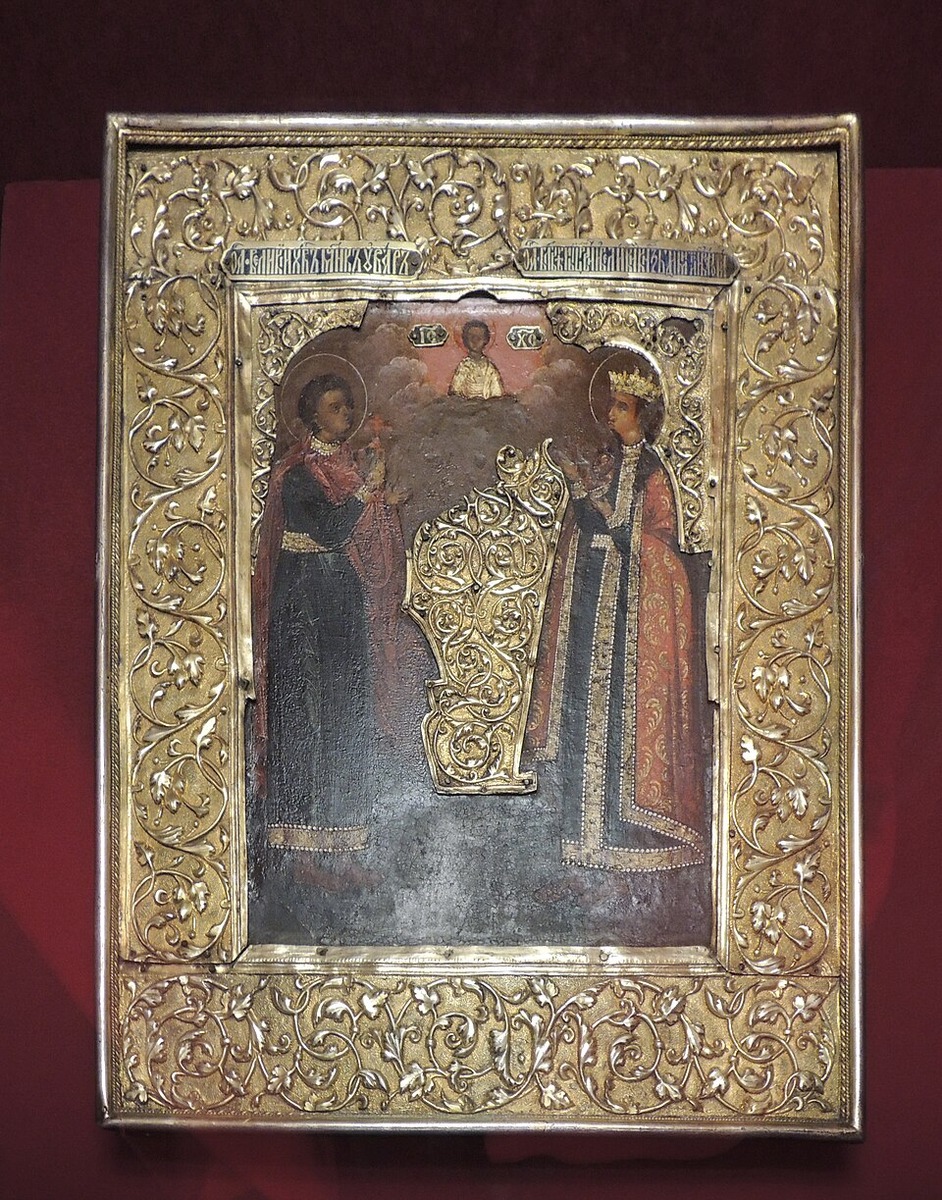
The cultus received a dynastic seal in the sixteenth century: Tsarevich Dimitry of Uglich, born on the martyr's feast, carried Uar as his baptismal name, and a chapel of St. Uar stood in the Archangel Cathedral of the Moscow Kremlin by the shrine of the murdered tsarevich, for which the surviving icon of the two saints together was painted. The practice of the "canon to Uar" remains living and remains discussed: the Russian Church's guidance has been that such prayer is private and domestic — the Church does not commemorate the non-Orthodox dead at the Liturgy — and some dioceses have cautioned against public services built on it. Both the devotion and the caution are part of the honest record of this saint, whose whole story, from the prison to Cleopatra's vision, is one of mercy overflowing the visible boundaries of the Church's prayer.
Feast and commemoration
October 19 on the church calendar (Old Calendar civil November 1), in all the Byzantine-rite calendars: the Greek Menaion appoints the day's second service to him (with the prophet Joel), the Slavic books commemorate "the martyr Uar and with him the seven teachers, and the blessed Cleopatra and John her son," and the OCA lists the martyr with the seven monastic martyrs. In Russian usage the day carries besides the public service the private devotion of the canon to the martyr for those dead outside the faith, noted above.
Hymns
Troparion — Tone 4
Beholding the army of the holy passion-bearers suffering according to the law, thou didst manfully show forth thy strength; and hastening of thine own will to the contest, thou didst desire to die for Christ, O Varus, and hast received the prize of the victory of thy suffering: entreat him to save our souls.
Original translation from the Slavonic
Kontakion — Tone 4
Following after Christ, O martyr Varus, and having drunk of his cup, thou wast bound with the crown of martyrdom and now keepest festival with the angels: pray without ceasing for our souls.
Original translation from the Slavonic
Iconography
Varus is painted as a young soldier-martyr — short-haired, in cloak or armour, holding the martyr's cross — and, in the narrative type, hung upon the tree of his torment. The Menologion of Basil II, which illustrates this day with Sadoth and with Joel, has no miniature of Varus; his iconography is richest in Russia, where he appears both alone and, in the icons of his Kremlin cultus, side by side with Tsarevich Dimitry, and where vita icons include Cleopatra kneeling at the shrine and the vision of the crowned Varus and John. The stored image is the Moscow icon of the first half of the 17th century, painted for the shrine of Tsarevich Dimitry in the Archangel Cathedral of the Kremlin: the martyr Uar and the tsarevich stand together beneath the blessing Christ, the icon clothed in its goldwork oklad. A Byzantine-period image of the martyr alone remains wanted.
Disputed questions
- Date and persecutor. The Life places the martyrdom "under Maximian," which in Egypt in these years may denote either Galerius Maximianus or Maximinus Daia, whose persecution raged in Egypt c. 305–311; the received date is c. 307.
- The seven or the six. The sources waver, naturally, between "seven teachers" (counting the one who died in prison, whose place Varus took) and the six beheaded after him; the calendars keep the seven, and the OCA styles the company "seven monastic martyrs."
- Not to be confused with Uar (Shmarin), Bishop of Lipetsk, the Russian new-hieromartyr of 1938 who bore the martyr's name in religion and is commemorated with the new martyrs (Old Style September 10); his entry is pending in this collection, and the shared name is the only link.