
Cosmas the Aetolian
The Holy New Hieromartyr and Equal-to-the-Apostles Cosmas the Aetolian, Teacher of the Nation
New Martyr · Hieromartyr · Equal to the Apostles · Venerable · b. c. 1714, at Mega Dendron in Apokouro, Aetolia — d. August 24, 1779, at Kolikontasi near Berat, in what is now southern Albania
Commemorated 24 August — His martyrdom by hanging on the bank of the river Apsos
Cosmas the Aetolian (c. 1714–1779) was a monk of Philotheou on Mount Athos who left the Holy Mountain to spend the last twenty years of his life walking the mountain roads of Epirus, Acarnania, Thessaly, Macedonia, Albania and the islands, preaching in the open air to Greek-speaking and Albanian-speaking Christians who had almost no clergy, no books and no schools. He founded something between two hundred and two hundred and fifty village schools, planted wooden crosses where he had preached, and gave away crosses, prayer-ropes and headscarves by the tens of thousands to pay for the teaching of the poor. Denounced to the Ottoman authorities as a Russian agent, he was hanged on 24 August 1779 on the bank of the river Apsos near Berat, and his body thrown into the water. The Ecumenical Patriarchate glorified him on 20 April 1961. He is the great missionary saint of the Greek world under the Turks, honoured at once as new-martyr, as equal-to-the-apostles, and as Didaskalos tou Genous — Teacher of the Nation.
.jpg)
Origins and education
He was born about 1714 in the village of Mega Dendron, in the district of Apokouro in Aetolia, near Thermo — a poor upland region of western Greece — and was given at baptism the name Constas (Constantine). The eighteenth century in which he grew up was the low point of Greek letters under Ottoman rule: whole provinces had no school of any kind, priests who could read were scarce, and in the mountain villages of Epirus and Albania the faith survived as memory and custom rather than as instruction.
His own schooling was got piecemeal and late. He learned his letters locally and then under the archdeacon Ananias Dervisanos, and afterwards made his way to Mount Athos, where between 1749 and about 1759 he studied at the newly founded Athonite Academy attached to Vatopedi, under Nikolaos Tzartzoulios of Metsovo and the great Eugenios Voulgaris — the best philosophical education then available anywhere in the Greek East. He also spent time at Constantinople perfecting his rhetoric. At the monastery of Philotheou he was tonsured a monk with the name Cosmas, and was ordained hieromonk.
The decision to preach
What broke his monastic stability was not restlessness but a diagnosis. He had seen the countryside from which he came; he had seen what he had learned on Athos; and he concluded — the Teachings return to it again and again — that the Christians of the Balkans were being lost not to force but to ignorance, and that ignorance could be attacked. Islamisation in Epirus and Albania in his lifetime was proceeding fastest exactly where there were no schools and no preaching.
He would not go without a blessing. He obtained the canonical permission of the Ecumenical Patriarch Seraphim II about 1760, and renewed it later under Sophronios II; he also secured the goodwill of the local bishops through whose dioceses he passed, and, where he could, of the Ottoman authorities themselves. This is a point his biographers stress and his enemies later ignored: Cosmas preached with written ecclesiastical permission, and several Turkish beys — most notably Kurt Pasha of Berat, in whose territory he would eventually die — gave him safe-conducts.
The four apostolic journeys
From about 1760 until 1779 he was almost continuously on the road, in what his biographers count as four great circuits: first through Constantinople, Thrace and the Danubian lands; then Thessalonica, Verroia, Macedonia and the Chalkidike; then Thessaly, Epirus, Acarnania and his native Aetolia; and finally, from 1775, the Ionian islands — Cephalonia, Zakynthos, Ithaca, Corfu — and the interior of Albania, Chimara and the northern Epirot villages.
His method was fixed and simple. Arriving at a village he asked the people to plant a large wooden cross in an open field or square, and set beside it a low wooden stool from which he preached; he spoke in the plainest demotic Greek, without rhetoric, in short sentences built out of proverbs and stories, and at the end he led the whole crowd — sometimes several thousand, drawn in from the surrounding villages — in prayer for the living and the dead. The crosses were left standing when he moved on, and many of them, replaced in stone, still mark his stations across western Greece.
He asked for nothing for himself. What money was pressed on him he spent on books, baptismal fonts, prayer-ropes, small crosses and headscarves, which he distributed by the tens of thousands, and above all on schools. He would not leave a village until it had undertaken to keep a teacher and pay him from a common fund; the number of schools thus founded is put by his biographers at about two hundred common schools and ten Greek schools, the last of them at Preveza in the year of his death. His social preaching was equally practical and equally unwelcome to some: he attacked the exploitation of the poor, denounced the buying and selling of Christian children, urged that girls be taught as well as boys, and pressed the Jewish and Christian traders of the towns alike to stop trading on Sundays so that villagers could attend the Liturgy.
Martyrdom
In the summer of 1779 he was preaching in the region of Berat in southern Albania. The Russo-Turkish war and the Orlov revolt of 1770 had left the Porte suspicious of any Greek who could gather a crowd, and Cosmas gathered enormous ones. He was denounced — the sources say by men whose commerce his Sunday preaching had damaged, and the charge laid before the authorities was that he was an agent of Russia stirring the rayah to revolt.
He was seized at the village of Kolikontasi, on the river Apsos (the modern Seman), without trial. On 24 August 1779, aged about sixty-five, he was led out at dawn, given time to pray, and hanged from a tree with a rope; his body was stripped and thrown into the river. It was recovered three days later by a priest named Markos, who found it floating upright, and was buried at the monastery of the Entry of the Theotokos at Kolikontasi. Veneration began at once and crossed confessional lines: Ali Pasha of Ioannina, who attributed his own rise to the saint's prophecy, raised a church over the grave in 1813 and endowed the monastery.
Writings, prophecies and legacy
No autograph of Cosmas survives. What we have are the Didachai — five "Teachings", transmitted in notes taken down by hearers and copied at second and third hand, which preserve his voice with a vividness rare in Greek homiletic prose: catechesis on the creation, the fall, the Incarnation, confession, the Cross and the last things, delivered in the syntax of a man talking to farmers. Attached to them in the manuscript tradition is a large and much later body of Prophecies, sayings foretelling the liberation of Greece and the coming of technologies, which circulated orally for generations before being printed and which cannot be critically separated from what the saint actually said. The Teachings themselves are the sound historical basis for his thought; the Prophecies are treated by careful editors as a tradition about him rather than as his work.
His influence on the modern Greek and Albanian Church is out of all proportion to the brevity of his mission. He is claimed as a founder by both — his preaching in Albanian districts is remembered there as much as his Greek schools are remembered in Epirus — and the Autocephalous Orthodox Church of Albania keeps him among its principal saints. Greek folk memory calls him simply Patrokosmas, "Father Cosmas."
Feast and commemoration
August 24 (church date; Old Calendar civil September 6), the day of his hanging at Kolikontasi. The feast is kept with special solemnity in Aetolia-Acarnania and Epirus, in the Church of Albania, and at the many village churches which stand where he set his crosses; Preveza, Arta, Ioannina and Berat keep him as a patron. He is also numbered among the New Martyrs of the Turkish Yoke commemorated collectively, and belongs with the Athonite renewal of the eighteenth century — with Nikodemos the Hagiorite and the Kollyvades fathers, who were his contemporaries and, in Nikodemos's case, his editor and admirer. The proper service is modern.
Hymns
Apolytikion — Tone 3 (common of a new-martyr and teacher)
Thou didst leave the stillness of the Holy Mountain for the roads of the poor, O Cosmas, and didst plant the Cross in the villages and letters in the mouths of children; and having taught the nation the way of salvation, thou didst seal thy teaching with a martyr's rope. Intercede with Christ God that our souls may be saved.
Kontakion — Tone 4
A monk taught by the fathers and a preacher sent by the Church, thou didst walk unwearied among the mountains, enlightening those who sat in darkness; and being hanged upon a tree for the sake of Him who hung upon the Cross, thou wast cast into the river and found incorrupt in honour. Wherefore we cry to thee: rejoice, O Teacher of the Nation.
Original translation from the Greek
Iconography
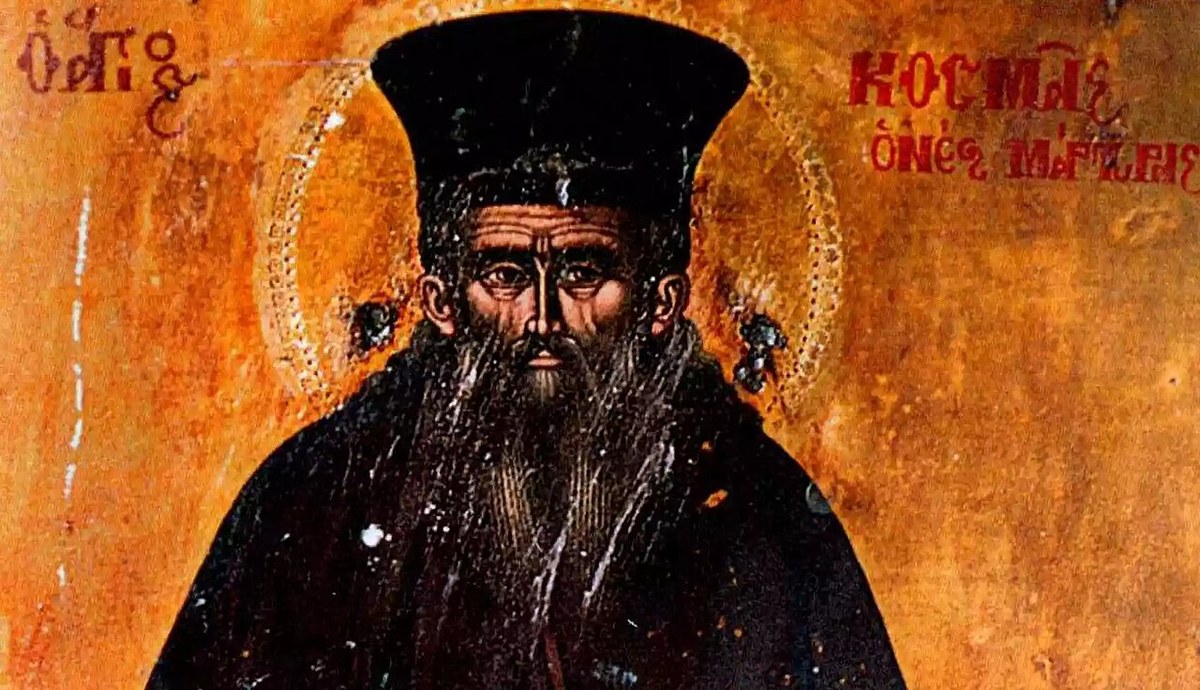
Cosmas is written as a hieromonk of the Ottoman centuries: an aged, spare, dark-bearded man in the black rason and the tall cylindrical kalimavkion of the Greek clergy, without the mitre or sakkos of a hierarch, holding in one hand a scroll bearing a line of his Teachings and in the other a cross, or leaning on the tall preacher's staff. The distinguishing attributes are narrative rather than vestimentary: the wooden cross planted in a field and the low stool from which he preached appear behind him in many icons, and in fuller compositions the border scenes give his preaching to a crowd, his seizure, and his hanging from the tree beside the river.
The stored image is the portable icon of the church of St Nicholas at Zitsa, in Epirus, one of the very oldest depictions of the saint: a bust-length half-figure against a worn gold ground, the face weathered and heavily modelled in the Epirot manner, inscribed at the sides Ο ΑΓΙΟΣ ΚΟΣΜΑΣ Ο ΝΕΟΣ ΜΑΡΤΥΣ — "the holy Cosmas the New Martyr." The panel is held locally to have been made during the saint's lifetime, and the Commons record gives it the date 1767; the inscription, which already calls him a martyr, tells against that reading and points rather to the years immediately after 1779, when portraits of him made from living memory were multiplying in Epirus. Either date places it well inside the public domain, and it is stored here as an eighteenth-century Epirot panel with the discrepancy noted rather than resolved.
Because his glorification is of 1961, the overwhelming majority of icons of Cosmas are modern works by living or recently living iconographers and are not storable under this repository's policy; the Zitsa panel is one of the few pre-modern exceptions.
Disputed questions
- The date of the feast. All the jurisdictional calendars — the Ecumenical Patriarchate, the Church of Greece, the Church of Albania, the OCA and the Slavic Menaia that have received him — keep him on 24 August, the day of his martyrdom. A secondary local commemoration of the translation of his relics is observed in some Albanian and Epirot usage but is not fixed in the general calendar, and is not asserted here.
- The year of birth. The traditional 1714 rests on the statement that he was sixty-five at his death; some biographers prefer c. 1700 or 1707, which would make him older at his Athonite studies. The traditional figure is retained here with the uncertainty noted.
- The place and fate of the relics. The remains were kept at the Kolikontasi monastery until the Albanian communist suppression of religion; portions are today venerated at the Metropolitan Cathedral of Athens and elsewhere, and the site at Kolikontasi (Fier) has been restored as a place of pilgrimage. The exact history of the relics between 1967 and 1991 is not fully documented.
- "Equal-to-the-apostles." The title is not a Patriarchal formula of 1961 but the judgment of the Church's usage since; the act of glorification names him a hieromartyr. Both titles are given him in the service books, and both are recorded here.