
Nikodemos the Hagiorite
Our Venerable and God-bearing Father Nikodemos the Hagiorite, the wise teacher of the Church
Venerable · b. 1749, Naxos — d. 14 July 1809, Karyes on Mount Athos
Commemorated 14 July — Repose at the Kelli of the Skourtaioi at Karyes on the Holy Mountain
Nikodemos the Hagiorite (1749–1809) was a monk of the Holy Mountain and the most consequential Orthodox writer and editor of the modern period. Born Nicholas on Naxos and schooled at Smyrna, he came to Athos in 1775 and was tonsured at Dionysiou; there the Metropolitan of Corinth, Makarios Notaras, set him to edit a manuscript anthology of the ascetic Fathers found at Vatopedi, and out of that obedience came the Philokalia (Venice, 1782), the book that has done more than any other to carry the hesychast tradition into the modern Orthodox world. In a working life of some thirty years he also gave the Church the Pedalion (the Rudder, the standard Greek commentary on the canons), the Evergetinos, the Exomologetarion, the New Martyrologion, the Synaxaristes, the Heortodromion, an edition of Symeon the New Theologian, and the two adapted Western manuals known in English as Unseen Warfare and Spiritual Exercises. A leading voice of the Kollyvades revival, he reposed at Karyes on 14 July 1809, aged sixty, and was glorified by the Ecumenical Patriarchate in 1955.

Naxos and Smyrna
He was born on the Cycladic island of Naxos in 1749, the son of pious parents, Antonios and Anastasia Kallivourtsis; his mother ended her days a nun, under the name Agathe, in the island's monastery of St Chrysostom. In baptism he was named Nicholas. Those who knew him remembered a boy of extraordinary quickness and a memory that never let anything go — a faculty which, in the judgement of his contemporaries, never afterwards failed him: he was said to know the Scriptures by heart down to the place on the page, and to be able to recite long passages of the Fathers from memory.
His first letters he had from the parish priest of his village; then, at the school in the town of Naxos, from the Archimandrite Chrysanthos, a brother of the great missionary Cosmas Aitolos. At about sixteen he was sent to the Greek school at Smyrna — the Evangelical School, the best Greek institution of the age — where under teachers of the first rank he took a thorough classical and theological education and learned ancient Greek, Latin, French and Italian. The Ottoman reprisals that followed the Russo-Turkish war broke up the school, and in 1770 he returned to Naxos, where he served for some years as secretary to the metropolitan of the island.
It was on Naxos, and afterwards on Hydra, that he met the men who determined his course: the Athonite fathers Gregory, Niphon and Arsenios, and — decisively — the former Metropolitan of Corinth, Makarios Notaras, and Silvestros of Caesarea. From them he learned of the Holy Mountain, and of the movement of patristic renewal then stirring there.
The Holy Mountain
In 1775, aged twenty-six, he crossed to Athos and was tonsured at the monastery of Dionysiou with the name Nikodemos. The fathers, seeing at once what they had been given, made him the house's reader and secretary. Two years later Makarios Notaras came to Dionysiou, and with him the manuscript he had found in 1777 in the library of Vatopedi: an anthology of the ascetic and hesychast Fathers. He put its editing into the young monk's hands. That obedience opened the literary labour that occupied the rest of Nikodemos's life.
He did not remain in the coenobium. He withdrew to the skete of Pantokrator (Kapsala), placing himself under the obedience of the Elder Arsenios of the Peloponnese, and lived thereafter as a hermit in one or another kelli, reading, and writing at a small desk, in poverty and in continual sickness. In 1783 he was tonsured into the Great Schema and passed some six years in near-complete silence; the return to writing came when Makarios, on a later visit, laid on him the editing of the works of Symeon the New Theologian — a task he could not refuse, and which ended his solitude for good.
The Philokalia
The Philokalia of the Holy Neptic Fathers was printed at Venice in 1782. It is an anthology, gathered from the manuscripts of the Athonite libraries, of the writings of the Fathers "who watch" — Antony, Evagrian and Macarian material, Diadochus, Hesychius, Maximus, Philotheos, Symeon the New Theologian, Gregory of Sinai, Gregory Palamas and many more — on the guarding of the mind, the passions, the prayer of the heart and the vision of the uncreated light. Makarios Notaras furnished the manuscripts and the plan; Nikodemos did the editorial work and wrote the long introduction and the brief lives that preface each author.
Its consequences were out of all proportion to the size of its first edition. Within a decade the Moldavian elder Paisius Velichkovsky had produced a Slavonic Dobrotolubiye (Moscow, 1793); in the following century the Russian Dobrotolyubie of Theophan the Recluse carried the same material into every literate Orthodox household in the empire, and in the twentieth century translations into English, French, Romanian and other languages made the hesychast tradition, for the first time, a general possession of the Orthodox world and a subject of Western study. Nearly every modern Orthodox account of prayer descends from this book.
The Pedalion and the canons
With the hieromonk Agapios Leonardos of Dimitsana Nikodemos compiled the Pedalion — "the Rudder of the noetic ship" — a complete corpus of the canons of the Holy Apostles, of the Ecumenical and local councils and of the Fathers, each canon given in the original with a paraphrase into the spoken Greek of the day and a commentary drawing on Zonaras, Balsamon and Aristenus and on the practice of the Church. It was printed in 1800 (some accounts give 1801) and became, and remains, the standard canonical handbook of the Greek-speaking churches; the English version of D. Cummings (1957) made it familiar in the West. Its temper is characteristic of its author: strict in stating what the canons require, and unfailingly attentive to oikonomia — the pastoral discretion by which the Church applies them to living people.
The books of the spiritual life
The rest of the output is best described by its range, which is unmatched in modern Orthodox letters. In ascetical and pastoral theology he wrote the Exomologetarion (1794), the first true manual of confession in the Orthodox Church — a book for confessors on what a confessor must be, and for penitents on how to come and how to live afterwards — and the Symvouleutikon Encheiridion, the Handbook of Spiritual Counsel, written for his cousin Hierotheos, bishop of Euripos, on the guarding of the five senses and of the imagination. He adapted two Western manuals for Orthodox use, purging what could not stand: Lorenzo Scupoli's Combattimento spirituale, which he issued in 1796 as the Aoratos Polemos (Unseen Warfare), and a book of Ignatian meditations that became his Pneumatika Gymnasmata.
In hagiography he produced the Neon Eklogion (Venice, 1803), the New Martyrologion (1799) — compiled with Makarios to show that the Church of the Ottoman centuries was still bringing forth martyrs, and to strengthen those tempted to apostasy — and the great Synaxaristes of the twelve months, published after his death in 1819, which remains a principal source for the Greek calendar. In liturgics and hymnography he published the New Theotokarion (Venice, 1796), sixty-two canons to the Mother of God recovered from the Athonite manuscripts; the Heortodromion, a commentary on the canons of the Lord's and the Theotokos's feasts (Venice, 1836); and the New Ladder, an exposition of the seventy-five Anabathmoi of the Oktoechos (Constantinople, 1844). He also composed offices of his own, among them a canon to the icon of the Mother of God "She who is Quick to Hear" and the service and encomium of all the saints who have shone on the Holy Mountain, still sung. In exegesis he edited a modern-Greek interpretation of the fourteen epistles of St Paul and wrote a commentary on the seven Catholic epistles (Venice, 1806); with Makarios he re-edited the eleventh-century patristic anthology the Evergetinos, and — most controversially — published the treatise On Continual Communion.
The Kollyvades
All this work belongs to a movement. From the middle of the eighteenth century the Holy Mountain had been divided by a quarrel that began over a small thing — whether the memorial kollyva might be offered on Sunday, the day of the Resurrection, instead of Saturday — and grew into a contest over the whole shape of Orthodox life under Ottoman rule. The party nicknamed the Kollyvades, from the boiled wheat of the dispute, stood for the strict keeping of the received order, the return to the Fathers and the liturgical books, and above all for frequent — even continual — communion, against a piety that had come to receive two or three times a year. Nikodemos, with Makarios Notaras and Athanasius Parios, was the movement's chief pen. Its members were denounced, tried and for a time driven from Athos; the positions they defended are now simply the practice of the Orthodox Church. The Kollyvades fathers are kept in a common synaxis in Greek usage.
Repose
The last years were spent in poverty and increasing infirmity. Worn out with writing and with the ascetic life, and unable to see his remaining manuscripts through the press, he went to live with two brothers by blood, the iconographer hieromonks Stephen and Neophytos Skourtaios, at their kelli near Karyes, that they might help him publish. There he was struck by a paralysis. On the day before the end he made his confession, received holy unction, and communicated. He died in the first hours of the morning of 14 July 1809, aged sixty. His disciples, seeing him quiet, asked whether he was at rest; he answered that he had taken Christ within himself, and asked how then he should not be at rest. His first biographer, the hieromonk Euthymios, wrote of that morning that as the sun rose over the earth the intelligible sun of the Church went down.
He was buried at the Kelli of the Skourtaioi at Karyes. His skull is kept there still; a portion of it is venerated at the monastery of the same dedication at Pentalofos in Kilkis. The Ecumenical Patriarchate numbered him among the saints on 31 May 1955.
Feast and commemoration
July 14 (church date; New Calendar civil July 14, Old Calendar civil July 27), the day of his repose. The feast is universal in the Orthodox Church and is kept with particular solemnity on Athos, on Naxos — where he is the island's own saint — and in the Greek and Athonite-influenced monasteries everywhere; where a polyeleos service of the saint is served, the Russian books appoint the matins Gospel Matthew 11:27–30 and, at the liturgy, Hebrews 13:17–21 and Luke 6:17–23, the readings of a venerable teacher. He is also commemorated among the Kollyvades fathers of the Holy Mountain in Greek usage, and among the saints of Naxos. Because his glorification is recent, his propers are modern compositions and are under copyright (see Hymnography).
Hymns
Apolytikion — Tone 8 (common of a venerable father)
By the streams of thy tears thou didst till the barren desert, and by thy sighing from the depths thou didst bear fruit an hundredfold in labours; and thou wast made a beacon to the whole world, shining with miracles, O Nikodemos our father: intercede with Christ God that our souls may be saved.
Iconography
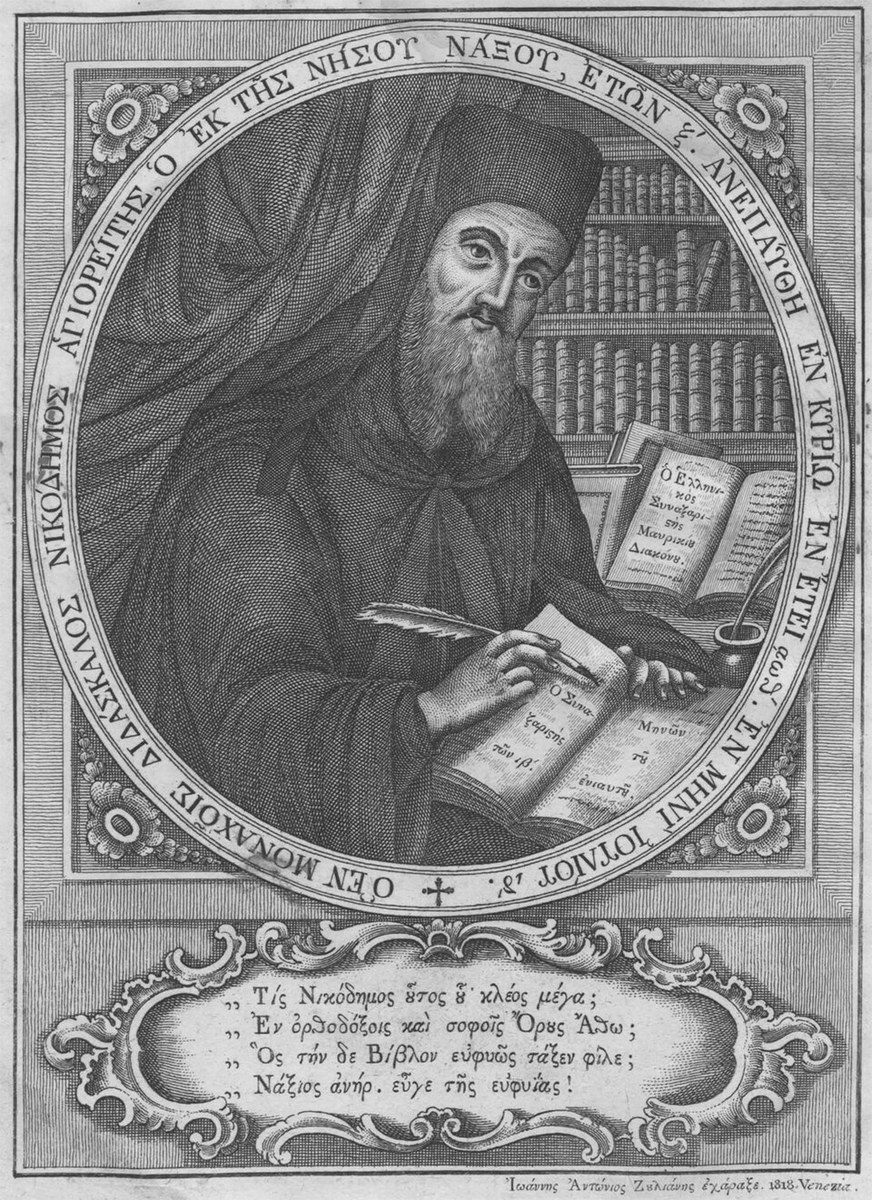
Nikodemos is written as a monk of the Great Schema, in the black mandyas and the koukoulion, of middle age, with a long forked beard going grey; his attribute is the book — most often an open codex or a scroll bearing the opening of the Philokalia, sometimes a pen and inkhorn, and in fuller compositions a desk and shelves of volumes, since he is honoured precisely as a writer. He is frequently shown paired with Makarios Notaras of Corinth, or in the group icon of the Kollyvades fathers, or among the saints of Athos. Because he was glorified only in 1955, every painted icon of him is a modern work and the copyright in it belongs to a living or recently living iconographer: several such images circulate on Wikimedia Commons under a bare "public domain" tag applied by the uploader, which does not touch the painter's rights, and none of them has been stored here.
What is stored instead is older than any icon of him: the copper engraving of 1818, signed at the foot Ἰωάννης Ἀντώνιος Ζουλιάνης ἐχάραξε. 1818 Venezia, made at Venice nine years after his death for the printing of his works. It shows him seated at his writing desk in the monastic skouphos and mantle, pen in hand over an open book inscribed Ὁ Συναξαριστὴς τῶν ιβ' μηνῶν τοῦ ἐνιαυτοῦ ("the Synaxaristes of the twelve months of the year"), with a second open volume and a shelf of books behind him. The oval frame carries the inscription ΝΙΚΟΔΗΜΟΣ ΑΓΙΟΡΕΙΤΗΣ, Ο ΕΚ ΤΗΣ ΝΗΣΟΥ ΝΑΞΟΥ, ΕΤΩΝ Ξ', ΑΝΕΠΑΥΘΗ ΕΝ ΚΥΡΙΩ ΕΝ ΕΤΕΙ ͵ΑΩΘ', ΕΝ ΜΗΝΙ ΙΟΥΛΙΟΥ ΙΔ', Ο ΕΝ ΜΟΝΑΧΟΙΣ ΔΙΔΑΣΚΑΛΟΣ — "Nikodemos the Hagiorite, of the island of Naxos, aged sixty, fell asleep in the Lord in the year 1809, in the month of July, on the fourteenth: the teacher among monks" — and beneath it a quatrain asking who this Nikodemos of great renown is, and answering: a man of Naxos. It is a portrait rather than an icon, made from the memory of men who had seen him, and it is the face from which the later icon-painters worked.
Disputed questions
- The year of birth. Greek sources and OrthodoxWiki give 1749; the OCA's life gives 1748. Both agree on an age of sixty at his repose in 1809 and on 1775 as the year of his coming to Athos, so the discrepancy is of a single year in the reckoning and is here recorded rather than resolved.
- The printing of the Pedalion. The title page of the first edition is dated 1800; the OCA's life states 1801. The earlier date is the one carried by the book itself and by the standard bibliography.
- The authorship of On Continual Communion. The treatise urging frequent reception of the Holy Mysteries circulated anonymously and has been attributed both to Nikodemos and to Makarios Notaras. The two worked so closely, and the Kollyvades habitually published without names in a time of controversy, that a clean division of hands is not now possible; the modern consensus treats it as substantially the work of Nikodemos issued under Makarios's protection.
- The Western sources. That an Athonite hesychast should have adapted a Counter- Reformation Theatine (Scupoli) and a book of Ignatian meditations has been thought anomalous, and was criticised in his own century and again in the twentieth. Nikodemos did not translate: he rewrote, removing what was incompatible with the Orthodox understanding of grace and of prayer, and used what remained as material. The question of how far the operation succeeded is a live one in modern Orthodox theology.
- Not to be confused with Nicodemus of Serbia (May 11), Nikodemos of Kozheozero (July 3), or the Nicodemus of the Gospel; nor with the "Nicodemus of Svyatogorsk" who appears in some working calendars under July 1, which is a doublet of this saint arising from the rendering of Hagiorite as Svyatogorets.