
Cyprian and Justina
The Holy Hieromartyr Cyprian, the Virgin-Martyr Justina, and the Martyr Theoctistus, of Nicomedia
Hieromartyr · Bishop · Virgin · Martyr · d. c. 304
Commemorated 2 October — Martyrdom at Nicomedia under Diocletian
Cyprian and Justina (†c. 304) are the protagonists of one of the most famous of all passiones: Cyprian, the great sorcerer of Antioch, hired to bend the Christian virgin Justina to a suitor's desire, found every demon he sent against her shattered by the sign of the Cross, renounced the devil, burned his books of magic, and rose from penitent to bishop; in Diocletian's persecution the two were tortured and finally beheaded together at Nicomedia, with the bystander Theoctistus who confessed Christ at their death. Honestly told, their story is a fourth-century Christian romance whose historicity the scholars doubt — yet its cultus is ancient and universal, and its tale of the magician who found sorcery powerless against the Cross made Cyprian the Church's patron against enchantment and a distant ancestor of the Faust legend.
.jpg)
The legend and its sources
What the Church received about Cyprian and Justina comes from a Greek passio composed in the fourth century in three originally distinct parts — the Conversion, the Confession (a first-person account placed in Cyprian's own mouth), and the Martyrdom. The legend was already famous by 379, when Gregory the Theologian preached on Cyprian at Constantinople, and in the fifth century the empress Eudocia, wife of Theodosius II, turned it into Greek hexameter verse in three books, substantial parts of which survive and which Photius still read and summarised in the ninth century. The account below follows the traditional narrative as the synaxaria transmit it; the serious problems it raises are set out under Disputed questions.
Cyprian the sorcerer
Cyprian was born of pagan parents at Antioch — which Antioch is itself a question — and was dedicated by them to the service of the gods from childhood. The Confession has him recite an extraordinary curriculum of late-antique paganism: consecrated as a boy, he was initiated in the mysteries on Mount Olympus, served Hera at Argos and Artemis at Tauropolis, studied the lore of the dead at Memphis in Egypt and astrology among the Chaldeans of Babylon, and returned to Antioch a master of every occult art — able, the narrative says, to summon the demons by name, and admitted at last to the presence of the prince of darkness himself, who gave him a company of spirits for his service. The pagans of Antioch revered him as a great priest and magician; the passio charges him with love-spells, poisonings, conjuring of the dead, and the ruin of many souls.
Justina and the defeat of the demons
In the same city lived Justina, a young woman who had come to faith in Christ by hearing the Gospel — the tradition says from a deacon named Praylius — and had then won her pagan parents, Aedesius and Cledonia, to the faith; Aedesius, formerly a priest of the idols, is said to have been ordained presbyter before his death. Justina consecrated her virginity to Christ and gave herself to prayer and fasting.
A wealthy young pagan, Aglaïdas, sought her in marriage and was refused. When force failed him he turned to Cyprian, who undertook to inflame the virgin with desire by his art. The sorcerer sent against her a demon, then a stronger, and at last — in the tradition's telling — the prince of the demons himself; each assault of impure thoughts and apparitions Justina broke by prayer, fasting, and the sign of the precious Cross, and the spirits fled, confessing themselves scorched by a power they could not face. Enraged, Cyprian struck her family and the whole city with plagues and pestilence, until public opinion demanded she marry to end the affliction; Justina answered by prayer, and the plague ceased.
Then Cyprian put to the demon the question on which the whole legend turns: if you tremble at the mere shadow of the Cross and the name of Christ, what will you do when Christ Himself comes? Understanding that the devil to whom he had given his life was a defeated slave, he renounced him; the spurned demon turned on him to destroy him, and Cyprian — still unbaptised — saved himself by making the sign of the Cross. He went to Anthimus, bishop of Antioch, carried his books of magic into the assembly of the Christians and burned them publicly (the gesture of Acts 19:19), was baptised, and never looked back.
Conversion and episcopate
The passio relates that the convert advanced through the degrees of the Church with astonishing speed: reader, then deacon, then priest, and on the death of Anthimus bishop of Antioch. As bishop he brought many pagans to the faith, and set Justina over a community of consecrated virgins as deaconess and mother. The one-time sorcerer became, in the hymnography's favourite paradox, "a most wise physician," healing by grace those he had once harmed by art.
Martyrdom
When Diocletian's persecution broke out, Cyprian and Justina were denounced and arrested, and brought before Eutolmius, count of the East, at Damascus. Cyprian's body was raked with iron claws and Justina was scourged; cast into a cauldron of boiling pitch, fat and wax, they remained — the passio says — unharmed, singing. The count, out of his depth, sent them to the emperor Diocletian himself at Nicomedia, who without further examination sentenced them to the sword. They were beheaded on the banks of the river Gallus, about the year 304. A Christian standing by, Theoctistus, seeing their endurance, embraced Cyprian, confessed Christ, and was beheaded with them — the third figure of the commemoration, who has no separate cultus.
The synaxarion's verses for October 2 keep the scene: Satan grieves, beholding his friend of old willing to die by the sword with Justina.
Relics and translations
The bodies lay unburied six days by the emperor's order; Christian sailors then carried them by night to their ship and brought them to Rome, where a noblewoman named Rufina, of the house of Claudius, buried them with honour on her estate. A later Roman tradition placed relics of Cyprian and Justina in the Lateran — by the baptistery of the Constantinian basilica — and their names entered the Western calendars as well as the Eastern.
Veneration and later cultus
The joint cultus of the sorcerer-bishop and the virgin is ancient: sermons of the late fourth century, the verse passio of Eudocia in the fifth, an entry in the Synaxarion of Constantinople, a miniature in the Menologion of Basil II (c. 1000), and a full proper service in the Menaion for October 2. From the shape of his story Cyprian became the saint invoked above all others against sorcery, spells, and the fear of the demonic; the "prayers of Saint Cyprian" against enchantment, in many recensions, circulate throughout the Greek, Slavic, Romanian and Arabic Orthodox worlds (their popular use has often drifted into the very superstition the saint's legend renounces, a point Orthodox pastoral writers regularly make). In the West the pair were kept on September 26 until 1969, when the Roman calendar reform removed them — precisely on the ground that their story could not be verified as history.
Hymnographic and literary legacy
The legend's literary afterlife is remarkable. Eudocia's hexameter Martyrdom of Cyprian survives in large part (Photius, Bibliotheca cod. 184, summarises all three books). The Confession — in which Cyprian recounts his formation in the occult, his dealings with the devil, and the collapse of that service before the Cross — is the earliest full narrative of a Christian magician bound to the demonic powers and delivered from them, and literary historians have long treated it as a principal ancient precursor of the Faust legend. Calderón de la Barca dramatised the story in El mágico prodigioso (1637), where Cyprian signs his blood-pact for the sake of Justina and is undone by grace — a play often set beside Goethe's Faust in the scholarship. In the Menaion the pair have a full proper service, including the vespers doxastikon "Thou didst put off the teaching of error" quoted below.
Feast and commemoration
October 2 (church date; Old Calendar civil October 15), kept universally in the Byzantine rite as the principal (and only) feast of Cyprian, Justina and Theoctistus, with a full proper service in the Menaion. The Greek books title the day "the holy hieromartyr Cyprian and Justina the virgin"; the Slavic books add Theoctistus expressly. In the West the pair were commemorated on September 26 until their removal from the General Roman Calendar in 1969. Popular Greek and Slavic piety keeps the day as a feast of deliverance from sorcery and the evil eye, with the "prayers of Saint Cyprian" read — a practice the Church blesses in its sober form and corrects in its superstitious one.
Hymns
Troparion — Tone 4
Sharing in the ways of the Apostles and a successor upon their throne, thou didst find thy practice of virtue an ascent to the vision of God, O inspired of God; wherefore, rightly dividing the word of truth, thou didst suffer for the faith even unto blood, O hieromartyr Cyprian: intercede with Christ God that our souls may be saved.
Original translation from the Greek
Kontakion — Tone 8
As a precious hierarch and a most steadfast athlete the whole world worthily honoureth thee, O Cyprian of everlasting renown, and glorifieth thy holy memory with hymns, entreating alway that through thee forgiveness of offences may be granted to them that sing thy praise. Turning from the art of sorcery to the knowledge of God, O divinely wise one, thou wast shown to the world as a physician most wise, granting healings to them that honour thee, O Cyprian, together with Justina: with her, pray to the Master who loveth mankind that He save our souls.
Original translation from the Greek
Stichera
Thou didst truly put off the teaching of error and the knowledge of idols, and didst put on the Cross as a weapon of salvation, O all-blessed Cyprian. Thou didst cast away thy books of magic and put off the old man, and the consubstantial Trinity made her dwelling in thee through the knowledge of God: entreat her, O hierarch, together with the angels, that we may be saved.
Iconography
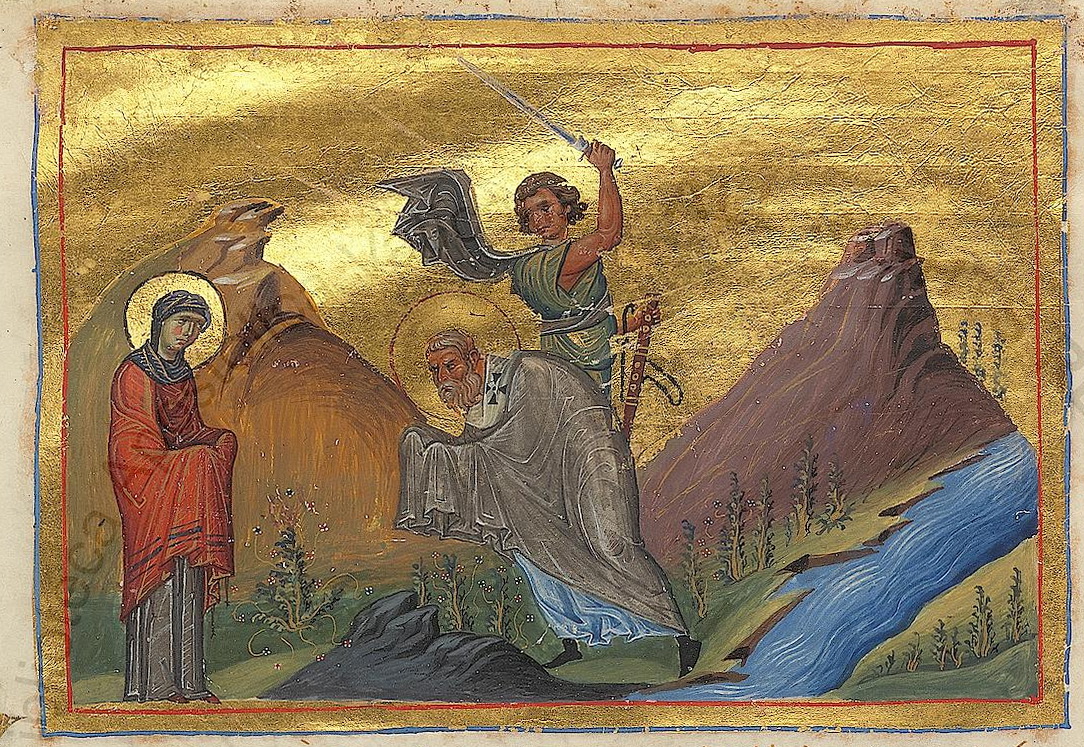
The stored image is the miniature of the Menologion of Basil II (Constantinople, c. 985; Vatican Library): Cyprian, in episcopal omophorion, bows beneath the executioner's raised sword on the bank of a river — the Gallus of the passio — while Justina stands by in the red maphorion of a martyred virgin, awaiting the same end. In panel icons the pair stand together, Cyprian vested as a bishop holding the Gospel and blessing, Justina beside him with the martyr's cross; Greek popular icons sometimes add, below, the burning books of magic or suppliants seeking deliverance from sorcery.
Disputed questions
- Historicity. The Bollandist scholarship (Delehaye above all) concluded that the passio is a hagiographic romance — an edifying fiction built from familiar novelistic and folkloric materials — and that no bishop Cyprian of Antioch is otherwise known to history: the episcopal lists of Syrian Antioch have no place for him, and Anthimus his alleged predecessor is equally unattested there. The cultus is ancient and genuine; the biography is legend. This entry records the tradition as the Church tells it without asserting it as verified history.
- Which Antioch? The passio's "Antioch" is usually read as the great Antioch of Syria, but scholars have long noted that the earliest stratum of the legend fits Pisidian Antioch better (Eutolmius examines the martyrs at Damascus in the developed text, yet the geography and the minor episcopal see sit more naturally in Pisidia); both identifications stand in the literature, and the question is open.
- Conflation with Cyprian of Carthage. The classic hagiographic problem of the dossier: Gregory the Theologian's oration on Cyprian (Constantinople, 379) already fuses the historical Cyprian of Carthage — the great third-century bishop, theologian and martyr (†258; August 31 in the Byzantine calendar, September 16 in the West) — with the converted magician of the Antioch legend, praising one Cyprian who was both rhetor of Carthage and sorcerer won by a virgin's prayers. Prudentius shows the same contamination. Some scholars hold the Antiochene legend itself arose as a novelistic double of the Carthaginian bishop (whose own conversion from paganism and burned library of secular learning supplied the seed). The two saints are distinct in the calendars and must be kept distinct: the October 2 Cyprian is the figure of the legend, not the Carthaginian father.
- Justina's name. In the oldest form of the legend the virgin is called Justa, renamed Justina in the developed passio; both names appear in the manuscript tradition.
- Not to be confused. Justina the virgin-martyr is unrelated to Justin Martyr the Philosopher (†c. 165, June 1), despite the near-identical names; and the martyr Theoctistus beheaded with the pair is distinct from the venerable Theoctistus of Palestine (†467, September 3), fellow-ascetic of Euthymius the Great.