
Cyprian of Carthage
The Holy Hieromartyr Cyprian, Bishop of Carthage
Hieromartyr · Bishop · b. c. 200–210, at Carthage — d. 14 September 258, at Carthage
Commemorated 31 August — Commemoration of the hieromartyr Cyprian, Bishop of Carthage
Cyprian, bishop of Carthage from 248/249 until his beheading on 14 September 258, is the greatest Latin churchman of the age before Constantine and the first bishop of the West to die a martyr with his acts recorded. A rich pagan rhetorician converted in middle life, he governed the African church through the Decian persecution, the plague of 252 and the schisms that followed both, and he thought out, under that pressure, the doctrine of the Church that the Latin world would carry ever afterwards: one Church, one episcopate held undivided by all bishops together, and outside it no salvation. His treatise On the Unity of the Catholic Church and his eighty-odd surviving letters are the earliest large body of Latin Christian correspondence. He quarrelled famously with Stephen of Rome over the baptism of heretics and was not reconciled; and when Valerian's edict came he refused exile a second time, came back to his city to die among his own people, and answered the sentence of death with two words — "Thanks be to God." The Byzantine calendar keeps him on August 31, the last day of the church year.
_-_икона_12311_Киприан.png)
Origins and early life
He was born Thascius Caecilius Cyprianus, about the year 200 or a little later, at Carthage — the second city of the Latin West, capital of proconsular Africa, rich, litigious and cosmopolitan. His family was pagan and wealthy, of the curial or senatorial class; he inherited estates and gardens, and he was given the whole training of a Roman gentleman. He became a teacher of rhetoric, which in that world meant a public man: an advocate, a shaper of opinion, a figure in the courts and the schools. His deacon and biographer Pontius, who wrote the Vita Cypriani within a few years of his death — the first Christian biography in Latin — presents this period as one of eloquence, comfort and honour, and passes over it quickly, as Cyprian himself did.
His conversion came late, about 246, when he was already in his forties. The instrument of it was an elderly Carthaginian presbyter named Caecilius (or Caecilianus), who lodged in his house and whose name Cyprian afterwards took as his own. What moved him, on his own account in the little book To Donatus, was not argument but the discovery that a man could be changed: he had thought the Christian claim of new birth impossible for one so deep in the habits of the world. He sold much of his property for the poor before his baptism — the gardens were later restored to him, his friends said, by the mercy of God — took a vow of continence, and set himself to read. The one Latin author he read constantly was Tertullian, his fellow-Carthaginian of the previous generation; Jerome preserves the tradition that Cyprian never let a day pass without him, and would say to his secretary simply "Give me the master." The debt is visible on every page, and so is the difference: Tertullian's fire without Tertullian's rancour, and a lawyer's instinct for what a church can actually be governed by.
Bishop of Carthage
He was ordained presbyter within two years, and in 248 or 249 the people of Carthage — over his own resistance, and against the objection of five senior presbyters who never forgave it — acclaimed him bishop. He was a neophyte raised over the heads of men ordained long before him, and the resentment of that minority runs under every crisis of his episcopate.
He had scarcely settled to the work of reform when the persecution of Decius broke in 250. The edict required every inhabitant of the empire to sacrifice and to obtain a certificate, a libellus, attesting it; it was the first systematic, empire-wide attempt to make Christianity impossible. Africa collapsed. Crowds went up to the Capitol to sacrifice before they were even compelled; others bought certificates without sacrificing (the libellatici) or had slaves sacrifice in their name. Cyprian himself withdrew into hiding, and governed his church for over a year by letter.
The decision was bitterly criticised at Rome and has been criticised since. His own defence — that a bishop known by name and marked for death would have drawn the persecution down upon his flock, and that his office was to keep the church in being — is the defence of a man who intended to survive in order to govern, and it is worth noticing that he did not make the same choice in 258, when flight would again have been possible. The letters of the hiding are the best evidence there is of how a large third-century church actually ran: money for the confessors in prison, discipline for the clergy, appointments, rebukes, consultations, all conducted by courier.
The lapsed, and the schisms
When the persecution slackened, the question that split the Church of the West presented itself: what is to be done with the lapsed? Confessors in prison — whose intercession was believed to carry great weight — had begun issuing libelli pacis, certificates of peace, sometimes in blank and by the handful, readmitting the fallen to communion at once. Cyprian's position was neither of the two extremes. The lapsed were not to be abandoned, for the Church has power to forgive; but neither were they to be received without examination and a penance proportioned to the fall, and the decision belonged to the bishop, not to the confessors and not to the individual presbyter. Cases were to be weighed one by one; the dying were to be reconciled.
Both wings turned on him. At Carthage the deacon Felicissimus and the five disaffected presbyters, with Novatus, formed a laxist party that received the lapsed indiscriminately and set up a rival bishop; Cyprian excommunicated them, and had his policy ratified by the council of Carthage of 251 and the councils that followed. At Rome the opposite party, led by the learned presbyter Novatian, held that the Church had no power at all to reconcile the lapsed and consecrated himself bishop against the lawfully elected Cornelius; Cyprian recognised Cornelius and threw the weight of Africa behind him.
Out of these months came his two most important books, both of 251: On the Lapsed (De lapsis), a merciless anatomy of the African collapse and of the covetousness that had prepared it, and On the Unity of the Catholic Church (De catholicae ecclesiae unitate), written for the council. Its images have never left Latin Christianity: the Church is the seamless robe that cannot be divided; the sun's many rays and the one light; the tree's many boughs and the one root; the spring and its many streams. Its two most quoted sentences are "He can no longer have God for his Father who has not the Church for his Mother," and, from the letters, "outside the Church there is no salvation" (salus extra ecclesiam non est, Ep. 73). The doctrine of the episcopate that holds them together is Cyprian's own and is stated in a phrase of great compression: the episcopate is one, and each bishop holds the whole of it (episcopatus unus est, cuius a singulis in solidum pars tenetur) — bishops are not officers under a superior but colleagues in a single undivided trust, and schism is not disobedience to a person but self-amputation from the body.
The plague, and the answer to Demetrianus
In 252 a great pestilence — the "plague of Cyprian," which ran through the empire for years — reached Carthage. The dead lay in the streets; the pagans threw out their own sick to avoid infection, and blamed the Christians for the calamity. Cyprian gathered his congregation and organised the burial of the dead and the nursing of the sick without distinction of religion, assigning the work by means and ability, the rich to pay and the poor to labour. Pontius regarded this as the summit of his bishop's life, and the modern historian of late antiquity has tended to agree that such organised, indiscriminate charity in an epidemic did more for the spread of the faith than any argument.
He wrote for the occasion On Mortality (De mortalitate) — that a Christian who has prayed for the kingdom should not be unwilling to go to it — and, against a pagan official who had blamed the Christians for the disasters of the age, To Demetrianus, which turns the charge round: the world is not worn out because men have abandoned the gods, but because men are what they are. On Works and Almsgiving and On the Lord's Prayer — the first Latin commentary on the Our Father — belong to the same years, and the last of them was read, copied and preached from for a thousand years.
The baptismal controversy with Stephen of Rome
The last great conflict of his life was with Rome. The question was whether converts baptised in heresy or schism must be baptised on entering the Church. African and Asian custom said yes — a baptism outside the Church is no baptism, for the Spirit is not there to give; Roman custom said no — the sacrament stands, and the convert is received by the laying-on of hands in penance.
Cyprian, with councils of African bishops in 255 and 256, restated the African practice; Stephen I of Rome answered with a letter of extraordinary sharpness, invoking custom and the tradition of Peter and threatening to break communion, and refused even to receive the African envoys. Cyprian did not give way. In the Seventh Council of Carthage, on 1 September 256, he assembled eighty-seven bishops of Africa, Numidia and Mauretania, put the question to each in turn, and had every one of the votes recorded — a document unique in the period. His own opening words to the council are as important as the verdict: "None of us sets himself up as a bishop of bishops, or compels his colleagues to obedience by tyrannical terror; for every bishop has, in the freedom of his own authority, his own free choice, and can no more be judged by another than he himself can judge another. We must all await the judgement of our Lord Jesus Christ." He had the powerful support of Firmilian of Caesarea in Cappadocia, whose scorching letter against Stephen survives in the Cyprianic corpus.
The rupture was never healed; both men died within two years, Stephen in 257 and Cyprian in 258, and both are saints. The Church's practice afterwards followed Rome on the sacramental question and Cyprian on the ecclesiological one, a settlement Augustine worked out a century and a half later — and Augustine, an African who revered Cyprian, was careful to say that Cyprian's error was covered by his martyrdom and his charity, since he never broke the unity he had defined. The Orthodox tradition has kept the tension alive rather than resolving it: the first canon of Basil the Great treats Cyprian's position with respect and leaves the reception of heretics to the discernment of the local church, which is in substance the Cyprianic answer. See Stephen I of Rome for the same dispute from the other side.
Exile and martyrdom
In August 257 the emperor Valerian issued the first of his edicts: bishops, presbyters and deacons were to conform to the Roman rites, and Christian assembly and use of the cemeteries were forbidden. Cyprian was summoned before the proconsul Aspasius Paternus, confessed himself a Christian and a bishop, refused to name his presbyters, and was banished to Curubis, a small coastal town some fifty miles from Carthage. He lived there eleven months, still writing — his letters of encouragement to the confessors condemned to the mines of Numidia belong to this exile — and had, Pontius says, a dream on the first night of it, in which a young man showed him by gesture that his own execution was deferred for a year.
The second edict, of 258, ordered bishops, presbyters and deacons to be put to death at once. Cyprian returned from Curubis to his own gardens outside Carthage, refusing to hide: it was fitting, he said, that a bishop should confess in the city where he had presided. Warned that officers were coming to take him to Utica, he withdrew for a few days only — because, as he wrote, he wished to die among his own people, and his martyrdom should be a testimony to the church he had governed.
On 13 September 258 he was arrested and brought before the proconsul Galerius Maximus at Sexti; the crowd of Christians who followed him kept vigil all night in the courtyard. The next morning the sentence was read: that Thascius Cyprianus, an enemy of the Roman gods and a ringleader in crime, should be executed by the sword. Cyprian answered "Deo gratias" — "Thanks be to God." He was led to a level place among the trees; the people climbed the branches to see. He gave his outer garments to his deacons, knelt in prayer, bound his own eyes with a cloth and had his hands tied by a presbyter and a subdeacon, and directed that twenty-five gold pieces be given to the executioner. The Christians spread cloths and napkins about him to catch the blood. He was beheaded on 14 September 258, and his body was carried away by night, with tapers and torches, to the cemetery of the procurator Macrobius Candidianus on the Mappalian way.
The Acts of the proconsular trial (Acta proconsularia Cypriani), which preserve the interrogation nearly verbatim, are among the very few authentic martyr-acts of the ancient Church, and with the Vita of Pontius they make Cyprian the best-documented martyr before the peace of the Church.
Relics, veneration and legacy
Two basilicas rose at Carthage over the place of his death and the place of his burial, and his feast was one of the great days of the African church until the Vandal and Arab centuries ended it. Relics were carried to Gaul under Charlemagne and are claimed at Lyons, Arles, Compiègne and Roenay; there is nothing left at Carthage but foundations.
His writings, by contrast, were never lost. The corpus — thirteen treatises and eighty-two letters, sixty-five of them his own and the rest addressed to him, the earliest such archive in Latin — was copied continuously from the fourth century, and was cited as authority at the councils of Ephesus and Chalcedon. He supplied the Latin Church with its ecclesiological vocabulary and the Eastern Church, through the canonical tradition, with one of the two classical answers to the question of the sacraments of the separated. Augustine wrote against his baptismal doctrine and preached on his martyrdom with veneration; the East, which knew him mainly through Eusebius, Jerome's catalogue and the councils, gave him a day at the end of its own year.
Feast and commemoration
August 31 (church date; New Calendar civil August 31, Old Calendar civil September 13). In the Byzantine books Cyprian is the second commemoration of the day, after the Placing of the Cincture of the Theotokos, and shares it with Gennadius of Constantinople. Because the festal office belongs to the Theotokos, Cyprian has no proper canon in the Menaion for this day and is sung from the common of a hieromartyr; his synaxarion notice, however, is full, and the Greek Great Synaxaristes gives him a long life.
In the West he is kept on September 16 together with Pope Cornelius, and the two names stand in the Roman Canon; his own day of death, September 14, is the Exaltation of the Cross. He is honoured as a father of the Church by East and West alike, without the title carrying, in his case, any implication that his baptismal doctrine was received.
He is the patron of North Africa, and of Algeria and Tunisia in modern Catholic usage; among the Orthodox he is invoked with the other fathers of the African church.
Hymns
Troparion — Tone 4 (common of a hieromartyr)
Sharing in the ways of the Apostles and a successor upon their throne, thou didst find thy practice of virtue an ascent to the vision of God, O inspired of God; wherefore, rightly dividing the word of truth, thou didst suffer for the faith even unto blood, O hieromartyr Cyprian: intercede with Christ God that our souls may be saved.
Original translation from the Greek
Kontakion — Tone 4 (common of a hieromartyr)
Having shone forth as a lamp of the Church of Africa, thou didst gather the scattered into one and didst seal thy teaching with thy blood, O most wise Cyprian; wherefore, having received the crown of martyrdom, entreat Christ God for us who honour thee.
Original translation from the Greek
Iconography
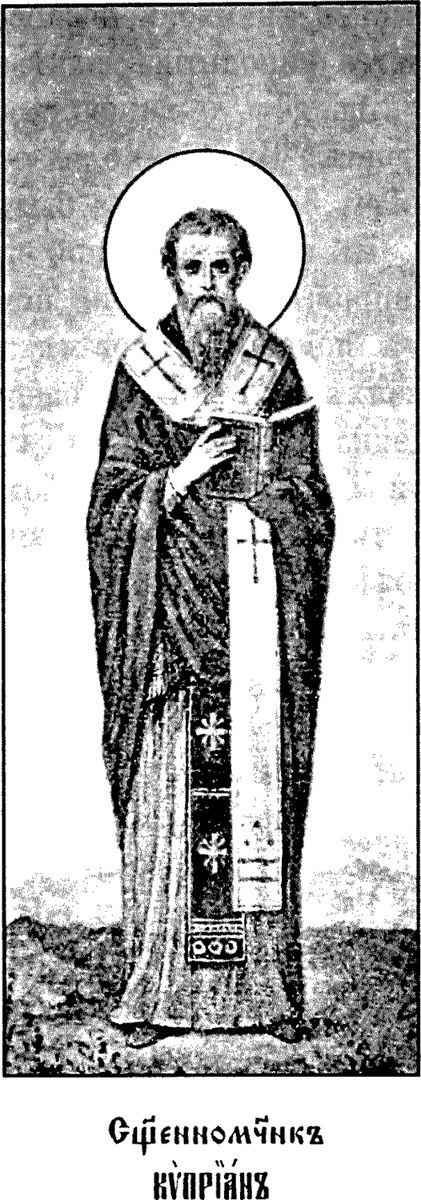
Cyprian is written as a hierarch of the ancient type: middle-aged, with a short dark or greying beard cut square, tonsured after the antique Roman manner rather than the long-haired Byzantine fashion, vested in the polystavrion — the white phelonion crossed with black — with the omophorion on his shoulders and the Gospel book held in both hands before his breast. He blesses with the right hand where the book is carried on the left. As a hieromartyr he may also hold a small cross, and Western images give him the sword of his beheading and the martyr's palm, sometimes with a book, and mitre and crozier of the Latin sort; those are not the Orthodox type.
His likeness is easily confused with that of Cyprian of Antioch (October 2), who is written in exactly the same hierarch's habit; the inscription is the only reliable guide, and where the inscription reads only Ὁ ἅγιος Κυπριανός, without a further epithet or a companion figure of the virgin Justina, the identification cannot be made with certainty. Two undated Byzantine miniatures on Wikimedia Commons circulate under Cyprian of Carthage's name — a gold-ground bishop of the eleventh or twelfth century, and a marginal scene of a beheading — but neither carries anything that distinguishes the Carthaginian from the Antiochene, and both were rejected for this entry on that ground.
The image stored here is the engraved plate for August 31 from the Russian illustrated Lives of the Saints after St Dimitry of Rostov (1903–1911), plate 12311 of the August volume, inscribed СЩЕННОМЧНКЪ КѴПРІАНЪ — "the hieromartyr Cyprian": the bishop full-length in polystavrion and omophorion, holding the Gospel, with the epitrachelion falling to his feet. Its identity is secured by its place in the volume, immediately before the plate of Gennadius of Constantinople, the two saints of this day in their calendar order.
Disputed questions
- Not to be confused with Cyprian of Antioch (October 2), the converted magician martyred with the virgin Justina — which is the single most persistent confusion in all hagiography, and it is ancient. Gregory the Theologian, preaching at Constantinople in 379, already fused the two, praising one Cyprian who was both the rhetor of Carthage and the sorcerer won by a virgin's prayers; Prudentius did the same in Latin verse. Some scholars hold that the Antiochene legend arose precisely as a novelistic double of the Carthaginian bishop, whose own conversion out of pagan learning supplied its seed. They are two saints, kept on two days: the Carthaginian father here on August 31 (September 16 in the West), the magician of the legend on October 2. Nor should either be confused with Cyprian the Righteous of Antioch (May 30), a third and quite separate Greek commemoration, nor with the martyr Cyprian kept at Nicomedia with Straton, Philip and Eutychian, nor with the later Russian saints of the name, among them Cyprian of Suzdal.
- The date of the feast. He died on 14 September 258, and that was his Western feast until the Exaltation of the Cross took possession of the day and displaced him to September 16, where the Latin books keep him (with Cornelius of Rome). The Byzantine calendar has him on August 31. No source explains the Greek date; the likeliest account is the same displacement working in the East, the Exaltation and its forefeast having swallowed the middle of September, with the further consideration that a hieromartyr of the West could be accommodated where the Menaion had room. The Antiochian, Greek and Slavonic books agree on August 31 and this collection follows them.
- The two recensions of De unitate 4. The fourth chapter of the treatise survives in two forms: a so-called Primacy Text, which speaks of a primacy given to Peter and of the chair of Peter as the source of unity, and a Received Text, which makes the same point about the apostles' equality without the Petrine language. Both are transmitted in good manuscripts. The long controversy — whether the Primacy Text is a later interpolation or a first edition revised by Cyprian himself during the quarrel with Stephen — is now usually resolved in favour of two authentic Cyprianic recensions, the fuller one written before the breach and softened after it. Nothing in either text makes Peter's successor a judge of his colleagues, as Cyprian's own words to the council of 256 show.
- The flight of 250. Whether his withdrawal was prudence or failure of nerve was disputed in his lifetime and remains so. The judgement of the Church has been governed by the fact that he did not flee in 258.
- Was he ever "reconciled" with Rome? No. The communion was strained to breaking and both parties died in the strain. Later Latin writers who assert a reconciliation are harmonising.