
Cyricus and Julitta
The Holy Martyrs Cyricus the Child and Julitta his Mother
Child Martyr · Martyr · d. c. 305
Commemorated 15 July — Martyrdom at Tarsus under the governor Alexander
Julitta was a Christian widow of noble family at Iconium in Lycaonia who fled the persecution of Diocletian with her infant son Cyricus — three years old in every Greek account — and two servants, and was arrested at Tarsus in Cilicia. Brought before the governor Alexander and refusing to sacrifice, she was tortured before the child's eyes; the boy struggled out of the governor's lap crying that he too was a Christian, and Alexander in a rage took him by the foot and flung him down the stone steps of the tribunal, so that his head was broken. Julitta gave thanks that her son had gone before her, endured the hooks and the boiling pitch, and was beheaded, about the year 305. Their memory is one of the most widely diffused in Christendom — kept in Greek, Slavonic, Georgian, Syriac, Coptic and Latin calendars alike, and carried into the West as Saint Cyr and Sainte Julitte — and they are invoked especially for the health of children and the peace of families.

Iconium and the flight
Julitta belonged to a distinguished family of Iconium, the city of Lycaonia where Paul and Barnabas had preached and where Thekla was converted; the sources make her wealthy, of the governing class, and related to the royal house of the region. She was widowed young and left with one child, whom she named Cyricus and brought up in the faith.
When the persecution of Diocletian reached the province — the sources set the events under the prefect Domitian of Lycaonia, and the martyrdom itself under the governor Alexander — Julitta did what many Christians of standing did: she abandoned house, lands and possessions, took the child and two maidservants, and went out as a stranger to live unknown. She went first to Seleucia in Isauria; finding the persecution as fierce there, she moved on to Tarsus in Cilicia. It was in Tarsus, among the crowd, that she was recognised as a Christian of rank and denounced; her servants fled, and she was taken with the boy in her arms.
Before the governor Alexander
Alexander had her set before the tribunal with the child, and the interrogation followed the ordinary form: name, city, station. To all three she gave the same answer — "I am a Christian" — and would say nothing else; the Greek acts make her repeat it as a refrain, adding only that she would not sacrifice to demons.
The governor ordered her stripped and beaten with rods. The child, set aside during the torture, was taken up by Alexander onto his lap, and he tried to quiet him and win him with caresses. But Cyricus, watching his mother beaten, twisted away, struck at the governor's face and beard with his small hands and feet, and cried out the words his mother had taught him: "Let me go to my mother; I too am a Christian." The Greek office turns on exactly this astonishment — that an infant of three years shamed a tyrant, and that the child at the breast comforted the mother rather than the mother the child.
The death of the child and the beheading of Julitta
Enraged and humiliated before his own court, Alexander seized the boy by one foot and hurled him from the height of the tribunal down its stone steps; his head was shattered on the edges and he died there on the pavement, his blood running over the steps. Julitta, seeing it, did not cry out but gave thanks that her son had been counted worthy before her and had gone ahead of her to Christ.
Her own torments were then increased: her sides were torn with iron hooks and boiling pitch was poured over her feet. Through it she made the same confession, and Alexander at last passed the sentence of the sword. She was beheaded outside the city, and the bodies of mother and son were thrown out unburied, among the corpses of criminals. The two surviving maidservants came by night, recovered them, and buried them in a field nearby. The traditional year is 304 or 305.
Relics and the spread of the cult
The synaxaria relate that one of the servants lived to the peace of the Church and, in the reign of Constantine, pointed out the grave, so that the relics were recovered and enshrined. From that point the cult spread with unusual speed and reach. In the East the head of Cyricus is venerated at the monastery of Grigoriou on Mount Athos, and portions of Julitta's relics at the Great Lavra, Simonopetra and other Athonite houses; churches of the two are found across Greece, Cyprus, Georgia and the Slavic lands, and the Georgian church of Lagurka in Svaneti is among the most famous of them.
In the West the diffusion was even wider, and older: the martyrs appear in the Martyrologium Hieronymianum, and Amator, bishop of Auxerre, is said to have brought relics into Gaul in the fifth century, whence the great French cult of Saint-Cyr — Nevers took Cyricus as its patron, and hundreds of parishes and place-names from Saint-Cyr-l'École to Santo Quirico in Italy and San Quirce in Spain carry their names. Anglican and Catholic dedications in Cornwall and Devon (St Veep, Luxulyan, Tickenham) preserve the same pair under the spellings Cyriacus and Julitta.
Feast and commemoration
July 15 (church date; New Calendar civil July 15, Old Calendar civil July 28), rank primary, kept universally. In the Greek Menaion they head the day and carry its whole office — the July 15 service is theirs, with proper stichera, an apolytikion ascribed to Patriarch Cyril VI of Constantinople, a kontakion and oikos, and a canon by Joseph the Hymnographer whose acrostic runs "I hymn Cyricus with her that bore him, gladly. Joseph." In Slavonic usage they are commemorated on the same day but yield the first place to Vladimir of Kiev, whose festal service displaces theirs; this is the sharpest Greek/Slavonic difference of weighting in the July calendar, and it is a difference of rank only, not of date. In the Latin West the pair were kept on June 16, a date carried into the Roman Martyrology, so that Western dedications and Eastern ones do not fall together. The Antiochian Archdiocese keeps them on July 15 with the other commemorations of the day.
Hymns
Apolytikion — Tone 4
The rational ewe-lamb of Christ, Julitta, together with her three-year-old lamb Cyricus, stood before the judgement seat, boldly proclaiming the name that is named of Christ; nor were they in any way dismayed by the threatenings of the tyrants; and now, wearing their crowns in the heavens, they rejoice as they stand before Christ.
Kontakion — Tone 4
Bearing Cyricus in her arms, Julitta the martyr of Christ stood with a mother's gladness in the arena, and cried aloud: Thou, O Christ, art the strength of the martyrs.
Original translation from the Greek
Sticheron
Come, all of you, and behold a strange sight and a marvellous: who has ever seen an infant of three years put a tyrant to shame? O the wonder! He was still at his mother's breast, and being suckled he cried out: Be not afraid, my mother, of the threats of the dread ruler of this world; for Christ is the hope of them that believe in Him.
Iconography
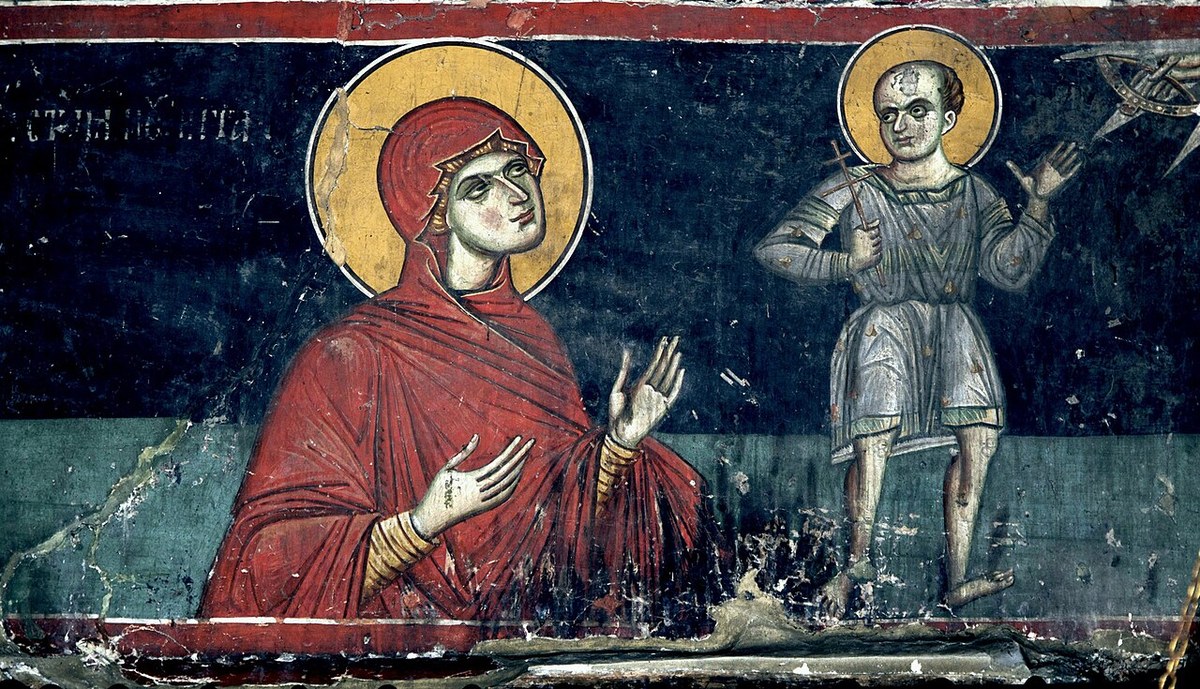
The pair is one of the most immediately recognisable groups in Byzantine painting, because the composition carries its own story. Julitta stands as a woman-martyr in the red maphorion, hands raised in prayer or one hand open in confession; beside her, at about the height of her waist, stands the child Cyricus, haloed, in a short belted tunic, holding a small cross in his hand and raising the other in blessing or supplication. In many icons she carries him in her arms — the composition the kontakion describes, "bearing Cyricus in her arms" — a deliberate echo of the Theotokos with the Child which the painters exploit and the hymns underline. Narrative scenes show the boy struggling out of the governor's lap, or lying at the foot of the tribunal steps. Because of the child's presence they are constantly invoked over sick infants, and their icon has a domestic place in Greek, Georgian and Russian houses that few martyr-icons have.
The stored image is a Serbian fresco of the fourteenth or fifteenth century: Julitta at the left in a deep red maphorion with both hands raised, part of a Slavonic inscription still legible beside her head, and Cyricus at the right, a small haloed figure in a pale tunic holding a slender cross, his other hand open — the standard two-figure type, considerably damaged in the plaster but unmistakable.
Disputed questions
- The acts are of two kinds. A long, miracle-laden Passion, purporting to be written by a Theodore who had it from the martyrs' servants, gives the child long theological speeches and a series of prodigies; this recension was already rejected in the West as apocryphal by the sixth-century Decretum Gelasianum, which names the passio Cirici et Iulittae among writings not to be received. A sober short recension, associated with a letter of Theodore, bishop of Iconium (5th century), keeps only the flight, the arrest, the child's cry, the fall down the steps and the beheading. The Byzantine synaxaria and the office follow the short form, and this entry follows it too; the sanctity and the fact of the martyrdom were never in question, only the literary elaboration.
- The age of Cyricus. Three years in the Greek tradition, and the whole hymnography depends on it — τριετὴς, "the three-year-old lamb." Some Latin versions make him seven or even older, and Western art accordingly sometimes shows a boy rather than an infant.
- The place of martyrdom. Iconium is the mother's city; Tarsus is where the trial and the deaths took place, and the Russian calendar accordingly styles them "Kirik and Iulitta of Tarsus." Some Latin notices transfer the whole story to Antioch or to Iconium itself.
- Not to be confused with Julitta the Venerable (June 14), a different woman of whom the synaxarion of Constantinople records only that she reposed in peace; nor with the widow Julitta of Caesarea in Cappadocia, burned about 303, whose memory is kept on July 30 and whose praise St Basil the Great preached — she is a martyr of a different city, a different death, and a different day, and Latin martyrologies have sometimes conflated the two.