
Vladimir of Kiev
The Holy and Right-believing Great Prince Vladimir, Equal-to-the-Apostles, Enlightener of the Land of Rus', named Basil in Holy Baptism
Equal to the Apostles · Prince · b. c. 958 — d. 15 July 1015
Commemorated 15 July — Repose at Berestovo near Kiev (1015)
Vladimir Svyatoslavich (c. 958–1015), Great Prince of Kiev, is honoured as Equal-to-the-Apostles because through him an entire people entered the Church. The grandson of Olga, he came to the throne by fratricidal war, ruled for eight years as a convinced pagan — raising idols above the Dnieper, keeping many wives and concubines, and permitting human sacrifice — and then, about the year 987, set himself to examine the religions of his neighbours. His envoys returned from the Great Church of Constantinople saying that they had not known whether they stood on earth or in heaven. In 988, having taken the Byzantine city of Cherson in the Crimea and won the hand of the purple-born princess Anna, he was baptised with the name Basil, and on his return commanded the baptism of Kiev in the waters of the Dnieper. The rest of his reign was a sustained attempt to govern as a Christian: churches, schools, tithes, the feeding of the poor from the prince's own gates, and a famous reluctance to put criminals to death. He died at Berestovo on 15 July 1015; his sons Boris and Gleb were murdered within weeks of him and became the first canonised saints of Rus'.
.jpg)
Origins and early life
Vladimir was the youngest son of Svyatoslav Igorevich, Great Prince of Kiev — the great warrior-prince who broke the Khazar khaganate and campaigned to the Danube — and of Malusha, a woman of the household of Svyatoslav's mother Olga, described in the Chronicle as her klyuchnitsa, housekeeper or steward. His birth is placed about 958. The circumstance mattered: his half-brothers Yaropolk and Oleg were born of a princely marriage, and Vladimir's enemies would afterwards taunt him as robichich, the son of a bondwoman. Malusha's brother Dobrynya — who passed into Russian epic as the bogatyr Dobrynya Nikitich — became the boy's guardian and, for the next thirty years, his most constant lieutenant.
Vladimir grew up in the household of his grandmother Olga, who had been baptised at Constantinople about 957 and who, according to the Chronicle, pressed the Christian faith on her son Svyatoslav without success: he answered that his retinue would laugh at him. Olga died in 969, when Vladimir was a boy of about eleven, and the Christian influence over him lapsed for a generation. In 970, before setting out on his last Balkan campaign, Svyatoslav divided his lands among his sons: Yaropolk received Kiev, Oleg the land of the Drevlyane, and Vladimir — at the request of an embassy from the north, and on Dobrynya's prompting — Novgorod. Svyatoslav was killed by the Pechenegs at the Dnieper rapids in 972.
The war of the brothers
The division did not hold. About 977 Yaropolk made war on Oleg, who was crushed to death in the press of his own men falling from a bridge into the ditch of the town of Ovruch. Hearing of it, Vladimir fled Novgorod "beyond the sea" — to the Varangians of Scandinavia — and returned two or three years later with a hired Varangian host, expelled Yaropolk's governor from Novgorod, and marched south.
On the way he asked for the hand of Rogneda, daughter of Rogvolod of Polotsk. She refused him in the words the Chronicle preserves — that she would not draw the boots off the son of a slave — and was betrothed instead to Yaropolk. Vladimir took Polotsk by storm, killed Rogvolod and his sons, and took Rogneda by force; she bore him Izyaslav, and the princes of Polotsk descended from that violent beginning. At Kiev he besieged Yaropolk, and then, by the treachery of Yaropolk's own counsellor Blud, drew his brother to a parley in his hall, where two Varangians ran him through with their swords as he entered the door. Vladimir took his brother's Greek wife — a captured nun, according to the Chronicle — who was already with child; her son was Svyatopolk, whom Vladimir raised as his own and whom the tradition would name "the Accursed" for the murder of Boris and Gleb. Vladimir became sole ruler of Rus' in 978 or 980.
This is not softened in the sources, and it is not softened here. The Church's veneration of Vladimir has always rested precisely on the distance between what he was and what he became; the Primary Chronicle itself sets the fratricide and the idols in the fullest light before it comes to the baptism, and the Slavonic hymns to him take the reversal as their whole theme.
The pagan prince
Vladimir's first act as sole prince was a public restoration of the old religion. On the hill outside his hall at Kiev he set up idols — Perun the thunderer with a silver head and a golden moustache at their head, and beside him Khors, Dazhbog, Stribog, Simargl and the goddess Mokosh — and Dobrynya set up another Perun over the Volkhov at Novgorod. Sacrifices were offered there, and the Chronicle says plainly that they were sometimes human: lots were cast over the sons and daughters of the citizens, and the victim slain before the idols.
The Chronicle's account of his household is equally blunt: five wives of standing — Rogneda, the Greek widow of Yaropolk, a Czech, a Bulgarian, and another — and hundreds of concubines kept at Vyshgorod, Belgorod and Berestovo. The chronicler compares him to Solomon, who was wise and yet perished in his women, and adds that Vladimir was "insatiable in fornication." Twelve sons are named to him.
The Varangian martyrs
In 983, returning from a victorious campaign against the Yatvingians, Vladimir ordered a thanksgiving sacrifice, and the lot fell upon the son of a Varangian who had come from Greece and was a Christian. The father — the tradition names them Theodore and John — refused to hand the boy over, and answered the mob: "These are not gods, but wood; today it is, and tomorrow it rots. They neither eat nor drink nor speak, but are made with hands out of timber." The crowd pulled down the porch of his house and killed both father and son. They are honoured as the first martyrs of Rus' (July 12), and every Russian account of Vladimir's conversion makes their blood the seed of it — the prince who ordered the sacrifice was afterwards baptised where they died, and the Church of the Tithes was raised over the place of their house.
The testing of the faiths
The Primary Chronicle sets under the years 986–988 the celebrated narrative of the choosing of a faith. Envoys came to Kiev in turn: Bulgars of the Volga, Muslims, who described a paradise of women but forbade wine — to which Vladimir returned the answer that has never been forgotten, "Drinking is the joy of the Rus'; we cannot exist without it"; Germans from Rome, whose fasting "according to a man's strength" he thought too easy and whose mission his fathers had once refused; and Khazar Jews, whom he asked where their homeland was, and, hearing that God had scattered them for their sins, replied that he had no wish to share such a scattering. Last came a Greek philosopher, who set out the whole economy of salvation from the creation to the resurrection, and at the end unrolled before the prince a curtain painted with the Last Judgement, showing the righteous entering into joy and the sinners going to torment. Vladimir sighed and said, "Well for those on the right hand; woe to those on the left." "Be baptised," said the philosopher, "and you will stand with them."
He would not decide alone. On the counsel of his boyars and elders he sent ten wise men to see each religion in its own place of worship. They came at last to Constantinople, where the Emperor and the Patriarch had them stand at the Divine Liturgy in the Great Church of Hagia Sophia; and their report, more than any argument, is the hinge of the whole account:
We knew not whether we were in heaven or on earth; for on earth there is no such splendour or beauty, and we are at a loss how to describe it. We know only that God dwells there among men, and their service surpasses the worship of all other places. For we cannot forget that beauty.
The elders added the argument from Olga: "If the Greek faith were evil, thy grandmother Olga would not have accepted it, and she was the wisest of all people."
Historians read the story as a literary composition of the eleventh century — a debate-of-the- faiths of a kind found also in Khazar and Latin sources, shaped to teach rather than to report. That does not make its judgement false. The choice of Constantinople over Rome, over Islam and over Judaism was a real political and cultural choice, made in the 980s, and everything that followed in the religious history of the eastern Slavs followed from it.
Cherson and the purple-born bride
The decision was executed with the arm of a soldier. In 987 the Emperor Basil II faced the revolt of Bardas Phokas and asked Kiev for troops; Vladimir sent six thousand Varangians — the nucleus of what became the Varangian Guard — and demanded in return the hand of the Emperor's sister Anna, born in the purple. No porphyrogenita had ever been given to a barbarian prince; the condition attached was that Vladimir be baptised. When the revolt was broken and the Emperor delayed, Vladimir marched on the imperial city of Cherson (Korsun) in the Crimea and besieged it. The Chronicle credits its fall to a certain Anastasius, who shot an arrow into the Russian camp with a message showing where the city's water-pipes ran; Vladimir cut them, and Cherson surrendered. From the captured city he sent word to the emperors that he would do the same to Constantinople if Anna were not sent.
Anna came, weeping, saying that she went as if into captivity. And at Cherson, the Chronicle relates, Vladimir was struck blind; Anna sent him word that if he wished to be rid of the disease he should be baptised at once. He was baptised in the church of St Basil in the middle of Cherson — the see-city's bishop performing the rite — and as he came up out of the font his sight was restored; whereupon he cried out, "Now have I seen the true God." He took the name Basil, after the reigning emperor and his own baptismal patron, and was married to Anna in the same city. The blindness and its healing are told as a figure: the Slavonic troparion sung at his feast makes the point explicitly, that Christ "shook off the blindness in the holy font, of the soul together with the body."
He restored Cherson to the emperors as his bride-price and returned to Kiev with priests, with relics of St Clement of Rome and his disciple Phoebus, with sacred vessels and icons, and with the Chersonite Anastasius.
The baptism of Kiev, 988
At Kiev he began with the idols he had himself raised. The image of Perun was tied to a horse's tail, dragged down the hill to the Dnieper, beaten with staves by twelve men as it went, and thrown into the river; men were set along the bank to push it off with poles until it passed the rapids. The Chronicle notes that the people who had sacrificed to it wept.
Then he sent a herald through the city: whoever does not appear tomorrow at the river, rich or poor, beggar or slave, shall be my enemy. On the appointed day the people of Kiev went down to the water at the mouth of the Pochaina where it joins the Dnieper — the tradition associates the place with the ravine of the Khreshchatyk — and stood in the river, some to the neck, some to the breast, the children by the bank, while the priests from Cherson and from Bulgaria read the prayers; and Vladimir, looking up to heaven, prayed for the new people. On the hill where Perun had stood he built a church of St Basil.
The mission went outward from Kiev with the same abruptness. Dobrynya and the priest Anastasius were sent to Novgorod, where the resistance was serious enough to be remembered in a proverb that Putyata baptised the Novgorodians with the sword and Dobrynya with fire. Vladimir set up schools, taking the children of the leading families for instruction in letters — their mothers, the Chronicle says, wept over them as over the dead. A hierarchy was established under a metropolitan sent from Constantinople (the Russian tradition names Michael, and after him Leontius), with sees at Novgorod, Chernigov, Belgorod, Rostov and elsewhere. The Slavonic liturgical books translated by Cyril and Methodius and their disciples were at hand from Bulgaria, and this — that the new Church prayed from its first day in a tongue its people understood — decided the whole character of Christianity among the Slavs.
The Christian reign
The Chronicle's account of Vladimir after 988 is not a list of pious foundations but a description of a changed man, and it is the part of his life that the Church has always pressed hardest.
He built the Church of the Tithes (Desyatinnaya) at Kiev, dedicated to the Dormition of the Theotokos, raised over the place where Theodore and John had been killed, completed about 996, and endowed with a tenth of the prince's revenues in perpetuity — the act from which the church took its name. He built the city and church of Belgorod, and a chain of fortified towns along the Sula, Trubezh, Desna and Stugna against the Pechenegs.
He fed the poor from his own court: carts were loaded with bread, meat, fish, vegetables, honey and kvass and driven through Kiev, the servants calling out to ask where the sick and the helpless were who could not come to the prince's gate. He kept open table three days in the week, and when his retinue grumbled at eating with wooden spoons he had silver ones made, saying that with silver and gold he would not find a retinue, but with a retinue he would find silver and gold — as his father and grandfather had done.
Most striking to the Greek clergy about him was his refusal to execute. Brigandage multiplied, and the bishops asked him why he did not punish robbers; he answered, "I fear sin." They told him that he was appointed by God for the punishment of the wicked as well as the mercy of the good, and he restored capital punishment for a time before returning to the older system of fines — the vira — for the maintenance of his troops. The exchange is preserved in the Chronicle without embarrassment on either side, and it is the single anecdote most often cited in his praise: a prince who had killed his brother now had to be argued into hanging thieves.
Repose
Vladimir's last years were shadowed by his sons. Svyatopolk, the son of Yaropolk's widow whom he had raised, was implicated in a plot with his Polish father-in-law Bolesław the Brave and the Latin bishop Reinbern, and was imprisoned. Yaroslav, set over Novgorod, refused in 1014 to send his father the tribute of two thousand grivnas, and Vladimir ordered the roads made ready and the bridges built for a campaign against his own son — a campaign that his sickness and death prevented.
He died on 15 July 1015 at his country residence of Berestovo, near Kiev. Boris, his favourite son, was away on the steppe with the druzhina against the Pechenegs. Those about the prince concealed the death, took up the floor between two rooms, wrapped the body in a carpet and lowered it to the ground, and carried it by night on a sledge to Kiev, so that Svyatopolk should not learn of it first; but he did learn of it, and seized the city. Vladimir was laid in a marble sarcophagus in the Church of the Tithes, beside the sarcophagus of Anna, who had died in 1011. Within a few weeks Svyatopolk had murdered Boris at the Alta and Gleb near Smolensk, and the passion-bearing of the sons became the first canonisation of the Church their father had planted.
Relics and translations
The Church of the Tithes was destroyed in the Mongol storming of Kiev in 1240, and the tombs went under the ruins. In 1635 the Metropolitan of Kiev, Peter Mogila, excavating the site, found a marble sarcophagus that he identified as Vladimir's; the skull was taken up and placed in the Dormition cathedral of the Kiev Caves Lavra, and portions were afterwards given to the Dormition cathedral of the Moscow Kremlin and to the church of the Tithes when it was rebuilt in the nineteenth century. A jaw was later kept at the St Sophia cathedral in Kiev. The identification rests on Mogila's judgement and is not beyond question, but the veneration of the relic is unbroken from the seventeenth century.
Veneration and later cultus
Vladimir was honoured at Kiev from soon after his death, but his formal glorification came late and by an odd road. The metropolitan Hilarion, in the Sermon on Law and Grace (c. 1050) — the first great work of native Rus' literature — already addresses him as an apostle and compares him to Constantine the Great, asking why he is not glorified, and the comparison became the settled category for him. The Russian tradition dates his public commemoration to the mid-thirteenth century and connects it with Alexander Nevsky, whose victory over the Swedes on the Neva fell on 15 July 1240, Vladimir's day, and was ascribed to his intercession.
He is the common father of the Russian, Ukrainian and Belarusian Churches, and his feast is kept far beyond them. In modern usage his day carries a national as well as an ecclesiastical weight: the Baptism of Rus' is commemorated on it by the Churches of Moscow, Kiev and elsewhere, and 15/28 July is a civil holiday in Ukraine and marked in Russia. The Russian calendar also keeps the Synaxis of the Saints of Kiev on this day, gathering the saints of the city whose Christian life began with him.
Feast and commemoration
July 15 (church date; New Calendar civil July 15, Old Calendar civil July 28), the day of his repose, rank primary. He has no second fixed feast of his own, though he is named in the Synaxis of the Saints of Kiev kept on the same day in Russian and Ukrainian usage, and in the various regional synaxes (the Saints of Volhynia, of Galicia, of Belarus). In the Slavonic books his day carries a full festal service with polyeleos; in Greek usage he is a commemoration of lesser rank but is kept, and the Greek Menaion for July 15 heads the day with Cyricus and Julitta rather than with him — the fullest instance in July of the difference between the Slavonic and Greek weighting of a day. The Antiochian Archdiocese, which uses the New Calendar, keeps him on July 15 with the other commemorations of the day.
Hymns
Troparion — Tone 4
Thou wast likened to a merchant seeking goodly pearls, O Vladimir of glorious dominion: enthroned upon the height of the mother of cities, God-preserved Kiev, thou didst make trial of the faiths and send unto the Imperial City to learn the Orthodox faith; and thou didst find the pearl beyond price, even Christ, who chose thee as a second Paul, and in the holy font shook off thy blindness, the blindness of the soul together with that of the body. Wherefore we thy people keep the feast of thy falling asleep: pray thou that they who rule thy land may be saved, together with the multitude committed to them.
Original translation from the Slavonic
Kontakion — Tone 8
Following the great Apostle Paul in thy grey hairs, O all-glorious Vladimir, thou didst forsake all thy zeal for idols as the reasonings of an infant, and, being made a man full grown, wast adorned with the purple of divine Baptism; and now, standing in gladness before Christ the Saviour, pray thou that they who rule thy land may be saved, together with the multitude committed to them.
Original translation from the Slavonic
Magnification
We magnify thee, holy Prince Vladimir, Equal-to-the-Apostles, and we honour thy holy memory: for thou didst enlighten the land of Rus' with holy Baptism.
Appointed readings
Epistle — Galatians 1:11–19
11But I certify you, brethren, that the gospel which was preached of me is not after man. 12For I neither received it of man, neither was I taught it, but by the revelation of Jesus Christ. 13For ye have heard of my conversation in time past in the Jews’ religion, how that beyond measure I persecuted the church of God, and wasted it: 14And profited in the Jews’ religion above many my equals in mine own nation, being more exceedingly zealous of the traditions of my fathers. 15But when it pleased God, who separated me from my mother’s womb, and called me by his grace, 16To reveal his Son in me, that I might preach him among the heathen; immediately I conferred not with flesh and blood: 17Neither went I up to Jerusalem to them which were apostles before me; but I went into Arabia, and returned again unto Damascus. 18Then after three years I went up to Jerusalem to see Peter, and abode with him fifteen days. 19But other of the apostles saw I none, save James the Lord’s brother.
Gospel — John 10:1–9
1Verily, verily, I say unto you, He that entereth not by the door into the sheepfold, but climbeth up some other way, the same is a thief and a robber. 2But he that entereth in by the door is the shepherd of the sheep. 3To him the porter openeth; and the sheep hear his voice: and he calleth his own sheep by name, and leadeth them out. 4And when he putteth forth his own sheep, he goeth before them, and the sheep follow him: for they know his voice. 5And a stranger will they not follow, but will flee from him: for they know not the voice of strangers. 6This parable spake Jesus unto them: but they understood not what things they were which he spake unto them. 7Then said Jesus unto them again, Verily, verily, I say unto you, I am the door of the sheep. 8All that ever came before me are thieves and robbers: but the sheep did not hear them. 9I am the door: by me if any man enter in, he shall be saved, and shall go in and out, and find pasture.
Iconography
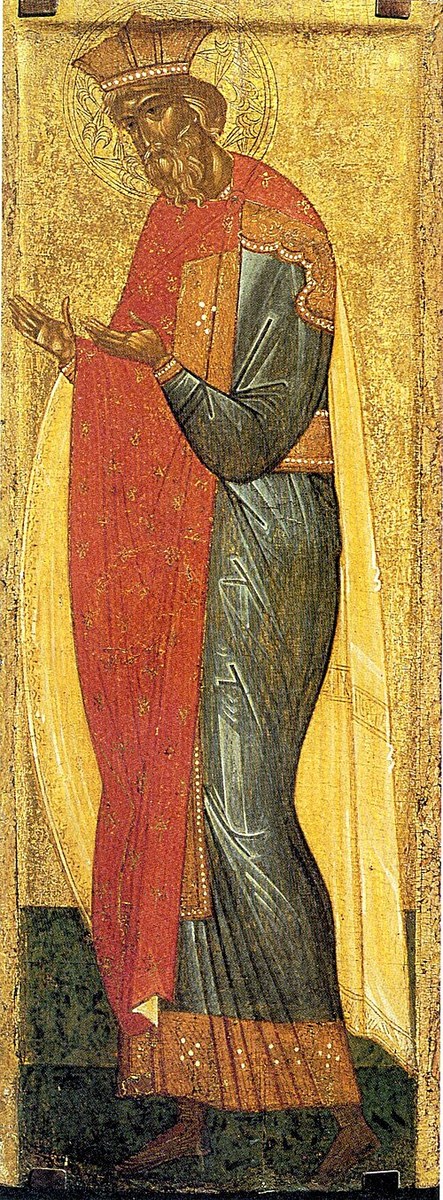
Vladimir is written as a prince in majesty: a mature man with a long, wedge-shaped or forked beard, bare-headed or crowned with the arched princely cap or a jewelled crown, in a long tunic and a great mantle — usually red or crimson, sown with gold — fastened at the shoulder and falling in heavy folds. His two proper attributes are the cross, which he holds upright in the right hand as an apostle of his people, and, in the fuller types, a model of a church or a scroll. In deesis tiers he appears without either, both hands raised in supplication towards Christ. He is very often paired with Olga his grandmother, the two of them flanking a cross in the manner of Constantine and Helen — the comparison the hymnography makes in words, the icon makes in composition — and he stands at the head of the ranks of the saints of Rus'. Narrative cycles show the envoys in Hagia Sophia, the pulling down of Perun and its dragging to the river, the baptism of the prince at Cherson, and above all the Baptism of the People of Kiev in the Dnieper, which became a great subject of Russian church painting in the nineteenth century.
The stored image is a Novgorod panel of the first third of the fifteenth century from a deesis tier, now in the State Tretyakov Gallery (inv. 12021): the prince stands in three-quarter turn towards the centre of the tier, crowned, in a crimson mantle powdered with gold over a grey-green tunic, both hands extended in prayer. The identification as Vladimir is the Tretyakov Gallery's, from the catalogue of the Ostroukhov collection; no inscription is legible in the available reproduction, and the entry records this rather than claiming an inscribed identification.
Disputed questions
- The date of the baptism. The Chronicle itself admits that men gave different accounts — some saying Vladimir was baptised at Kiev, some at Vasilev, some elsewhere — and answers them by asserting Cherson. Modern scholarship generally places his personal baptism in 988, with the taking of Cherson either just before it or just after; the baptism of the Kievans is usually put in 988 or 989. The traditional date of 988 for the Baptism of Rus' is a received liturgical reckoning rather than a secured chronology.
- The blindness. Told by the Chronicle as a physical affliction healed at the font. It is read by many as a hagiographic figure modelled on the blindness of Saul on the Damascus road — a reading the hymnography effectively endorses, since the kontakion calls Vladimir a second Paul.
- Byzantine silence. The Greek historians who describe the Varangian aid against Bardas Phokas and the marriage of Anna say almost nothing of Vladimir's baptism as an event of the Church's history. Yahya of Antioch, the Arab Christian chronicler, is in fact the fullest independent witness to the bargain and the conversion, and is the source usually set beside the Slavonic account.
- The mother of Boris and Gleb. See Boris and Gleb: the Chronicle's roster of Vladimir's sons and the Lives disagree over whether the two passion-bearers were born of a Bulgarian wife or of Anna the Porphyrogenita.
- Not to be confused with Vladimir Yaroslavich of Novgorod (†1052, October 4), his grandson, builder of the St Sophia cathedral at Novgorod.