
David of Hermopolis
Our Venerable Father David of Hermopolis in Egypt, the Former Robber
Venerable
Commemorated 6 September — Repose
David of Hermopolis was the leader of a band of robbers in the Egyptian desert who, moved in old age to reckon with his crimes, forced his way into a monastery — threatening, when the abbot judged the life beyond his strength, to return and sack it — and there outstripped all the brethren in ascetic zeal. The tradition relates that the Archangel Gabriel announced God's forgiveness to him, and, when David could not believe that so great a sinner was so soon pardoned, left him mute except for the prayers and services of the church. He received grace to heal the sick and cast out demons, and reposed in peace, in the sixth century by the Greek reckoning. He is commemorated on September 6.
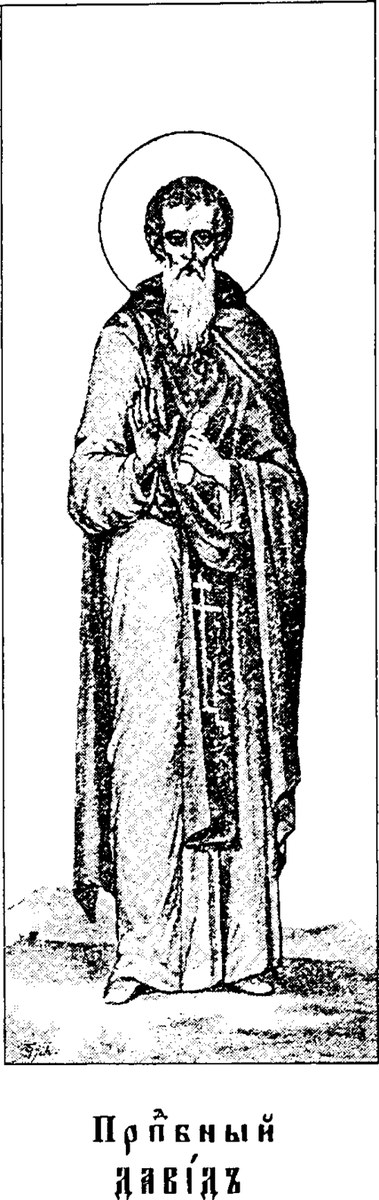
_-_%D0%B8%D0%BA%D0%BE%D0%BD%D0%B0_01062_%D0%94%D0%B0%D0%B2%D0%B8%D0%B4.png)
David was the chief of a robber band in the desert of Hermopolis, in the Thebaid of Egypt, and the accounts do not soften his record: he had committed many murders and every kind of violence, and none in Egypt, they say, was more feared. In old age, considering what he had done, he was seized with fear of the judgement of God. Leaving his band, he went to a monastery and begged the igumen to receive him among the brethren. The igumen refused, telling him plainly that the monastic life was severe beyond his strength. David persisted, and at last revealed who he was: the notorious robber David — adding that if he were not received he would return to his robbery, bring his band, and destroy the monastery and its monks. At that the igumen admitted him.
What force began, grace completed: to the astonishment of all, David gave himself to the ascetic life with such severity that he surpassed every monk in the house. The tradition relates that after some time the Lord sent the Archangel Gabriel to announce to him that his sins were forgiven; and that David, in his great humility, could not believe that God would pardon so great a sinner in so short a time. For this unbelief the Archangel declared that he would be mute — yet at David's own entreaty he was left speech for his prayers, his monastic rule, and his part in the services of the church, remaining speechless in all else. The judgement thus became a second asceticism: the penitent's tongue was loosed only toward God.
Toward the end of his life David received from God the grace of wonderworking: he healed many of the sick and delivered the possessed. Having lived many years in the monastery, he reposed in peace.
Feast and commemoration
September 6 (church date; Old Calendar civil September 19), among the commemorations of the day of the Miracle at Chonae. The calendars list him as a venerable monastic saint (the OCA as "Saint David of Hermopolis, Egypt"; the Slavic calendars as Прп. Давид); his memory is kept universally, without a separate service.
Hymns
Troparion — Tone 8
In thee, O father, that which is according to the image was preserved unimpaired; for taking up the cross thou didst follow Christ, and by thy deeds thou didst teach us to overlook the flesh, for it passeth away, but to care for the soul, an immortal thing; wherefore thy spirit, O venerable David, rejoiceth with the angels.
Original translation from the Greek
Iconography
David is depicted as an aged monk in the full monastic habit, bearded, his hand raised before his breast — nothing in the received type recalls his former life, the point of the image being precisely the completeness of the repentance. The stored image is an engraving from the illustrated Russian Lives of the Saints (Moscow, 1903–1911), inscribed "the Venerable David"; no earlier icon of him could be verified on the sources searched, and a pre-modern icon remains wanted.
Disputed questions
- Century. The OCA calendar gives "4th century"; the Greek Synaxaristes and the generality of the synaxaria place David in the sixth. The sixth century is followed here for the century of repose, with the disagreement recorded. The narrative itself — a spiritually beneficial tale of the Egyptian fathers — carries no dates.
- Not to be confused with David of Thessalonica (venerable, †c. 540, commemorated June 26), nor with the Prophet and King David, nor with the Athonite New Martyr David of Saint Anne's Skete (†1813), who shares the June 26 commemoration.